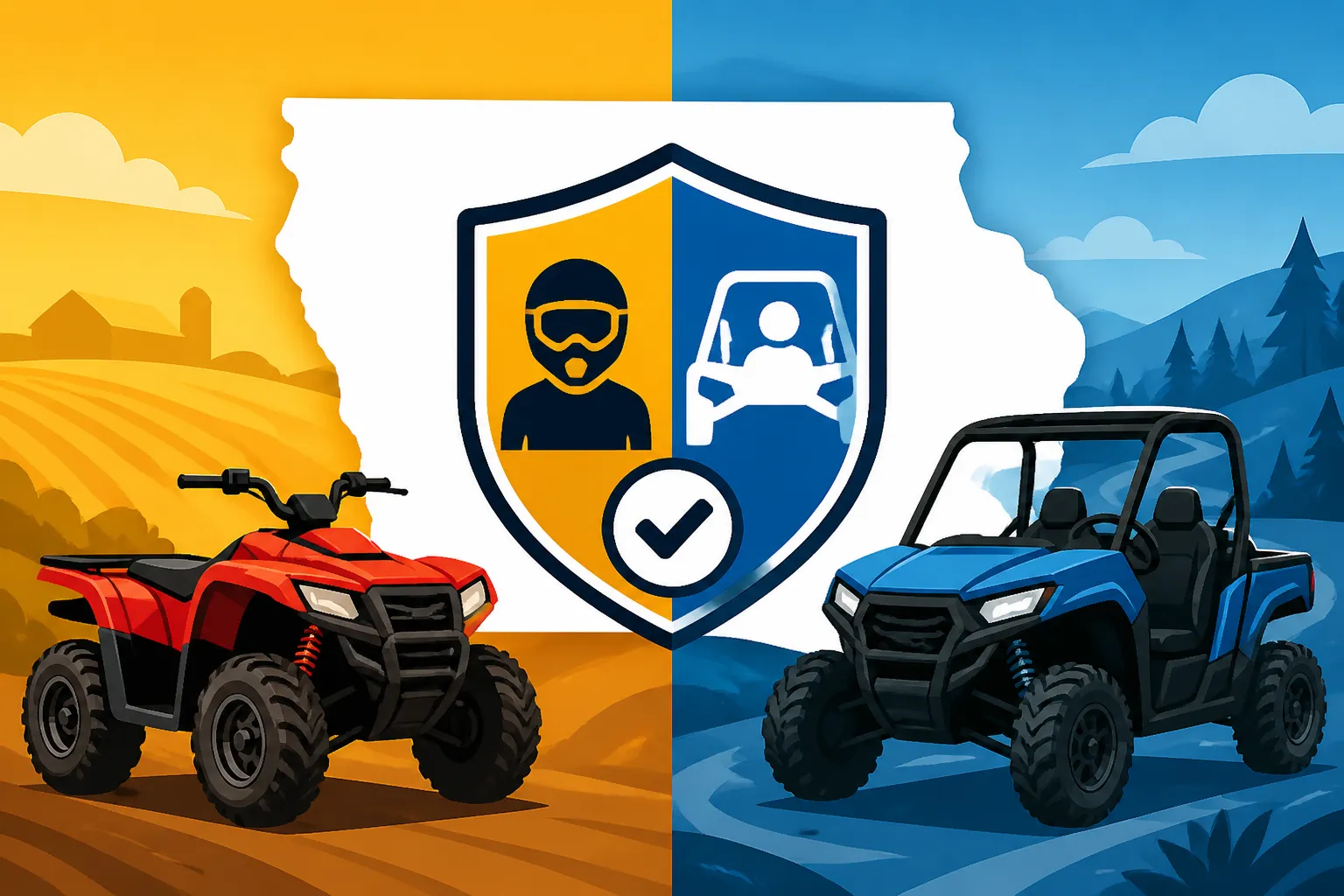
Why the Rule Follows the Machine Type
Iowa’s off-highway safety-certificate rules can seem inconsistent: an ATV rider may need a certificate while a side-by-side operator does not. The key is that Iowa treats vehicle categories differently. Knowing which category your machine belongs to—and whether age and riding location change the rule—helps you prepare before heading to a trail.
Why Iowa’s certificate rule depends on the machine
An ATV, a side-by-side, and an off-road motorcycle may all be used off-road, but they are not automatically treated as the same type of vehicle. Iowa’s safety-certificate requirements depend in part on the machine category, not simply on whether the rider is young or whether the vehicle is being used on a trail.
That is why two riders of the same age can face different certificate requirements. An eligible teen operating an ATV may need a safety certificate in a setting where an operator of a side-by-side does not. An off-road motorcycle operator also has a different exemption. These distinctions are about how Iowa classifies the machine; they are not a judgment about which vehicle is safer or more difficult to operate.
| Machine category | How the certificate rule differs | What to check |
|---|---|---|
| ATV | Iowa’s age-related certificate rule applies to certain ATV operators | Rider’s age and the place of operation |
| Side-by-side or UTV | Operators are treated differently from ATV operators under the certificate rule | Confirm the machine’s legal category |
| Off-road motorcycle | The ATV certificate rule does not apply in the same way | Check separate riding-area and operating rules |
The table summarizes the main distinction, not every requirement that might apply to a ride. Registration, permits, landowner permission, riding-area rules, and supervision requirements are separate questions. A certificate exemption does not make a machine exempt from all Iowa rules.
The category name used in a sales listing or advertisement is not always enough to settle the question. A machine may be described casually as a “quad,” “utility vehicle,” or “off-road vehicle,” even when its official paperwork identifies a more specific category. Look at the manufacturer’s information and ownership or registration documents, and ask the Iowa DNR or the riding area if the classification is unclear. Don’t rely on appearance alone, such as the number of seats or the presence of a steering wheel.
For a closer look at the age and operating requirements, see Iowa ATV Safety Certificate Requirements and Iowa Safety Certificate Age Range. Those are especially useful if the rider is a teen or if you are trying to decide whether a course is needed before a trip.
Which rules apply to ATVs, side-by-sides, and dirt bikes
ATVs and the age-based requirement
Iowa’s certificate requirement is associated with certain ATV operators ages 12 through 17. That age range is important, but it does not answer every question by itself. Where the machine is being operated and which rules apply to that location also matter. A rule for a designated riding area should not be assumed to apply identically to every private property or every kind of ride.
If the operator is in the age range covered by the ATV rule, do not assume the requirement disappears because an adult is nearby or because the ride is on a familiar trail. Check the requirements for the specific place you plan to ride, including any age and supervision rules. The broader rules for riding locations are covered in Iowa Rules for Riding a Designated Riding Area.
A rider younger than 12 should not assume that the certificate requirement is the only relevant age rule. Age restrictions and supervision requirements can be separate from the certificate itself. Check Iowa Rules for Riders Under 12 before planning a ride for a younger child.
Side-by-sides and UTVs
A side-by-side is not simply a larger ATV for the purposes of this certificate question. Iowa treats side-by-side operators differently from ATV operators, so the ATV age-related certificate requirement does not automatically carry over to a UTV operator. That distinction is the reason an ATV rule can apply to one member of a family while not applying to another riding a different machine.
The exemption is narrow: it concerns the safety-certificate requirement. It does not mean a UTV can be operated anywhere, by anyone, without other conditions. Registration or a visitor permit may still be required, and the riding area can have its own rules. If you plan to take a UTV onto public land or a designated riding area, check those requirements before leaving home.
For the specific distinction between the two machine types, see Does an Iowa UTV Operator Need a Certificate? and Why Iowa Exempts Side-by-Side Operators. If you are comparing a UTV with a conventional quad, also make sure you have the right registration information; Iowa Registration for a Side-by-Side explains that separate issue.
Off-road motorcycles
An off-road motorcycle is also treated differently from an ATV under the certificate rule. A dirt bike operator does not fall under the ATV certificate requirement just because both machines are used off-road. That is a classification distinction, not a general exemption from trail rules.
A riding area may have requirements for motorcycles, including rules about where they can go and what equipment or registration they need. The fact that the ATV certificate is not required for an off-road motorcycle does not by itself confirm that the motorcycle is eligible to ride at a particular location. See Why an Iowa Off-Road Motorcycle Operator Is Exempt for the certificate distinction, and check the rules for the park or land where you plan to ride.
How to check your situation before riding
Start by identifying the machine as precisely as possible. Use the manufacturer’s description and the paperwork that came with it, rather than relying on a casual name used in an online listing or conversation. If the documents do not make the category clear, ask the Iowa DNR or the relevant riding area before you make plans. A mistaken category can lead to checking the wrong age or certificate rule.
Then work through these questions:
- What machine category is shown in the documents? Confirm whether it is an ATV, side-by-side or UTV, or off-road motorcycle. If you are buying a used machine, ask the seller for its paperwork rather than assuming that the style of the vehicle tells the whole story.
- How old is the operator? For an ATV operator ages 12 through 17, check whether the certificate rule applies to the planned ride. For younger riders, look separately at minimum-age and supervision requirements.
- Where will the machine be operated? Rules can depend on whether the ride is on a designated riding area, private property, or another kind of land. Get permission before riding private ground and follow the site’s posted conditions.
- Is the machine properly registered, or does it need a visitor permit? A safety certificate and a registration decal or permit serve different purposes. Having one does not automatically satisfy the other.
- Does the riding area have additional rules? Check its current requirements for machine types, rider ages, riding areas, and operation. A certificate exemption is not a substitute for reading those rules.
This order matters. If you begin with age alone, you may overlook the vehicle-category distinction. If you begin with a machine’s marketing label, you may end up applying the wrong rule. Confirm the category first, then check age and location.
Keep the certificate question separate from reciprocity
Visitors often have another issue to sort out: whether a home-state registration or credential is accepted in Iowa, or whether an Iowa nonresident permit is needed. That question is separate from the safety-certificate exemption. A UTV operator’s exemption from Iowa’s ATV certificate rule does not, by itself, settle the visitor’s registration or permit obligations.
Likewise, carrying an out-of-state registration does not necessarily answer whether a teen ATV operator meets Iowa’s safety-certificate requirement for the planned location. Check both questions independently: the machine’s registration or permit status, and the operator’s certificate status. Do Visitors Need an Iowa ATV Permit? and Iowa Reciprocity With Minnesota explain the visitor-permit and reciprocity issues in more detail.
If you ride in Iowa often, keep the relevant documents together and check them before each trip, especially when switching machines or destinations. A certificate that is not required for one type of machine should not be assumed to cover a different machine. And when riding with a family or group, check requirements for each operator and each vehicle rather than treating the entire group as one case.
A simple example shows why that approach helps: an adult may take a side-by-side while a teenager rides an ATV on the same outing. The adult’s certificate status does not decide the teenager’s requirement, and the side-by-side’s exemption does not transfer to the ATV. Each operator must be matched to the category of the machine they will operate, their age, and the location’s rules.
When the category or requirement is unclear, confirm it before the ride rather than relying on a guess at the trail gate. The useful distinction is straightforward: Iowa’s ATV certificate rule does not automatically extend to every off-road machine, and an exemption for one category does not erase the other rules that govern riding.
Disclaimer
This article is for general informational purposes only and does not constitute professional advice. Laws, prices and regulations vary by location and change over time. Consult a qualified professional for guidance on your specific situation.