Iowa Rules for a Machine Over the Width Limit
A wide side-by-side can look ready for an Iowa ride and still be turned away at a trail entrance. The key is to distinguish a machine’s registration or permit from the riding area’s equipment rules. Check how the width limit applies, measure the machine as it is configured, and confirm the specific site’s rule before hauling it there.
What Iowa’s width limit means for ATV and UTV riders
The width number riders often encounter for Iowa off-highway riding areas is 65 inches. A site may use that as a maximum vehicle width, which can rule out some full-size UTVs and modified machines. But do not treat 65 inches as a universal pass for every Iowa trail, public property, private park, or road.
A width limit is an access condition, not a registration class or a permit. A valid registration, decal, or nonresident permit does not necessarily authorize a machine that exceeds the site’s limit. Likewise, fitting a vehicle within the width limit does not satisfy registration, safety, or land-access requirements by itself. Review Iowa Rules for Riding a Designated Riding Area and Iowa Rules for Riding Public Land as separate parts of your planning.
Rules can differ by location and may also differ among trails within the same riding area. Some sites may restrict wider rigs across their trail system; others may identify specific routes or areas for them. A published general limit might not address temporary closures, construction, trail conditions, or vehicle classes allowed on an individual route. The specific riding area’s current instructions are the practical authority for deciding whether your machine can enter.
Keep these distinctions in mind:
- Registration or permit: Whether the machine has the required Iowa registration or visitor permit.
- Width limit: Whether its actual dimensions meet the riding area’s equipment rules.
- Trail access: Whether that machine is permitted on the particular route, at the time you plan to ride.
- Road use: Whether separate road-use rules allow the machine on a road or crossing.
A machine can meet the first requirement and still fail the second or third. And a trail’s width limit does not determine whether the machine may legally travel on a public road.
If you are planning to ride a wider rig, check with the operator or managing agency before loading. Ask directly whether the limit applies to the entire riding area, whether there are routes open to wider machines, and how the site measures width. If the answer is unclear, get confirmation before making the trip rather than relying on a general statement about Iowa riding.
How to measure your machine before a ride
Use the machine’s current setup, not just the width listed in a brochure or owner’s manual. That published figure may describe a standard configuration, while your vehicle has different tires, wheels, fenders, or other additions. A small difference can matter when a site has a fixed maximum.
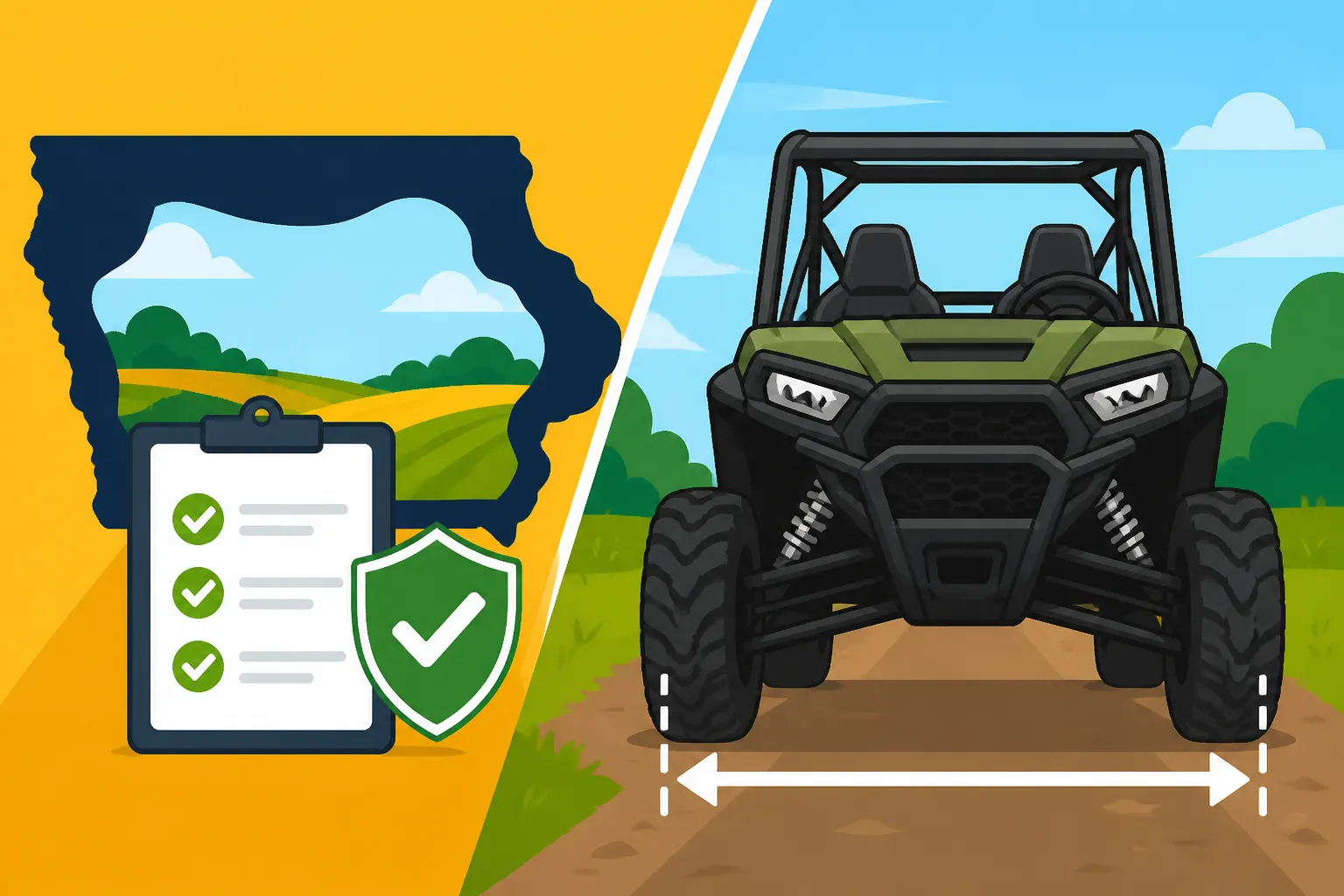
A practical check is to measure the widest point from one side of the machine to the other with the vehicle parked on level ground. A long tape measure can help; a hardware-store tape or one purchased through a retailer such as Amazon may work, provided it is long enough to measure across the vehicle. Have another person hold the far end if needed, and keep the tape straight rather than following the curve of a fender.
Before relying on your measurement, ask the riding area how it defines width. A site may have a specific measuring method or may treat attachments differently. Do not assume that mirrors, tires, fender extensions, doors, or other protruding parts are excluded. It is better to describe the machine and ask what counts than to arrive with a measurement based on an assumption.
Check your setup for changes that can increase the overall dimension:
- Wider aftermarket wheels or tires
- Wheel spacers
- Flares or extended fenders
- Side steps, nerf bars, or other exterior accessories
- Plows, racks, or attachments that extend beyond the body
Measure with the equipment installed if you intend to bring it. If you have removable accessories, ask whether the operator measures the machine with them attached and whether removing them would make the vehicle eligible. Removing an accessory does not make an over-width vehicle acceptable if the tires or body still exceed the limit.
A manufacturer’s stated width is still useful as a starting point, but it is not a substitute for checking the current vehicle. Compare the stated figure with your own measurement and share both with the site operator if you are uncertain. If your machine is close to the stated maximum, leave room for measurement differences rather than assuming it will be accepted.
| What to check | Why it matters | Best next step |
|---|---|---|
| Manufacturer’s width specification | It gives a baseline, but may reflect a different configuration | Compare it with the vehicle as equipped |
| Widest point on the machine | Tires, fenders, or accessories may extend beyond the body | Measure across the machine on level ground |
| Site’s measurement method | The operator may count protruding parts differently than you expect | Ask what parts are included |
| Route and site restrictions | A machine allowed at one location may not be allowed on every trail | Confirm access for the exact riding area and route |
| Permit or registration status | Width compliance does not replace paperwork requirements | Check the applicable registration or visitor-permit rules |
Do not use a road-width rule, another state’s limit, or a rule from a different Iowa park as a substitute for the site’s own instructions. If the machine is near or over the limit, give the operator its make, model, configuration, and measured width. That gives them a clearer basis for answering than asking whether “a full-size UTV” is allowed.
Permits, reciprocity, and width are separate questions
Visitors sometimes assume a home-state registration or an Iowa nonresident permit settles every access question. It does not. Permit and reciprocity rules concern whether the machine meets the applicable registration or permit requirements; they do not automatically override an individual riding area’s size restrictions.
If you are visiting from another state, check the paperwork rules before setting out. Iowa’s Nonresident User Permit explains the visitor-permit issue, while Iowa ATV Registration for a Nonresident is useful for understanding how registration status fits into trip planning. Confirm the requirements for your machine and situation rather than assuming that a decal, plate, or permit from home is accepted everywhere in Iowa.
Then check width separately. A machine may have the correct paperwork but still be too wide for the trail system you want to use. The reverse is also possible: a machine may fit under a site’s width limit but still need an Iowa permit or other required documentation. Treat these as separate checks on your preparation list.
For a straightforward call or message to a site operator, have the following information ready:
- The machine’s make, model, and year.
- Its width from the manufacturer’s specification.
- Your measurement of the machine as currently equipped.
- Any attachments or modifications that change its outside dimensions.
- The riding area and route you intend to use.
- Your machine’s registration or permit status, if the question also involves paperwork.
Ask whether the site allows the machine, how it defines the limit, and whether access depends on a specific trail or current condition. Save or note the response, including the date and the name or office you contacted. A quick confirmation can prevent a long haul to a gate where the posted rules do not match your assumption.
If you are planning to use a club trail or another managed route, check with its operator too. A trail’s management and access conditions may differ from those at a state-designated riding area. Iowa Rules for Riding a Club Trail can help frame that distinction, but the club or land manager should confirm the current rules for the route you plan to ride.
What to do if your machine is wider than the limit
If your measurement exceeds the maximum stated by the riding area, do not assume that a waiver, registration decal, or alternate tire pressure will make it acceptable. Ask the operator whether any routes at that site are open to the machine. If not, choose a different riding area that expressly allows its width, or leave that machine at home and use a compliant one.
Avoid trying to solve the issue at the entrance. Staff may have no authority to make exceptions, and a machine that cannot enter may leave you with a trailer, vehicle, and riding group without a usable plan. Check before you depart, especially when traveling with several machines that may have different dimensions.
Also avoid modifying the machine solely to meet a stated limit until you understand the site’s measuring method. Removing a mirror, changing a rack, or taking off an accessory may not address the widest point. Any change should be safe, appropriate for the vehicle, and acceptable under the riding area’s rules. A narrower setup is not useful if it compromises control or makes the machine unsuitable for the terrain.
If you need a backup, choose it in advance. Confirm that the alternate riding area is open, permits your machine, and has routes suited to its size and type. Check Iowa Trail Conditions Before You Ride and Iowa Rules for Riding a Closed Trail when planning around closures or changing conditions. A site that generally accepts wider vehicles may still close a trail or restrict access on a particular day.
Finally, keep road use separate from trail access. A machine that exceeds a trail’s width limit does not automatically become eligible for roads, and a road-use rule does not grant entry to a riding area. If your route involves public roads or a road crossing, verify those requirements independently. The safest plan is one in which the machine’s paperwork, dimensions, route, and access permission all match the place you intend to ride.
Disclaimer
This article is for general informational purposes only and does not constitute professional advice. Laws, prices and regulations vary by location and change over time. Consult a qualified professional for guidance on your specific situation.