Iowa Rules for Retrieving Game by ATV
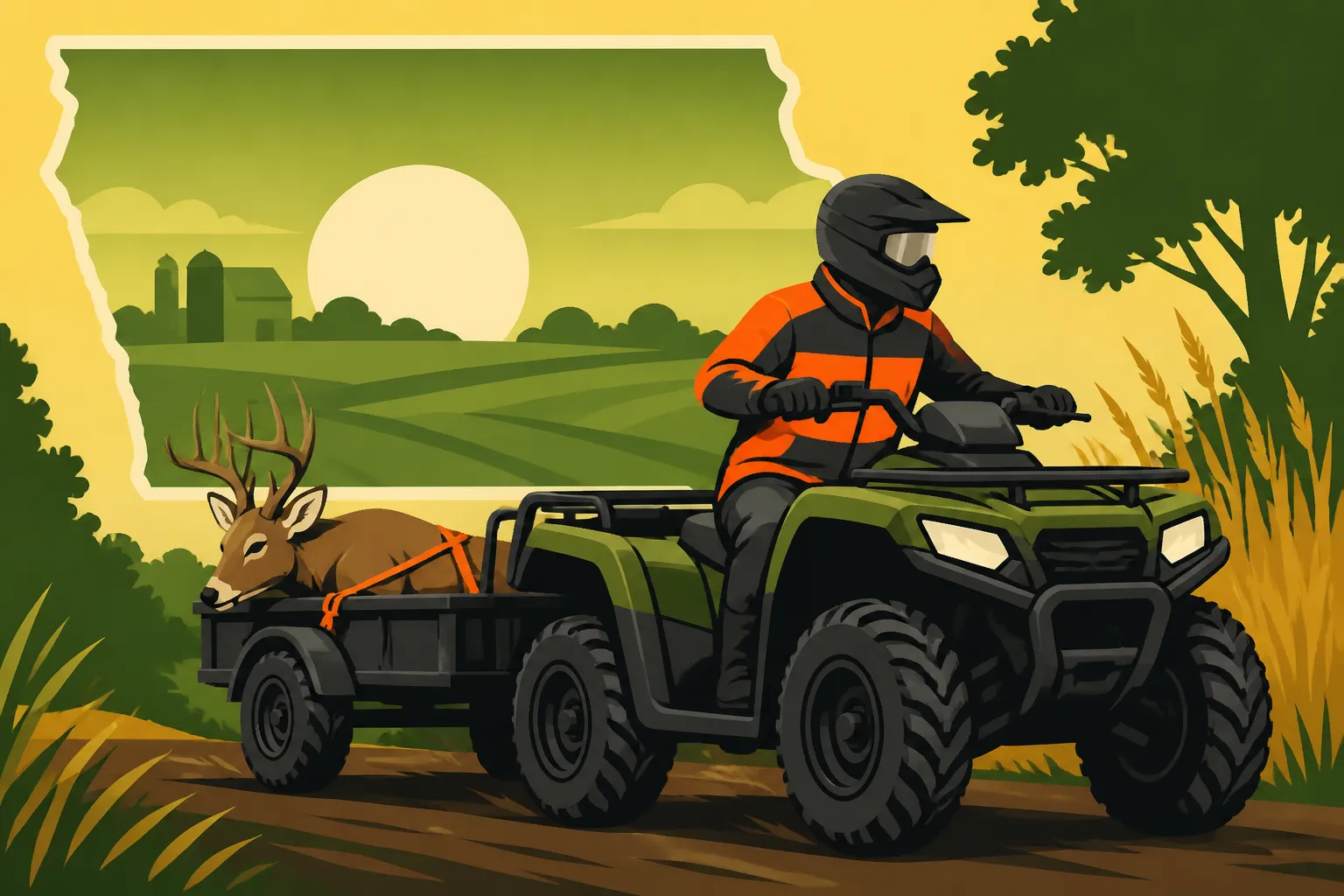
An ATV can make it much easier to move harvested game, especially when a recovery route crosses rough or muddy ground. But having a hunting license does not automatically make every trail, field, or wildlife area open to motorized travel. In Iowa, check access rules for the exact land, secure any required permission, and handle the harvest and machine paperwork separately.
Start With the Land, Not the ATV
The first question is not whether your machine can reach the animal. It is whether you may ride that route. Hunting permission and permission to drive an ATV are related but separate: a landowner may allow you to hunt without allowing motorized travel across the property.
On private land, ask the owner or person who controls access before riding in to retrieve game. Be specific about where you plan to travel, whether you may leave an established lane, and whether you can cross a field, fence, or drainage. A casual “you can hunt here” may not answer those questions. More detail is covered in Iowa Landowner Permission Rules and Iowa Rules for Riding Private Property.
Public land needs its own check. Wildlife areas and other public properties can restrict motorized vehicles to roads, parking areas, or routes marked open to vehicles. Some places may allow certain kinds of access under limited conditions; others may prohibit off-road ATV travel. Do not assume that a route is open just because it appears on a map or has tire tracks. Read signs at the entrance and check the specific area’s current rules. [Iowa Rules for Riding a Wildlife Area] explains why access restrictions matter.
| Where you plan to ride | What to check before retrieving game |
|---|---|
| Private land | Permission from the owner or person controlling access, including permission for the route and off-road travel |
| Public wildlife area | Posted rules, vehicle restrictions, and whether the route is specifically open to ATVs |
| Designated riding area | Whether hunting and game retrieval are allowed there, as well as the area’s vehicle rules |
| Public road | Whether the road is open to ATVs and whether the machine and operator meet road-use requirements |
| Leased or managed land | Permission from the person who controls access, plus any rules set by the owner or managing organization |
On a public property, a hunting license does not override a vehicle closure. If the posted route ends before the animal, do not treat retrieval as an automatic exception that lets you drive beyond the boundary. Find out whether the managing agency allows another method of recovery, such as walking in or using a hand-pulled cart.
A designated riding area is not necessarily a hunting area. Its vehicle rules may permit ATV use while its land-use rules do not allow hunting or game transport. Check both sets of rules, rather than assuming permission for one activity covers the other. See Iowa Rules for Riding a Designated Riding Area for the distinction.
Handle the Harvest Before Moving It
The ATV does not change the rules for taking, tagging, reporting, or possessing game. Follow the requirements tied to your license and the species you harvested before starting transport. For deer, pay particular attention to the tag and harvest-reporting instructions that apply to your license. Keep the required information with you and complete each step within the required time.
A practical retrieval order is:
- Make sure the animal is dead and that it is safe to approach.
- Complete the required tagging and harvest-reporting steps for the species and license.
- Confirm that the planned route is open to your ATV and that you have permission to use it.
- Decide whether the machine can reach the animal without damaging the land or putting the rider at risk.
- Secure the animal and any equipment before moving, then travel only on the route you are allowed to use.
Do not postpone required tagging or reporting because the animal is difficult to reach. Check your license instructions before the hunt so you know what must be done in the field and what information you may need later. If you are uncertain about a requirement, contact the Iowa Department of Natural Resources or the land manager before hunting rather than guessing during retrieval.
Transport the animal in a way that keeps it secure and does not create a hazard. Use suitable tie-downs, keep the load balanced, and avoid placing weight where it can interfere with steering, braking, visibility, or the machine’s ability to handle uneven ground. A heavy or awkward load can change how an ATV responds, especially on slopes, in mud, or while crossing ruts. If the load cannot be secured safely, make more than one trip or use another method.
Keep the firearm or other hunting equipment under control during the ride. Follow the applicable rules for carrying a firearm on an ATV, and do not let a firearm interfere with the operator’s ability to control the machine. The relevant considerations are discussed in Iowa Rules for Carrying a Firearm on an ATV. If another person is riding with you, account for passenger rules and the machine’s capacity; an additional rider and a game load can make an ATV less stable.
Be considerate of other hunters and land users. Keep noise and travel to a minimum, avoid cutting across standing crops or sensitive ground, and do not block an open road or trail while loading. If another person is hunting nearby, coordinate before moving through the area. Safe, permitted access still calls for care around people, livestock, fences, and equipment.
Check the Machine and Route Requirements
A legal hunting trip does not make an ATV legal to operate on every route. Before the season, confirm that your machine’s registration or permit status is appropriate for Iowa and for the place where you intend to ride. The requirements can depend on whether you live in Iowa, whether the machine is registered elsewhere, and whether Iowa recognizes that registration for the planned use.
Visitors should not assume that a home-state registration or hunting license is enough. Reciprocity and visitor-permit rules concern the machine’s operation, not permission to hunt or access private property. Check Iowa’s Nonresident User Permit and What Sticker a Visiting Out-of-State Quad Needs if you are bringing a machine from another state. A permit or decal does not grant access to closed public land or private property.
For residents and visitors alike, make sure required registration documents and decals are current and displayed as instructed. If you are unsure whether your machine needs a title, registration, or a different permit for the trip, sort that out before heading to the hunting area. Iowa ATV Registration Paperwork can help you identify the documents to review.
The route matters just as much as the machine. A road that appears to be a convenient connection may have different rules from the field or trail beside it. If you need to use a public road, confirm that ATVs may use that road and meet the equipment and operator requirements for road travel. Do not turn a short road connection into a reason to ride along an unauthorized shoulder, ditch, or right-of-way. See Iowa Rules for Riding a Gravel Road for road-specific considerations.
If the route crosses multiple properties, obtain permission from each person who controls access. A neighbor’s approval does not automatically cover the next parcel, a public easement, or a trail managed by a club. Likewise, a landowner’s permission does not cancel restrictions imposed by a public agency or road authority.
Before loading, look for current closures and local instructions. Wet ground, active farm work, seasonal restrictions, maintenance, or a special event can affect whether a route is usable. If signs are unclear, stop and ask the land manager or responsible office. Do not ride past a barrier or around a closure sign simply because you are retrieving game.
Plan a Safe and Respectful Recovery
Retrieval can be more demanding than ordinary trail riding because the rider may be tired, visibility may be poor, and the animal may be in difficult terrain. Plan the route before setting out, and avoid choosing a line that requires steep side-hills, soft banks, deep water, or tight turns with a load. If the ground is unsafe, walk the route first or use a different recovery method.
A few practical steps can prevent a manageable recovery from becoming a machine or injury problem:
- Tell someone where you are hunting and how you plan to get back.
- Carry a charged phone, but do not rely on cell service in every rural area.
- Bring straps or other equipment appropriate for securing the load.
- Keep the load low and balanced, and do not exceed the machine’s capacity.
- Avoid riding alone into terrain where a stuck or overturned machine would be hard to reach.
- Stop if conditions change or the route becomes unsafe.
Protect the land as well as the rider. Spinning tires can tear up soil and vegetation, particularly when ground is wet. A rut made during one recovery can become a drainage problem or make access worse for the owner and other users. If the machine starts losing traction, stop rather than applying more throttle. Back out on the route you used, or ask for help.
Be especially cautious around fences, livestock, crops, and farm equipment. Do not cut or move a fence unless the owner has explicitly authorized it, and leave gates as you found them. A permission conversation should cover any unusual crossing or access route in advance. If a retrieval would require damaging property, creating a safety risk, or using a closed route, choose another method and contact the land manager.
The safest rule is simple: use the ATV only where that machine is allowed, stay on an authorized route, and treat game retrieval as a reason to plan carefully—not as a blanket exception to access rules. If you cannot confirm that the route is legal, pause and ask the landowner or public land manager before riding.
Disclaimer
This article is for general informational purposes only and does not constitute professional advice. Laws, prices and regulations vary by location and change over time. Consult a qualified professional for guidance on your specific situation.