Unpaved County Secondary Roads in Iowa
Many Iowa ATV and UTV enthusiasts dream of the freedom of riding their machines from their property straight to the nearest trail, or simply using a gravel road to connect to a neighbor’s land. It’s a common frustration to feel like you’re constantly trailering your machine just to get a few miles down the road. This comprehensive guide is here to cut through the confusion and explain exactly what Iowa law says about riding your ATV or UTV on unpaved county secondary roads, outlining the rules, requirements, and responsibilities that come with it.
Understanding Iowa's Road Rules for OHVs
Iowa's relationship with off-highway vehicles (OHVs) on public roads is often misunderstood, leading to a lot of head-scratching and, unfortunately, some costly citations. It’s not as simple as just slapping a license plate on your rig, like you might in some other states. Iowa has specific, detailed regulations that govern where and how you can operate an ATV or UTV on its vast network of roads.
The Core Principle: Designated Roads Only
First and foremost, it’s absolutely critical to understand that riding an ATV or UTV on public roads in Iowa is generally restricted. This isn't a state where you can just cruise down any paved street or highway. The law makes a clear distinction: OHVs are primarily for off-road use, and their presence on public roadways is an exception, not the rule. Many riders get frustrated trying to figure out what's allowed and what's not, especially when wanting to connect trails or just get from point A to point B without the hassle of loading and unloading a trailer. The core principle is that you can generally only ride on specifically designated roads, and even then, under strict conditions. This isn't about being "street legal" in the same way a car is; it's about being "road legal" within Iowa's very specific OHV framework.
When we talk about "designated roads," Iowa isn't talking about every road in the state. The focus is heavily on gravel, unpaved secondary roads, and sometimes, with specific county or city authorization, certain paved secondary roads or city streets. The idea is to allow reasonable access for utility, recreation, and agricultural purposes without turning every road into an open playground for OHVs. This often means your dream of riding into town for groceries on your UTV might be limited to communities that have explicitly voted to open their streets. It's a nuanced system that requires riders to be informed and proactive.
Defining Unpaved County Secondary Roads
So, what exactly is an unpaved county secondary road in Iowa? Picture the vast majority of rural roads crisscrossing our state – those are your unpaved county secondary roads. We're talking about gravel roads, sometimes dirt, often less maintained than primary highways, and almost always connecting farms, small towns, and rural residences. They are the backbone of rural Iowa, vital for agriculture and local traffic, and distinct from the paved state highways you might see on a map. These roads are under the jurisdiction of the individual counties, which is a crucial detail because it empowers counties to make certain decisions about their use.
These roads contrast sharply with primary highways, which are typically paved, multi-lane, and form the main arteries of statewide travel. You won't find ATVs or UTVs legally cruising down Highway 20 or I-80 in Iowa, except for very limited, specific crossings. Similarly, city streets, while sometimes looking similar to county roads, fall under municipal jurisdiction and have their own separate set of rules, often requiring explicit city council authorization to be open to OHVs. For unpaved county secondary roads, the general rule is that they are permitted for OHV use unless specifically prohibited by a county ordinance. This distinction is vital for riders to understand when planning their routes.
Key Requirements for Riding Unpaved Secondary Roads
Now that we know where you might be able to ride, let's talk about the how. Simply having an ATV or UTV doesn't automatically grant you access to these roads. Iowa has a detailed list of requirements for both the operator and the machine itself, designed to ensure safety and integrate OHVs into the existing traffic flow. Many riders overlook these details until it's too late, ending up with a ticket instead of a scenic ride.
Age and Licensing Requirements
One of the most frequently misunderstood rules for operating an ATV or UTV on Iowa roads is the age requirement. Iowa law is very clear on this: you must be at least 18 years old to operate an off-highway vehicle on any public road, including unpaved county secondary roads. This often comes as a surprise to families who are used to riding together on trails, where younger operators are permitted with proper supervision and a safety certificate. But on public roads, the rules change significantly. This minimum age of 18 means that even if your 16-year-old has their driver's license and an [Iowa ATV Safety Certificate Requirements], they still cannot legally operate an ATV or UTV on a public road in Iowa.
Beyond the age requirement, you also need a valid driver's license to operate an OHV on these roads. This isn't just a suggestion; it's a legal necessity. The expectation is that anyone operating a vehicle on a public road, regardless of whether it's a car or an ATV, possesses the basic knowledge of traffic laws and safe operation demonstrated by holding a valid driver's license. For many families, this rule can make group rides tricky, especially if teens or young adults in the 16-17 age range are part of the riding party. They can ride on private land or designated OHV parks like [Gypsum City OHV Park at Fort Dodge] with a safety certificate, but the moment they hit a public road, even an unpaved secondary one, they must meet the 18+ and licensed driver criteria.
Machine-Specific Equipment
Your ATV or UTV isn't ready for road use straight out of the box, or even after a season of trail riding. Iowa law mandates specific equipment to make your machine visible and controllable for sharing the road with other vehicles. Overlooking any of these items can quickly lead to a roadside stop and a citation, which is a frustrating experience when you thought you were doing everything right. It's often an aftermarket retrofit process, as many machines are primarily designed for off-road excursions.
Here's what your machine generally needs:
- Headlights: Your ATV or UTV must have at least one headlight that is illuminated at all times while operating on a public road, even during daylight hours. This isn't optional; it's a constant visibility requirement.
- Tail Lights and Brake Lights: A functioning tail light and brake light are crucial for signaling your presence and intentions to traffic behind you.
- Turn Signals: While not strictly mandated for all ATVs by federal law, Iowa's road use often implies the need for turn signals, especially for UTVs or if you want to indicate changes in direction clearly. It's a smart addition for safety.
- Horn: A working horn is required to alert other drivers or pedestrians to your presence.
- Rear-View Mirror: You must have at least one rear-view mirror attached to the machine, positioned to allow the operator a clear view of traffic approaching from the rear. Many riders choose a mirror that clamps onto their handlebars or roll cage. Companies like SuperATV offer a wide range of robust mirrors designed to withstand off-road conditions while providing the necessary visibility for road use.
- Slow-Moving Vehicle (SMV) Triangle: This bright orange, reflective triangle must be displayed on the rear of your ATV or UTV. It signals to other drivers that your vehicle is designed to operate at speeds below typical road traffic, encouraging them to exercise caution when approaching. This is perhaps one of the most recognizable requirements for farm equipment and OHVs alike on Iowa roads.
- Windshield (if applicable): If your machine has a windshield, it must meet visibility standards, free from excessive tinting or obstructions.
These requirements ensure that your OHV can be safely and effectively operated in a mixed-traffic environment, which is very different from a dedicated trail.
Registration and Insurance
Even on unpaved county secondary roads, your ATV or UTV isn't exempt from the core administrative requirements that apply to all OHVs in Iowa. These two items are non-negotiable and are usually the first things a law enforcement officer will check during a roadside stop. Many riders think their general liability or homeowner's insurance will cover them, but Iowa has very specific minimums for road operation.
First, your ATV or UTV must be properly registered with the Iowa Department of Natural Resources (DNR) through your local county recorder's office. This means having a current registration decal prominently displayed on the rear of your machine, usually on the left side, as specified by [Iowa ATV Decal Placement] rules. [Registering an ATV in Iowa] is an annual process, and that decal is your proof that you’ve paid your dues to support Iowa’s OHV programs. If you’re riding on any public land or road, this decal is essential. Not having it means you're operating an unregistered vehicle, which carries penalties.
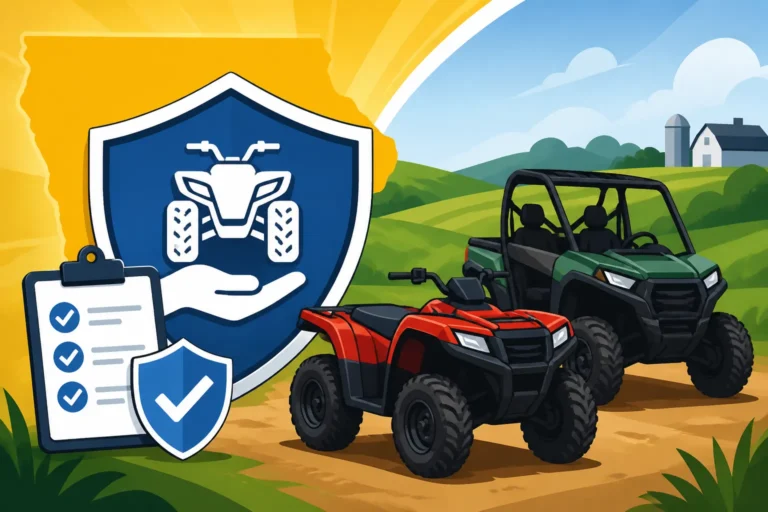
Second, and perhaps most critically for road use, you absolutely must carry proof of liability insurance that meets Iowa’s minimum coverage requirements. These minimums are often expressed as 20/40/15:
- $20,000 for bodily injury to one person in an accident.
- $40,000 for bodily injury to two or more persons in an accident.
- $15,000 for property damage in an accident.
It’s not enough to just "have insurance." Your policy must explicitly cover your ATV or UTV for road use and meet these specific minimums. Companies specializing in powersports insurance can help you find a policy that fits. Without this insurance, you face significant [Iowa Fines for No Proof of Insurance], and the financial consequences of an accident could be devastating. Always carry proof of your current insurance while riding on public roads; a physical card or digital proof on your phone is usually acceptable.
| Requirement | Details | Why It's Important |
|---|---|---|
| Operator Age | 18 years old minimum | Ensures mature, licensed drivers operate on public roads. |
| Driver's License | Valid driver's license required | Demonstrates knowledge of traffic laws and safe driving practices. |
| Registration | Current Iowa OHV decal displayed | Legalizes your machine for public use and contributes to OHV programs. |
| Insurance | Minimum 20/40/15 liability coverage | Protects against financial burden from accidents on public roads. |
| Headlights | On at all times (day and night) | Enhances visibility to other vehicles. |
| Tail & Brake Lights | Functioning and clearly visible | Signals presence and braking intentions to following traffic. |
| Horn | Operational | Allows operator to alert others of their presence. |
| Rear-View Mirror | At least one, providing clear rear view | Essential for situational awareness and safe lane changes/movements. |
| SMV Triangle | Displayed on the rear of the machine | Warns other drivers of slow-moving vehicle ahead, promoting caution. |
| Speed Limit | 35 mph maximum | Reduces risk of severe accidents and maintains compatibility with road infrastructure. |
Understanding the "Most Direct Route" Rule
One of the nuances that often trips up riders in Iowa is the "most direct route" rule. This isn't about aimlessly joyriding on gravel roads; it's about using these roads with a specific purpose in mind. Iowa's law allows for the use of unpaved county secondary roads as a means of transportation, not as a destination in themselves, unless you are using them to access something specific.
Navigating to and from OHV Parks or Private Land
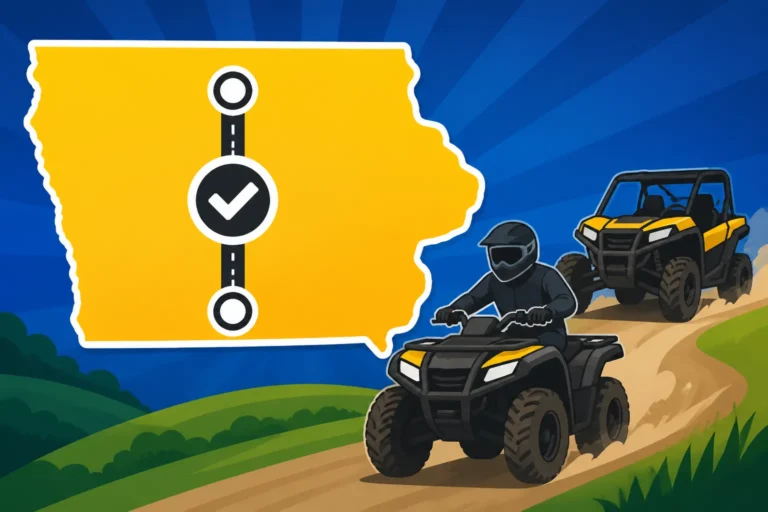
The "most direct route" rule essentially means that you can use authorized unpaved county secondary roads to travel between a designated OHV park, your private property, or other private land where you have permission to ride. The spirit of the law is to provide a practical way to get to your riding destination without requiring you to trailer your machine for every short distance. For example, if you live a few miles down a gravel road from [Bluff Creek OHV Park at Eddyville] or a friend's timber, you are generally allowed to ride your ATV or UTV on that road using the shortest, most practical path.
This isn't an invitation to take the scenic route or explore every backroad in the county. Law enforcement can, and often does, interpret "most direct" quite literally. If there's a shorter, more logical path, you're expected to take it. Let's consider a hypothetical scenario: you're leaving your property, which is located on an unpaved secondary road, and you want to get to [The Most Direct Route to an Iowa OHV Park]. You can take the most direct path on authorized roads. However, if you're spotted miles out of the way, just cruising for pleasure, you might be in violation. This rule demands a level of intentionality in your road use, and it's a critical distinction from simply being "street legal" for general travel.
Connecting Designated Roads
Another common question revolves around using short stretches of paved roads to connect two unpaved roads. The general answer is no, not automatically. While some states allow incidental use of paved roads to connect trails, Iowa is more restrictive. Unpaved county secondary roads are generally open by default for OHVs, but paved secondary roads are only open if the individual county Board of Supervisors has passed an ordinance specifically authorizing their use. This means you cannot assume that because a road is a "secondary road," you can ride on it if it's paved. You need to verify if the county has taken specific action. [Paved Secondary Roads and County Authorization] highlights this local control.
This lack of universal authorization can be a major source of frustration for riders trying to plan longer routes or connect different areas. It forces you to do your homework and understand the specific ordinances of each county you plan to traverse. For instance, you might be legally riding on a gravel road, come to a T-intersection with a paved county secondary road, and find yourself in a legal bind if that paved road hasn't been explicitly opened to OHVs. While the law does allow for [Crossing a Multi-Lane Highway at an Intersection] at a right angle for the most direct route, this is a very specific maneuver and not a general allowance for riding on paved surfaces. Always check with the county recorder or sheriff's office for the most up-to-date information on local ordinances before venturing onto paved secondary roads.
Speed Limits and Safe Practices
Safety is paramount when operating an OHV on any public road, and Iowa's laws reflect this by imposing strict limits and expecting responsible behavior from riders. The dynamics of an ATV or UTV are very different from a car or truck, especially on gravel, and understanding these differences is key to a safe and enjoyable experience.
The 35 mph Cap
One of the most straightforward, yet often challenged, rules for OHVs on Iowa roads is the speed limit. When operating an ATV or UTV on any public road, including unpaved county secondary roads, you are strictly limited to a maximum speed of 35 miles per hour. [Iowa's 35 mph Cap] is a non-negotiable legal requirement. It's not a suggested speed; it's the absolute ceiling.
It's easy to exceed this on a powerful machine, especially if you're used to open trails or faster off-road riding. However, exceeding 35 mph on a public road instantly puts you in violation of the law and can result in a speeding ticket, just like in a car. More importantly, it significantly increases your risk of an accident. ATVs and UTVs are designed for off-road performance, not high-speed road stability. Their suspension, tire characteristics, and handling can become unpredictable at higher speeds on a hard, unpaved surface, especially if there's washboarding or loose gravel. Maintaining the 35 mph limit is not just about avoiding a ticket; it's about safeguarding yourself and others on the road.
Responsible Riding and Road Etiquette
Beyond the legal speed limit, responsible riding on unpaved secondary roads means adopting specific behaviors to ensure everyone's safety. These roads are shared spaces, and OHV riders have a responsibility to be courteous and vigilant.
- Yielding to Traditional Traffic: Always yield to cars, trucks, and especially farm equipment. These are the primary users of these roads, and they often have right-of-way. When you see a large tractor or combine, pull over to the side, slow down, and allow them to pass safely. [Meeting a Combine on a Gravel Road] isn't uncommon in rural Iowa, and patience is key.
- Dust Control and Visibility: Unpaved roads generate dust, particularly in dry conditions. Be mindful of the dust cloud you create, especially when approaching other vehicles or residential areas. Excessive dust can severely impair visibility for other drivers. Slow down when approaching others to minimize dust and allow them a clear view. Using a full windshield, like those offered by SuperATV, can also help your own visibility.
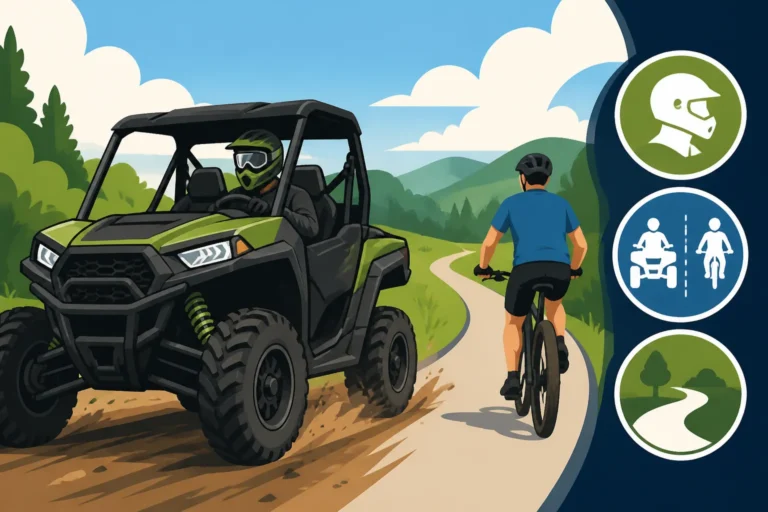
- Riding Single File and to the Right: When riding in a group, always ride single file. Do not ride side-by-side on public roads, even if it feels natural on a wide trail. Stay as far to the right of the road as safely possible, giving ample space to oncoming traffic and vehicles wishing to pass.
- Signaling Intentions: Use your turn signals (if equipped and required) well in advance of turns. If you don't have turn signals, use clear hand signals.
- Appropriate Safety Gear: While Iowa doesn't mandate helmets for adult ATV/UTV operators on roads, wearing one is always a smart choice. Accidents can happen, and a helmet significantly reduces the risk of serious head injury. Other protective gear like eye protection, gloves, and sturdy footwear are also highly recommended.
- Watch for Obstacles: Unpaved roads can have potholes, washboards, loose gravel, or even unexpected debris. Stay alert and constantly scan the road ahead for potential hazards.
Adhering to these practices not only keeps you safe but also promotes a positive image for OHV riders, which can be crucial for maintaining access to these roads.
Enforcement and Penalties
Knowing the rules is one thing; understanding how they're enforced and the potential consequences of non-compliance is another. Iowa law enforcement takes ATV and UTV road use seriously, primarily for safety reasons. You could encounter a county sheriff's deputy, a city police officer, or an Iowa DNR conservation officer on these roads, and they are all authorized to enforce OHV laws.
What a Deputy Checks Roadside
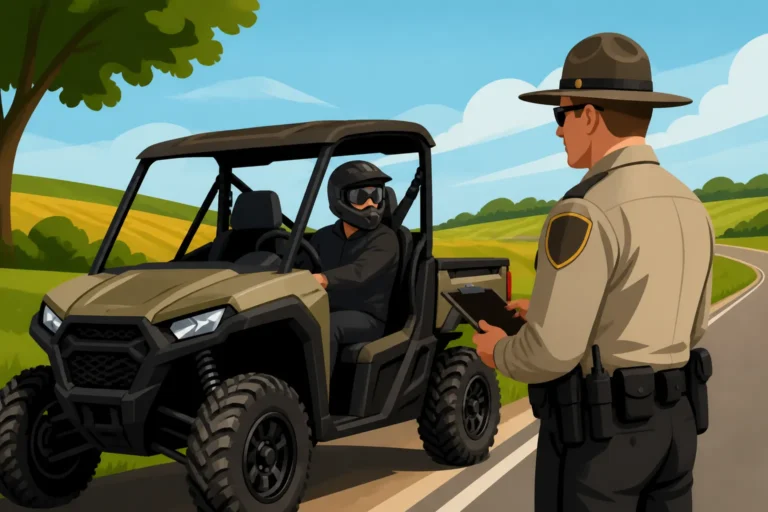
When a law enforcement officer pulls over an ATV or UTV on an Iowa road, they're typically looking for a specific set of compliance factors. It's not a random stop; it's usually because something appears out of order or you've committed a traffic infraction. The good news is, if you're fully compliant, the stop should be brief. [What an Iowa Deputy Checks Roadside] typically includes:
- Registration Decal: Is it current and properly displayed on the rear of your machine? An expired or missing decal is an immediate red flag.
- Proof of Insurance: Do you have valid proof of liability insurance that meets Iowa's minimum requirements (20/40/15) and specifically covers your OHV for road use?
- Driver's License: Do you possess a valid driver's license? Are you at least 18 years old?
- Required Equipment: Are your headlights on (even during the day)? Are your tail lights and brake lights working? Do you have a horn and at least one rear-view mirror? Is the slow-moving vehicle (SMV) triangle properly affixed to the rear?
- Speed: Were you operating within the 35 mph speed limit?
- Reasonable Use: Are you truly on a "most direct route" to an authorized destination, or does it appear you're just joyriding?
The consequences of not having these things can range from a warning to a citation and fine, and in some cases, your machine could even be impounded. [Getting Cited for Riding Without a Recorder Decal] or without insurance is a common penalty for non-compliance, and these fines can be substantial. It's far cheaper and less stressful to ensure everything is in order before you hit the road.
Variances and Local Ordinances
One of the biggest challenges for ATV and UTV riders in Iowa is the decentralized nature of certain road use permissions. While unpaved county secondary roads are generally open unless a county says otherwise, the rules become much more complex for paved roads or city streets.
Counties have the authority to pass ordinances that specifically open certain paved secondary roads to OHVs. This is not universal; each county must decide for itself. Similarly, cities can pass ordinances allowing OHV use on specific city streets or alleys. This leads to a patchwork of regulations across the state. What's perfectly legal in one county or city might be strictly prohibited just across the county line or in the next town over. [Iowa Cities That Opened Their Streets] is a great example of this, where some communities have embraced OHV access while others have not.
The frustrating part for riders is that there is no single, statewide consolidated list or map detailing which counties have opened paved roads or which cities allow OHVs on their streets. [Why Iowa Publishes No List of City Ordinances] means the onus is entirely on the rider to do their research. If you're planning a trip that takes you through multiple jurisdictions or want to ride in a specific city, you absolutely must contact the county recorder, county sheriff, or city clerk's office for that specific jurisdiction. Ask directly about their ordinances regarding OHV use on their paved roads or city streets. Assuming permission could lead to an unexpected and unwelcome citation, even if you’ve been riding responsibly just a few miles down the road in another jurisdiction. This local control means always verifying local rules.
Disclaimer
This article is for general informational purposes only and does not constitute professional advice. Laws, prices and regulations vary by location and change over time. Consult a qualified professional for guidance on your specific situation.