Iowa Trails for a Wide Machine
A wide side-by-side can turn an easy Iowa trail day into a frustrating one if the route narrows between trees, has a tight turn, or is closed after rain. This guide explains how to assess Iowa riding areas for a wider machine, what to check before loading up, and how to avoid arriving at a trail that doesn’t suit your vehicle.
What makes an Iowa trail suitable for a wide machine
Trail width is only one part of the fit
A trail may look wide enough on a map or in a parking-area photo but still be awkward for a full-size UTV. Trees can pinch the route, bends can be too tight for a long wheelbase, and uneven ground may leave little room to reposition. Width also varies along a trail, so a broad entrance does not guarantee a comfortable ride all the way through.
Think about your machine’s actual dimensions, including accessories. A roof, mirrors, doors, a spare tire, or a cargo box can make a setup wider than the factory measurement. Before choosing a route, check the machine’s width and compare it with the riding area’s posted rules. If you cannot find clear information, ask the park or managing organization rather than relying on a guess.
A useful distinction: a trail that permits a wide machine may still be a poor match for it. Legal access and a relaxed, enjoyable ride are not always the same thing. A route with tight corners, steep banks, or deep ruts can be stressful even when your vehicle is allowed.
Know the difference between a park and a trail
Iowa riding areas do not all offer the same kind of terrain or trail layout. Some have several routes and riding zones; others may feel more compact or have features aimed at particular types of machines. Even within one park, a route that suits a narrow ATV may feel constricted in a wide UTV.
Use the park’s own rules and trail information to confirm which machines are allowed and whether any sections are limited. Pay attention to listed width restrictions, signs at the entrance, and directions from staff or volunteers. If the park offers a map, use it to identify routes that appear more open, but treat the map as a planning aid—not a promise that every section will feel roomy.
For a broader look at terrain and riding options, see [Iowa Trails for a Wide Machine] and [Iowa Trail Difficulty Ratings]. Before making a trip around one particular area, also check [Iowa Trail Conditions Before You Ride]. A machine’s width matters, but so do the route’s surface, turns, elevation changes, and current condition.
Iowa riding areas to investigate before you go
Start with parks that have information you can confirm
Gypsum City OHV Park near Fort Dodge is one place to investigate when planning a ride with a wider machine. The park has an extensive trail network, but the number of routes does not mean every route will suit every vehicle. Check current park information, posted rules, and any trail guidance before deciding which loops to try.
Bluff Creek OHV Park near Eddyville, Paul Huting Recreation Area in Waterloo, Lakeview OHV Park near Solon, Nicholson-Ford OHV Park in Marshalltown, Rathbun OHV Area near Plano, and Tama OHV Park are other Iowa riding areas to research. Their terrain, layouts, and operating conditions differ. Don’t assume that a wide machine allowed at one park will be appropriate—or permitted—on every route at another.
The most useful question is often not simply “Can I ride here?” but “Which routes are comfortable for my machine today?” A park may have a mix of trail types, and a wet spell or maintenance work can change what is practical. For park-specific planning, consult [Where to Ride an ATV in Iowa] and [Iowa's Eight Designated OHV Parks].
Use maps to plan, then verify locally
A map can help you understand where a park is, how its trails connect, and what route options might be available. Tools such as onX Offroad can be useful for organizing a trip and reviewing mapped routes, especially when you are comparing riding areas or coordinating with friends. Still, don’t treat a digital map as confirmation that a route is open, wide enough, or approved for your vehicle.
Before you leave, compare any map-based plan with the park’s own current notices and rules. If something is unclear, call the park or check its official updates. This matters particularly when you are driving a long distance with a trailer: learning about a closure or a restriction after unloading is a miserable way to start the day.
You can also use onX Offroad to keep your planned route and nearby alternatives in view, then confirm those options with the managing park. If conditions change, having a backup plan is better than trying to force a machine through a tight or damaged section. For closure planning, see [Iowa Trail Closures to Check First] and [Iowa's Weather-Driven Trail Closures].
| Planning question | Why it matters for a wide machine | What to do |
|---|---|---|
| Is the machine’s width allowed? | Parks may set vehicle or route restrictions | Check current park rules and posted signs |
| Are turns and trail edges manageable? | A wide vehicle needs room to steer and recover | Ask about tight sections and narrow routes |
| Is the trail open and dry enough? | Soft ground and ruts can make maneuvering harder | Check conditions before leaving home |
| Is there room at the staging area? | A wide rig and trailer need space to park and unload | Confirm parking or staging details |
| Is there a backup route or park? | Closures can disrupt a planned outing | Identify another option before you travel |
Prepare the machine and your group for narrow spots
Measure the complete setup, not just the vehicle
Before the ride, measure your machine at its widest point. Include accessories that extend beyond the body, such as mirrors, wheels, racks, or a spare tire. If your machine has removable accessories, decide whether taking them off would make the trip easier—and whether doing so is safe and practical for your setup.
That measurement helps you ask a more useful question when contacting a park. Instead of saying, “Will my side-by-side fit?” give the vehicle’s width and describe its accessories. Ask whether the park has marked vehicle-width limits, whether restrictions differ by trail, and whether there are especially narrow or technical sections. A clear question is more likely to get you an answer you can act on.
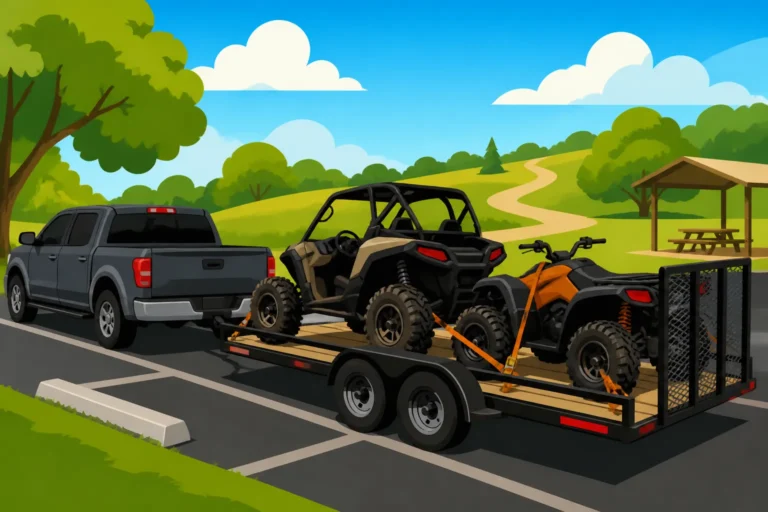
Also think about the trailer and tow vehicle. A wide machine may be straightforward to ride but awkward to unload in a crowded staging lot. Arriving early can make it easier to park, unload, check the rules, and make a plan before the area gets busy. For general machine-selection and fit considerations, [Best Machine Width for Iowa Trails] is a useful related read.
Make a group plan before you enter the trail
If you’re riding with friends, agree on the route and regrouping points before heading out. A wide machine may need more room to turn around or pass another vehicle safely, so avoid letting the group stretch out until the lead and rear riders lose sight of each other. Make sure everyone knows what to do if the trail narrows or someone decides the route is no longer comfortable.
Give the lead rider permission to turn around. It can be tempting to keep pushing because the group has already traveled a distance, but squeezing through a tight section can damage the trail, the vehicle, or both. If you meet another group in a confined area, slow down and communicate rather than attempting a rushed pass.
Before the ride, check that the group has a way to contact one another if machines separate. Cell coverage can vary by location, so don’t make a phone the only part of your plan. Review [How Iowa Parks Mark Their Trail Loops] and [Breaking Down Deep in an Iowa OHV Park] when preparing for a longer ride.
Ride responsibly when conditions or fit are uncertain
Treat wet and damaged trails as a reason to change plans
Iowa trail surfaces can change quickly with rain. Soil that felt firm during a dry week may become slick or deeply rutted after a storm. For a wide machine, those ruts can make it harder to keep all four wheels on a stable line, while soft shoulders may offer less room to maneuver. Even if the route is technically open, poor conditions can make it a bad choice for your machine.
Check the park’s alerts before you load, then look again before you start riding. If a trail is closed, stay off it. If staff or volunteers ask riders to avoid a damaged section, follow that direction rather than trying to find a way around the closure. Riding around a blocked area can widen the damage and may put you on land or a route where riding is not allowed.
When the ground is soft, a responsible choice may be to postpone the trip or use a different riding area. [Iowa Trails Closed After Rain] explains why closures matter, while [Trail Damage From Riding Too Wet] covers the consequences of riding when a route needs time to recover.
Keep the ride within posted rules and your comfort level
A wide side-by-side is not automatically suitable for every Iowa OHV trail. Confirm that the machine is allowed at the riding area, follow posted directions, and stay on designated routes. If a narrow section looks uncomfortable, stop somewhere safe and reassess rather than pushing ahead because the rest of the group is continuing.
Think about passengers, too. A tight turn or uneven trail can feel very different from inside a UTV than it looks from the staging area. Keep speeds controlled, allow space between vehicles, and give other riders room where the trail permits it. If your machine’s width limits safe passing, wait for an appropriate place instead of edging off the marked route.
The best wide-machine trip is one where the park, route, conditions, and vehicle all suit one another. Confirm access in advance, arrive with a backup plan, and be willing to change course when the trail tells you it is not a good fit. That little bit of preparation can save a long drive, protect the trail, and make the ride more enjoyable for everyone.
Disclaimer
This article is for general informational purposes only and does not constitute professional advice. Laws, prices and regulations vary by location and change over time. Consult a qualified professional for guidance on your specific situation.