Asking a Neighbor to Ride Their Timber
A neighbor’s timber can look like the perfect place for a short ATV ride, especially when public trails are a long drive away. But a friendly wave across the fence is not the same as clear permission to ride. This guide explains how to ask, agree on boundaries and conditions, and avoid turning a neighborly favor into a trespass or property-damage dispute.
Start with a clear, respectful request
Ask before you ride, not after you unload
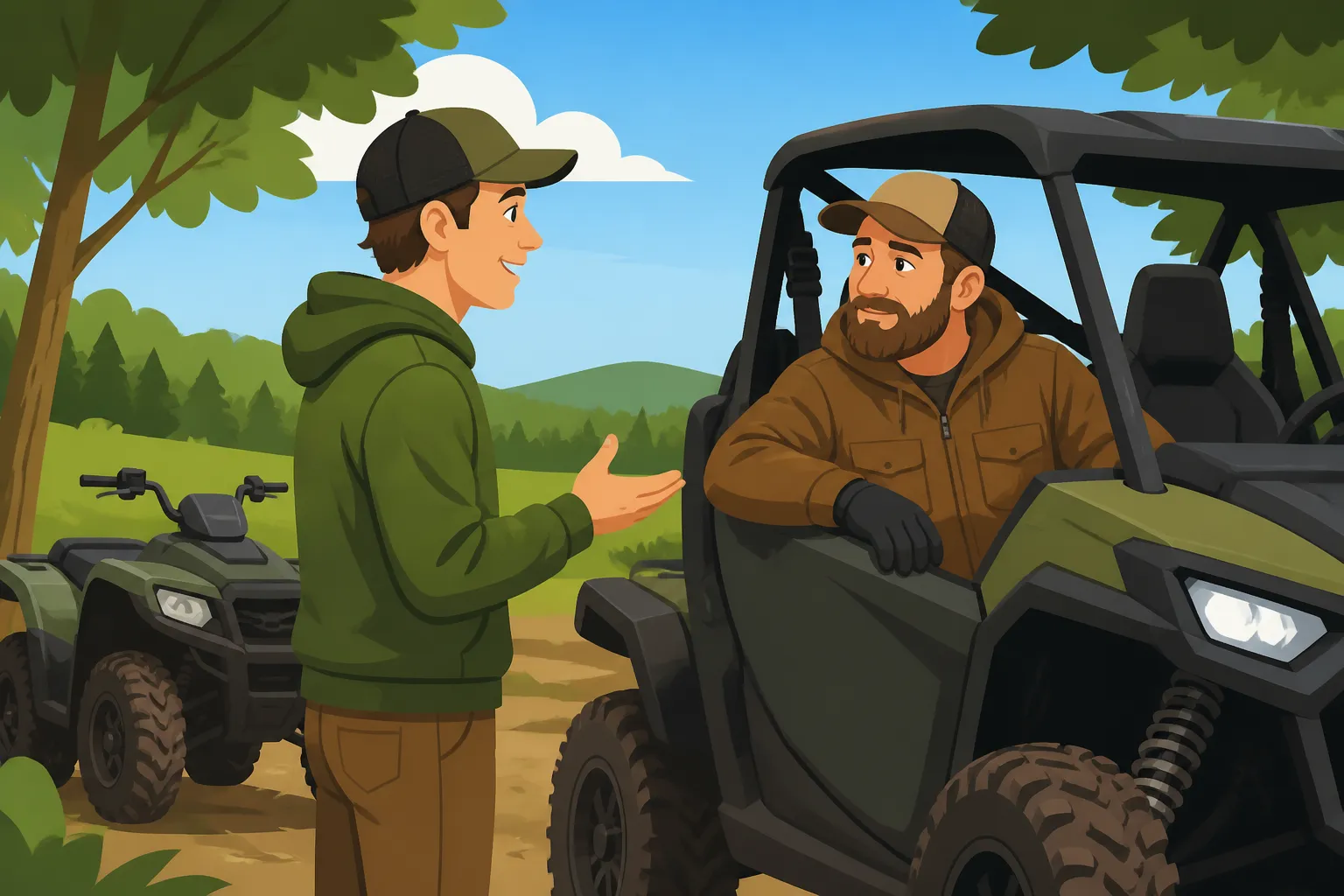
If you can, ask in person when your neighbor has time to talk. A quick conversation at the mailbox or while they are moving equipment may not be the right moment to discuss where you can ride, who may come along, or what parts of the property are off-limits. Make the request before bringing machines, trailers, or guests onto the land.
Be direct about what you have in mind. For example: “Would you be comfortable with me riding my ATV on the timber trails sometime this weekend? I’d be riding with one friend, and we would stay on the route you approve.” That gives the landowner enough detail to say yes, no, or suggest different conditions. Avoid asking in a way that makes a no feel awkward, such as announcing that you plan to ride and then asking whether that is all right.
A neighbor may be comfortable with you walking through the timber but not with motorized riding. They may allow a single machine but not a group, or agree to a weekday ride but not a busy weekend. Treat those as reasonable boundaries, not an invitation to bargain them away. Permission is voluntary, and the owner gets to decide whether the proposed activity works for them.
Explain who will ride and what you plan to do
Give the owner a practical picture of the ride: how many machines, who will operate them, when you expect to arrive and leave, and whether anyone will be riding as a passenger. If you plan to bring children, say so. If a friend might join later, ask about that separately rather than assuming the original permission covers extra riders.
Explain the kind of route you have in mind. A slow ride on an established lane is different from climbing banks, crossing a creek, riding through brush, or making new trails. If the owner wants you to stay on a farm lane or an existing path, repeat that back to confirm you understood. In Iowa, a timber edge may be close to crops, drainage areas, livestock, buildings, or equipment, so a route that looks open from the road may not be appropriate to the landowner.
It can help to ask what the owner is trying to protect. Maybe they are concerned about a newly planted area, hunting activity, a creek crossing, or a gate used by farm equipment. Knowing the reason makes it easier to follow the rule correctly. The broader principles in Iowa Landowner Permission Rules and Riding Private Ground in Iowa are useful reminders that access depends on the landowner’s permission and the limits attached to it.
Agree on boundaries and conditions before the ride
Identify the approved area together
Do not rely on a vague instruction such as “You can ride in the back.” Walk or drive the proposed route with the owner if possible. Ask where the permitted area starts and ends, which trails or lanes are okay, and whether there are places you must avoid. A visible landmark can help: “Stay west of the creek,” for instance, is more useful when both of you have looked at which creek and which crossing you mean.
A mapping app such as onX Offroad can help you review a route or discuss the general layout, but a map is not permission. Property boundaries shown in a digital layer may not be exact enough to settle a dispute, and a line on a screen cannot tell you whether a landowner has approved access. Use mapping as a conversation aid, then confirm the route directly with the owner. If a boundary is uncertain, stay well inside the area they have clearly allowed.
You might ask, “Would you mind pointing out the places you don’t want us to go?” That question is often more useful than asking only where you can ride. The owner may identify a wet section, a neighbor’s parcel, a crop field, a hunting area, or a gate that needs to remain accessible. If the owner later changes the route or closes an area, follow the updated direction rather than relying on an earlier understanding. For more on the legal and practical side of staying within the approved area, see Iowa Rules for Riding Private Land and [Iowa Rules for Riding Off the Trail].
Put the important details in writing
For a one-time ride, a brief text message can help everyone remember the agreement. It might say that you have permission to ride a particular route on a certain day, identify the riders, and list any restrictions the owner gave you. The goal is not to turn a neighborly favor into a complicated contract. It is to prevent simple misunderstandings such as one person thinking “the timber” includes the pasture while the other means only a marked trail.
For recurring access, be more specific. Agree on when you may ride, how much notice to give, how many people can come, whether guests need separate approval, and how the owner will tell you if the route is temporarily closed. Clarify whether permission applies only to you or also to family members and friends. Never assume that permission transfers to another person just because you invited them along.
| Detail to agree on | Helpful question to ask | Why it matters |
|---|---|---|
| Riders | “Who may ride with me?” | Permission for you may not include guests |
| Route | “Which trails or lanes are approved?” | Prevents accidental entry into crops or adjoining land |
| Timing | “What days or hours work for you?” | Avoids conflicts with farm work, hunting, or quiet hours |
| Gates | “Should we open or close this gate?” | Keeps livestock contained and equipment access clear |
| Conditions | “Are there areas we should avoid after rain?” | Helps prevent ruts and trail damage |
| Changes | “How should I check if plans change?” | Makes it easier to respect temporary closures |
If the owner is comfortable with it, use onX Offroad or another mapping tool to look at the same route together. Save a copy for your own reference, but remember that the owner’s directions take priority over a map. If you are not sure whether a trail crosses a parcel line, stop and ask rather than treating a mapped route as proof that you can continue.
Make the ride easy on the landowner
Ride only as agreed and leave the property as you found it
Arrive when you said you would, keep the group to the agreed size, and stay on the approved route. Do not make a new trail because the existing one is muddy or inconvenient. If you reach a blocked path, a gate, a flooded crossing, or a place that looks different from what you expected, turn around or contact the owner. The fact that a track is physically passable does not mean it is part of the permission.
Iowa weather can change a timber trail quickly. After rain, clay soil and low areas may become soft, and repeated passes can leave ruts that are difficult to repair. Ask whether the owner wants you to cancel after wet weather. If they say yes, do not treat the request as overly cautious. A neighbor may be trying to protect the trail, prevent erosion, or keep farm access usable. For more detail on avoiding damage when conditions are poor, review Trail Damage From Riding Too Wet.
Keep the ride considerate beyond the trail itself. Avoid disturbing livestock, wildlife, hunting activity, crops, gates, fences, and stored equipment. Do not leave trash, spill fuel, or use the property as a place to practice aggressive turns or hill climbs unless the owner has specifically approved that activity. If you notice a damaged fence, a fallen limb blocking a lane, or another problem, tell the owner promptly instead of trying to fix something you may not understand.
Be ready to stop, and check your own requirements
Permission to use private land does not automatically settle every other requirement for the machine or rider. Registration, safety, age-related rules, and other obligations may depend on the circumstances and the kind of machine. Check the rules that apply to your ride rather than assuming that private property means every requirement disappears. The articles Iowa Rules for Riding Private Land and Iowa ATV Safety Certificate Requirements can help you identify issues to verify before heading out.
Make sure each rider understands the route and the owner’s conditions before starting. A guest who takes a wrong turn can create a problem even if you personally followed the directions. Share the boundaries, agree on a meeting point, and make sure riders know not to continue onto adjoining property. If a rider is inexperienced, choose a pace and route that match their ability rather than turning the neighbor’s timber into an impromptu skills course.
If the owner asks you to stop or leave, do so calmly and promptly. Do not argue that you have already driven part of the route or that the land looks unused. Permission can be limited or withdrawn, and a respectful response is more likely to preserve the relationship. For broader information about access and unauthorized riding, see Iowa Trespass Rules for Riders.
Keep a good relationship beyond one ride
Follow up and thank the owner
A short thank-you after the ride matters. Tell the owner that you stayed on the agreed route and mention any issue you noticed, such as a washed-out section or a gate that was difficult to close. If you caused damage, be honest about it and offer to discuss how to address it. Hiding a mistake can turn a minor repair into a lasting problem between neighbors.
Do not assume that one successful ride creates permanent access. Ask again before your next outing, especially if the season has changed, the owner is preparing for hunting, farm work is underway, or the route has become wet. A simple message—“Would this Saturday still work, and should we avoid the creek trail?”—shows that you understand permission is specific and can change.
If you want to ride regularly, ask whether the owner would prefer a predictable schedule or a quick text each time. Some landowners appreciate knowing who is on the property and when. Others would rather grant access only for occasional rides. Let them set the arrangement. A clear, low-pressure request is more likely to keep the conversation comfortable than repeated last-minute asks.
Make it easy for the owner to say no
A good request leaves room for a genuine answer. You can say, “No worries if now isn’t a good time,” or “If you’d rather not have machines on the property, I understand.” That reassures the owner that declining will not create tension. If they say no, thank them and look for a designated riding area or another place where access is allowed.
If the owner says yes with conditions, repeat the conditions and follow them exactly. If they say yes only for you, do not bring friends. If they approve a particular route, do not explore beyond it. If they ask you to avoid certain dates or areas, make a note so you do not have to rely on memory later. A mapping tool such as onX Offroad may help you keep the route straight, but your notes should reflect what the owner actually authorized—not what the map appears to show.
The best outcome is not merely getting permission for one afternoon. It is showing that you are trustworthy enough that the neighbor feels comfortable having the conversation again. Ask clearly, ride carefully, respect every limit, and make it easy for the owner to change the arrangement. That approach protects the relationship as well as the land.
Disclaimer
This article is for general informational purposes only and does not constitute professional advice. Laws, prices and regulations vary by location and change over time. Consult a qualified professional for guidance on your specific situation.