Why the Iowa Decal Is the Admission
A ride can feel fully planned until you reach an Iowa OHV park and realize the sticker on your machine is doing more than identifying it. Iowa’s registration decal or required visitor permit is the proof you need for designated riding areas, rather than a separate day-use ticket at the gate. This guide explains what that means, what it does not cover, and what to check before loading up.
What it means when the Iowa decal is the admission
The decal is proof of authorization, not a park ticket
At Iowa designated OHV riding areas, the required decal is tied to the machine’s registration or permit status. It is the visible proof that the machine has the authorization required to ride there. That is why you may hear riders say the decal “is the admission”: in many cases, there is no separate day-use charge collected at the trailhead.
That arrangement can be easy to misunderstand if you are used to parks with a booth, gate attendant, or daily vehicle pass. You may pull into a staging area and see no one collecting money, but that does not mean the ride is automatically free of requirements. The machine still needs the correct Iowa registration decal or other applicable permit, and riders need to follow the park’s rules.
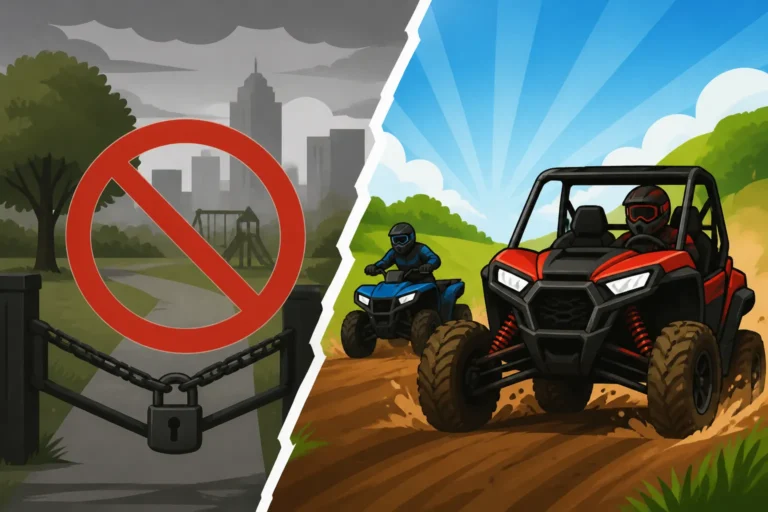
The decal is not a universal pass to every piece of land in Iowa. It does not give permission to ride private property, closed trails, or any area where OHV use is not allowed. It also does not replace requirements that may apply to the rider, machine, or activity. For an overview of the park system, see [Iowa's Eight Designated OHV Parks].
Why there may be no second charge at the trailhead
A separate day-use fee and the required decal serve different purposes. A day-use ticket is typically a payment for access on a particular visit. Iowa’s decal or permit is associated with the machine’s authorization to ride, so it can be checked without a new transaction every time you arrive at a participating riding area.
That difference can make a first visit feel pleasantly simple: you arrive, unload, check the rules, and ride without buying another pass at the gate. It can also create confusion when someone assumes “no gate fee” means no registration or permit is needed. The absence of a payment booth does not cancel the decal requirement.
Park operations can still vary. A site may have separate arrangements for camping, special events, organized activities, or other services. Those are not the same thing as ordinary day-use admission. The practical takeaway is to understand the decal requirement first, then check the particular park’s information for anything beyond basic trail access. For more on the distinction, see [Why Iowa Parks Charge No Day-Use Fee].
A pass on the machine is not permission for every kind of riding
The decal relates to the machine’s riding authorization. It does not mean every trail is open, every route is appropriate for your vehicle, or every type of riding is allowed at every location. A park can close trails because of weather or maintenance, and a rider can still be expected to obey boundaries, signs, posted hours, and local operating rules.
Think of a valid decal as one required part of getting ready, not a guarantee that the whole outing is cleared. A family could arrive with correctly registered machines and still need to turn around if a trail is closed or a machine does not meet a park’s posted requirements. Likewise, a rider with a valid decal cannot leave a designated trail and assume that the surrounding land is open to riding.
That distinction matters most when you are planning a route that combines a public OHV area with nearby roads, private ground, or other recreation land. Check the rules for each segment separately. [Iowa Rules for Riding a Designated Riding Area] is a useful next read if you want to understand how designated-area rules differ from general riding permissions.
Which decal or permit your machine may need
Iowa residents should verify the machine’s registration status
For an Iowa resident, the starting point is whether the machine has the required Iowa registration and current decal. A sticker from a previous season may not be enough simply because it remains attached to the fender. Check its validity and confirm that it belongs to the machine you are taking.
This small check can prevent an aggravating morning at the staging lot. Imagine hauling a quad from central Iowa to Gypsum City, unloading, and discovering that the decal is expired or was never transferred to the machine you bought. The trailer, fuel, and drive are already behind you, but the paperwork issue can keep the ride from going as planned. It is much easier to confirm registration at home.
If you are unsure whether a machine is registered or what paperwork applies, review [Registering an ATV in Iowa] and [Renewing an Iowa ATV Registration]. The details can vary with the machine’s history and ownership, so do not rely only on what a previous owner says or on a sticker that looks familiar.
Visitors need to check what Iowa requires for an out-of-state machine
A visitor’s home-state registration does not automatically settle every Iowa riding-area requirement. Nonresidents should check whether their home-state registration is recognized for the intended use or whether Iowa requires a nonresident permit. The answer can depend on the machine’s status and where you plan to ride, so it is worth confirming before traveling.
This is especially important for riders crossing from nearby states such as Minnesota, Wisconsin, Missouri, or Nebraska. A machine that is properly documented at home may still need an Iowa permit for riding in Iowa. Do not assume a plate, registration card, or sticker from another state will serve as the Iowa OHV authorization at a designated park.
Start with [Iowa's Permit for a Visiting Machine] and [Does Iowa Honor Out-of-State Registration?]. If a permit is required, confirm how it must be displayed and whether it applies to one machine or more. A permit connected to one quad should not be treated as permission for a second machine in the trailer.
The machine type and intended use still matter
“ATV” is often used casually to describe several kinds of off-highway machines, but requirements can differ by machine type. A side-by-side, dirt bike, youth machine, or electric machine may have different registration or rider-related rules. Confirm the category of your vehicle rather than assuming that advice written for a standard ATV applies to every rig.
The same care applies to how and where you plan to ride. A machine’s registration decal is not the same as a road-use authorization, and it does not make an otherwise restricted public road open to OHV traffic. Road riding has separate rules and equipment requirements. Trail access at a designated OHV area should not be treated as permission to ride there by an unrestricted route.
If the machine is unusual, newly purchased, borrowed, or recently brought into Iowa, check the relevant requirements before you leave. For a broad overview of permit questions, [Iowa ORV Permits Explained] can help you identify what to confirm rather than guessing from the shape of the vehicle or the sticker.
| Your situation | What to check before the ride | Common assumption to avoid |
|---|---|---|
| Iowa resident with a registered ATV | Current Iowa registration and decal for that machine | An old decal is still valid because it is attached |
| Visitor with an out-of-state machine | Iowa nonresident permit and reciprocity rules | Home-state registration always covers Iowa riding |
| Side-by-side, dirt bike, or youth machine | Rules specific to that machine type and rider | All off-highway vehicles follow identical requirements |
| Borrowed or newly purchased machine | Registration status, ownership paperwork, and decal match | The owner’s paperwork automatically covers every rider or machine |
| Machine at a closed or restricted site | Park status, trail access, and posted rules | A valid decal makes every trail open |
What the decal covers and what it does not
It supports access to designated riding areas
The decal’s practical value is clearest at designated OHV areas: it is part of the proof that the machine is authorized for the activity. But it is still the rider’s job to confirm that the particular riding area is open and that the chosen machine and route are allowed. A decal is not a substitute for checking the park’s current operating information.
That check matters in Iowa because trail conditions can change quickly. Rain can leave clay and natural-surface trails vulnerable to damage, and parks may close trails or entire sites to protect them. A rider who drives several hours based on last weekend’s conditions can be disappointed if the gate or trail system is closed when they arrive.
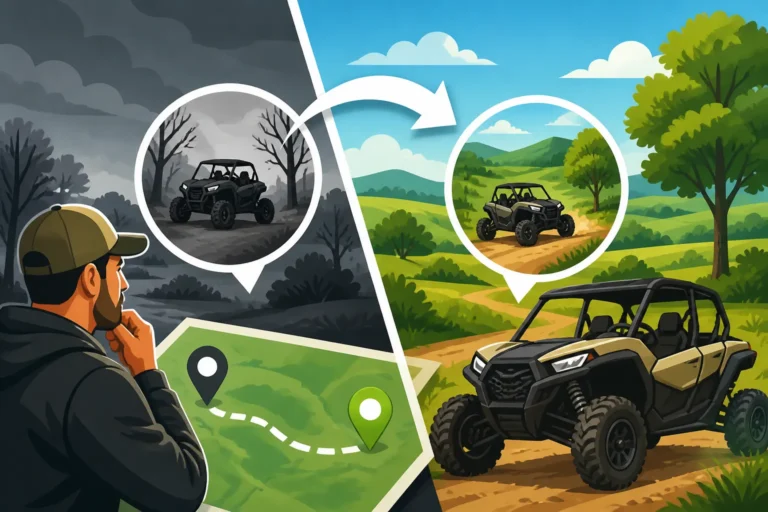
Before loading, check [Iowa Trail Conditions Before You Ride] and [Iowa Trail Closures to Check First]. If you use a mapping service such as onX Offroad to sketch a route or compare nearby riding options, treat the map as a planning aid, not as official confirmation that a trail is open. Verify the status with the park or the relevant official information channel.
It does not grant access to private land
A valid decal does not give you permission to cross a farm, ride a neighbor’s timber, or use a private trail. This is a common point of confusion when a public OHV area appears close to a road or parcel of land that looks rideable. Physical proximity is not authorization.
For example, a route shown on a map may appear to connect a staging area with a nearby gravel lane. That visual connection does not establish a legal route or landowner permission. onX Offroad and other mapping tools can help you orient yourself, but boundaries and access rights must be understood correctly; a map is not a substitute for permission from the owner or a posted route that allows riding.
The safest approach is to keep the ride within the designated area and follow marked trails. If you intend to ride private land, get permission directly and understand any limits the landowner sets. Do not assume that the registration decal, a friend’s invitation, or a previous visit means access is still allowed.
It does not guarantee a trail is suitable for your machine
A park’s trails may include different terrain, widths, grades, and obstacles. A valid decal does not certify that every route is suitable for every machine. A wide side-by-side may not fit where a narrow ATV can travel comfortably, and a beginner or young rider may need a route that avoids steep, rutted, or technical sections.
Before riding, read posted signs and park rules, and choose trails that fit the machine and the group’s experience. If you are riding with children or a mixed group, make a plan that gives the least experienced rider a safe option to stop, turn around, or take an easier route. Do not let the pressure to keep up turn a familiar day ride into a risky one.
Mapping apps such as onX Offroad can help you review terrain and prepare a general plan, but do not use an app’s line or label as proof that a route is open or passable. Conditions, signs, and local information at the park take priority. A good plan includes a backup route and the willingness to shorten the ride.
How to prepare for a smooth park visit
Confirm the decal before you put the machine on the trailer
Start with the machine, not the trailhead. Check the decal’s validity, placement, and match to the vehicle. If you have several machines, look at each one separately; it is easy to assume the correct sticker is on all of them when only one has been renewed.
Keep registration or permit documentation accessible as well. A decal is visible proof, but a registration certificate or permit record can help answer questions if the sticker is damaged, difficult to read, or challenged. Put the paperwork somewhere it will not get soaked or buried under riding gear. Before leaving, compare the machine identification details on the documentation with the machine you are hauling.
If something looks wrong, resolve it before the ride rather than hoping the park will have an easy fix. Check [Iowa ATV Decal Placement] if you are uncertain where a decal belongs, and [Iowa ATV Registration Help] for common registration questions. A few minutes of checking in the garage can save a long, frustrating conversation at a park entrance.
Check conditions, hours, and park-specific instructions
The decal answers only one part of the preparation question. Confirm that your chosen park is open, the trails are available, and the hours work for your arrival and departure. Park operating information can change, especially when weather or trail maintenance affects access.
A useful routine is to check the park’s information the evening before and again before you start driving. If you are traveling from far away, call the park or check its current official alerts rather than relying on an old social post or a saved map. A route that was open the last time you rode may not be open after heavy rain or maintenance.
Use onX Offroad or another map to plan the drive, identify nearby alternatives, and understand the general area, but confirm access through official park information. Consider choosing a backup park before you leave. If the primary site is closed, you will be able to decide whether the alternate is practical instead of searching on your phone with the trailer already hitched.
Make the decal part of a broader pre-ride checklist
A decal is essential, but a well-prepared visit involves more than registration. Check fuel, tires, brakes, lights where relevant, tie-downs, helmets and protective gear, water, and any equipment your group needs. If you are traveling with children, confirm rider requirements and supervision arrangements before the trip. [Iowa's Safety Certificate for Ages 12 to 17] is relevant for families checking youth-rider rules.
The group should also agree on a simple riding plan. Decide who leads, where you will regroup, and what to do if someone gets separated or has a mechanical problem. Tell newer riders that turning around is always an option. It is better to change the route early than to push a rider beyond their ability or continue into terrain that is not right for the machine.
Finally, leave room for park-specific rules. Check whether the area has restrictions on vehicle types, passengers, noise, or other conduct, and follow signs when you arrive. The registration decal gets you through one important part of preparation; safe, considerate riding is what helps protect the trails and keeps access available for everyone.
Common decal and admission misunderstandings
“There is no booth, so I do not need a pass”
This is probably the most costly misunderstanding. A park may not have a staffed entrance or a separate day-use payment point, but the absence of a booth does not mean the decal requirement disappears. The responsibility is still on the rider to bring a properly authorized machine.
When you arrive, look for posted instructions and follow them even if no one is present to check. Do not interpret an unattended staging area as an invitation to skip registration. If you are uncertain about the requirement, pause and verify it before riding rather than assuming that other vehicles in the lot have the same status as yours.
“My friend has a decal, so our group is covered”
A decal is associated with the machine, not a whole trailer or riding party. If you bring three machines, do not assume one decal authorizes all three. Check that every machine has its own required registration or permit and that its documentation matches.
This becomes easy to miss when friends share a trailer or one person handles the paperwork. Make a quick pre-trip check with everyone in the group: identify each machine, verify its decal, and confirm the rider knows where the supporting documents are. That conversation is much less awkward at home than discovering a missing permit at the park.
“A valid decal means the park must be open”
A decal does not override closures. Weather, maintenance, safety concerns, or park-specific operations can limit access. A machine can be correctly registered and still be unable to use a closed trail or site.
Before driving, check current trail status and have a backup plan. A mapping tool such as onX Offroad can help locate nearby possibilities, but it cannot replace confirmation from the park that a route is open and authorized. Treat official updates and posted signs as the final word, and respect closures even when the conditions look rideable from the parking lot.
“The decal is permission to ride anywhere nearby”
The sticker is not a roaming pass for roads, fields, timber, or trails outside the designated area. Each location has its own access rules, and private property requires permission. Road use is governed by separate rules, which can vary by road type and local authorization.
If your plan includes riding beyond the OHV park, research each part of the route independently. Do not use an app’s suggested line as proof of legal access, and do not assume a nearby property is public simply because it appears undeveloped. The decal is a necessary part of many Iowa park visits, but responsible riding starts with knowing exactly where it applies.
Disclaimer
This article is for general informational purposes only and does not constitute professional advice. Laws, prices and regulations vary by location and change over time. Consult a qualified professional for guidance on your specific situation.