Where a Gravel Road Meets Pavement
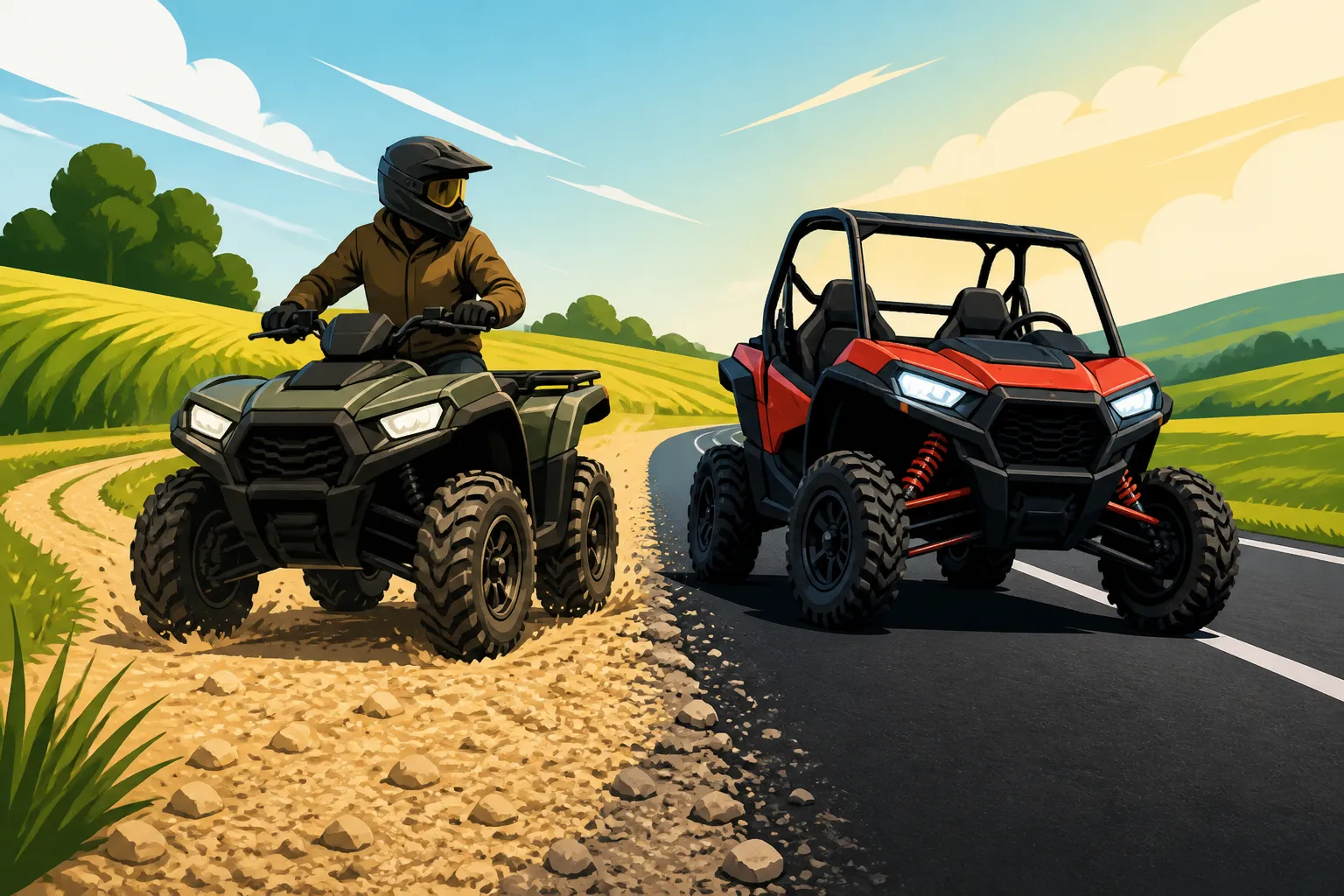
We’ve all been there: you’re enjoying a fantastic ride on a long stretch of Iowa gravel, the dust kicking up behind you, the scenery flying by, and suddenly, you see it – a smooth, black ribbon of pavement stretching ahead. Your heart might sink a little, or maybe you sigh, wondering, "Now what?" Navigating the transition from an unpaved county road to a paved one with your ATV or UTV in Iowa can feel like stepping into a minefield of rules and regulations. This guide is here to untangle the confusion, helping you understand precisely what Iowa law expects when your tires leave the loose rock and meet the asphalt.
The Inevitable Pavement: Why the Transition Matters
Riders in Iowa frequently encounter situations where a beautiful gravel route suddenly gives way to a paved road, or perhaps the quickest way to get from one fantastic trail system to another involves a brief stint on blacktop. It's a common dilemma, and one that often causes a lot of head-scratching. The truth is, while Iowa has made strides in allowing more freedom for ATVs and UTVs on certain public roads, the distinction between unpaved and paved surfaces is a critical one that carries different sets of rules. Ignoring these differences can quickly turn an enjoyable outing into a costly interaction with law enforcement. Understanding these nuances isn't just about avoiding a ticket; it's about staying safe and being a responsible rider in the Hawkeye State.
Iowa’s landscape is a beautiful patchwork of agricultural fields, small towns, and, of course, countless miles of roads. While many of us love the thrill of unpaved county secondary roads, it’s virtually impossible to ride for any significant distance without eventually encountering pavement. Whether you're trying to get to a local gas station, cross a highway, or simply connect to another gravel road, that moment where dirt turns to asphalt is a moment where your responsibilities as a rider shift. It’s not just a physical transition for your machine; it's a legal one for you. This often means remembering specifics about speed limits, required equipment, and even who is allowed to operate the machine on that particular surface.
Iowa's Baseline Rules for Road Use
Before we dive into the nitty-gritty of gravel versus pavement, it's crucial to understand the foundational rules Iowa has in place for ATV and UTV use on any public road. These are the non-negotiables that apply broadly and serve as the starting point for any discussion about riding on public thoroughfares. Failing to meet these basic requirements means you shouldn’t even be thinking about transitioning from one road type to another.
First and foremost, your machine absolutely must be registered with the Iowa Department of Natural Resources (DNR) and display a valid decal. This isn't just for trail riding; it applies to public road use as well. You also need to have your registration certificate handy – not tucked away at home, but on your person or stashed safely on the machine. An officer making a roadside stop will always ask to see this. For residents, this is handled through your [Registering at an Iowa County Recorder]. For visitors, Iowa requires a specific [Iowa's Nonresident User Permit] to legally ride on public lands and designated road routes.
Another fundamental is age and licensing. In Iowa, to legally operate an ATV or UTV on a public road, the driver must be at least 18 years old and possess a valid driver's license. This means that even if a 16-year-old has a driver's license for a car, they are not permitted to operate an off-highway vehicle on a public road. This rule can be a real sticking point for families, as younger riders might be perfectly capable off-road but are legally restricted on public roads. It's a crucial distinction and one that deputies in rural areas are well aware of, particularly if they see a younger rider on a road they shouldn't be on.
Finally, there's the speed limit. On any road where ATVs and UTVs are permitted, Iowa law imposes a strict speed limit. You cannot exceed [Iowa's 35 mph Cap], regardless of the posted speed limit for cars. Even if the road is perfectly straight, flat, and empty, pushing past 35 mph can earn you a citation. This particular rule is often a source of frustration for riders with powerful machines, but it’s a non-negotiable safety measure put in place to reflect the inherent differences in handling and braking between off-highway vehicles and standard automobiles.
Gravel Roads: The Home Turf for Many Riders
For most Iowa ATV and UTV enthusiasts, unpaved county secondary roads feel like home. These are the dusty, rock-strewn paths that crisscross much of the state, connecting farms, small communities, and offering miles of scenic riding. Iowa has been quite accommodating when it comes to allowing off-highway vehicle use on these roads, but there are still specific rules you need to follow. The ease with which you can ride these roads often makes the transition to pavement feel jarring because the freedom you enjoyed suddenly tightens up.
The primary reason these roads are generally open to ATVs and UTVs is that they are considered "unpaved county secondary roads." Counties in Iowa have the authority to open these routes, and generally, most have chosen to do so. This means you can often ride for considerable distances without issue. However, you are still subject to the general rules mentioned above, like registration, age, and the 35 mph speed limit. You'll also need to ensure your machine is equipped with the necessary safety features. This includes working headlights, a tail lamp, a horn, and at least one rearview mirror. Many riders opt for accessory kits from companies like SuperATV to ensure they meet these requirements easily.
A crucial point for [Iowa Rules for Riding a Gravel Road] is understanding the "most direct route" rule. This rule applies when you're using a public road to get to or from an OHV park, a designated trail, or even just another section of gravel road. You're expected to take the shortest, most reasonable path. You can't just meander down gravel roads for fun if your ultimate destination isn't directly served by that specific route. This rule is designed to ensure that road use is for transportation to a legal riding area, rather than simply joyriding on public roads.
Consider a real-life scenario: You're riding with friends on some excellent gravel roads near Ames. You know there's another great set of trails about five miles away, but to get there, you need to ride about a mile on a paved secondary road. As long as you are taking the [The Most Direct Route to an Iowa OHV Park] or another legal riding area, that brief paved section is permissible, provided you adhere to the rules for that specific type of road. It’s the intentional, extended cruising on roads not designated for such use that tends to draw unwanted attention.
Paved Secondary Roads: Navigating the Asphalt
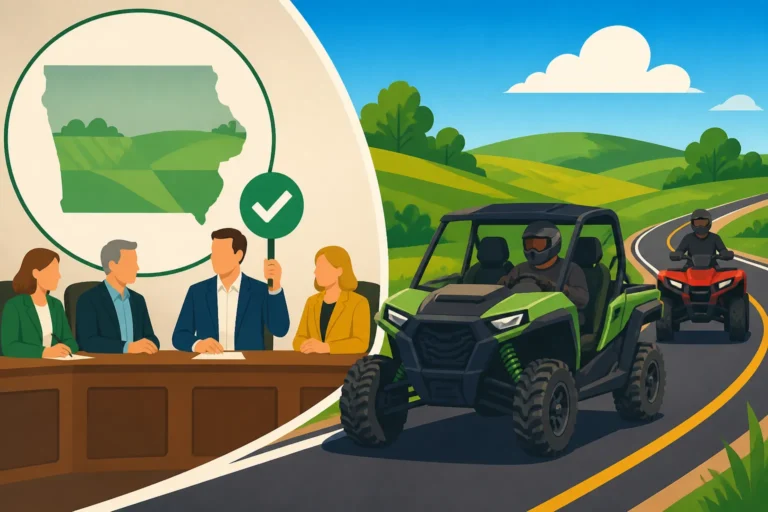
This is where things often get tricky and where many riders find themselves on the wrong side of the law if they aren't careful. While Iowa generally permits ATVs and UTVs on unpaved county secondary roads, riding on paved secondary roads is a different beast entirely. It's not an automatic "yes." For a paved county secondary road to be open to ATVs and UTVs, the county Board of Supervisors must explicitly authorize its use through a formal ordinance. Without that explicit county approval, paved secondary roads remain off-limits to off-highway vehicles.
This lack of statewide standardization can be incredibly frustrating. You might be riding legally on a paved road in one county, cross into the next, and suddenly be in violation of the law. There isn't a readily available, comprehensive state list of which counties have opened which paved roads, so riders really need to do their homework for the specific areas they plan to ride. This involves contacting the county sheriff's office or county auditor’s office to inquire about local ordinances. It's a hassle, but it's essential for staying legal.
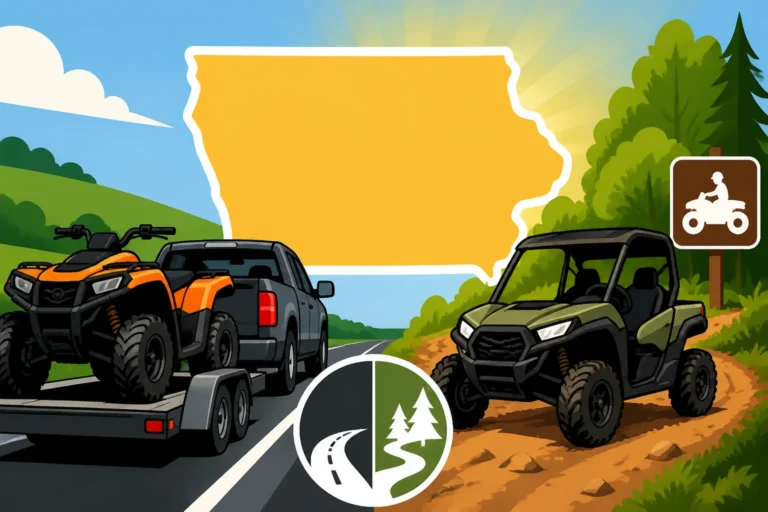
When a county does authorize [Iowa Rules for Riding a Paved Secondary Road], the same baseline rules apply: 18 years old with a valid driver's license, your machine must be registered and display a decal, and you absolutely cannot exceed 35 mph. But the key difference is that county-by-county authorization. It's not enough that it's a "secondary" road; it must have been specifically opened if it's paved. This is why you often see riders pulling over to trailer their machines when a gravel road turns to pavement, even if it's still a secondary road. They're avoiding the risk of riding on an unauthorized paved section.
Here’s a practical tip: always assume a paved secondary road is closed unless you have confirmed otherwise. It's better to err on the side of caution. If you're on a multi-county ride, the best practice is to stick to gravel as much as possible, or only use paved sections where you know for a fact that they've been opened. High-quality mirrors, like those available from SuperATV, are especially helpful when riding paved roads as they improve visibility of faster-moving traffic.
Crossing Primary Highways and Navigating Cities
Beyond county roads, Iowa also has rules for crossing primary highways and for navigating city streets. These are distinct situations with their own set of regulations.
Primary Highways: You cannot ride your ATV or UTV on an Iowa primary highway (those are the ones marked with a state route shield, like Highway 20 or Highway 141), nor can you ride on interstate highways. These are strictly off-limits for continuous travel. However, Iowa law generally allows you to cross a primary highway at an intersection, provided you do so safely and directly. This is typically done to get from one legal riding area to another. You can't ride down the shoulder of a state highway, but you can go straight across it when it intersects with a county road that you are permitted to ride on. Always exercise extreme caution when doing this, as traffic on primary highways moves at much higher speeds.
City Streets: Just like paved county secondary roads, city streets are generally off-limits unless the city council has passed an ordinance specifically authorizing their use by ATVs and UTVs. This varies wildly from town to town. Some smaller communities might open certain streets or alleys to facilitate access for residents, but larger cities rarely do. Again, there is no statewide list, so it's up to you to check with the city clerk's office in any municipality you plan to ride through. If you are riding through a city that has opened its streets, you'll still be subject to the 35 mph speed limit and all the same equipment requirements. [Iowa Cities That Opened Their Streets] are rare, so don't assume.
This fragmented approach can be one of the most frustrating aspects of riding in Iowa. What’s legal in Waukon might be illegal just a few miles down the road in another town. This is why many riders use trailers to transport their machines when a ride involves passing through or near urban areas, or if they need to cover significant distances on paved roads. It minimizes the risk and hassle.
Essential Equipment for Mixed-Surface Riding
When you're transitioning between gravel and pavement, your machine needs to be properly equipped to meet Iowa's road-use requirements. This isn't just about legality; it's about safety, especially when sharing roads with cars and trucks.
Here's a quick rundown of what Iowa requires:
- Headlights: Your ATV or UTV must have at least one headlight that emits a white light visible for 500 feet. If you're riding after sunset or before sunrise, these must be on. Many riders simply keep their headlights on all day when riding public roads, which is a smart safety practice. [Headlights On All Day in Iowa] is a good rule of thumb.
- Tail Lamp: At least one red tail lamp, visible from 500 feet, is required.
- Brakes: Functional brakes are, of course, a must.
- Horn: Your machine must have a working horn that can be heard from at least 200 feet away. This is crucial for alerting other drivers to your presence.
- Rearview Mirror: At least one rearview mirror is required. This allows you to monitor traffic behind you, which is particularly important on paved roads where vehicles travel at higher speeds. Accessories like wide-angle mirrors from SuperATV can greatly enhance your field of vision.
- Muffler and Spark Arrestor: Your exhaust system must have a muffler and a spark arrestor in good working order. These are more about environmental protection and noise control, but they are mandatory.
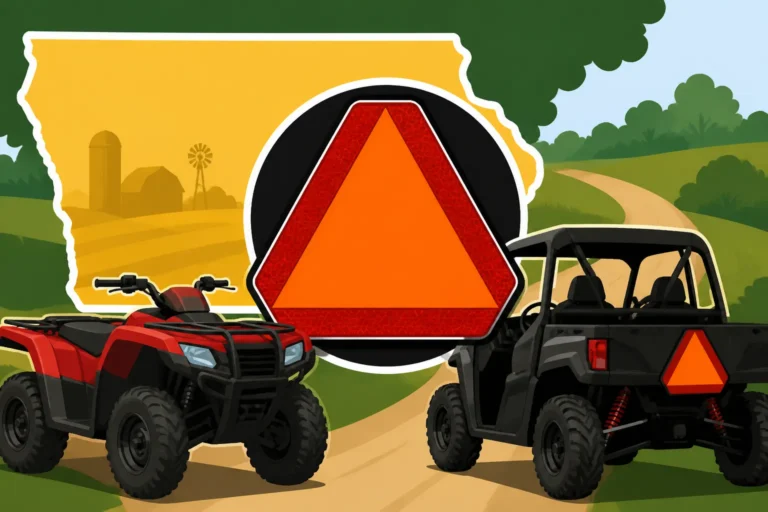
- Slow-Moving Vehicle (SMV) Triangle: This bright orange-red triangle must be displayed on the rear of your machine. It signifies to other drivers that your vehicle is traveling at 25 mph or less. Even though the ATV/UTV speed limit is 35 mph, the SMV triangle is still a required item. [Iowa's Slow-Moving Vehicle Triangle] is a universal symbol of caution on rural roads.
- Insurance: This is absolutely non-negotiable for public road use in Iowa. You must carry liability insurance with minimum coverage limits: twenty thousand dollars for one person injured, forty thousand dollars for two or more people injured, and fifteen thousand dollars for property damage. [Iowa ATV Insurance Requirement] is serious, and not having it can lead to significant fines. Always carry proof of insurance with you.
Table: Iowa Road Use Requirements at a Glance
| Feature/Requirement | Unpaved Secondary Roads | Paved Secondary Roads | Primary Highways & Interstates | City Streets |
|---|---|---|---|---|
| Registration & Decal | Required | Required | N/A (except for crossing) | Required (if authorized) |
| Operator Age | 18+ with valid driver's license | 18+ with valid driver's license | N/A (except for crossing) | 18+ with valid driver's license (if authorized) |
| Speed Limit | 35 mph max | 35 mph max (if authorized) | N/A (except for crossing) | 35 mph max (or lower posted city limit, if authorized) |
| County Authorization | Generally open (unless posted otherwise) | Explicit county ordinance required | N/A | Explicit city ordinance required |
| Headlights/Tail Lights | Required | Required | Required (for crossing) | Required (if authorized) |
| Horn | Required | Required | Required (for crossing) | Required (if authorized) |
| Rearview Mirror | Required | Required | Required (for crossing) | Required (if authorized) |
| SMV Triangle | Required | Required | Required (for crossing) | Required (if authorized) |
| Liability Insurance | Required (20/40/15 minimums) | Required (20/40/15 minimums) | Required (for crossing) | Required (20/40/15 minimums, if authorized) |
| "Most Direct Route" | Yes, when connecting to legal riding areas | Yes, when connecting to legal riding areas (if authorized) | Yes, for direct crossing at intersection | Yes, for direct access to legal riding areas (if authorized) |
Safety First When Mixing Surfaces
Beyond the legal requirements, there are practical safety considerations when transitioning between gravel and pavement. The handling characteristics of your ATV or UTV change dramatically on different surfaces.
- Traction: Gravel offers a certain amount of slip and slide that off-road tires are designed to handle. Pavement, especially wet pavement, offers far more grip, which can be unforgiving if you're not used to it. Aggressive knobby tires, perfect for mud and trails, can feel squirmy and less stable on asphalt, reducing your contact patch and increasing braking distances.
- Braking: Braking distances will be shorter on dry pavement than on loose gravel, but sudden, hard braking on pavement can still cause instability, especially with tires not optimized for road use. Always anticipate your stops and leave plenty of space.
- Traffic: Paved roads, even secondary ones, are likely to have faster-moving vehicle traffic. Always be aware of your surroundings, use your mirrors frequently, and make your intentions clear with hand signals if your machine lacks turn signals (which are not required in Iowa but can be a good upgrade from companies like SuperATV). The SMV triangle is vital for making you visible to approaching vehicles.
- Passenger Rules: If your machine is designed to carry a passenger, ensure they are seated properly and follow all safety guidelines. Remember, the 18+ driver's license rule still applies, and Iowa rules [Iowa Rules for a Passenger on a Road] are explicit.
When you see that gravel road turn to pavement, it’s not just a visual change; it’s a cue to shift your riding mindset. Slow down, scan for traffic, double-check your surroundings, and ensure you're compliant with all the necessary legal and safety requirements for that specific section of road. A little preparation and awareness go a long way in ensuring your Iowa ATV and UTV adventures remain fun and free of unexpected trouble.
Disclaimer
This article is for general informational purposes only and does not constitute professional advice. Laws, prices and regulations vary by location and change over time. Consult a qualified professional for guidance on your specific situation.