A Headlight Aimed for an Iowa Gravel Lane
There's a common misconception, a whisper that floats around coffee shops and farm fields, that taking your ATV or UTV out on an Iowa road is a quick ticket to trouble. It's true that simply hopping on and hitting the pavement can lead to a hefty fine, but the reality is more nuanced. Many riders feel frustrated by what seems like a patchwork of rules, but this guide will clear up the confusion, helping you understand precisely when and where your off-highway vehicle can legally share Iowa's public roads, and what you need to do to make it happen safely and legally.
Navigating Iowa's Complex Rules for ATVs and UTVs on Public Roads
Let's be honest: Iowa's rules for riding ATVs and UTVs on public roads can feel like navigating a corn maze blindfolded. You hear bits and pieces from friends, read a forum post here, a local ordinance there, and it all quickly becomes a jumble. The biggest frustration for many riders is the lack of a simple "yes" or "no" answer to the question, "Can I ride my ATV on the road?" The truth is, it's rarely that straightforward, but it's certainly not impossible.
The Core Challenge: Understanding What's Allowed and What's Not
The primary challenge isn't that Iowa doesn't allow ATVs and UTVs on any roads; it's that the allowance comes with significant conditions. Unlike your car or truck, which is designed and licensed for all public roads, your off-highway vehicle (OHV) is built for off-road use. This fundamental difference means that when it ventures onto public thoroughfares, it enters a different regulatory category.
Many riders just want to get from their farm to a hunting spot, or from their home to the nearest gravel pit without having to load up a trailer. This desire for practicality often clashes with the state's efforts to ensure safety for all road users. The rules are in place not to make your life harder, but to protect you and others, especially given the different characteristics of an OHV compared to a passenger vehicle. Understanding this underlying purpose can help make the rules feel less arbitrary and more like a necessary framework.
Dispelling Myths: What "Street Legal" Really Means in Iowa
You might hear someone talk about making their ATV "street legal." In Iowa, this term needs a lot of clarification. It doesn't mean you can register your ATV like a car and drive it on every paved road in the state, including major highways. Iowa does not title ATVs as street-legal vehicles in the same way it does automobiles. Instead, it permits their use on specific types of roads under specific conditions, provided the machine meets certain equipment standards and the operator meets certain qualifications.
For example, simply adding a turn signal kit from SuperATV might make your machine more equipped for road use, but it doesn't magically open up all roads to you. The concept of "street legal" in Iowa for ATVs and UTVs is more about compliance with conditional road use statutes rather than a full reclassification of the vehicle. It's about being legal for certain roads, not all roads. This distinction is crucial and can save you from a lot of heartache (and fines) if you misunderstand it. Think of it less as being "street legal" and more like "road-use compliant under specific circumstances."
Essential Requirements for Riding Your Machine on Iowa Roads
So, you've decided to venture onto an Iowa road with your ATV or UTV. What do you need to have in place before you even turn the key? The state has clear-cut requirements designed to bring your off-road machine closer to the safety standards expected on public roadways. Skipping any of these steps isn't just risky; it's a sure way to face penalties.
Driver Qualifications and Age Restrictions
Before your machine even moves an inch onto a public road, let's talk about who's behind the wheel. In Iowa, to operate an ATV or UTV on any public road, the driver must be at least 18 years old and possess a valid driver's license. This isn't just a suggestion; it's a hard and fast rule. [Iowa Minimum Age to Ride a Road] and [Iowa Driver's License Rules for ATVs] are clear on this.
This requirement often surprises younger riders or parents who are used to their teenagers riding off-road on private property. While a 16-year-old might be an experienced rider in the fields, the moment they hit a gravel road, the state sees them as an unlicensed driver operating a non-standard vehicle, which can lead to serious legal consequences. The rationale is that road riding requires a different level of judgment, awareness of traffic, and adherence to rules that are typically associated with licensed adult drivers. It's about ensuring all road users, including those in cars and trucks, can anticipate predictable behavior from every vehicle on the road.
Mandatory Machine Equipment: Lights, Horns, and Mirrors
Your ATV or UTV needs to be equipped to be visible and communicate with other traffic. This means outfitting your machine with specific safety equipment.
Here's a breakdown of the essentials:
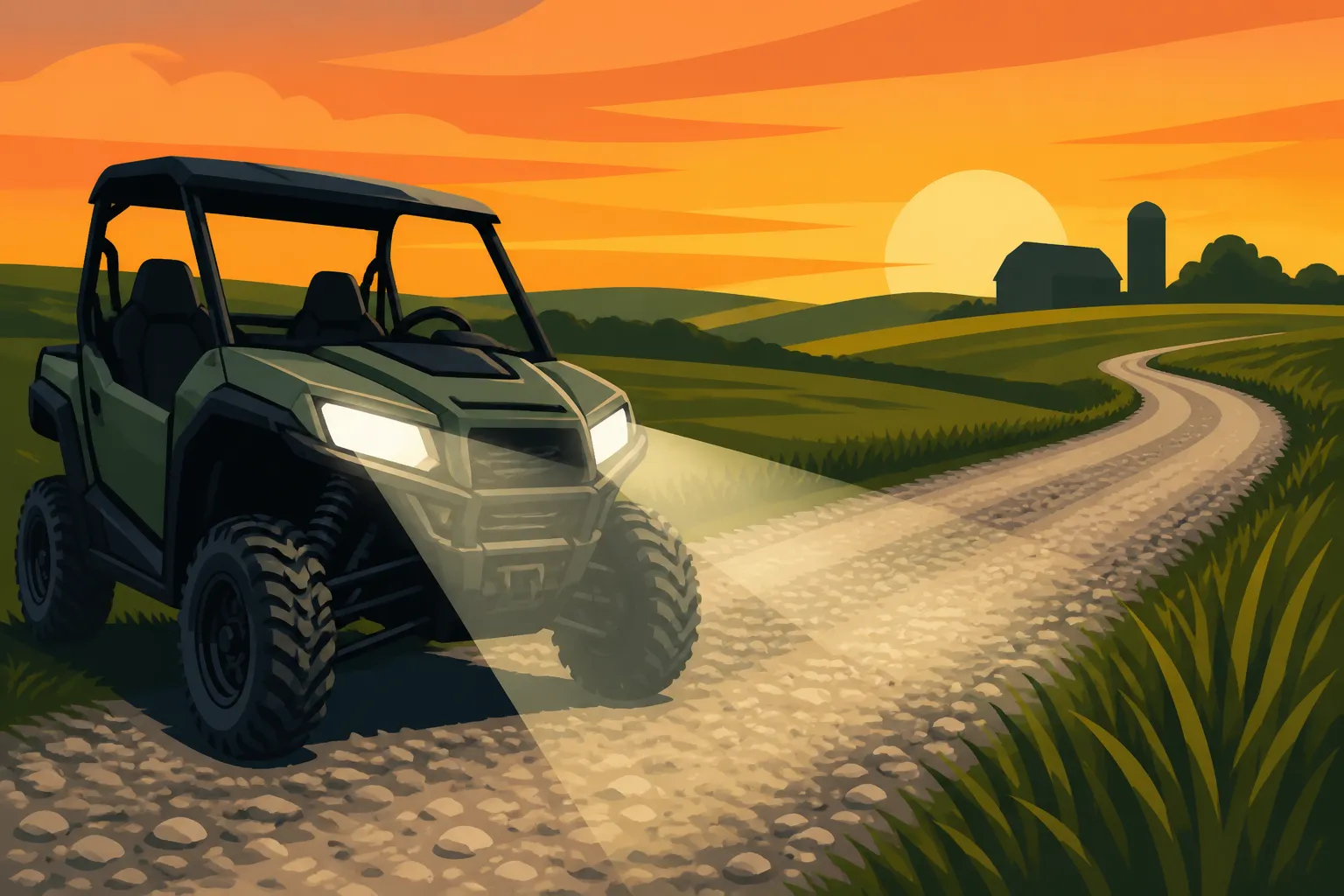
- Headlights and Taillights: You must have at least one headlight and one taillight, both fully operational. And here's the kicker: your headlight needs to be on at all times when operating on a public road, not just at dusk or night. This significantly increases your visibility to oncoming traffic. [Iowa Lighting Requirements for ATVs] details these regulations.
- Brakes: Your machine must have a functional braking system. This might seem obvious, but proper maintenance is key.
- Horn: A working horn is mandatory for signaling. Whether it's the small button on your handlebar or an aftermarket air horn, it needs to be audible. Many riders opt for aftermarket horns from companies like SuperATV to ensure they meet standards and can be heard over engine noise or by drivers in enclosed vehicles.
- Rearview Mirror: At least one rearview mirror is required. This allows you to monitor traffic approaching from behind. Again, if your machine didn't come with one suitable for road use, an aftermarket mirror is a simple addition. [Iowa Mirror Requirement for Road Use] covers this in more detail.
- Muffler and Spark Arrester: Your machine must have a muffler that keeps noise levels within legal limits and a U.S. Forest Service-approved spark arrester. This is more about environmental and noise control, but it's part of being road-compliant.
Ensuring your machine has all this equipment is paramount. Law enforcement will check for these items during a roadside stop. It's not enough to have them; they must be operational.
Insurance: Your Non-Negotiable Protection
This is perhaps one of the most critical requirements, and one that many riders overlook or underestimate. If you're going to ride your ATV or UTV on an Iowa public road, you must carry liability insurance. This isn't optional, and the penalties for not having it can be severe.
Iowa requires minimum liability coverage, typically in the amounts of 20/40/15:
- $20,000 for bodily injury or death of one person.
- $40,000 for bodily injury or death of two or more people.
- $15,000 for property damage in any one accident.
[Iowa ATV Insurance Requirement] further explains these minimums. Think of it this way: if you're involved in an accident with another vehicle on a public road, this insurance protects you from potentially ruinous financial responsibility for damages or injuries you cause. Without it, you're exposing yourself to incredible risk. Always carry proof of insurance with you when riding. Getting caught without it can result in significant fines, and potentially even impoundment of your machine.
The Slow-Moving Vehicle Triangle and Other Visibility Aids
Because ATVs and UTVs often operate at lower speeds than typical road traffic, they are classified as slow-moving vehicles when on public roads. This means you must display a slow-moving vehicle (SMV) triangle on the rear of your machine. This bright orange triangle with a red border is a universal symbol alerting other drivers that the vehicle ahead is traveling at 25 mph or less.
Mounting this triangle securely to the rear of your machine is non-negotiable for road use. It's a critical safety feature that gives approaching motorists ample warning to slow down and prepare to pass safely. [Iowa Slow-Moving Vehicle Sign Rules] outlines these requirements. Beyond the SMV triangle, consider other ways to enhance visibility, especially if you're riding a UTV. Reflective tape, bright clothing, and keeping your machine clean can all contribute to being seen, which is your best defense against accidents when sharing the road with faster traffic.
Where Can You Actually Ride Your ATV or UTV in Iowa?
Even with all the right equipment and driver qualifications, you can't just take your ATV or UTV anywhere on Iowa's public road system. Iowa's laws are very specific about which types of roads are permissible and under what conditions. This is where many riders get confused or caught off guard, assuming that if they're "street legal" (as defined loosely), all roads are open season. They are not.
Unpaved Secondary Roads: The Most Common Pathway
Generally speaking, unpaved county secondary roads are the most common and widely accepted routes for ATVs and UTVs in Iowa. These are your typical gravel roads, dirt roads, and unimproved county roads that connect farms, small communities, and rural areas. You don't usually need special county authorization to ride on these. [Iowa Rules for Riding a Gravel Road] details what's generally allowed here.
However, even on gravel, there are still rules:
- Speed Limit: You cannot exceed 35 mph on these roads. [Iowa's 35 mph Cap] is a strict limit, not a suggestion.
- Right-of-Way: You must obey all traffic laws, yield right-of-way, and treat intersections just as any other vehicle would.
- Daylight Hours (Generally): While your headlight must be on, some local ordinances might restrict night riding even on gravel. Always check local rules.
These unpaved roads represent the bulk of legal road access for OHVs in Iowa. They're often the most practical routes for riders who live in rural areas and need to connect properties or access trailheads.
Navigating Paved Secondary Roads and City Streets
This is where it gets tricky, and where a lot of local variation comes into play.
- Paved Secondary Roads: Unlike unpaved secondary roads, paved secondary roads (county highways) can only be opened to ATV and UTV traffic if the county Board of Supervisors explicitly passes an ordinance authorizing it. Just because it's a "county road" doesn't automatically mean it's open if it's paved. [Paved Secondary Roads and County Authorization] highlights this local decision-making process. If your county hasn't passed such an ordinance, riding on a paved secondary road is illegal.
- City Streets: Similarly, city streets are generally off-limits unless the specific city council has passed an ordinance opening its streets or certain designated routes to ATVs and UTVs. Small towns, particularly those near popular riding areas, are more likely to have such ordinances. For example, some towns might allow them on certain streets to access local businesses or trail systems, but restrict them from main thoroughfares. [City Streets and Iowa Council Authorization] explains this local control. You absolutely cannot assume a city's streets are open without verifying a specific ordinance.
This patchwork of local rules can be frustrating. What's legal in one county or town might be illegal just a few miles down the road. It means riders have a responsibility to know the specific regulations for the area they intend to ride in. A quick call to the county recorder's office or city clerk can save you a lot of trouble.
Direct Route Rules: Getting to Your Destination
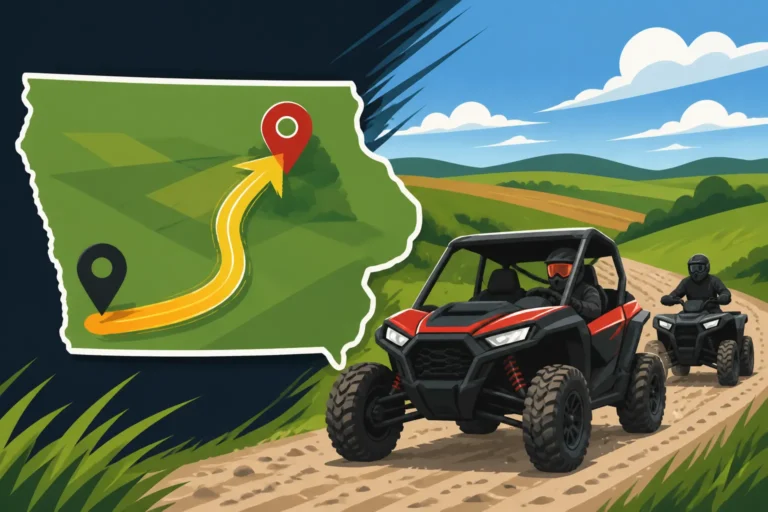
Even when riding on permissible roads, Iowa law often stipulates that your road use must be for the "most direct route" to a specific destination. This means you can't just joyride aimlessly on public roads, even gravel ones. The purpose of your road use must be to get from Point A to Point B, such as:
- To and from your home or property.
- To and from an [Iowa's Eight Designated OHV Parks] or other authorized riding area.
- To and from a place of business for supplies or services (e.g., fuel).
- To and from a hunting or fishing area.
[The Most Direct Route to an Iowa OHV Park] is a key concept here. You should be taking the most reasonable and shortest path. Deviating significantly from this direct route, especially for recreational cruising, can put you at risk of a citation, even if you're on an otherwise permissible road. The idea is to limit road exposure to essential travel, not to facilitate casual road riding.
Prohibited Roads: Where You Absolutely Cannot Go
Regardless of equipment, driver qualifications, or direct route rules, some roads are strictly off-limits for ATVs and UTVs in Iowa:
- Interstate Highways: No ATVs or UTVs are permitted on interstate highways at any time.
- Four-Lane Primary Highways: Generally, any divided four-lane primary highway (like U.S. 20, U.S. 30, Iowa 141, etc.) is prohibited. While you might be able to cross a multi-lane highway at an intersection, riding on it is forbidden. [Iowa Rules for Crossing a Four-Lane Road] addresses this distinction.
- Certain Primary Highways: Undivided two-lane primary highways are also generally prohibited, though there may be very specific, rare exceptions for agricultural purposes or crossing at intersections. It's best to assume these are off-limits for recreational use.
Trying to ride on these prohibited roads is extremely dangerous due to high traffic speeds and volumes, and it will almost certainly result in a citation. These are simply not suitable for the type of vehicle an ATV or UTV is.
| Road Type | General Legality in Iowa | Conditions/Notes |
|---|---|---|
| Unpaved Secondary Roads | Generally Allowed | Must be 18+ with valid DL, insured, equipped. Max 35 mph. Most direct route. |
| Paved Secondary Roads | Conditional | Requires specific County Board of Supervisors ordinance. Max 35 mph. |
| City Streets | Conditional | Requires specific City Council ordinance. Max 35 mph. |
| Interstate Highways | Prohibited | Absolutely no ATV/UTV use. |
| Four-Lane Primary Highways | Prohibited | Cannot ride on them; crossing at intersections may be permitted. |
| Two-Lane Primary Highways | Generally Prohibited | Rare agricultural exceptions; avoid for recreational use. |
Fines, Enforcement, and Staying Compliant
Understanding the rules is one thing, but understanding the consequences of not following them is just as important. Iowa law enforcement, including county sheriffs and DNR conservation officers, takes these regulations seriously. The goal isn't to ruin your day, but to ensure safety and compliance for everyone using public lands and roads.
Consequences of Non-Compliance
The penalties for illegal ATV or UTV road use can vary depending on the specific infraction, but they are generally structured to deter non-compliance. You're not just looking at a slap on the wrist.
Common fines and actions include:
- Operating without valid registration: Your machine needs to be properly registered with the Iowa DNR, even for off-road use. If it's on a public road, this will definitely be checked. [Iowa Fines for an Unregistered ATV] can be significant.
- Operating without required safety equipment: Missing a headlight, horn, mirror, or SMV triangle can lead to a fine.
- Operating without insurance: This is a serious offense. Fines are substantial, and your machine could be impounded. [Iowa Fines for No Proof of Insurance] outlines the severity.
- Operating by an underage or unlicensed driver: This can lead to charges for the driver and potentially for the owner of the machine.
- Operating on a prohibited road: Riding on interstates, four-lane highways, or unapproved paved county roads/city streets will almost certainly result in a citation. [Iowa Fines for Illegal ATV Road Use] covers these violations.
- Speeding: Exceeding the 35 mph limit is a traffic violation.
Beyond the financial penalties, repeated offenses or serious violations could impact your driver's license, even if you're on an ATV. It’s also worth considering that if you’re involved in an accident while non-compliant, your insurance might refuse to cover damages, leaving you personally liable for extensive costs.
What to Expect from a Roadside Stop
If you're pulled over while riding your ATV or UTV on a public road in Iowa, knowing what to expect can help make the experience smoother, even if you've made an error.
Law enforcement officers will typically check for:
- Driver's License and Age: They will ask for your valid driver's license to confirm you are 18 or older.
- Registration: They will verify that your ATV or UTV is properly registered with the Iowa DNR and has the current decal. [Registering an ATV in Iowa] is a critical first step for any machine.
- Proof of Insurance: You must be able to provide proof of current liability insurance.
- Equipment Check: The officer will likely do a quick check of your machine for operational headlights (on!), taillights, horn, rearview mirror, and the slow-moving vehicle triangle. They may even check for a spark arrester.
- Road Legality: They will also assess whether the specific road you are on is permissible for ATV/UTV use in that county or city, and if you appear to be taking the most direct route for a legitimate purpose.
Remember, always be courteous and cooperative with law enforcement. Answer their questions honestly and provide the requested documentation. If you've ensured your machine is properly equipped (perhaps with quality aftermarket parts from SuperATV) and you understand the local regulations, you'll be in a much better position. It's always best to err on the side of caution and ensure you're fully compliant before hitting any public road, even if it's just to run a quick errand. The peace of mind alone is worth the effort.
Disclaimer
This article is for general informational purposes only and does not constitute professional advice. Laws, prices and regulations vary by location and change over time. Consult a qualified professional for guidance on your specific situation.