Iowa Rules for a Passenger on a Road
It's a common scenario: you've just picked up a shiny new side-by-side or maybe a well-loved quad, and the open gravel roads of Iowa are calling. Naturally, you want to share that experience, perhaps take a family member or a friend along for the ride. But before you load up and head out, you're probably asking yourself, "Can I even have a passenger on my ATV or UTV when I'm riding on an Iowa road, and if so, what are the rules?" It's a completely valid question, because the regulations around passengers on off-highway vehicles (OHVs) can be surprisingly nuanced, and getting it wrong can lead to fines, safety risks, or worse. This guide will meticulously break down Iowa's rules, offering clarity on when and how you can legally and safely carry a passenger on your OHV on public roads.
Understanding Iowa's General Road Riding Rules for OHVs
Before we even dive into the specifics of passengers, it’s crucial to understand the foundational rules for operating an ATV or UTV on Iowa’s public roads in the first place. You can't just take your machine on any road you please, and certain conditions must be met by both the vehicle and the operator. Getting these basics right is your first step to a legal ride, with or without a passenger.
Which Roads Are Open to OHVs?
Iowa isn't like some states where OHVs are largely confined to designated trails or private land. Our state offers a bit more flexibility, particularly on our extensive network of gravel roads. The primary rule of thumb is that unpaved county secondary roads are generally open for OHV use. This covers a vast portion of rural Iowa, allowing farmers and recreational riders alike to traverse their local areas. These are the classic dirt and gravel paths you often see winding through cornfields and alongside pastures. [Unpaved County Secondary Roads in Iowa] are often the bread and butter for many riders.
However, things get a little more complex when it comes to paved roads. While unpaved roads are usually fair game by default, paved secondary roads can only be opened to OHV traffic if the individual county board of supervisors has specifically authorized it. [Paved Secondary Roads and County Authorization] is a local decision, not a blanket state rule. So, what might be legal in one county could be strictly prohibited in the next, even on a similar type of road. It’s absolutely vital to check with the specific county recorder’s office or the county’s official website for their ordinances before venturing onto any blacktop. The same goes for city streets: they are generally off-limits unless the city council has passed an ordinance specifically allowing OHV use within its corporate limits. [City Streets and Iowa Council Authorization] for OHVs are typically reserved for smaller towns looking to boost tourism or provide access for residents. You won't find major interstates or four-lane primary highways open to OHV traffic under any circumstances – those are strictly for conventional vehicles.
The Driver's Basic Requirements for Road Use
Even if you're on a road where OHVs are permitted, the operator still has to meet several key requirements. This isn't just about legality; it's about safety, especially when you're considering bringing a passenger along. First and foremost, to operate an ATV or UTV on any public road in Iowa, the driver must be at least 18 years old. [Iowa Minimum Age to Ride a Road] This isn't a suggestion; it's a hard and fast rule. A 16-year-old with a driver's license can operate a car on the road, but they cannot legally operate an ATV or UTV on that same road.
Secondly, the driver must possess a valid driver's license. [Iowa Driver's License Rules for ATVs] You can't just hop on if you're 18 but don't have a license. This ensures a baseline level of driving competency and understanding of traffic laws. Beyond that, your machine needs to be properly registered and titled with the county recorder, and you must have liability insurance that meets Iowa’s minimum coverage requirements. [Iowa ATV Insurance Requirement] This insurance is critical not only for protecting you and your machine but also for covering any potential damages or injuries involving a passenger if an accident were to occur. Finally, remember that even on open roads, you're generally limited to a maximum speed of 35 mph. These rules are in place to integrate OHVs safely (as much as possible) into the existing road infrastructure and traffic patterns.
Iowa's Specific Rules for Carrying Passengers on OHVs on Public Roads
Now for the main event: can you actually bring someone along for the ride? This is where the type of machine you own and how it's designed plays an absolutely critical role. Iowa law is quite specific about where passengers can be, and it boils down to the manufacturer's intent.
Designated Seating and Machine Design
The core principle in Iowa for carrying a passenger on an ATV or UTV on public roads is that the machine must be designed by the manufacturer to carry more than one person. This might seem straightforward, but it has significant implications, particularly for traditional ATVs. Most standard ATVs are designed and manufactured for a single operator. They have one seat, one set of handlebars, and are balanced for one rider. Trying to squeeze a second person onto an ATV not designed for it is not only incredibly dangerous but also illegal on Iowa's public roads.
Think about the engineering: a single-rider ATV has its weight distribution, suspension, and steering calibrated for one person. Adding a passenger, especially an adult, dramatically alters the center of gravity, making it much more prone to tipping, difficult to steer, and harder to stop. This is why you'll often see "Operator Only" stickers on these machines. Even if you manage to strap on a makeshift second seat or a large cargo box that someone could sit on, it doesn't change the machine's original design intent. In the eyes of Iowa law, if the manufacturer didn't build it for two, you can't have two on a public road. While aftermarket companies like SuperATV offer fantastic upgrades for comfort, protection, and cargo, adding a bench seat to a single-rider ATV doesn't magically make it street legal for two passengers in Iowa. Those kinds of modifications are generally for off-road use only, where private land rules might apply.
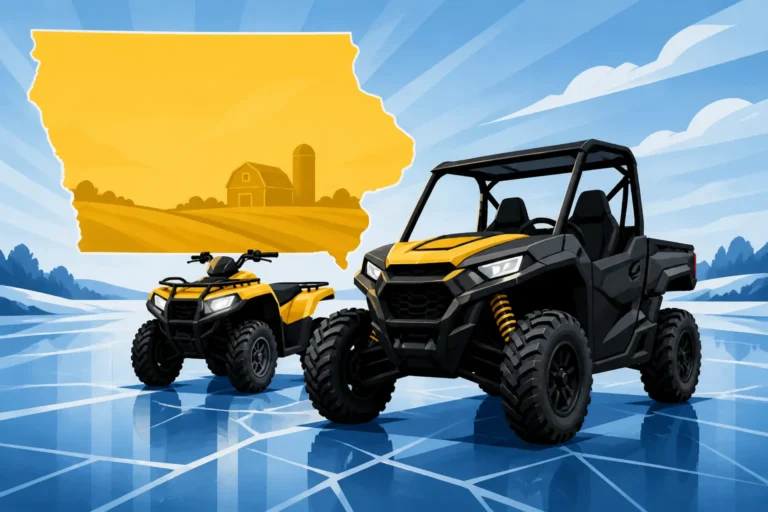
This is where UTVs, or side-by-sides, generally have a significant advantage. Most UTVs are explicitly designed by the manufacturer with multiple seats, often side-by-side (hence the name!) or even with a second row. These machines have seat belts, roll cages, and suspension systems built to accommodate the weight and dynamics of multiple occupants. If your UTV has two, three, or even four factory-installed seats, then you can legally carry that number of passengers on Iowa's permissible roads, provided each passenger is using an available, designated seating position.
Passenger Age and Requirements
Interestingly, Iowa law doesn't typically specify a minimum age for a passenger on an ATV or UTV when operating on public roads, unlike the strict 18-year-old requirement for the driver. The primary focus is on the machine's design for carrying passengers and the driver's qualifications. However, this doesn't mean common sense or safety should go out the window.
Even though there isn't a specific age floor for passengers, it’s imperative that any passenger can safely and securely occupy their designated seating position. For children, this means they must be tall enough to have their feet firmly planted on the floorboards or footrests, capable of holding on to grab handles, and mature enough to follow instructions and not interfere with the driver's operation. If a child is too small to safely sit in a UTV seat, even with a seatbelt, they shouldn't be riding. Their weight and movement can still impact the vehicle's stability, and in an emergency, they need to be able to brace themselves.
While Iowa doesn't mandate helmets for adults riding ATVs/UTVs on public roads, it's always a highly recommended safety measure, especially for passengers and particularly for younger ones. Helmets, eye protection, sturdy footwear, and long clothing are all smart choices that can minimize injury in the event of an unforeseen incident. For UTVs already designed for multiple occupants, exploring accessories from brands like SuperATV, such as upgraded harnesses or full doors, can certainly enhance the passenger experience and overall safety, even if they aren't strictly required by law for road use.
Practical Considerations and Safety Beyond the Letter of the Law
Just because something might be technically legal doesn't always mean it's the safest or smartest choice. When you add a passenger to your OHV, especially on public roads, you introduce a whole new layer of responsibility and risk. It's important to think beyond the printed law and consider the real-world implications.
The Risks of Carrying Undesignated Passengers
The biggest risk, as touched upon, is the fundamental alteration of your machine's dynamics. An ATV designed for one rider becomes unstable and unpredictable with a second person aboard. This dramatically increases the risk of rollovers, especially when turning, climbing, or descending slopes (even slight road inclines), or hitting unexpected bumps. A small change in the passenger's weight shift can throw the machine off balance.
Beyond the physical risks, there are significant legal liabilities. If you are involved in an accident while carrying an illegal passenger on a public road, your insurance company might deny coverage. This could leave you personally responsible for medical bills, property damage, and potentially extensive legal fees. A citation from an Iowa law enforcement officer for carrying an unauthorized passenger could also come with substantial fines. Imagine a deputy on a county road noticing a second person on your single-rider ATV; they're not just going to give you a friendly wave.
Consider a hypothetical scenario: You're riding down a gravel road with your spouse on the back of your single-seater ATV. You hit an unexpected patch of loose gravel, the ATV veers, and you both go down. Even if no other vehicle is involved, the fact that your machine was not designed for two occupants on a public road could mean your liability insurance is void, leaving you financially exposed to your spouse's medical bills and your own. It's a risk not worth taking.
Equip Your Machine for Safety
For machines that are designed for multiple passengers (primarily UTVs), ensuring they are properly equipped is paramount. While Iowa law sets minimum requirements, you can always go above and beyond. Start with the basics: ensure all factory-installed seat belts are functional and used by every occupant. Check the condition of your tires, brakes, and lights – all crucial for road safety.
Many UTV owners choose to enhance their machines with aftermarket safety features. For example, upgrading to a full set of four or five-point harnesses from the factory lap belts can provide significantly more secure passenger restraint in case of an impact or rollover. Adding stronger doors or even full enclosures can offer better protection from debris and elements. Additional grab handles for passengers, especially those in the back seats, can also be a valuable addition for comfort and stability on rougher terrain or bumpy roads. Brands like SuperATV offer a wide array of such accessories, from heavy-duty roll cages to impact-resistant windshields, which can greatly improve the safety profile of your passenger-ready UTV for both on-road and off-road adventures.
Always Confirm Local Ordinances
As we discussed earlier, while Iowa state law lays out the general framework, individual counties and cities have the power to enact their own ordinances regarding OHV use on paved secondary roads and city streets. This includes any specific rules they might have about passengers, although generally, they defer to the state's "manufacturer-designed seating" rule.
The crucial takeaway here is that you cannot assume. Just because you rode with a passenger on a city street in Waukon, for example, doesn't mean you can do the same in Des Moines County or another municipality. Before you venture onto any paved county road or city street with a passenger, take a few minutes to confirm the local rules. A quick call to the county recorder's office, the city clerk's office, or even checking the county's or city's official website can save you a lot of headache. [Calling a City Clerk About ATVs] about their ordinances is a smart move. Without confirmation, you're rolling the dice on whether you're complying with local mandates, which can often be stricter than state law.
| Feature / Scenario | Single-Rider ATV on Road | Multi-Passenger UTV on Road |
|---|---|---|
| Manufacturer Design | Designed for one operator only. | Designed with multiple designated seating positions. |
| Legality with Passenger | Illegal on public roads in Iowa to carry a passenger. | Legal to carry passengers up to the number of designated seats. |
| Driver Age | Must be 18+ and licensed. | Must be 18+ and licensed. |
| Passenger Age/Requirements | Not applicable (cannot carry). | No specific minimum age, but must safely occupy seat and use restraints. |
| Insurance Impact | High risk of voided coverage if an accident occurs with a passenger. | Coverage generally applies if passenger is legal and properly seated. |
| Safety Concerns | Severe stability issues, high rollover risk, difficult control. | Designed for passenger stability, but safe driving practices are key. |
| Aftermarket Seating | Does not make it legal to carry a passenger on public roads. | Can enhance comfort/safety, but actual passenger count limited by design. |
| Local Ordinances | Always check, but generally prohibits passengers regardless. | Always check, may add specific conditions for paved roads/streets. |
Disclaimer
This article is for general informational purposes only and does not constitute professional advice. Laws, prices and regulations vary by location and change over time. Consult a qualified professional for guidance on your specific situation.