Iowa’s $250 Fine for Riding Without Insurance
Picture this: you're enjoying a beautiful Iowa afternoon, cruising your ATV or UTV down a scenic gravel road, feeling the breeze, and just soaking it all in. Then, a sheriff's deputy pulls up behind you. Your heart sinks. You know your registration is current, and your machine is in good working order. But then the deputy asks for proof of insurance, and suddenly, that carefree feeling vanishes. Many riders don't realize that using their off-highway vehicle (OHV) on public roads in Iowa comes with the same insurance requirements as any other motor vehicle. Failing to meet these requirements can lead to a hefty financial penalty, starting with Iowa's $250 fine for riding without insurance, not to mention the much larger financial risks if you're involved in an accident. This comprehensive guide is here to walk you through exactly what Iowa expects from you when it comes to ATV and UTV insurance on its roads, helping you understand the rules, the risks, and how to stay protected.
The Unseen Danger: Why Iowa Demands ATV Insurance on Roads
It might seem unfair that your recreational machine, which you primarily use for tearing up trails or helping around the farm, suddenly needs car-like insurance just to cross a paved road or ride a short stretch of gravel. But the reality is that once your ATV or UTV leaves private land and enters the public road system, it becomes part of the traffic flow, and with that comes a significant increase in potential risk. Iowa lawmakers, recognizing the inherent dangers and the potential for serious accidents involving OHVs on public thoroughfares, enacted laws to ensure financial protection for everyone involved in such incidents. It's not just about covering your own machine; it's about protecting other drivers, pedestrians, and public property from damage that could stem from an unforeseen event.
Understanding the Legal Mandate
Iowa's legal framework is clear: if you intend to operate your ATV or UTV on any public road where it is legally permitted to do so, you must carry adequate liability insurance. This isn't a suggestion; it's a non-negotiable requirement. The state doesn't differentiate between your primary vehicle and your off-road machine when it comes to financial responsibility on public ways. It's the same principle as needing insurance for your car or truck; if it's on the road, it needs to be covered.
Many riders, especially those new to the hobby or those who have only ever ridden on private property, are caught off guard by this rule. They might have a valid registration decal mounted on their machine, but a quick conversation with a deputy will reveal that registration is only one piece of the puzzle. The financial protection offered by insurance is critical for mitigating the fallout of an accident, which, let's be honest, can happen to anyone, no matter how skilled or careful a rider you are.
The Real Risks of Uninsured Riding
Imagine a scenario: you're on a permitted [Iowa Rules for Riding a Gravel Road] with your UTV, perhaps heading to a nearby trailhead. Suddenly, a deer darts out, and you swerve, losing control and crashing into a fence belonging to a farmer, or worse, colliding with another vehicle. If you don't have insurance, every single expense from that incident falls squarely on your shoulders. This isn't just about the damage to your own machine, which could be substantial, especially if you've invested in quality aftermarket parts from a company like SuperATV. It's about the fence, the other vehicle, and any potential medical bills for injuries sustained by yourself or others.
Without insurance, you are personally liable for these costs. A simple fender bender on a gravel road could quickly turn into tens of thousands of dollars in damages and medical bills. The initial excitement of saving a few bucks by skipping insurance quickly fades when faced with the harsh reality of accident costs. This financial burden can be crippling, leading to judgments against you, wage garnishments, or even the loss of assets you've worked hard to acquire.
Beyond the Fine: Personal Liability
The $250 fine for riding without insurance is just the tip of the iceberg. While it's a penalty that stings, the true financial devastation can come from personal liability in an accident. If you're deemed at fault for an accident and lack insurance, you're not just looking at a fine; you're looking at potentially catastrophic legal claims. Property damage claims, medical bills for injured parties, lost wages, pain and suffering – these can quickly escalate into figures that dwarf the cost of any insurance policy.
This is where the true value of insurance becomes clear. It acts as a financial shield, protecting your personal assets from claims arising from an accident. Without it, your home, savings, and future earnings could be on the line. Even if you're the most cautious rider out there, accidents are, by their very nature, unpredictable. Riding without insurance is essentially gambling with your entire financial future, a bet that Iowa law—and common sense—strongly advises against.
Decoding Iowa's Mandatory Minimums: What Your Policy Needs to Cover
Understanding that you need insurance is one thing; knowing exactly what kind of coverage and how much of it Iowa mandates is another entirely. The state has specific minimums that must be met to ensure that anyone operating an OHV on public roads has at least a basic level of financial responsibility. These minimums are often referred to by a series of numbers, which, at first glance, might seem like a secret code. But once you break them down, they are quite straightforward and represent crucial layers of protection.
The "20/40/15" Rule Explained
When talking about auto insurance, or in this case, OHV insurance for road use, Iowa typically refers to the "20/40/15" rule. This is the minimum amount of liability coverage you must carry. Let's break down what each number means:
- $20,000 for bodily injury liability per person: This is the maximum amount your insurance company will pay for medical expenses, lost wages, and pain and suffering for one person injured in an accident where you are at fault. So, if you hit someone and they incur $30,000 in medical bills, your insurance would pay $20,000, and you would be personally responsible for the remaining $10,000.
- $40,000 for bodily injury liability per accident: This is the total maximum amount your insurance company will pay for all bodily injuries in a single accident, regardless of how many people are injured. If two people are injured and their combined medical bills total $50,000, your insurance would cover $40,000, leaving you to pay the additional $10,000 out of pocket.
- $15,000 for property damage liability per accident: This covers damage you cause to someone else's property in an accident. This could be another vehicle, a fence, a mailbox, or any other physical property. If you crash your [Iowa Registration for a Side-by-Side] into someone's parked car and cause $20,000 worth of damage, your policy would cover $15,000, and you would be on the hook for the remaining $5,000.
These numbers represent the bare minimum. While meeting these is legally compliant, many riders find peace of mind and greater protection by opting for higher coverage limits. The cost difference between minimum coverage and slightly higher limits is often quite small compared to the potential out-of-pocket expenses if an accident exceeds those minimums.
Property Damage: Protecting What's Not Yours
The "15" in the 20/40/15 rule specifically addresses property damage. This coverage is absolutely vital because, let's face it, ATVs and UTVs can cause significant damage. Hitting another vehicle, even a minor scrape, can result in thousands of dollars in repairs. If you accidentally drive into a ditch and damage a farmer's crop field or a public utility box, the costs can skyrocket.
Imagine you're riding a dirt bike on an approved [Iowa Trails for a Wide Machine] and somehow veer onto someone's lawn, taking out a sprinkler system and some landscaping. Without property damage coverage, you'd be looking at paying for all those repairs yourself. This component of your liability insurance ensures that when you cause damage to property belonging to someone else, your insurer steps in to cover the costs up to your policy limit, protecting your personal finances from expensive repair or replacement bills.
Uninsured/Underinsured Motorist Coverage: An Important Consideration
While Iowa mandates your liability coverage, it's also smart to consider adding uninsured/underinsured motorist (UM/UIM) coverage to your policy. This isn't usually required for your ATV/UTV road use, but it's a powerful layer of protection for you. What happens if you're involved in an accident with another driver, and they are at fault, but they either have no insurance or not enough insurance to cover your damages and medical bills?
This is where UM/UIM coverage steps in. It pays for your medical expenses and property damage if the at-fault driver is uninsured, or if their insurance isn't enough to cover everything. In a world where not everyone follows the rules, having this additional safety net can save you from a huge financial headache after an accident that wasn't even your fault. It's a testament to planning for every eventuality, even when you're following all the rules.
The Roadside Check: Proving You're Insured in Iowa
Knowing the rules and having the right insurance is great, but it's equally important to be able to prove it when an officer asks. Just like with a car, carrying proof of insurance is a fundamental part of legal operation on Iowa's public roads. The moment a deputy or state patrol officer pulls you over, whether for a routine check or after an incident, one of their first requests will likely be for your driver's license, registration, and proof of insurance. Being prepared for this moment can save you a lot of hassle and potential fines.
What a Deputy Looks For
When an officer asks for proof of insurance, they are looking for specific information that confirms your coverage. This usually includes:
- Your name (or the policyholder's name, if you're a listed driver).
- The insurance company's name.
- The policy number.
- The effective dates of the policy (showing that the coverage is current and hasn't expired).
- A description of the insured vehicle, or at least confirmation that your ATV/UTV is covered under the policy.
The goal is to quickly verify that you have an active policy that meets Iowa's minimum liability requirements. They're not looking for your entire policy document; a standard insurance card or digital equivalent usually provides all the necessary details. It's wise to ensure your card is clearly legible and up-to-date, reflecting your current machine if you've recently upgraded or changed vehicles.
Digital vs. Physical Proof
In today's digital age, many states, including Iowa, have embraced technology to make proof of insurance more convenient. This means that in addition to a traditional paper insurance card, you can often present proof of insurance on your smartphone or another electronic device. This can be a huge convenience, as most of us have our phones with us at all times, making it less likely to accidentally leave a physical card at home.
However, a word of caution: while digital proof is acceptable, make sure your device is charged and readily accessible. If your phone dies, or if you're in an area with no signal and can't pull up the information, you could still face issues. Some riders choose to carry both a physical card and have a digital copy for redundancy. Think about how many times you’ve had a dead zone, like in some parts of Appanoose County when you're riding near Rathbun. Having a physical card tucked into your wallet or a waterproof compartment on your [Iowa Registration for a Quad] can be a real lifesaver in those situations.
Consequences Beyond the Initial Fine
Failing to produce proof of insurance at a roadside stop immediately puts you in a difficult spot. The immediate consequence, as we've highlighted, is [Iowa's $250 Fine for Riding Without Insurance]. However, depending on the circumstances, there could be additional repercussions. In some cases, an officer might impound your vehicle, especially if there are other violations or safety concerns, or if they suspect you've been intentionally riding uninsured for an extended period. This adds towing and storage fees to your growing list of expenses.
Furthermore, getting cited for riding without insurance can impact your driving record and potentially lead to higher insurance premiums down the line, even if you eventually get covered. Insurers see this as a higher risk behavior, and they'll adjust your rates accordingly. It's a cascade of consequences that starts with one simple oversight: not having valid proof of insurance readily available. It’s far better to be prepared than to deal with the headache and financial strain of a roadside stop that escalates.
Navigating the Penalties: Iowa's $250 Fine and Beyond
The shock of being pulled over can be intense, but the reality of the penalties for riding without insurance can hit even harder. Iowa doesn't take the absence of liability insurance lightly, especially when it comes to vehicles operating on public roads. The initial fine is significant, but it's important to understand that this sum often represents only the beginning of potential financial and legal troubles. The consequences can snowball, turning a single oversight into a long-term burden.
The Immediate Financial Hit
The most immediate and obvious penalty for operating an ATV or UTV on an Iowa public road without the required liability insurance is a $250 fine. This isn't a minor parking ticket; it's a substantial sum that can easily drain your weekend riding budget or eat into other household expenses. For many, $250 is a significant chunk of change, and it's money that could have been far better spent on machine maintenance, fuel for more rides, or even upgrading parts from a reputable supplier like SuperATV.
This fine is typically issued on the spot and requires prompt payment. Ignoring it will only lead to further penalties, including additional court fees, potential late charges, and even suspension of your driving privileges. It’s a clear message from the state that they are serious about ensuring financial responsibility on their roads, and the financial bite is designed to deter riders from taking the risk of going uninsured.
Compounding Problems: Repeat Offenses and Accidents
While a single $250 fine is bad enough, the situation can quickly worsen if you're a repeat offender or, even more severely, if you're involved in an accident while uninsured. Repeat offenses for riding without insurance will often result in escalating fines, potentially stricter legal action, and a much higher likelihood of your machine being impounded. The courts and law enforcement have little patience for individuals who continually flout the law, especially when it concerns public safety and financial responsibility.
Now, imagine the worst-case scenario: you're riding uninsured and cause an accident. The $250 fine suddenly seems trivial. You're now personally responsible for all damages, medical bills, and potential legal fees, which could easily run into the tens or hundreds of thousands of dollars. A simple mishap could lead to wage garnishments, liens on your property, or even bankruptcy. This is precisely why [Iowa ATV Insurance Minimum Coverage] is so important; it's a safeguard against these potentially life-altering financial repercussions.
The Lasting Impact on Your Driving Record
Beyond the immediate financial penalties, a citation for riding without insurance can have a long-lasting impact on your driving record. This isn't just about your ability to drive your car; it can affect your overall driving history, which in turn influences future insurance rates. Insurers categorize individuals cited for uninsured operation as high-risk, meaning you'll likely face significantly higher premiums when you do seek coverage for any vehicle, including your ATV or UTV. This increased cost can linger for several years, making the initial decision to forgo insurance a much more expensive one in the long run.
In some cases, especially with repeat offenses, your driver's license could even be suspended. This means you wouldn't be able to legally operate any motor vehicle on public roads, completely disrupting your daily life and making simple tasks like commuting to work or running errands incredibly difficult. The ramifications of riding uninsured extend far beyond a quick fine; they can affect your mobility, your finances, and your reputation as a responsible vehicle operator for years to come.
Getting Covered: Finding the Right ATV/UTV Insurance in Iowa
The good news is that securing the right insurance for your ATV or UTV in Iowa doesn't have to be a complicated or overly expensive process. Many reputable insurance providers offer policies specifically tailored for off-highway vehicles, ensuring you meet Iowa's legal requirements without breaking the bank. The key is to approach the process with a clear understanding of your needs and to compare your options diligently.
Comparing Providers and Policies
When you're ready to get insured, start by contacting several different insurance providers. Don't just go with the first quote you receive. Major national insurers often offer ATV/UTV policies, but you might also find specialized carriers who focus specifically on recreational vehicles. Each company will have slightly different rates, policy structures, and available discounts.
When comparing policies, look beyond just the price. Pay close attention to:
- Coverage Limits: Ensure they meet Iowa's 20/40/15 minimums for bodily injury and property damage, and consider if you want higher limits for greater protection.
- Additional Coverage Options: Does the policy offer comprehensive or collision coverage for your machine? What about [Uninsured/Underinsured Motorist Coverage: An Important Consideration]? These can protect your own investment and well-being.
- Deductibles: This is the amount you pay out of pocket before your insurance kicks in. A higher deductible usually means a lower premium, but ensure it's an amount you're comfortable paying in the event of a claim.
- Discounts: Ask about potential discounts, such as multi-policy discounts (if you bundle your ATV insurance with your car or home insurance), safety course completion discounts, or even discounts for having certain safety features on your machine.
- Customer Service and Claims Process: Look for companies with a reputation for excellent customer service and a smooth claims process. You don't want to be left in the lurch if you need to file a claim after an incident.
Factors Affecting Your Premium
Several factors will influence the cost of your [Iowa ATV Insurance Cost per Year]. Understanding these can help you manage your premium and potentially find ways to save money:
- Type of Machine: Generally, more powerful, expensive, or newer ATVs and UTVs will have higher premiums than older, less powerful models. If you’ve added significant modifications, like a specialized lift kit or heavy-duty suspension from SuperATV, ensure your insurer is aware, as this can affect both your premium and the coverage for those specific parts.
- Your Riding History: A clean driving record with no accidents or violations will typically result in lower premiums. Conversely, a history of claims or citations will likely lead to higher rates.
- Your Location: Insurance rates can vary by geographic location, influenced by factors like local accident rates and theft statistics.
- Coverage Limits and Deductibles: As mentioned, higher coverage limits and lower deductibles will increase your premium.
- Age and Experience: Younger, less experienced riders may face higher premiums due to perceived higher risk.
- Storage: How and where you store your machine (e.g., in a locked garage versus uncovered outdoors) can sometimes influence rates.
Being honest and thorough when providing information to your insurance agent will ensure you get an accurate quote and appropriate coverage.
Specific Considerations for Iowa Riders
For those riding in Iowa, there are a few specific nuances to keep in mind. First, always confirm that your policy explicitly covers your ATV or UTV for road use. Some basic off-road policies might only cover you on private property or designated trails and not on public roads. You might need a specific endorsement or a separate policy to ensure you're compliant with [Iowa ATV Insurance Requirements].
Also, consider what other types of riding you do. If you frequent off-road parks like Gypsum City or Bluff Creek, ensure your policy also provides adequate coverage for those activities. Some policies might exclude certain high-risk activities or types of terrain, so always read the fine print. Ultimately, the goal is to find a policy that not only meets Iowa's legal minimums for road use but also provides comprehensive protection for all your riding adventures, giving you true peace of mind whenever you hit the dirt or the gravel.
Beyond Insurance: Other Legal Requirements for ATV/UTV Road Use in Iowa
While insurance is a critical component of legal ATV and UTV road use in Iowa, it's far from the only requirement. Operating these machines on public roads involves a suite of other rules and regulations designed to ensure the safety of the rider and everyone else on the road. Ignoring these can lead to fines, citations, and even more severe legal consequences, regardless of whether you have insurance. It's essential to understand the full picture of what Iowa expects from you when your OHV leaves the trail or private property.
Age and Licensing: Who Can Ride Where
One of the most common misconceptions about ATV and UTV use on public roads is who is legally allowed to operate them. Iowa has specific rules regarding age and licensing that must be followed. Generally, to operate an ATV or UTV on a public road in Iowa, the operator must be at least 18 years old and possess a valid driver's license. This means that even if you're a skilled young rider, you typically cannot ride your ATV on public roads until you meet these age and licensing criteria.
This rule is a stark contrast to some off-road scenarios where younger riders with proper supervision and [Iowa ATV Safety Certificate Requirements] might be allowed. For example, a 16-year-old with a safety certificate might ride trails, but they cannot legally operate that same machine on a county gravel road. The state wants experienced, licensed drivers behind the wheel or handlebars when sharing roads with other traffic. Ignoring [Iowa Minimum Age to Ride a Road] or [Iowa Driver's License Rules for ATVs] can result in citations, fines, and even vehicle impoundment.
Machine Requirements: Lights, Mirrors, and More
Just like cars, ATVs and UTVs need to meet certain equipment standards to be considered roadworthy in Iowa. Your trail-ready machine might be fantastic in the mud, but it needs specific modifications to be street legal. These requirements are primarily focused on visibility and the ability to safely interact with other road users. Common requirements include:
- Headlights and Taillights: Must be on and fully functional, even during daylight hours on public roads. Many riders opt for brighter LED upgrades, often available from aftermarket specialists like SuperATV, to enhance visibility.
- Brake Lights: Essential for signaling your stops to traffic behind you.
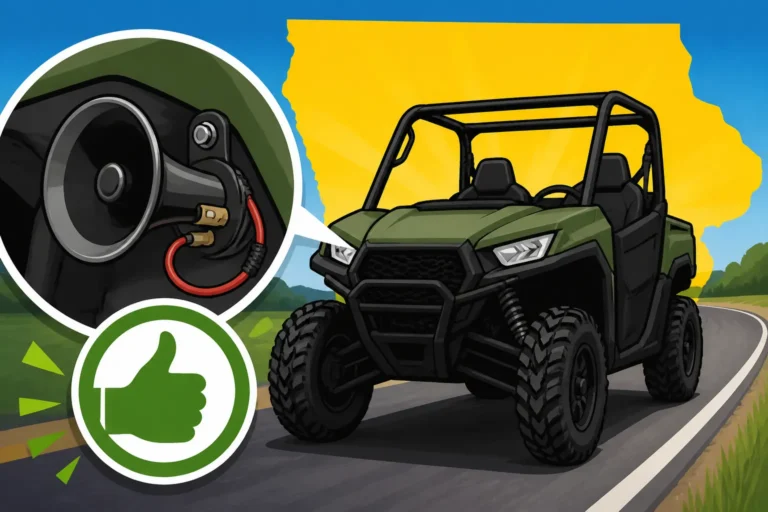
- Horn: A working horn is necessary to alert others to your presence.
- Mirrors: At least one rearview mirror, typically mounted on the left side, is required to allow you to see traffic approaching from behind.
- Slow-Moving Vehicle (SMV) Triangle: If your ATV/UTV is incapable of maintaining the normal speed of traffic (which is often the case for ATVs on roads), you'll need an SMV emblem mounted on the rear.
- Muffler and Spark Arrester: All machines must have a working muffler and a U.S. Forest Service-approved spark arrester to control noise and prevent wildfires.
It's critical to ensure your machine is properly equipped before venturing onto public roads. A quick glance from a deputy can spot missing or non-functional equipment, leading to a stop and potential citation for failing to meet [Iowa Lighting Requirements for ATVs] or [Iowa Mirror Requirement for Road Use].
Understanding Local Ordinances
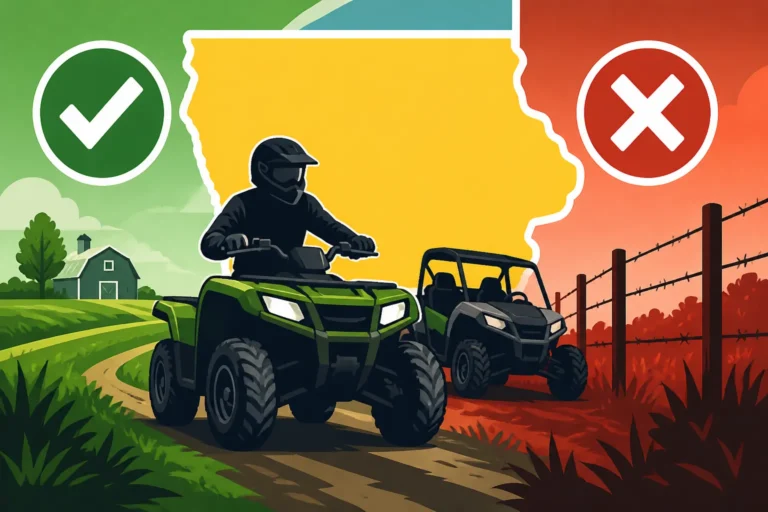
Even if you meet all statewide insurance, age, licensing, and equipment requirements, you still need to be aware of local ordinances. Iowa's laws permit counties and cities to pass their own ordinances regarding ATV and UTV use on their roads. This means that while [Are ATVs Street Legal in Iowa?] might be answered with a "yes" for certain types of roads statewide (like most unpaved county secondary roads), individual counties or cities can impose further restrictions or open up paved roads.
For example, a county might allow OHVs on all unpaved secondary roads but prohibit them on all paved county roads unless specifically authorized. Cities, even small ones, can decide whether to open their streets and alleys to ATVs and UTVs, and often come with specific time restrictions or designated routes. Before riding in any new area, it's always prudent to check with the local county sheriff's office or city clerk's office for their specific rules. Getting caught riding where it's not permitted, even if you're fully insured and legal otherwise, can still result in a citation for illegal operation. This patchwork of rules means always doing your homework before you ride.
Disclaimer
This article is for general informational purposes only and does not constitute professional advice. Laws, prices and regulations vary by location and change over time. Consult a qualified professional for guidance on your specific situation.