Iowa’s Farm License Exemption
Trying to navigate the maze of Iowa's ATV and UTV laws can feel like wrangling a runaway tractor, especially when you're a farmer just trying to get your work done. The lines between what's allowed and what's strictly forbidden on public roads often seem blurry, leaving many agricultural operators scratching their heads and worrying about fines. This comprehensive guide is here to untangle the complexities of Iowa's farm license exemption, giving you a clear roadmap for legally using your off-highway vehicles for vital farm duties on public roads.
Understanding the Foundation of Iowa's Road Rules for OHVs
Before we dive into the specifics of the farm exemption, it's crucial to understand the baseline rules for operating ATVs and UTVs on Iowa's public roads. Most of the time, these machines are simply not designed or intended for highway speeds or the cut-and-thrust of regular traffic. This fundamental principle forms the backdrop against which all exemptions are viewed.
The General Prohibition: Why OHVs Aren't "Street Legal" by Default
It's a common misconception that if a vehicle has wheels and an engine, it should be able to go anywhere. However, ATVs and UTVs are primarily designed for off-road terrain – rugged trails, open fields, and challenging landscapes. Their suspension, steering, braking systems, and even their tires are optimized for traction and maneuverability in these environments, not for the pavement. Trying to use them like a car on a busy street can be incredibly dangerous, not just for the operator but for other motorists too. They lack the full suite of safety features found in traditional on-road vehicles, like crumple zones, airbags, or even simple turn signals on many older models. This inherent design difference is why Iowa, like many states, generally prohibits them from public roads unless very specific conditions are met.
Imagine trying to drive a golf cart down a busy state highway; it's simply not built for it, and it puts everyone at risk. The same logic applies to your quad or side-by-side. The state's primary concern is public safety, and the regulations reflect this. This can be incredibly frustrating for farmers who simply want to cross a road to get to the next field, or drive a short distance to check on livestock without having to load their machine onto a trailer every single time. It feels like an unnecessary hurdle when the machine is a tool, not a toy, in these situations.
Specific Roads Where Riding is Generally Allowed (with caveats)
Despite the general prohibition, Iowa law does make provisions for OHV use on certain types of public roads, even outside of specific exemptions. The most well-known allowance is for unpaved county secondary roads. You'll often hear about riders being allowed on these gravel and dirt roads, but it's never a free-for-all. There are always conditions attached, such as sticking to the "most direct route" between a point of origin and an off-highway riding area or private land. This means you can't just joyride down every gravel road you see; there has to be a legitimate purpose for your travel.
Beyond gravel, some cities and counties have taken action to open specific paved roads or streets to OHVs through local ordinances. These are rare and highly localized, requiring explicit approval from the city council or county board of supervisors. You can't assume that just because one town has opened its streets, the next town over has done the same. [Iowa Rules for Riding a Gravel Road] details these distinctions further, highlighting the patchwork nature of permissible riding areas. Understanding these general allowances is key, as the farm exemption often works within or alongside these existing frameworks, but with its own set of rules tailored specifically for agricultural operations.
The Core of the Exemption: What "Farm License Exemption" Actually Means
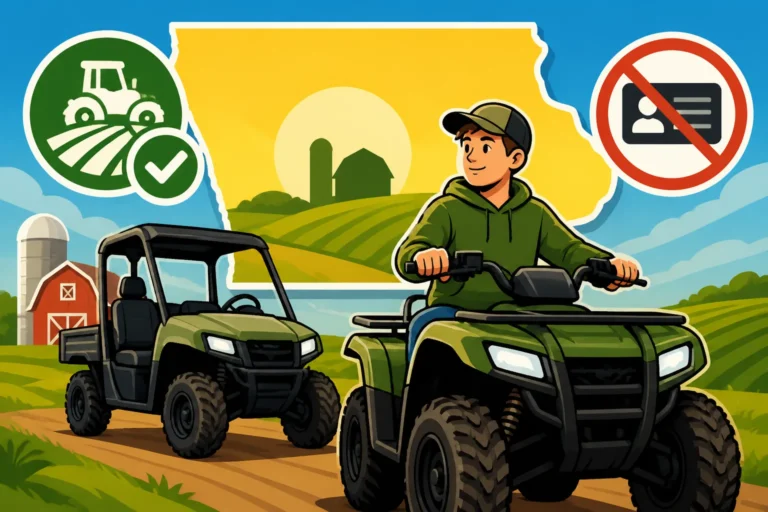
The "farm license exemption" isn't a blanket pass to drive your ATV or UTV anywhere, anytime. Instead, it's a specific legal allowance designed to facilitate legitimate agricultural operations, recognizing that these machines are often indispensable tools for farmers. It's built on the premise that when an OHV is used as an integral part of farming, it should be treated differently from a recreational vehicle.
Defining "Agricultural Purposes" and "Implement of Husbandry"
At the heart of Iowa's farm exemption lies the concept of "agricultural purposes" and the classification of the vehicle as an "implement of husbandry." What exactly does this mean? "Agricultural purposes" generally refers to activities directly related to the production of crops, livestock, poultry, or dairy products. This goes beyond simply tilling a field or harvesting; it can include tasks like hauling feed to animals in a distant pasture, checking fence lines across property boundaries, transporting small tools for field repairs, or even moving irrigation equipment short distances. The key is that the activity must be directly supportive of a farming operation. It's not about driving to the local hardware store to pick up bolts for your home project, even if you are a farmer.
An "implement of husbandry" is a legal term describing a vehicle or piece of equipment designed primarily for agricultural purposes. While a tractor is the quintessential example, an ATV or UTV can certainly fit this definition when equipped and used specifically for farm work. For instance, a UTV outfitted with a spray rig, a feed box, or a small trailer for hauling produce or tools clearly falls under this umbrella. [The Implement of Husbandry Exemption in Iowa] explores this concept in greater detail. The intent behind the use of the machine, and its configuration, are paramount in determining if it truly qualifies. Without this direct link to agricultural production, the exemption simply doesn't apply.
Who Qualifies: Farmers, Ranchers, and Their Employees
This exemption is not for everyone. It is specifically carved out for individuals actively engaged in agriculture. This primarily means bona fide farmers, ranchers, and their direct employees who are operating the ATV or UTV as part of their job. If you own a small plot of land and occasionally use your quad to clear brush, you likely wouldn't qualify under this exemption because your primary purpose isn't large-scale agricultural production. The spirit of the law is to assist those whose livelihood depends on farming.
Consider a multi-generational farm where various family members and hired hands operate different pieces of machinery. As long as they are performing tasks directly related to the farm's operations—whether it's checking cattle, delivering supplies to a remote field, or moving small equipment—they would typically fall under this exemption. It's about the function being performed, by whom, and for what purpose. It's critical that the operator understands these boundaries. Using a farm-registered UTV for a weekend trail ride with friends, even if you're a farmer, would immediately invalidate the exemption for that particular instance. Contrast this with [Riding Iowa Private Land Without Registering], which discusses how the rules change when you're entirely off public thoroughfares. The exemption is a privilege tied directly to the agricultural nature of the work, not just the owner's profession.
Specific Conditions for Utilizing the Farm Exemption on Public Roads
Even when you're a farmer using your OHV for legitimate agricultural purposes, the exemption doesn't grant carte blanche on public roads. Iowa law imposes very specific conditions that must be met to legally operate under this provision. These conditions are designed to balance the needs of farmers with the safety of the general public. Ignoring these rules, even with good intentions, can lead to serious legal consequences.
The "Two Miles From the Farm" Rule
One of the most critical and often misunderstood aspects of Iowa's farm license exemption is the "two miles from the farm" rule. This provision allows an ATV or UTV used as an implement of husbandry to be operated on public roads within a two-mile radius of the farm or farm operation. This distance isn't arbitrary; it's designed to accommodate common agricultural needs like moving between adjacent parcels of land, accessing a distant gate, or bringing equipment to a nearby shared facility, all without the cumbersome process of loading onto a trailer for very short distances. It acknowledges that farm properties aren't always contiguous and that operations often span across public rights-of-way.
However, this two-mile limit is strict and must be interpreted carefully. It's measured from the boundary of your primary farm operation. You can't use it as a justification to drive into town for supplies, even if the store is just 1.5 miles away, unless those supplies are directly for the farm work you are currently performing with that machine on the road. The purpose of the trip must remain agricultural. For example, driving your UTV to a neighboring field to spread fertilizer is perfectly acceptable within this rule, assuming it's within two miles. But using the same UTV to go pick up your mail at the end of the gravel road, even if it’s less than two miles, would likely fall outside the spirit of the exemption because the mail-retrieval isn't an "agricultural purpose." This rule is explicitly detailed in [2 Miles From the Farm in Iowa], emphasizing its importance.
Sunrise to Sunset Operation
Another key restriction for the farm license exemption is the timing of operation: ATVs and UTVs used as implements of husbandry are generally permitted on public roads only from "sunrise to sunset." This limitation is primarily a safety measure. Off-highway vehicles often have lower-mounted headlights that can be less effective than a car's, and their overall profile might be less visible to other drivers, especially in low-light conditions. Operating during daylight hours significantly reduces the risk of accidents by maximizing visibility for both the OHV operator and other road users.
Being caught operating your farm machine on a public road outside of these daylight hours, even if performing legitimate farm work, could lead to a citation. While some farm equipment is equipped with extensive lighting for night work in fields, simply having those lights doesn't automatically negate the sunrise-to-sunset rule for road travel under this specific exemption. It's a hard limit. Farmers often face long hours, especially during planting and harvest seasons, and it can be tempting to extend a trip to the nearest field slightly past dusk. However, the law is clear, and adherence is critical to avoiding fines and ensuring safety.
Specific Equipment Requirements for Farm Use on Roads
Even though a farm machine might be exempt from some licensing requirements, it is by no means exempt from basic safety equipment when traveling on public roads. To ensure visibility and prevent accidents, any ATV or UTV operating under the farm exemption must be equipped with essential lighting and marking. This includes a properly functioning headlight, taillight, and, most importantly, a slow-moving vehicle (SMV) triangle prominently displayed on the rear of the machine. The SMV triangle is a universally recognized symbol indicating that the vehicle ahead will be traveling at speeds significantly slower than typical road traffic, giving other drivers ample warning to slow down and pass safely.
These requirements are not optional; they are fundamental to road safety. While your machine might be a workhorse, it still needs to signal its presence clearly to others. Many farmers choose to upgrade their machines with additional lighting or reflective materials to enhance visibility, especially if they frequently use public roads, even for short distances. Companies like SuperATV offer a range of aftermarket lighting solutions, mirrors, and turn signal kits that, while not always legally required under the exemption, can significantly improve safety and peace of mind when crossing or briefly traveling on paved or gravel roads. [Iowa's Slow-Moving Vehicle Triangle] explains the specifics of this vital safety device. Equipping your machine appropriately isn't just about avoiding a ticket; it's about protecting yourself and others on the road.
Limitations and Misconceptions of the Farm Exemption
While the farm license exemption provides crucial flexibility for agricultural operations, it's vital to understand its strict boundaries. Misinterpreting or overextending the exemption can lead to fines, legal issues, and even insurance complications. This isn't a loophole for general road use; it's a narrowly defined provision.
When the Exemption DOESN'T Apply: Recreational Use, Extended Travel
The biggest pitfall for many is assuming the farm exemption somehow permits broader use than it actually does. Let's be unequivocally clear: this exemption is solely for genuine agricultural purposes. It does not magically transform your ATV or UTV into a street-legal vehicle for personal or recreational use. If you're heading to a friend's house, driving to the local gas station to fill up for a recreational ride, or even using your farm UTV to go hunting, you are no longer operating under the protection of the farm exemption. The purpose of the trip dictates whether the exemption applies. The moment your objective shifts from a direct farm-related task to anything leisure-oriented or personal, you forfeit the benefits of the exemption.
This distinction can be tricky in practice. Imagine you've finished checking fences in a remote pasture and you decide to take a scenic route home, or you stop at a convenience store along the way for a snack. In these scenarios, even if you were performing farm work moments before, the purpose of that specific segment of travel has changed. [What Changes the Moment You Cross Onto Public Ground] illustrates this critical shift in legal status. The exemption is about the work being done, not simply who owns the machine or what their profession is. Any use outside of direct agricultural labor on the designated roads will subject you to the full force of Iowa's off-highway vehicle laws, including potential penalties for unregistered or illegal road use.
The Importance of Registration and Titling (Even for Farm Machines)
Here's another crucial point of confusion: the "farm license exemption" does not automatically exempt your ATV or UTV from registration and titling requirements in Iowa. The exemption pertains specifically to the licensing of the operator and certain equipment requirements when used as an implement of husbandry under strict conditions. However, the machine itself may still need to be registered with the county recorder, especially if it will be used on public land for any reason, or if it doesn't always fall under the implement of husbandry definition. For instance, if you occasionally take your UTV to one of Iowa's designated OHV parks for recreation, it absolutely needs to be registered.
Furthermore, all ATVs and UTVs purchased or transferred in Iowa generally require a title, regardless of their intended use. This is primarily for ownership tracking and preventing theft. When you sell the machine, you'll need a clear title. Therefore, while you might not need a specific "farm license" for your machine when operating under the exemption, you still must navigate the standard administrative requirements for ATV and UTV ownership. Many farmers mistakenly believe that because they only use their machine for farm work, it's completely outside the purview of the DNR and county recorder. This is not always the case, and understanding when your machine needs to be officially documented is key. You can learn more about general registration processes in [Registering an ATV in Iowa].
Insurance Requirements and Liability
Perhaps one of the most overlooked, yet critical, aspects of operating any vehicle on public roads – even under an exemption – is insurance. Iowa law mandates minimum liability insurance coverage for all motor vehicles operating on public roads. While the farm exemption might address certain licensing and equipment rules, it does not waive the requirement for insurance. If you are operating your ATV or UTV on a public road, even for a short distance under the farm exemption, you are legally required to carry proof of financial responsibility.
Without adequate insurance, you are personally liable for any damages or injuries you cause in an accident. Imagine a scenario where your farm UTV, while crossing a paved county road to reach another field, collides with a passenger car. The damages could be extensive, and without insurance, your farm's assets could be at risk. The minimum coverage in Iowa is typically 20/40/15 (which translates to $20,000 for bodily injury per person, $40,000 for bodily injury per accident, and $15,000 for property damage). It is paramount to check with your insurance provider to ensure your existing farm liability policy, or a separate ATV/UTV policy, adequately covers road use, even under this specific exemption. Neglecting this crucial step can lead to devastating financial consequences. [Iowa ATV Insurance Requirement] provides further details on what you need to know.
Navigating Practical Scenarios and Roadside Interactions
Understanding the letter of the law is one thing, but knowing how to apply it in real-world situations, especially during a roadside stop, is another. Farmers need to be prepared to articulate why they are legally operating their ATV or UTV on a public road under the farm exemption.
Proving Your Agricultural Purpose During a Stop
Let's face it, getting pulled over by law enforcement can be nerve-wracking, especially when you're simply trying to get work done. If you're operating your ATV or UTV on a public road under the farm license exemption and you're stopped by a deputy or a conservation officer, they will likely want to verify your purpose. The key here is clear communication and demonstrating your machine's role in an active farming operation. While there isn't a specific "farm exemption card" to carry, you should be ready to explain the nature of your farm work and why your current travel on the road is directly related to it.
For instance, if you're moving your UTV from one pasture to another, and you have livestock feed or fencing tools in the bed, you can clearly point to these as evidence of your agricultural purpose. If you're carrying a small sprayer, or your machine is visibly equipped for field work (e.g., specific tires, attachments), this can also help your case. It's always a good idea to carry your driver's license (if you have one, even though it's not strictly required for the exemption itself, it helps establish identity), and potentially some form of farm identification or business card if available. Remaining calm, respectful, and clearly articulating your farm duties and adherence to the two-mile and sunrise-to-sunset rules will go a long way in ensuring a smooth interaction.
Potential Penalties for Misusing the Exemption
Misusing the farm exemption, whether intentionally or unknowingly, can lead to a range of penalties. If you're caught operating your ATV or UTV on a public road for recreational purposes, outside the two-mile radius, or after dark, you could face citations for illegal road use of an off-highway vehicle. These fines can be substantial. Beyond that, if your machine is found to be unregistered when it should be, or if you lack the required insurance, those are additional infractions with their own penalties. [Iowa Fines for an Unregistered ATV] will give you a sobering look at the financial consequences.
In some cases, severe or repeated violations could even lead to your machine being impounded, causing significant disruption to your farm work and adding storage fees to your list of expenses. Law enforcement officers are trained to identify legitimate farm use versus recreational use, and simply stating you're "a farmer" isn't enough if your actions clearly contradict the exemption's intent. The best way to avoid these penalties is to strictly adhere to the conditions of the exemption and, when in doubt about a particular use, err on the side of caution or seek clarification from local authorities.
Comparing Exemption to Standard Road Use Rules
To truly grasp the unique nature of the farm license exemption, it's helpful to see how it differs from the general rules for operating ATVs and UTVs on public roads (where allowed). This comparison highlights why the exemption is so valuable for farmers, yet also how constrained it is.
| Feature | Farm License Exemption (Implement of Husbandry) | Standard OHV Road Use (where allowed by county/city) |
|---|---|---|
| Purpose | Exclusively for direct agricultural purposes. | Recreational, transportation to OHV parks, etc. (purpose varies by local ordinance). |
| Operator Age | No specific age license required for farm work (adult supervision for minors). | Generally 18 years old with a valid driver's license for public roads. |
| Speed Limit | Generally considered a "slow-moving vehicle"; implied safe operating speed. | Usually capped at [Iowa's 35 mph Cap]. |
| Distance Limit | Within 2 miles of the farm operation. | No specific distance limit, but usually restricted to "most direct route." |
| Time of Day | Sunrise to Sunset only. | Generally permitted anytime lights are required (with proper equipment). |
| Required Equipment | Headlight, taillight, Slow-Moving Vehicle (SMV) triangle. | Headlight, taillight, horn, mirror, SMV triangle (if speed under 35 mph), insurance. |
| Registration/Title | Title usually required; registration depends on other uses (e.g., OHV park). | Both title and current registration decal are mandatory. |
| Driver's License | Not required for the exemption itself, but good practice for ID. | Required (18+ with valid driver's license). |
This table clearly shows that the farm exemption is tailored for a very specific type of use and offers certain flexibilities (like operator age/license) that aren't available for general recreational road use. However, it also imposes its own strict limits on distance and time. It's not a free pass, but rather a targeted legal framework for agricultural producers.
Best Practices for Iowa Farmers Using OHVs on Roads
For Iowa farmers, understanding the legal framework is just the first step. Implementing best practices ensures not only compliance with the law but also the safety and longevity of their valuable equipment and, most importantly, themselves and others on the road.
Equipping Your Machine for Road Safety
Even with the specific allowances of the farm exemption, safety on public roads should always be paramount. While the law mandates a headlight, taillight, and SMV triangle, taking additional steps to enhance your machine's visibility and roadworthiness is always a smart move. Consider adding brighter LED lights, especially if your stock lighting is dim, to ensure you're seen by oncoming and trailing traffic. Reflective tape placed strategically on the sides of your machine can also dramatically increase visibility, particularly in transitional lighting conditions like dawn or dusk, even if you are operating within the sunrise-to-sunset window.
Many farmers also find it beneficial to add a rearview mirror, or even a set of mirrors. While not always strictly mandated for the farm exemption, a mirror can provide crucial awareness of traffic behind you, allowing you to react safely to other vehicles. Brands like SuperATV offer a variety of robust mirrors, windshields, and other accessories designed for UTVs and ATVs that can greatly improve road safety and driver comfort. Installing a horn, even a simple one, can also be a vital safety feature for alerting others. Remember, the goal is to make your relatively small and slow-moving vehicle as conspicuous as possible to prevent accidents.
Educating Yourself and Your Employees
The complexities of Iowa's OHV laws, especially concerning road use and exemptions, mean that ongoing education is crucial. As a farm owner or operator, it's not enough for just you to understand the rules; every employee who might operate an ATV or UTV for farm purposes on public roads needs to be fully aware of the limitations and requirements. This includes the two-mile rule, the sunrise-to-sunset restriction, and the mandatory safety equipment. A brief annual review of these rules can prevent costly mistakes and ensure everyone is on the same page.
Laws can also change, albeit slowly, so staying informed through agricultural associations, county recorder offices, or the Iowa DNR is a good practice. It's helpful to have a printed summary of the farm exemption rules readily accessible on the farm, perhaps posted in a common area or carried in the glove box of each machine. This proactive approach not only fosters a culture of safety but also demonstrates due diligence if an incident were ever to occur. Investing a little time in education can save a lot of headaches, fines, and potential accidents down the road. You can find general information on farm-related road use in [Iowa Rules for Agricultural Road Use].
When in Doubt, Consult Local Authorities or Legal Counsel
Iowa's laws can sometimes have nuances that are difficult to interpret for every unique farm situation. If you have a specific, complex scenario that isn't clearly covered by the general rules of the farm exemption, it's always best to seek expert advice. This might mean contacting your local county recorder's office, which is often the first point of contact for ATV and UTV registration questions, or reaching out to the Iowa Department of Natural Resources (DNR) Off-Highway Vehicle program coordinator. These are the governmental bodies responsible for administering and enforcing these regulations.
For particularly ambiguous or high-stakes situations, consulting with an attorney specializing in agricultural law or transportation law in Iowa can provide invaluable clarity and protection. They can offer tailored advice based on the specifics of your operation and ensure you're fully compliant. Remember, this guide, like any informational resource, provides general information. It's not a substitute for professional legal advice or direct clarification from the authorities responsible for enforcing the laws. Taking the extra step to get official guidance can save you from potential legal issues and financial penalties, giving you peace of mind as you manage your farm.
Disclaimer
This article is for general informational purposes only and does not constitute professional advice. Laws, prices and regulations vary by location and change over time. Consult a qualified professional for guidance on your specific situation.