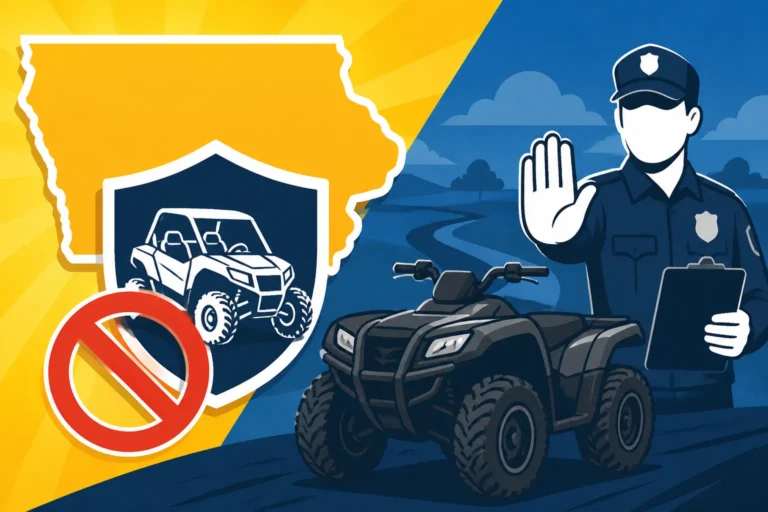
Why Iowa Requires a Driver 18 or Older
It can be incredibly frustrating for younger off-highway vehicle (OHV) enthusiasts in Iowa, especially those who feel competent and responsible, to learn that the state imposes a strict age limit of 18 years old for operating an ATV or UTV on public roads. This isn't just a casual guideline; it's a firmly established legal boundary designed with specific safety and liability concerns in mind. This guide will meticulously break down the rationale behind Iowa's 18+ age requirement for road use, explore what constitutes a "public road," detail the other essential responsibilities that come with legal road operation, and touch on limited exceptions, helping you understand the full scope of the law.
The Core of Iowa's Age Restriction for Road Use
Iowa's approach to OHV road use is largely centered on public safety and the unique risks associated with these machines on roadways shared with traditional vehicles. The 18-year-old minimum age isn't arbitrary; it reflects a legislative decision to align OHV road operation with other adult driving privileges, recognizing the complexities and responsibilities involved. It’s a measure that often sparks debate among riders, particularly those with capable teenagers who actively use their machines on private property, but the state's stance remains clear: public roads are different.
Understanding Iowa Code: Establishing the Age Limit
At its heart, Iowa law, specifically within its off-highway vehicle statutes, defines who is legally permitted to operate an ATV or UTV on public roads. These rules are distinct from those governing private land or designated off-road parks. While a 12-year-old, for instance, might be able to operate an ATV on private property with proper supervision and a safety certificate, the moment that machine touches a public road or even crosses a road, the 18+ rule comes into play. This distinction is crucial and often misunderstood. The legal framework treats OHVs on public roads more like motor vehicles, requiring a level of maturity, judgment, and licensing typically associated with adult drivers. This means that even if a younger rider has years of experience on trails, that experience doesn't translate to road legality until they meet the age threshold.
Prioritizing Safety on Public Thoroughfares
The primary driver behind the 18-year-old age requirement is public safety. Operating an ATV or UTV on a public road presents a very different set of challenges compared to off-road riding. Roads involve interacting with other traffic—cars, trucks, and even farm equipment—at varying speeds and with different right-of-way rules. OHVs, by their design, often have a higher center of gravity, different braking characteristics, and can be less visible to other drivers than a typical car. Legislators recognize that younger drivers, regardless of their off-road skill, may lack the nuanced judgment, risk perception, and experience in complex traffic situations that come with age. The law aims to mitigate potential accidents and reduce the severity of injuries by ensuring that only adult drivers, who are also required to hold a valid driver's license for other vehicles, operate these machines in a public road environment. This is why [Iowa Minimum Age to Ride a Road] is so specific.
What "Public Road" Truly Means in Iowa for OHVs
Understanding Iowa's public road classifications is paramount for any ATV or UTV owner, especially when considering the 18+ age restriction. The state doesn't treat all roads equally when it comes to OHV access, and what might seem like a simple gravel lane can have complex legal implications. It’s not just about what has asphalt; it’s about jurisdiction and designation.
Differentiating Between Gravel and Paved Secondary Roads
Iowa's secondary road system, often maintained by counties, is where you'll find the most common opportunities for OHV road use. Generally, unpaved secondary roads, those gravel or dirt paths crisscrossing the countryside, are typically open to OHVs for riders 18 and older, provided the county has not enacted specific restrictions. These are the roads where many farmers use their machines for transport between fields, or where recreational riders might access trails. However, once you transition to a paved secondary road, the rules change significantly. Paved secondary roads are only open to OHVs if the county Board of Supervisors has passed a specific ordinance authorizing such use. Without that explicit authorization, even a seemingly quiet paved county road is off-limits. This distinction can be confusing for riders who see little difference between a well-maintained gravel road and a less-trafficked paved one, but the legal framework makes a clear separation. Understanding [Iowa Rules for Riding a Gravel Road] is essential here.
Navigating Primary Highways and City Streets
Moving up the hierarchy, primary highways (state and federal routes) are almost universally off-limits for OHVs, with very few exceptions. These are high-speed, high-traffic corridors where the risks associated with slower, less visible OHVs are deemed too great. The only common exception for primary highways is crossing them at an intersection, which must be done as directly and safely as possible, following all traffic laws. You can’t ride down them, only across them. This also applies to multi-lane highways; [Crossing a Multi-Lane Highway at an Intersection] is usually permitted, but not sustained travel.
City streets introduce another layer of complexity. Just like paved secondary roads, city streets are generally closed to OHVs unless the local city council has passed an ordinance specifically allowing their use. Some Iowa towns, often smaller communities, have opted to open certain streets or alleys to OHVs, usually with specific hours, speed limits, and other restrictions. This patchwork of local ordinances means what’s legal in one town might be strictly prohibited in the next. Always check with the local municipality's clerk or sheriff's department before attempting to ride an OHV on city streets. The 18+ age rule applies uniformly to any of these legally accessible public roads.
The Responsibilities That Come With Road Privilege
Once a rider turns 18 and potentially gains the legal right to operate an ATV or UTV on authorized Iowa roads, the journey doesn't end there. Road privilege comes with a significant set of responsibilities, mirroring those of traditional motor vehicles, to ensure safety for everyone on the road. Simply being 18 isn't enough; you must also meet specific requirements for licensing, registration, insurance, and vehicle equipment.
Licensing, Registration, and Insurance Mandates
First and foremost, any person operating an ATV or UTV on an authorized public road in Iowa, being 18 years or older, must possess a valid driver's license. This isn't an optional extra; it's a fundamental requirement, just as if you were driving a car or truck. The state expects that if you're navigating public thoroughfares, you have demonstrated a basic understanding of traffic laws and safe driving practices. This means if your driver's license is suspended or revoked, you cannot legally operate an OHV on the road.
Beyond individual licensing, the machine itself must be properly registered with the state of Iowa. This involves obtaining a registration decal from your county recorder's office and ensuring it is renewed annually. This registration helps fund OHV programs and trails across the state. Furthermore, a critical component of road legality is insurance. Iowa mandates specific minimum liability insurance coverage for any ATV or UTV operated on public roads. This means you need proof of insurance that meets the state's minimums, typically referred to as 20/40/15 coverage (meaning $20,000 for bodily injury to one person, $40,000 for bodily injury to two or more people, and $15,000 for property damage). Without this, you're not just risking a citation; you're exposing yourself to immense financial liability in the event of an accident. Always make sure you understand [Iowa Driver's License Rules for ATVs] and [Iowa ATV Insurance Requirement].
Equipment Requirements for Road-Legal Machines
Operating an OHV on public roads also means your machine must be equipped with certain features to ensure visibility and safety for yourself and others. This isn't about customizing for style; it's about meeting legal minimums. Iowa law stipulates that your ATV or UTV must have:
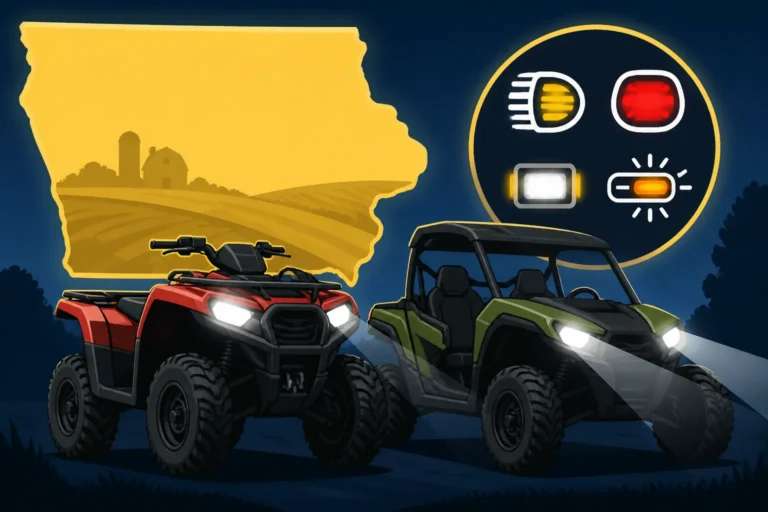
- Headlights and Taillights: These must be on at all times, even during daylight hours. This greatly enhances your visibility to oncoming traffic.
- Brakes: Functional brakes are, of course, a given, ensuring you can stop safely.
- Muffler/Exhaust System: Your machine must have a functional muffler to reduce noise emissions.
- Rearview Mirror: At least one rearview mirror is required to allow the operator to see traffic approaching from behind.
- Horn: A working horn is necessary for signaling other drivers or pedestrians.
- Slow-Moving Vehicle (SMV) Triangle: For any machine traveling at 25 mph or less (and OHVs on roads are typically capped at [Iowa's 35 mph Cap]), a reflective orange SMV triangle must be prominently displayed on the rear. This alerts faster-moving vehicles to exercise caution.
- Tires: Your tires must be in good condition, without excessive wear, and suited for road use (though specific "DOT approved" ATV tires are not always explicitly mandated, they are certainly a good idea for safety and handling).
Many of these items can be added as aftermarket parts. Companies like SuperATV offer a wide range of accessories, from mirrors and horns to full turn signal kits, that can help bring an off-road-focused machine into compliance with Iowa's road-legal equipment standards. It’s worth noting that while some of these modifications might seem minor, they are critical to meeting the [What Iowa Requires of an ATV on a Public Road] standards and ensuring your safety and legality.
Here's a quick summary of key road requirements for 18+ riders:
| Requirement | Description | Legal Provision / Rationale |
|---|---|---|
| Age | Minimum 18 years old to operate on public roads. | Iowa Code, Public Safety |
| Driver's License | Valid state-issued driver's license required. | Proof of driving competency and knowledge of traffic laws |
| Registration | Current Iowa OHV registration decal displayed. | Funding for OHV programs, machine identification |
| Insurance | Minimum liability coverage (20/40/15). | Financial protection for accidents and liability |
| Headlights | On at all times (day and night). | Enhanced visibility to other vehicles |
| Taillights | On at all times (day and night). | Rear visibility, especially for following traffic |
| Brakes | Functional and adequate. | Safe stopping capability |
| Muffler | Operational to reduce noise. | Noise pollution control |
| Rearview Mirror | At least one, mounted for clear rear view. | Awareness of surrounding traffic |
| Horn | Functional audible signaling device. | Communication with other drivers/pedestrians |
| SMV Triangle | Displayed on the rear for speeds ≤ 25 mph. | Warns faster traffic of slower-moving vehicle |
Exceptions and Exemptions: When Age Rules Shift (Slightly)
While the 18-year-old minimum age for road use is a bedrock principle in Iowa, there are a couple of very specific, narrowly defined scenarios where an OHV might legally touch a public road with an operator under 18, or where the typical road-use rules are temporarily suspended. These aren't loopholes for recreational riding; they are functional exemptions for practical purposes.
Agricultural Use and the "Implement of Husbandry" Exemption
One of the most significant exemptions in Iowa law relates to agricultural operations. An ATV or UTV can be classified as an "implement of husbandry" when it is being used directly for farming, ranching, or other agricultural purposes. This means that if a machine is being used, for instance, to herd cattle, check fences, transport tools between fields, or spread fertilizer, it may be exempt from certain registration and even age requirements while engaged in bona fide agricultural work. This exemption often allows younger operators, working on a family farm, to briefly use an OHV on a public road to get from one field to another, or to access a barn, provided it is part of their farming duties.
However, this exemption is not a blanket pass. The machine must be primarily used for agricultural purposes, and the road use must be directly incidental to those purposes. Taking the ATV for a joyride down the county road after chores, or using it to pick up groceries, would immediately void the "implement of husbandry" status for that particular trip. Moreover, even under this exemption, the machine must still operate safely, and the operator should be experienced and competent. This exemption is explicitly designed to support Iowa's agricultural backbone, not to relax OHV road-use laws for general recreation. You can learn more by reading about [The Implement of Husbandry Exemption in Iowa].
Crossing Roads and the "Most Direct Route" Rule
Another narrow exception to sustained road travel, which can indirectly involve younger riders who are otherwise legally operating their machines on private land, is the ability to cross public roads. Iowa law generally allows an OHV to cross a highway or road at a right angle to gain access to private land or another trail, even if that road is otherwise off-limits for continuous travel. This crossing must be done safely, quickly, and only when traffic permits. The 18+ rule still applies if you're operating on the road for any distance, but a quick perpendicular crossing, even by a supervised younger rider on private property, isn't usually considered "road use" in the same way.
Furthermore, Iowa has the "most direct route" rule, which allows for brief travel on certain roads to get to or from an OHV park or an area where riding is permitted. This usually applies to gravel roads or specifically authorized paved secondary roads. The key here is "most direct" – you cannot take a scenic detour. And crucially, even under the "most direct route" rule, the 18-year-old operator requirement, along with all other licensing, registration, insurance, and equipment mandates, remains firmly in place. This rule does not create an exception for underage riders; it simply allows legally compliant adult riders to access designated riding areas. [Iowa's Most Direct Route Rule] provides more detail on this.
Consequences of Non-Compliance: What Happens If You Ride Underage
Ignoring Iowa's age restriction for ATV and UTV road use, or any of the associated requirements, isn't just about bending a rule; it carries significant legal, financial, and safety consequences. The state takes these regulations seriously, primarily to protect both the rider and the public sharing the roads. It's a risk that far outweighs any perceived convenience or thrill of an illegal ride.
Fines, Citations, and Legal Repercussions
If an underage rider is caught operating an ATV or UTV on a public road in Iowa, the immediate outcome is likely a citation from law enforcement – whether it's a county sheriff's deputy, a state trooper, or a DNR conservation officer. These citations can come with substantial fines, often ranging into the hundreds of dollars. Beyond the financial penalty, the operator's parents or legal guardians could also face legal repercussions, as they are ultimately responsible for supervising their minor child and ensuring compliance with the law. Depending on the specifics of the incident and any accompanying violations (such as riding without a helmet if applicable in a specific zone, operating an unregistered machine, or lacking insurance), additional charges could be filed. Repeat offenses could lead to more severe penalties, including potential impoundment of the machine or more significant legal trouble for the minor and their guardians. This is why it's vital to avoid [Iowa Fines for Illegal ATV Road Use].
Moreover, such citations can become part of a minor's record, potentially impacting future driving privileges when they do turn 16 and apply for a driver's license. While not always directly translating to points on a future driving record, it signals a disregard for traffic laws that could be viewed negatively.
Insurance Implications and Liability Risks
Perhaps even more concerning than fines are the insurance implications and liability risks. If an underage rider, operating illegally on a public road, is involved in an accident, the situation can quickly spiral into a financial nightmare. Because the operation was illegal (due to the age of the driver), any existing insurance policy for the ATV or UTV might be voided or refuse to cover damages, as the terms of the policy would have been violated. This means that the family of the underage rider could be held personally liable for all damages, including:
- Medical expenses: For anyone injured in the accident, including the underage rider, passengers, and occupants of other vehicles. These costs can easily run into hundreds of thousands of dollars.
- Property damage: To other vehicles, public property, or private property involved in the collision.
- Legal fees: The cost of defending against lawsuits, which can be exorbitant regardless of the outcome.
Imagine an underage rider, unfamiliar with traffic patterns, pulling out in front of a pickup truck. If the rider doesn't have insurance or their insurance is voided due to illegal operation, the medical bills for injuries to the truck's occupants, along with the cost to repair or replace the truck, would fall squarely on the rider's family. This devastating financial burden is a key reason why Iowa's age restrictions and insurance mandates are so strictly enforced. Without meeting the [Iowa ATV Insurance Minimum Coverage], the risks are simply too high.
Educating Younger Riders for Future Road Readiness
While the 18+ rule for Iowa road use might feel restrictive, it doesn't mean younger enthusiasts are left without options. In fact, it provides a crucial window to focus on developing foundational skills and a responsible mindset that will serve them well when they are legally able to ride on public roads. Preparing them properly now can make them safer, more confident riders in the future.
Emphasizing Safety Training and Off-Road Skills
The period before a rider turns 18 is an ideal time to enroll them in an approved ATV safety course. While Iowa mandates a safety certificate for anyone aged 12 to 17 operating an OHV on public land (like OHV parks), taking such a course is beneficial even if they only ride on private property. These courses teach essential riding techniques, such as proper turning, hill climbing, descending, emergency braking, and hazard avoidance. They also instill a strong understanding of environmental responsibility and trail etiquette.
A comprehensive safety course goes beyond just machine operation; it covers critical decision-making skills, understanding terrain, and recognizing personal limits. These are transferable skills that build a solid foundation for any type of riding, including future road use. By mastering these basics off-road, younger riders develop the instinctual control and judgment that will be invaluable when they eventually encounter the complexities of shared roadways. Many of these courses are offered online, such as the ones that lead to [Iowa ATV Safety Certificate Requirements].
Building Responsible Riding Habits on Private Land
Private land offers a fantastic, controlled environment for younger riders to gain experience without the added pressures and dangers of public roads. Encouraging responsible riding habits here is paramount. This includes:
- Wearing appropriate safety gear: Helmets, eye protection, gloves, long sleeves, and sturdy boots should be non-negotiable, regardless of the terrain or perceived risk. This habit becomes second nature, so it's not a question of whether to wear it on a road later.
- Adhering to speed limits and caution: Even on private property, riders should learn to control their speed and operate within their skill level and the machine's capabilities.
- Understanding machine maintenance: Learning how to perform basic checks (tires, oil, brakes) fosters a sense of responsibility for the machine and ensures it's always in safe operating condition.
- Riding with supervision: Especially for younger riders, consistent adult supervision helps reinforce good habits and allows for immediate correction of unsafe practices.
- Respecting property boundaries and rules: Instilling respect for land, other users, and designated riding areas early on translates to respectful and lawful behavior when interacting with public roads and other drivers.
By cultivating these habits on private land, younger riders develop a strong sense of personal responsibility and a deep respect for the power and potential risks of their machines. This disciplined approach is the best preparation for the greater responsibilities that come with legal road operation at 18.
Advocating for Change: Understanding the Legislative Landscape
While Iowa's 18+ age restriction for OHV road use is currently the law, it's not set in stone forever. Laws evolve, often influenced by the very communities they govern. Understanding how legislative changes occur, and the various factors that lawmakers consider, can illuminate the path for those who wish to see different rules in the future. It’s a balance between passionate advocacy and pragmatic public policy.
How OHV Clubs Influence Policy
Off-highway vehicle clubs and organizations play a pivotal role in advocating for riders' interests, including potential changes to age restrictions or road access rules. These groups often consist of dedicated enthusiasts who are keenly aware of the challenges and opportunities facing the OHV community. They actively:
- Lobby legislators: Club representatives regularly meet with state lawmakers to discuss proposed changes, share rider concerns, and provide data supporting their positions. They can highlight responsible riding programs or offer statistics from other states with different age requirements.
- Organize events and rallies: These gatherings not only foster community but also serve as platforms to raise awareness and demonstrate the economic and recreational benefits of OHV riding. A visible, organized riding community carries more weight with lawmakers than individual complaints.
- Provide safety education: By promoting safety courses and responsible riding, clubs help counter negative stereotypes about OHVs and demonstrate a commitment to safety within their ranks. This can build trust with policymakers.
- Participate in public hearings: When new legislation is being considered, clubs provide expert testimony and represent the collective voice of thousands of riders.
Through these concerted efforts, OHV clubs act as a unified front, translating individual rider sentiments into actionable policy proposals. Their ability to present well-reasoned arguments, backed by safety data and community support, is crucial for any potential legislative change.
The Balance Between Access and Public Safety
Any discussion about changing OHV age restrictions for road use inevitably comes down to a delicate balance between providing greater access for riders and ensuring the safety of all citizens on public roads. Legislators aren't just thinking about the convenience of riders; they're also considering:
- Statistical data: Accident rates involving younger OHV operators, particularly on roads, play a significant role. If data suggests a higher risk, it becomes harder to argue for lower age limits.
- Public perception: How the general non-riding public views OHV road use impacts legislative decisions. Concerns about noise, safety, and potential damage to infrastructure can lead to stricter rules.
- Enforcement challenges: Law enforcement agencies need clear, enforceable rules. Complex or ambiguous regulations can be difficult to implement consistently.
- Liability concerns: The state and counties are keenly aware of their potential liability in opening more roads or lowering age limits, especially if it leads to an increase in accidents.
- Economic impact: The economic benefits of OHV tourism and sales, and the potential for increased recreational opportunities, are also factors that can influence policy decisions, such as those that might support businesses like SuperATV with their aftermarket parts for road conversions.
Ultimately, any movement to alter Iowa's 18+ age rule for OHV road use would require a compelling case that addresses these complex factors, demonstrating that increased access can be achieved without compromising public safety or imposing undue burdens on communities and law enforcement. It’s a long game, often requiring years of persistent, data-driven advocacy.
Disclaimer
This article is for general informational purposes only and does not constitute professional advice. Laws, prices and regulations vary by location and change over time. Consult a qualified professional for guidance on your specific situation.