Iowa’s Most Direct Route Rule
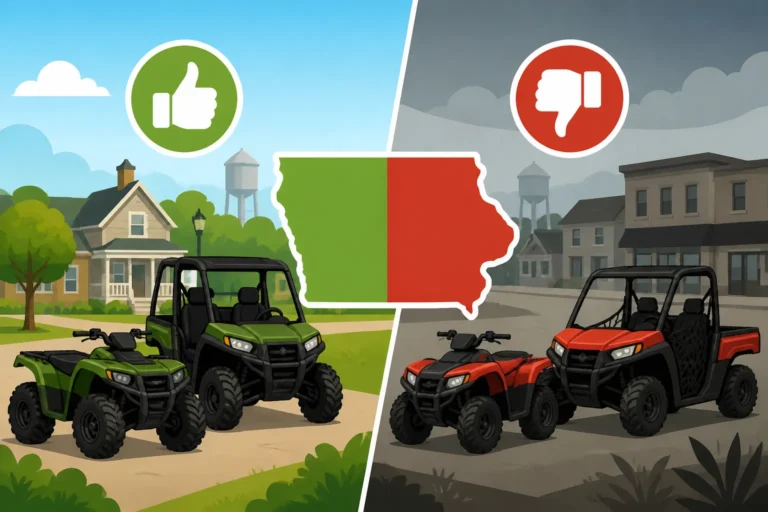
One of the trickiest parts of owning an ATV or UTV in Iowa isn't mastering the trails, but navigating the rules of the road when you need to get to them. Many riders get frustrated, or worse, face fines because they're unsure exactly how to legally transport their machines from point A to point B without a trailer. This guide will meticulously break down Iowa's "Most Direct Route" rule, explaining what it means, when it applies, and how to stay compliant while getting your off-highway vehicle (OHV) where it needs to go.
Deconstructing Iowa's "Most Direct Route" Rule
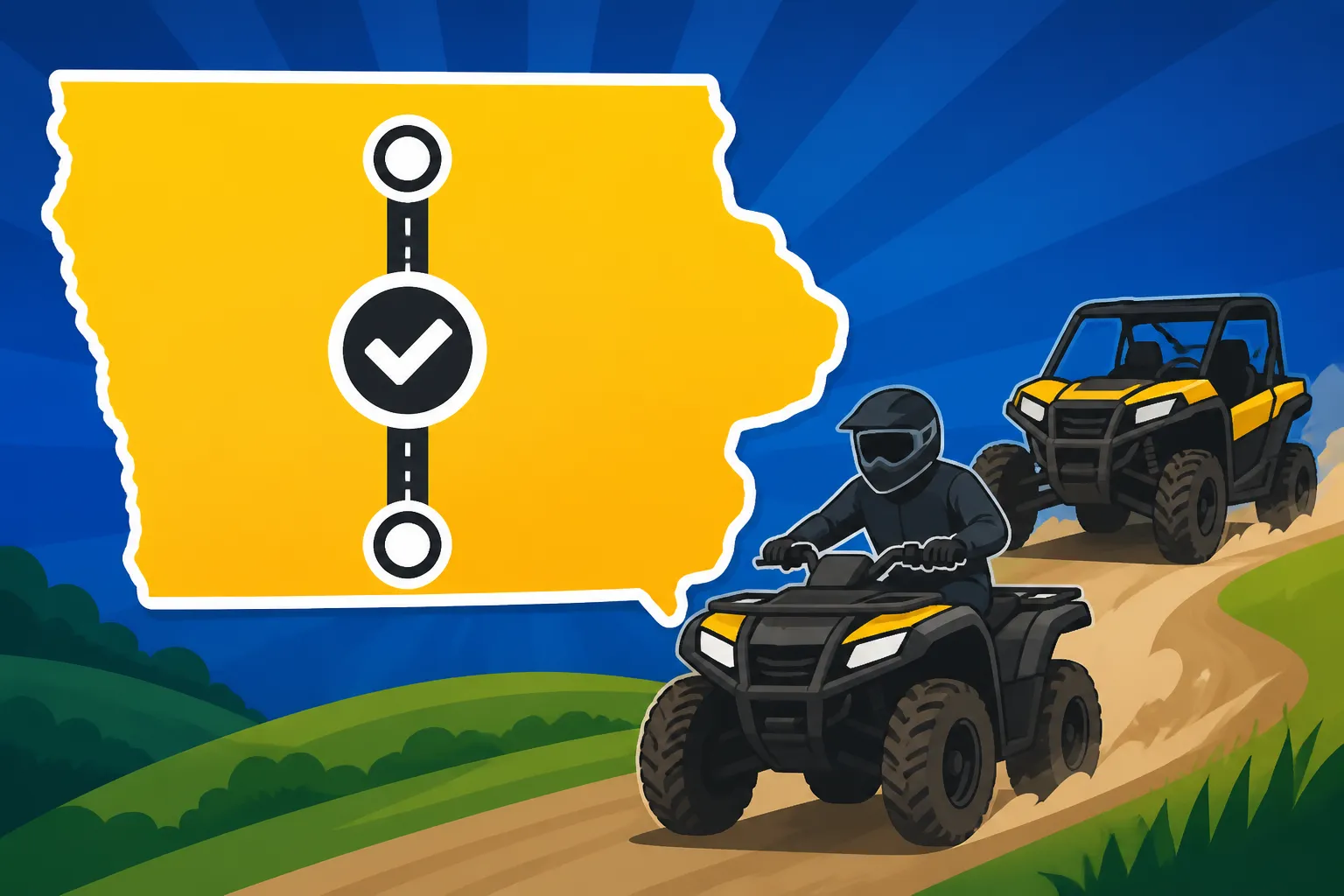
The concept of the "Most Direct Route" is a cornerstone of Iowa's regulations for operating ATVs and UTVs on public roads. It's a phrase that sounds simple, but its application can be complex, leading to confusion if you don't fully grasp its intent. Essentially, this rule dictates that if you're riding your OHV on a public road, you must choose the shortest and most straightforward path between your starting point and your destination. It's not about convenience or finding the prettiest backroad; it's strictly about efficiency in travel.
What "Most Direct" Truly Means for ATV/UTV Riders
For ATV and UTV riders, "most direct" translates directly to the shortest practical distance. Imagine drawing a straight line on a map from where your machine is parked to where you intend to ride or store it. While you can't always drive in a straight line, the path you choose must adhere as closely as possible to that imaginary line, utilizing only roads that are legally open to OHV traffic. This isn't just about mileage; it's about minimizing the time your machine spends on public roads and ensuring that its presence there is solely for essential transit, not recreational touring.
It's a common misconception that "most direct" allows for a bit of leeway, perhaps to pick up a friend or make a quick stop at a gas station that's slightly off the shortest path. This is generally not the case. The rule is quite strict in its interpretation: any deviation from the most immediate route to your intended destination could be considered a violation. You're expected to plan your journey with precision, ensuring that every turn and mile contributes directly to reaching your objective without unnecessary detours.
Think of it this way: your ATV or UTV is allowed on certain Iowa roads as a means to an end – specifically, to access off-road riding areas, reach your private property, or for agricultural purposes. It is not intended for joyriding on public thoroughfares, even if those roads are unpaved. The "most direct route" rule is Iowa's way of balancing the desire for OHV accessibility with the safety and operational considerations of shared public roadways.
The Spirit and Intent Behind the Regulation
The underlying spirit of the "Most Direct Route" rule is rooted in public safety and the appropriate use of infrastructure. Iowa's road system is designed primarily for conventional vehicles, and while ATVs and UTVs have limited permissions, these are granted with specific constraints. The state wants to minimize the potential for accidents involving these machines on roads, as well as reduce wear and tear on paved surfaces not designed for their tire types or suspension systems. By enforcing the most direct route, the state limits the exposure of OHVs to general traffic and keeps them primarily on roads better suited for them, like unpaved secondary routes.
Furthermore, the rule aims to prevent the misuse of public roads for extended recreational riding. Iowa has designated OHV parks and extensive private land available for off-road recreation. The public road system is not meant to be an extension of these riding areas. The "most direct" clause helps ensure that road use is functional and purposeful, not leisurely. This legislative intent helps preserve the peace for residents along rural roads and reduces conflicts between different types of road users.
It's also about managing the impact on local communities. When ATVs and UTVs are permitted on roads, there are concerns about noise, dust, and general disruption. By limiting their presence to the most direct routes, Iowa mitigates these potential impacts, especially in residential or sensitive environmental areas. This thoughtful approach allows riders to access the fun without unduly burdening the local populace or infrastructure.
Differentiating From Leisurely Cruising
One of the biggest distinctions a rider must understand is that the "Most Direct Route" rule explicitly differentiates necessary travel from leisurely cruising. If your goal is simply to "go for a ride" on public roads, you are likely in violation of the spirit, if not the letter, of this law. The rule is not a loophole for enjoying the scenery from your UTV on county roads; it is a directive for efficient transportation. A quick detour to take in a sunset or explore an interesting side road, even if it adds only a few miles, is almost certainly a violation.
Think of it like this: if you're driving your truck to work, you take the most direct route to save time and gas. You don't take a scenic detour through a neighboring town just because you enjoy the drive. The same principle applies here. Your ATV or UTV's presence on the road is strictly utilitarian. There should be a clear, provable destination that is reached via the most expeditious path possible. [The Most Direct Route Home in Iowa] should be exactly that, not a scenic loop.
Therefore, when planning a ride, it's crucial to distinguish between a trip to a riding area and a recreational ride on public roads. If your intention includes any amount of non-essential road travel beyond what is strictly necessary to reach an approved off-road area or private property, you are stepping outside the bounds of the "most direct route" rule. Ignoring this distinction can lead to unpleasant encounters with law enforcement and significant fines.
Scenarios Where the Direct Route is Your Only Path
The "Most Direct Route" rule isn't just a theoretical concept; it applies to specific, everyday situations riders encounter. Understanding these scenarios is paramount to staying legal and avoiding citations. Essentially, whenever your ATV or UTV touches a public road, whether paved or unpaved, the clock starts on the "most direct route" requirement. This is about purposeful travel, not casual exploration.
Accessing Designated OHV Parks and Trails
One of the most common reasons riders use public roads is to access Iowa's designated OHV parks and trails, such as Gypsum City or Bluff Creek. The rule is very clear here: you must take the most direct path from your home or staging area to the entrance of the park or trailhead. This means no detours to grab lunch at a restaurant a few miles out of the way, or to meet up with friends at an inconvenient location. Every mile driven on the road should be an intentional step closer to your destination. [The Most Direct Route to an Iowa OHV Park] is not an option; it's a mandate.
For example, if you live five miles east of the entrance to Gypsum City OHV Park, and there's a direct gravel road connecting your property to the park, you must use that road. You cannot take a longer, potentially more scenic route that adds three extra miles, even if that longer route is also on permissible roads. The enforcement officer's expectation is that your chosen path makes the most sense logically and geographically to get you to the park entrance without unnecessary travel.
This also extends to returning from the trails. Once you exit the OHV park, your immediate obligation is to take the most direct route back to your private property or designated staging area. The same stringent adherence to efficiency applies. Any post-ride detours for leisure or convenience, unless they are specifically part of an approved agricultural use, would put you in violation. It’s a point-to-point journey, and the points are defined by your property and the trail access.
Traveling to and From Your Property
Perhaps you need to move your ATV or UTV from your home to a different private property you own, or to a friend's land where you have permission to ride. In these instances, the "Most Direct Route" rule also applies. You cannot weave through residential areas or take roundabout paths simply because they offer a more interesting drive. Your journey must be the shortest practical distance between your starting private property and your destination private property.
Consider a situation where you have a hunting cabin ten miles away from your primary residence, and both are accessible by approved county roads. You must plot the most direct course between these two points. Stopping at a hardware store three miles off that direct route, even for a necessary item, could be viewed as a violation because it diverts from the primary, most direct purpose of your travel. This underscores the need for careful pre-planning for any road use.
This rule emphasizes that the permission to ride on certain public roads is conditional. It's not a blanket authorization for all road use. It's about connecting private property or connecting private property to designated public riding areas. The moment you deviate from that direct path for any reason unrelated to the core transit, you risk being in non-compliance. Always have a clear, direct destination in mind.
Essential Services and Agricultural Use
Another critical scenario where the "Most Direct Route" rule applies is when traveling for essential services or for agricultural purposes. This could mean taking your UTV to a local repair shop for maintenance, or driving your ATV to a fuel station. Again, the shortest, most efficient path is required. You can't turn a trip to the mechanic into a scenic drive through the countryside.
For agricultural use, the rule is similarly strict. Farmers may use their ATVs and UTVs on roads for tasks directly related to their farming operations. This often includes traveling between fields, moving equipment, or checking livestock. However, even these uses are subject to the "most direct route." You can't use the agricultural exemption to justify a leisure ride on roads that aren't part of your farm's immediate operational needs. [Iowa Rules for Riding a Gravel Road] details how some of these exemptions interact with road types.
For example, if you need to take a specialized farm UTV for a specific task to a field two miles down the road, you take the shortest route. You don't drive an extra five miles to check on a different pasture if that pasture isn't directly on the path to your primary destination. The machine's presence on the road must be directly and efficiently linked to the agricultural task at hand, minimizing any non-essential road time. It's a privilege, not a right, to use these machines on public thoroughfares, and the "most direct route" is a key condition of that privilege.
Applying the Rule Across Iowa's Road Network
Iowa's road system is diverse, ranging from remote gravel paths to bustling multi-lane highways. The "Most Direct Route" rule interacts differently with each type of road, and understanding these nuances is crucial for legal operation of your ATV or UTV. While the principle of directness remains constant, the specific permissions for OHVs vary significantly by road classification.
Navigating Unpaved County Secondary Roads
Unpaved county secondary roads, often referred to as gravel roads, are generally the most permissible routes for ATVs and UTVs in Iowa, assuming they are part of a "most direct route." These roads are typically less traveled and their surfaces are more forgiving for OHV tires and suspension compared to paved roads. Many rural areas in Iowa rely heavily on these gravel roads, and they often form the backbone for accessing farms, private land, and trailheads.
When planning your most direct route, prioritize these unpaved secondary roads whenever possible. They are the least restrictive environment for OHV travel, assuming local county ordinances don't impose additional bans. However, remember the "most direct" aspect still applies. Even if an entire county's gravel roads are open to OHVs, you still cannot take a circuitous path purely for the enjoyment of riding on gravel. Your trip must have a legitimate, direct purpose. [Unpaved County Secondary Roads in Iowa] are your best bet for legal road travel.
It's also important to note that while generally permissible, not all unpaved county roads are created equal. Some may be Level B roads, which are minimally maintained and often not suitable for OHV traffic due to their condition. Always confirm the road classification and check for any local restrictions before you ride. The general permissibility of gravel roads is a significant benefit for Iowa riders, but it must be used responsibly and always within the confines of the direct route rule.
Paved Secondary Roads and County Authorization
Things get a bit more complicated when it comes to paved secondary roads. Unlike unpaved county roads, paved secondary roads are not automatically open to ATV and UTV traffic in Iowa. For an OHV to be legally operated on a paved secondary road, the specific county board of supervisors must pass an ordinance explicitly authorizing such use. Without this specific authorization, riding your ATV or UTV on a paved secondary road is illegal, regardless of whether it's the "most direct route."
This means that even if a paved road is the absolute shortest distance between your property and an OHV park, you cannot legally use it unless the county has explicitly opened it to OHV traffic. This requires active research on your part. You need to check with the county recorder's office or the county's website for their current ordinances regarding OHV use on paved roads. [Iowa Rules for Riding a Paved Secondary Road] are clear on this point: county-by-county authorization is key.
If a county has authorized paved secondary roads for OHV use, then and only then can you consider them as part of your "most direct route." Even then, specific restrictions may apply, such as speed limits, hours of operation, or helmet requirements. It's a patchwork of regulations across the state, so never assume. Always verify county-level permissions before you venture onto any paved secondary road with your ATV or UTV.
Crossing Undivided Two-Lane Primary Highways
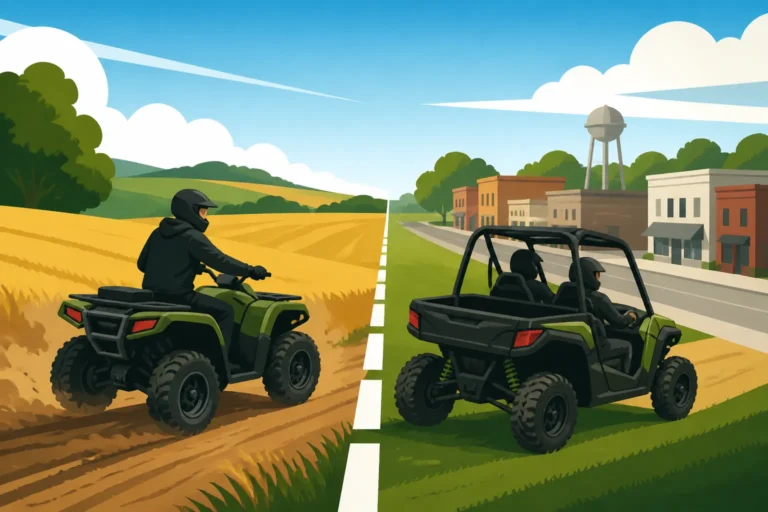
Iowa law also addresses the specific scenario of crossing undivided two-lane primary highways. These are state highways, typically marked with numbers, that are not interstates or multi-lane divided roads. You are permitted to cross these highways directly, but not ride on them. The intent is to allow you to get from one permissible road (like a gravel county road) to another, or to access private property, when a state highway intersects your "most direct route."
The key here is "crossing directly." This means approaching the highway, stopping, checking for traffic, and proceeding straight across the intersection to the connecting road on the other side. You cannot turn and ride down the primary highway, even for a short distance, to reach another road or entrance. The law explicitly prohibits longitudinal travel on these highways for ATVs and UTVs. [Crossing a Multi-Lane Highway at an Intersection] highlights the specific challenges, even though a two-lane primary highway is a different category.
For example, if your most direct route involves a gravel road that continues on the other side of an Iowa State Highway 14, you can cross Highway 14 at a right angle. You cannot, however, turn left or right onto Highway 14 and drive even a hundred yards to reach a different intersecting road. This restriction is primarily due to the higher speed limits and volume of traffic on state highways, making it inherently more dangerous for slower-moving OHVs. Plan your routes to minimize, and ideally eliminate, any interaction with primary highways beyond a straight-line crossing.
Mapping Your Route: Practical Steps for Compliance
Understanding the "Most Direct Route" rule is one thing; successfully applying it in the real world is another. This requires a proactive approach to planning your rides, using all available tools, and knowing what to do when the most direct path presents challenges. Don't leave your route planning to chance, as that's often where costly mistakes are made.
Pre-Ride Planning: Using Maps and Technology
The most effective way to comply with Iowa's "Most Direct Route" rule is through thorough pre-ride planning. Before you even fire up your engine, you should have a clear, documented route in mind. Start by identifying your exact starting point (e.g., your driveway) and your precise destination (e.g., the entrance to Bluff Creek OHV Park). Then, consult maps—both physical and digital.
Online mapping tools like Google Maps, while primarily designed for conventional vehicles, can still be incredibly useful. You can often toggle to satellite view to distinguish between paved and unpaved roads. Plot your course, paying close attention to road classifications. Mark intersections and identify potential points where you might need to cross a primary highway. Look for the shortest path that adheres to the rules we've discussed, prioritizing unpaved county roads. Consider using apps designed for off-road navigation or even paper maps specifically detailing county road systems, which often denote paved versus gravel sections. [Measuring the Most Direct Route] is a skill you'll develop over time.
It's also a good idea to scout the route, if possible, in a conventional vehicle, especially if it's unfamiliar territory. This allows you to identify any hidden hazards, check road conditions, and confirm road types before you commit your ATV or UTV. Having a digital copy of your planned route on your phone or a GPS device can be a lifesaver, allowing you to confirm your path as you ride and avoid unintentional detours.
Real-World Examples: Riding to Gypsum City or Bluff Creek
Let's put this into practice with a couple of real-world scenarios. Imagine you live five miles from Gypsum City OHV Park near Fort Dodge. You've identified that there's a network of county gravel roads that connect your property directly to the park entrance. Your pre-ride plan would trace this exact path, making sure no detours are added. You know that if you encounter a paved secondary road, you'll need to confirm that Webster County has specifically authorized OHV use on that segment. If not, you must find an alternative, even if it adds a slight distance, assuming that alternative is still the most direct legal route. [Riding to Gypsum City the Short Way] means just that.
Another example: you're planning a trip to Bluff Creek OHV Park near Eddyville. Your home is accessible by a gravel road, but to reach the park, you must cross a short segment of a paved primary highway. Your map shows a direct crossing. Your plan would explicitly note this crossing, ensuring you approach the highway, cross directly, and immediately re-enter permissible gravel roads on the other side, without any longitudinal travel on the paved highway. [Riding to Bluff Creek the Short Way] should emphasize strict adherence to the direct path.
In both these scenarios, your plan would not include stopping at a local diner for breakfast, even if it's "just a minute" off the path. Your purpose is singular: reach the park. Any deviation, no matter how small or seemingly innocent, could be seen as violating the "most direct route" rule. Documenting your route, even with simple notes, can be helpful if you're ever stopped by law enforcement, demonstrating your intent to comply.
What to Do When a "Direct" Route Seems Impractical
Sometimes, the "most direct" path might seem impractical or even unsafe. Perhaps it involves a poorly maintained road, a particularly busy intersection, or a section of road that feels dangerous for OHV travel. In these situations, your safety should always come first. However, this doesn't automatically give you carte blanche to choose a longer, "safer" route.
If the most direct path involves a road that is legally not open to ATVs/UTVs (e.g., an unauthorized paved secondary road or longitudinal travel on a primary highway), then that route is simply not an option. You must find the next most direct route that is legally permissible for your machine. This might mean adding a few miles, but it keeps you compliant with the law.
If the most direct legal route feels unsafe due to conditions (e.g., heavy traffic on a specific gravel road), you have a few choices. One, consider trailering your machine. Trailering removes the "most direct route" requirement for the OHV itself, as it's then considered cargo. Two, if you believe the route is truly impassable or unduly dangerous, contact local law enforcement or the county road department before you ride to inquire about alternative legal paths. They might offer guidance, or even temporary permissions if conditions warrant. However, always remember that you are responsible for knowing and adhering to the law; personal preference for a less direct but more pleasant ride is not a legal defense.
Avoiding Common Pitfalls and Costly Interpretations
Even with good intentions, many riders fall into common traps when interpreting Iowa's "Most Direct Route" rule. These pitfalls often stem from a misunderstanding of the strictness of the law or an overestimation of personal discretion. Avoiding these mistakes is crucial for keeping your rides enjoyable and free from legal headaches.
The Lure of the Scenic Detour
Perhaps the most common pitfall is succumbing to the temptation of a "scenic detour." Iowa's rural roads can be incredibly beautiful, especially in the spring or fall. It's natural to want to extend a ride a little to take in a picturesque view, or to explore a winding back road. However, the "Most Direct Route" rule explicitly prohibits such recreational detours. If the additional miles don't contribute directly and immediately to reaching your destination, they are a violation.
Imagine you're taking the most direct route home after a day at Bluff Creek. You know a slightly longer path passes by a beautiful river overlook. While it might only add a mile or two, and you're still on permissible gravel roads, taking that detour for leisure is a breach of the "most direct route" stipulation. The law is not concerned with the beauty of the landscape; it's concerned with the efficiency of your travel. [The Most Direct Route Home in Iowa] means getting there, not seeing the sights along the way.
This is where the spirit of the law truly comes into play. The state is granting you limited permission to use these roads for specific purposes. When you use that permission for non-essential recreation, you undermine the rationale behind the regulation. Law enforcement officers are trained to look for deviations from logical routes, and a scenic detour is often an easy tell that a rider is not adhering to the direct path requirement.
Misunderstanding "Agricultural Use" Exemptions
Another significant area of misunderstanding revolves around "agricultural use" exemptions. Many rural residents operate ATVs and UTVs for various farm-related tasks. Iowa law does provide some flexibility for these machines when used directly in farming operations. However, this exemption is not a blanket permit for all road use, nor does it override the "most direct route" rule for non-farm related travel.
For example, using a UTV to check fences on your property and then crossing a public road directly to access another field is likely permissible under the agricultural exemption and the direct route rule. However, taking that same UTV on a ten-mile loop around the county, claiming you are "checking neighboring fields" or "going for parts," without a clear, direct, and immediate agricultural purpose, would very likely be a violation. The "primarily" test for agricultural use was removed, but the requirement for direct involvement in farming remains. [The Implement of Husbandry Exemption in Iowa] clarifies some of these points.
It's crucial to distinguish between a machine used in agriculture and a machine used for recreation by someone who happens to be a farmer. If your primary purpose for being on the road isn't directly and immediately tied to an agricultural operation, the agricultural exemption likely doesn't apply, and the "most direct route" rule becomes even more stringent. Always err on the side of caution and ensure your road use is unequivocally agricultural when claiming this exemption.
The Difference Between Permissible and Prohibited Roads
Finally, a common and potentially costly mistake is failing to differentiate between permissible and prohibited roads. As discussed, not all roads are created equal for OHV use. While gravel county roads are often open, paved secondary roads require specific county ordinances, and primary highways (other than for direct crossing) and interstates are almost universally prohibited. [Are ATVs Street Legal in Iowa?] highlights the complexities of road legality.
Riders sometimes assume that if "some" roads are open, then all similar-looking roads must be. This is a dangerous assumption, particularly with the county-specific nature of paved road authorizations. Riding an ATV or UTV on a paved county road in a county that hasn't authorized it, even if it's the "most direct route," is a clear violation. The "most direct route" only applies to roads that are already legally open to OHV traffic.
Always verify the legal status of every segment of your planned route. Don't rely on assumptions or what you've seen others do. A quick call to the county recorder's office or checking their online ordinances can save you a significant fine and potential vehicle impoundment. Understanding this distinction is fundamental to legal and responsible ATV/UTV operation on Iowa roads.
Equipping Your Machine for Legal Road Travel
Even when you're diligently following Iowa's "Most Direct Route" rule, your ATV or UTV still needs to meet certain equipment standards to be legal for road use. These aren't just suggestions; they are mandatory safety features designed to make your machine visible and controllable on public thoroughfares. Failing to have the correct equipment can lead to citations, regardless of how perfectly you adhered to your direct route.
Mandatory Lighting and Visibility Requirements
When operating your ATV or UTV on public roads in Iowa, even for the most direct route, your machine must be equipped with proper lighting. This means having at least one headlamp that is illuminated at all times, day or night. This isn't just for seeing where you're going after dark; it's a critical visibility component to ensure other drivers can see you, especially when approaching intersections or cresting hills on dusty gravel roads. [Headlights On All Day in Iowa] is a rule that many riders overlook, but it's essential.
In addition to a headlamp, your machine needs at least one red taillamp that is illuminated whenever the headlamp is on. This ensures you're visible from the rear to other vehicles. If you're riding after sunset or before sunrise, these lights are absolutely non-negotiable. Furthermore, many UTVs, and some ATVs, come with turn signals. While not always explicitly required for all OHVs on roads, having functional turn signals vastly improves safety and communication with other drivers.
Ensuring your lighting is up to par is not just about avoiding a ticket; it's about preventing accidents. On a dusty gravel road or a winding paved secondary road, the small profile of an ATV or UTV can make it hard to spot. Bright, functional lights dramatically increase your visibility, protecting both you and other motorists.
Essential Safety Features: Horns, Mirrors, and SMV Signs
Beyond lighting, there are other crucial safety features your ATV or UTV must have for legal road operation. A horn is mandatory. Just like a car, your OHV needs to be able to audibly warn other drivers or pedestrians of your presence or potential hazards. This isn't a toy horn; it needs to be loud enough to be effective in traffic. Many aftermarket options exist, and companies like SuperATV offer robust horn kits that are easy to install and meet legal requirements, ensuring you can be heard when it matters most.
You must also have at least one rearview mirror. This allows you to monitor traffic behind you, which is especially important on roads where you might be traveling slower than other vehicles. While many OHVs come with a single rearview mirror, some riders prefer to add side mirrors for better peripheral vision. Again, SuperATV provides a variety of mirror options, from basic clamp-on mirrors to more integrated designs, helping riders ensure they have adequate visibility. [A Horn and a Mirror for Iowa Road Use] is a specific requirement, so make sure yours are up to par.
Finally, a slow-moving vehicle (SMV) triangle sign is required on the rear of your machine. This bright orange-red reflective triangle signals to other drivers that your vehicle typically travels at speeds slower than the flow of traffic. It's a critical safety device, especially on roads where you might be sharing the lane with faster cars and trucks. The SMV triangle should be clearly visible and mounted properly, as detailed in [A Triangle on the Back of an Iowa Machine]. These signs are vital for preventing rear-end collisions and are a mandatory part of road-legal ATV/UTV equipment.
Insurance and Driver Licensing for Road Use
Beyond the physical equipment on your machine, you, as the operator, also have responsibilities. If you are riding your ATV or UTV on any public road in Iowa, including those covered by the "most direct route" rule, you must carry proof of liability insurance. Iowa requires specific minimum coverage amounts, typically known as 20/40/15: $20,000 for injury or death of one person, $40,000 for injury or death of two or more persons, and $15,000 for property damage. [Iowa ATV Insurance Requirement] is not optional; it's the law.
Failure to carry adequate insurance can result in significant fines and legal consequences if you are stopped or involved in an accident. Always have your insurance card or proof of coverage readily accessible when riding on public roads. It's a good idea to keep it in a waterproof bag or secured compartment on your machine.
Furthermore, to operate an ATV or UTV on public roads in Iowa, you must possess a valid driver's license. This means you must be at least 18 years old and hold a standard motor vehicle driver's license. Minors, even if they possess an ATV safety certificate, are generally not permitted to operate OHVs on public roads. [Iowa Minimum Age to Ride a Road] is 18, so ensure you meet this requirement. Always carry your driver's license with you when riding, as it will be requested if you are stopped by law enforcement. These personal requirements are just as important as the vehicle's equipment in ensuring legal and safe road use.
Consequences of Straying from the Direct Path
Ignoring Iowa's "Most Direct Route" rule or misinterpreting its intent can lead to a host of negative consequences, ranging from financial penalties to the loss of your riding privileges. It's essential to understand that law enforcement takes these regulations seriously, and ignorance of the law is not a valid defense. These aren't just minor infractions; they can significantly impact your wallet and your ability to enjoy your machine.
Understanding Fines and Citations
The most immediate consequence of violating the "Most Direct Route" rule is receiving a citation and an associated fine. The specific amount can vary depending on the severity of the infraction, local county ordinances, and whether other violations (like missing equipment or lack of insurance) are also present. These fines can quickly add up, turning what was intended to be a quick trip into an expensive mistake. [Iowa Fines for Illegal ATV Road Use] are designed to be a deterrent, so they're not negligible.
For instance, a deputy might observe you taking a meandering route on gravel roads when a more direct path was clearly available, or catching you turning down a paved road that isn't authorized for OHV use. In such cases, they have the authority to pull you over and issue a ticket. Beyond the fine itself, you might also incur court costs and administrative fees, further increasing the financial burden. These citations go on your record, potentially impacting future interactions with law enforcement.
It's also important to remember that even if you feel your deviation was minor or unintentional, the enforcement officer's interpretation of "most direct" is what matters at the moment of the stop. Arguing your case roadside is generally not effective; if you believe you've been wrongly cited, the proper course of action is to address it in court. However, preventing the citation in the first place by meticulous route planning is always the better option.
Potential for Vehicle Impoundment
In more severe or repeated instances of violating Iowa's road use rules, including a blatant disregard for the "Most Direct Route" or operating on clearly prohibited roads, your ATV or UTV could be impounded. This is a far more serious consequence than a simple fine, as it immediately removes your ability to use your machine and adds a significant layer of expense and hassle to retrieve it.
Impoundment means your machine will be towed to an impound lot, and you will be responsible for all towing fees, storage fees (which accrue daily), and any associated administrative costs. These fees alone can quickly run into hundreds of dollars, on top of any fines from the citation. Retrieving an impounded vehicle is a process that requires prompt payment of all fees and often proof of corrected violations (e.g., getting proper insurance, fixing equipment).
The potential for impoundment highlights the state's seriousness about these regulations. It's not just about revenue generation from fines; it's about ensuring public safety and compliance with the law. If your machine is found on roads where it clearly shouldn't be, especially if you're taking routes that are far from "most direct" or on strictly prohibited pavement, impoundment becomes a very real possibility. This can ruin a weekend ride and leave a lasting financial impact.
Impact on Your Riding Privileges and Record
Beyond fines and impoundment, repeated or serious violations of Iowa's OHV road rules can have a detrimental impact on your riding privileges and your overall driving record. While an ATV citation might not directly impact your standard driver's license points in the same way a speeding ticket in your car would, it still creates a legal record. This record can be reviewed in future encounters with law enforcement.
For example, if you are stopped again for another OHV road violation, a history of prior infractions could influence the officer's decision regarding leniency, potentially leading to a stricter outcome like impoundment or a higher fine. In extreme cases, or for habitual offenders, there could even be discussions about restricting your ability to operate OHVs on public lands or roads in the state.
More broadly, consistent disregard for state laws, even specific OHV regulations, can reflect poorly on the entire riding community. When individual riders act irresponsibly, it can lead to calls for stricter legislation or the closure of currently accessible roads and trails. Therefore, adhering to the "Most Direct Route" rule and all other regulations isn't just about protecting yourself; it's about preserving the privilege of riding for everyone in Iowa. Responsible riding is collective riding.
Disclaimer
This article is for general informational purposes only and does not constitute professional advice. Laws, prices and regulations vary by location and change over time. Consult a qualified professional for guidance on your specific situation.