Riding 2 Miles From the Home Place
It's a common scenario across Iowa: you've got an ATV or UTV that's indispensable for farm work, hauling feed, checking fences, or just getting around your property. But what happens when that work takes you "just down the road a bit" to the neighbor's field or the other side of your land? Many landowners feel a real pinch trying to understand where private property use ends and public road rules begin, especially concerning registration. This guide will clarify the specific agricultural exemptions in Iowa, particularly the nuanced "2 miles from the home place" rule, so you can confidently operate your machine without fear of an unexpected citation.
Understanding Iowa's Agricultural Exemption for OHVs
Iowa recognizes that ATVs and UTVs are vital tools for agricultural operations, and the law makes provisions for their use on public roads under specific conditions without needing full registration. This isn't a blanket pass, though; it's a carefully defined exemption aimed at supporting farmers and landowners in their daily work. The key to understanding this lies in what the state considers an "implement of husbandry."
What Qualifies as an "Implement of Husbandry"?
First, let's clear up the definition of an "implement of husbandry" in Iowa. This isn't about the type of machine itself, but rather its primary use. An ATV or UTV qualifies if it's chiefly designed for, adapted to, or utilized in farming operations. Think about the countless tasks these machines perform on a farm: hauling tools, moving small loads of grain or hay, checking livestock, spraying small fields, or transporting personnel quickly across large properties. When your quad or side-by-side is consistently performing these kinds of duties, it starts to fall under this agricultural umbrella.
The law understands that a four-wheeler used solely for recreational trail riding at an OHV park is a very different animal from one that spends its days checking irrigation pivots. It's the functional purpose that matters. If your machine is part of the working landscape of your farm, genuinely aiding in the production, harvesting, or care of agricultural products, it stands a good chance of being considered an implement of husbandry. This classification is the foundation for the road use exemption. [The Implement of Husbandry Exemption in Iowa] delves deeper into these definitions.
The "Two Miles From the Home Place" Rule
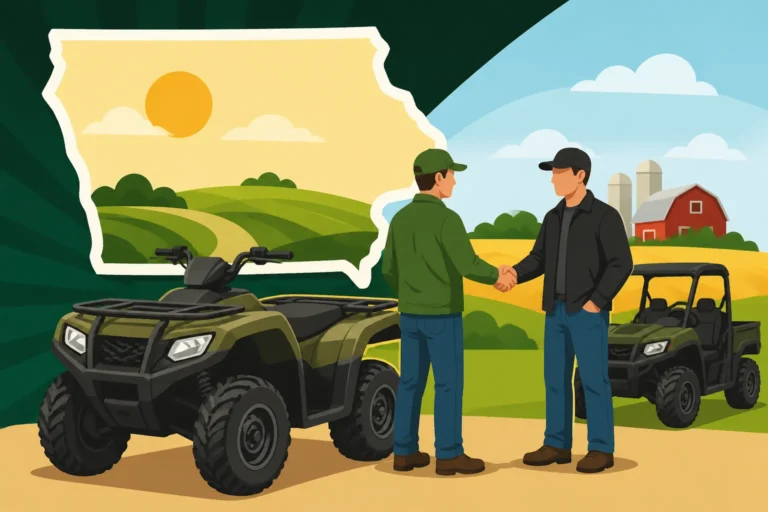
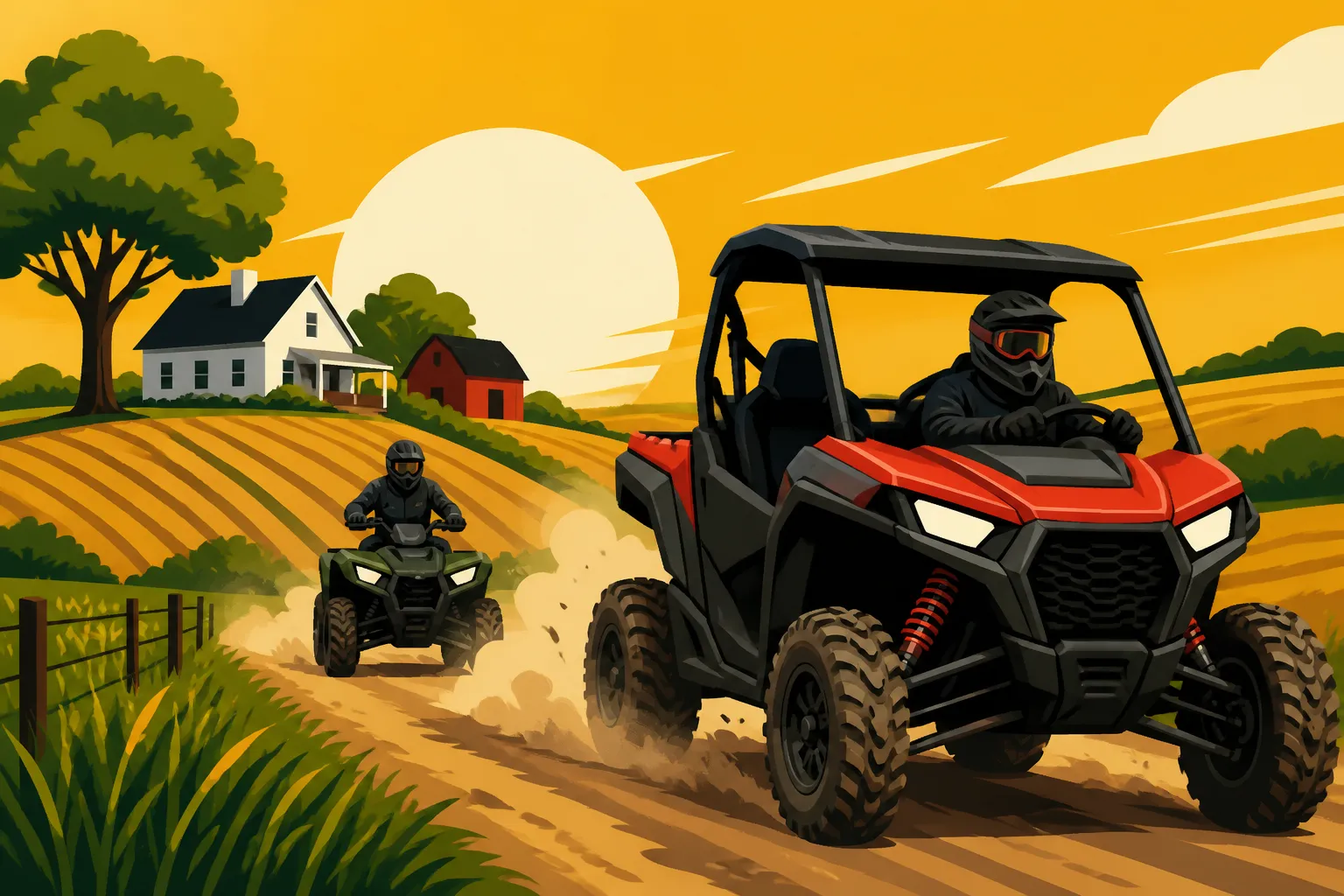
Now, let's get to the heart of the matter: the "two miles from the home place" rule. This specific provision allows an ATV or UTV classified as an implement of husbandry to be operated on certain public roads for distances up to two miles from the point of origin or the "home place." The "home place" in this context refers to your farm or the specific location where the agricultural operation originates. The intent is to permit farmers to move their essential equipment efficiently between fields, barns, or to neighboring farm properties without the burden of full vehicle registration, which typically applies to recreational OHVs.
This isn't an open invitation to joyride. The travel must be directly related to agricultural operations. For instance, moving your UTV to a different pasture to check cows or driving your quad to a neighboring field to perform a quick repair on a fence line would fall squarely within this rule. Critically, this exemption primarily applies to unpaved secondary roads. Some counties may authorize paved secondary roads for such use, but that's something you'd need to verify with your local county government. The travel must also occur between sunrise and sunset; riding after dark under this specific exemption is generally not permitted. [2 Miles From the Farm in Iowa] provides more granular details on this distance and its implications.
When the Exemption Doesn't Apply
It's absolutely crucial to understand the limitations of the "two miles from the home place" rule, because stepping outside these boundaries can lead to trouble. The exemption is only for agricultural purposes and only within the specified distance and road types. If you're using your ATV or UTV for recreational riding – even if it's on your own property, but you venture onto public roads for fun – the exemption immediately ceases to apply. The moment your primary purpose shifts from farm work to leisure, you're expected to comply with standard OHV registration and road use laws.
Furthermore, exceeding the two-mile limit, even for farm work, will invalidate the exemption. If your fields are three or four miles apart, that extra distance means you're no longer covered. Similarly, attempting to use this exemption on primary highways, interstates, or city streets not specifically authorized by local ordinance will likely result in a citation. Riding after dark, even if within the two-mile radius and for farm work, is also a no-go under this specific rule. If you're stopped and found to be outside these narrow parameters, you could face fines for improper registration, lack of insurance, or other violations associated with illegal road use.
Registration and Titling for Farm-Used Machines
The question of whether to register and title an ATV or UTV used primarily for farm work is often a source of confusion. The "implement of husbandry" exemption affects these requirements directly, but it's not always a straightforward "yes" or "no" answer. Understanding the nuances can save you headaches and penalties down the line.
When You Don't Need to Register or Title Your ATV/UTV
If your ATV or UTV is strictly and exclusively used as an implement of husbandry for agricultural purposes, and its operation on public roads adheres precisely to the "two miles from the home place" rule (meaning unpaved secondary roads, sunrise to sunset, direct farm operations only), then it may not need to be registered or titled in Iowa. This is a significant point for many farmers who simply need to cross a road or move between adjacent parcels of land for their work.
The core idea here is that the machine isn't being used in a way that generates the need for typical road vehicle regulation. It's not a recreational vehicle, and it's not operating as general transportation. It's farm equipment. For instance, if you're using your side-by-side solely on your private land to haul feed, or occasionally driving it a mile down an unpaved county road to another field you own, and never for recreational rides or longer journeys, you might fall under this exemption. This can also apply to machines that never leave private property at all. For more on this, check out [Do You Need to Register an ATV on Private Land in Iowa?]. However, always consider that "strictly and exclusively" are very high bars to clear, and any deviation can change the requirement.
When Registration and Titling Become Necessary
While the agricultural exemption offers some leeway, there are many situations where registration and titling absolutely become necessary for your farm ATV or UTV. If you ever plan to use your machine for recreational purposes on public trails or designated OHV parks, such as Gypsum City or Bluff Creek, full registration with the Iowa DNR (via your County Recorder) is a must. The agricultural exemption doesn't cover recreational use, even if you sometimes use the machine for work. [Registering an ATV in Iowa] and [Titling an ATV in Iowa] lay out the full requirements for these instances.
Furthermore, if your agricultural operations require you to travel beyond the two-mile limit, or to use paved roads not specifically authorized, or to travel after dark, your machine will need to be fully registered and meet all other requirements for legal road use, including insurance and proper lighting. Even if you're selling the machine, a title is typically required for a smooth and legal transfer of ownership. It establishes the chain of ownership and protects both the buyer and seller. Without a title, selling a used machine can become complicated and raise red flags for potential buyers.
Essential Documentation for Farm Machines Even if Exempt
Even if your ATV or UTV qualifies for the agricultural exemption and doesn't require state registration or a title for its primary use, it's still incredibly important to maintain essential documentation. Think of it as your proof of ownership and a defense against any misunderstanding if you're ever stopped while operating on an exempted road. The most crucial document is a clear and complete bill of sale. This isn't just a scribble on a napkin; it should detail the buyer and seller, the machine's make, model, year, and most importantly, its Vehicle Identification Number (VIN) or serial number.
Having a robust bill of sale from a reputable source, like a template from LawDepot, can make all the difference. This document proves you legally own the machine and weren't just "borrowing" it indefinitely. Beyond the bill of sale, keep records of any repairs or maintenance, and if applicable, any documentation confirming its use primarily for agricultural purposes (e.g., invoices for farm-related parts or attachments). This paper trail validates your claims about the machine's intended use, which is critical if an officer questions its presence on a public road without a registration decal. Even if it seems like overkill, having these documents readily available can prevent a lot of hassle. Learn more about what Iowa expects for proof of ownership in [An Iowa Bill of Sale for an ATV].
Navigating Public Roads with Your Farm ATV/UTV
Using your farm ATV or UTV on public roads, even under the agricultural exemption, requires a clear understanding of the rules and potential pitfalls. It's not the same as driving a tractor, and it definitely isn't the same as trail riding. You're entering a gray area where specific conditions apply, and failing to meet them can turn a simple trip into a legal issue.
Rules for Unpaved Secondary Roads Under Exemption
When operating your ATV or UTV as an implement of husbandry on unpaved secondary roads, remember the strict conditions. The "two miles from the home place" rule is paramount. Your travel must be for a direct farm operation, such as moving equipment to a different field, checking livestock in a remote pasture, or performing vital tasks that cannot reasonably be done on private land alone. This travel is limited to sunrise to sunset. If the sun goes down, your exemption for road use typically expires, and you'll need to be off public roads or meet the full requirements for general road use.
Safety equipment is also critical. While full registration may not be required, your machine still needs to be visible and safe. Iowa law usually requires that any vehicle operating on a public road, even under exemption, display a slow-moving vehicle (SMV) triangle on the rear. This warns other motorists of your slow speed. Adequate lighting, including headlights and taillights, should be functional, though the "sunrise to sunset" rule might mean you don't use them as often. While Iowa does not have a universal helmet law for ATVs, always prioritize safety with proper gear.
General Road Use Rules for ATVs/UTVs in Iowa Beyond Exemption
It's vital to differentiate the agricultural exemption from the general rules for ATV/UTV road use in Iowa, because they are very different. If you need to travel beyond two miles from your farm, if your purpose isn't strictly agricultural, or if you want to ride on paved roads (unless specifically opened by county ordinance), your machine must be fully registered and titled. This means paying the annual registration fee and displaying the current decal. [Iowa ATV Registration Cost] details these fees.
Beyond registration, the rules become much more stringent. To operate an ATV or UTV on authorized public roads (which typically means unpaved secondary roads, and potentially some paved ones if a county has passed an ordinance), the operator must be at least 18 years old and possess a valid driver's license. The machine must also be insured with specific minimum liability coverage (often stated as 20/40/15: $20,000 for injury to one person, $40,000 for injury to two or more, and $15,000 for property damage). There's also a speed limit of 35 mph, and the machine needs to be equipped with proper headlights, taillights, a horn, and at least one rearview mirror. [What Iowa Requires of an ATV on a Public Road] explains these in detail. This set of rules applies to all general public road use, regardless of whether you’re commuting to an OHV park or simply making a longer trip for farm supplies. For a complete overview, see [Are ATVs Street Legal in Iowa?] and [Riding an ATV on Iowa Roads].
Best Practices for Farm Riders
Given the complexities, farm riders in Iowa should always lean towards caution and thoroughness. First, if there's any ambiguity about whether your specific use falls strictly within the "implement of husbandry" exemption, consider voluntarily registering your machine. The cost of registration is minimal compared to potential fines and legal headaches. This gives you broader flexibility and peace of mind. Secondly, always know your local county ordinances. While the state sets the general rules for unpaved secondary roads, individual counties have the authority to open or close specific paved secondary roads to OHV traffic. A quick call to your county recorder or sheriff's office can clarify local rules. [Iowa Rules for Riding a Gravel Road] outlines general expectations.
Third, maintain clear, accessible proof that your machine is primarily used for agricultural purposes. This could include a detailed bill of sale (perhaps one you got using a template from LawDepot), records of farm-related modifications or purchases, or even a simple letter from your farm validating its role. If you're ever stopped, being able to quickly articulate and, if necessary, provide documentation about your machine's use for "husbandry" can often de-escalate a situation. Finally, equip your machine properly. Even if not strictly required under the exemption, having functional headlights, taillights, a horn, and an SMV triangle is just good common sense for safety on any public road.
Common Misconceptions and Avoiding Penalties
The agricultural exemption for ATVs and UTVs in Iowa is a nuanced topic, and it's easy to fall prey to common misconceptions. These misunderstandings can lead to unexpected fines and legal trouble. Let's tackle some of the most pervasive myths and set the record straight to help you stay compliant.
"It's Just a Farm Machine, I Don't Need Anything"
This is perhaps the most dangerous assumption a farm rider can make. While it's true that your ATV or UTV may primarily be a tool for farm work, the moment it touches a public road, even for a short distance, it enters a regulated space. The "implement of husbandry" exemption is not a free pass for any use; it's a very specific exception based on use and circumstances. Just because your machine spends 90% of its time on private farmland doesn't mean the other 10% on public roads is automatically exempt.
The state of Iowa distinguishes between private land operation (where registration is generally not required unless you enter a public trail system) and public road operation. The specific use case on the public road is paramount. If you're taking your "farm machine" a mile down the road to visit a friend or grab a soda, that's not an agricultural purpose, and the exemption does not apply. In such a scenario, your machine would need full registration, and you would need to meet all general road use requirements. Neglecting these rules because you assume your machine is inherently exempt can lead to citations for riding an unregistered ATV, which can result in significant fines. [Iowa Fines for an Unregistered ATV] explains the financial implications.
"I Can Ride Anywhere if It's for Farm Work"
Another widespread misconception is that if you're doing farm work, you can ride your ATV or UTV on any public road, anytime, anywhere. This is simply not true. As we've discussed, the agricultural exemption is very specific:
- Distance Limit: Strictly two miles from the home place.
- Road Type: Primarily unpaved secondary roads. Paved secondary roads only if explicitly authorized by county ordinance. Primary highways (like state routes) and interstates are generally off-limits, even for farm work.
- Time Limit: Sunrise to sunset. Nighttime travel is not covered by this exemption.
- Purpose: Must be directly for agricultural operations.
So, while it might be tempting to take the paved road because it's smoother or quicker, or to extend your trip a few extra miles, doing so will immediately put you outside the bounds of the exemption. The rules are designed to allow practical farm-to-field movement, not unrestricted road access. Understanding these very narrow allowances is key to avoiding legal issues.
Verifying Your Status and Staying Compliant
The best way to avoid penalties and ensure compliance is to proactively verify your status and adhere to best practices. If you're unsure about a specific road or a particular type of travel, your first stop should be your local County Recorder's office. They are the primary contact for ATV/UTV registration and can often provide clarity on local ordinances or direct you to the correct resource. The Iowa Department of Natural Resources (DNR) website also offers extensive information on OHV laws.
Keep your paperwork organized and accessible. This includes your bill of sale, any previous registration documents (if applicable), and perhaps even a copy of local ordinances if they pertain to your specific travel. Using a service like LawDepot for well-formatted legal documents, such as a bill of sale or even a simple agreement between landowners if you're operating across different properties for farm work, can provide valuable proof of your machine's intended use and ownership. When in doubt, it's always safer to opt for full registration. While an annual fee, it offers the broadest flexibility for legal operation across different scenarios and can prevent a much more costly fine. Stay informed, be prepared, and ride responsibly.
Disclaimer
This article is for general informational purposes only and does not constitute professional advice. Laws, prices and regulations vary by location and change over time. Consult a qualified professional for guidance on your specific situation.