Why Iowa Parks Are Run by Clubs and Counties
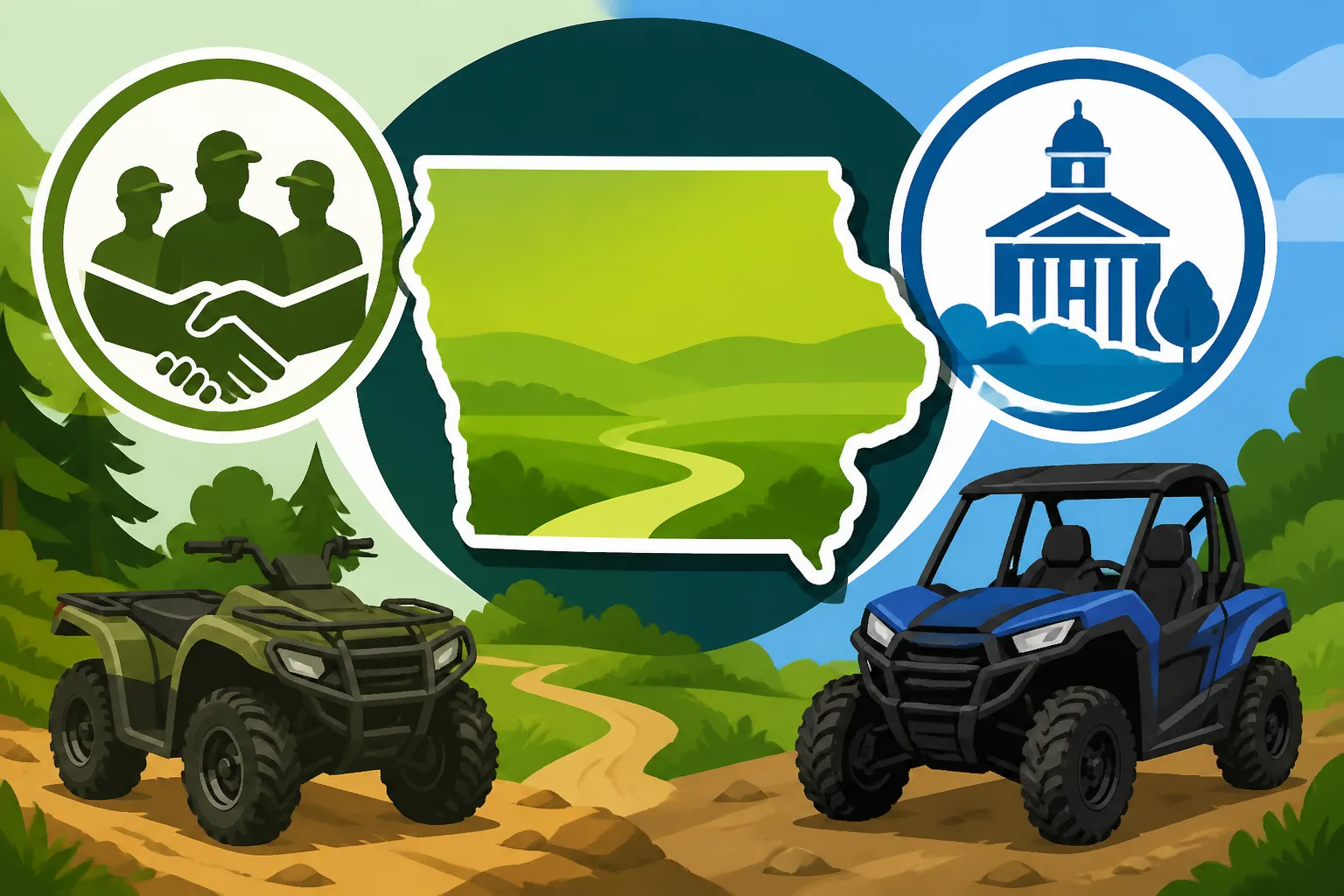
Iowa riders can arrive at a trailhead expecting one statewide system, then find that operating hours, closures, facilities, and local rules vary from park to park. That patchwork can feel confusing, especially when a long drive is involved. Understanding why clubs and counties help run Iowa’s off-highway vehicle parks makes it easier to know who manages what, where to check conditions, and how riders can help keep trails open.
Why Iowa relies on local park operators
Iowa’s off-highway vehicle riding areas are spread across communities with different landscapes, facilities, and local priorities. A single statewide agency can set broad direction, but it is not always the most practical organization to handle every trail inspection, gate, campground, and visitor question on the ground.
That is where local governments and riding clubs can make a real difference. A county may have staff, land-management experience, and a direct connection to local residents. A club may have members who understand trail conditions and are willing to help maintain routes. Often, the useful arrangement is not “one group does everything,” but several partners handling different parts of a park’s operation.
Local knowledge matters on the ground
Trail conditions can change quickly. Iowa clay that is firm after a dry stretch can become slick and deeply rutted after rain. A low spot may hold water longer than expected, while a hill section may need attention after repeated use. Local operators are often better positioned to notice these changes promptly because they are close to the land and familiar with how that particular park drains and gets used.
That local knowledge is practical, not abstract. A club member who regularly rides Gypsum City near Fort Dodge may know which areas tend to soften after a storm. People familiar with Bluff Creek near Eddyville may recognize that a section needs attention before the next busy weekend. Local familiarity helps operators make decisions based on the place in front of them, rather than treating every Iowa trail as if it had the same terrain and weather.
Local responsibility can also make it easier to hear from riders. If a sign is hard to see, a trail marker is missing, or a parking area is getting congested, people who use the park may be able to bring the issue to a club or local manager directly. That does not mean every suggestion can be acted on immediately. It does mean the people making day-to-day decisions may understand the specific concern without needing a long explanation of the local layout.
Each park has different needs
An OHV park is more than a network of trails. Depending on the location, visitors may also rely on staging areas, parking, restrooms, camping facilities, signs, gates, and routes suitable for different machine types. The work required to maintain those features can vary substantially from one park to another.
Gypsum City, outside Fort Dodge, is known for its extensive riding area and campground. A park with more trail mileage or camping infrastructure may have different upkeep demands from a smaller site with fewer visitor facilities. Likewise, Rathbun near Plano, Lakeview outside Solon, and Nicholson-Ford near Marshalltown each have their own surroundings and visitor patterns. Their operating arrangements need to account for what is actually present on site.
This is one reason riders should avoid assuming that a rule or service at one park applies everywhere. A gate schedule, camping arrangement, trail layout, or closure practice may be specific to that location. Before loading the trailer, check the individual park’s information and local notices. A good starting point is [Iowa's Eight Designated OHV Parks], followed by the current information for the park you plan to visit.
Statewide support and local operation can complement each other
Local management does not mean a park exists entirely outside statewide rules or support. Iowa’s Department of Natural Resources has a role in the broader off-highway vehicle system, while county governments, clubs, and other local partners may take on practical responsibilities at particular sites. The details can differ, so it helps to distinguish the statewide framework from the people managing a specific trailhead.
A useful way to think about it is that statewide systems can establish common expectations and support programs, while local partners handle many site-level tasks. That may include communicating a temporary closure, maintaining trails, managing a facility, coordinating volunteers, or helping visitors understand local conditions. The precise split depends on the park and its agreements.
For riders, the distinction matters when something goes wrong or a question comes up. A general question about Iowa’s OHV system may belong with a statewide resource, while a question about a park’s gate, campsite, or trail condition is better directed to that park’s local operator. Knowing which level is responsible can save the frustrating round of calls that happens when everyone assumes someone else is in charge.
What clubs contribute to Iowa OHV parks
Off-road riding clubs can bring a kind of practical attention that is difficult to replicate with occasional visits. Members often use the trails themselves, understand how riders move through the site, and can spot wear or confusing signage. When clubs work with a county or another local partner, they can help connect the needs of the riding community with the daily work of maintaining a public recreation area.
Club involvement is not just a matter of enthusiasm. Trail work, event coordination, and rider communication take time and organization. Volunteers may help with specific tasks, but they still need clear expectations, safe work practices, and coordination with whoever has authority over the property.
Volunteers can help maintain trails and facilities
Trail maintenance is ongoing. Water can cut channels into a slope, branches can fall across a route, and heavy use can wear down corners or create ruts. Depending on the park and its operating arrangement, club volunteers may assist with work such as clearing vegetation, improving signs, reporting damage, or helping prepare for an event.
The important point is that volunteer work is usually part of a broader maintenance system, not a substitute for every responsibility. Land-management decisions, equipment use, safety procedures, and work permissions still need to be handled appropriately. A volunteer should not assume that a good intention automatically makes any kind of trail work acceptable.
For riders, that means there are useful ways to contribute even without operating equipment or joining a formal work crew. Reporting a downed limb, a damaged sign, or a muddy section to the park’s designated contact can help the operator decide what to do. If a club organizes a workday, follow its instructions about tools, access, and where volunteers should meet. The people coordinating the work need accurate information just as much as they need willing hands.
Clubs can represent riders’ practical needs
A club can help operators understand how people actually use a park. Riders may have concerns about trail difficulty, route markings, machine width, family-friendly areas, or congestion at the staging lot. A club with a range of members can bring those observations forward in a more organized way than a stream of disconnected complaints.
This does not mean every rider will agree with every club decision. A group may prioritize safety or erosion control over a preferred route, or support a closure that frustrates riders who planned a weekend trip. The value of a club is not that it can make every requested change happen. It is that it can provide a channel for discussion and share the reasoning behind local decisions.
Clubs can also help promote good riding habits. Experienced members can remind newer riders to stay on marked routes, respect posted closures, and avoid riding when trails are too wet. That kind of informal guidance matters because a park’s long-term health depends on everyday choices made by visitors, not just on official maintenance days.
Club involvement has limits and responsibilities
A club’s participation does not necessarily mean it owns the land, controls every operating decision, or can grant permission to ride anywhere nearby. Riders should pay attention to the park’s official rules and posted boundaries instead of treating a club’s presence as blanket authorization.
The same caution applies to events. A club may help organize a group ride or volunteer day, but a public event can involve additional permissions, safety planning, or insurance requirements. Organizers should work with the responsible park operator rather than assuming that informal approval is enough. Riders attending an event should follow the instructions given by the organizers and park staff.
It is also worth remembering that volunteer groups have limited time. A small club may be balancing trail work, event planning, member communication, and ordinary jobs and family responsibilities. If a response takes time, or a requested repair cannot happen right away, that does not automatically mean the concern was ignored. Clear, respectful communication is more likely to help than repeated public complaints that do not identify the specific location or problem.
What counties bring to park management
Counties can contribute more than land or a name on a map. A county government may have experience with public facilities, maintenance planning, local budgets, public communication, and coordination with other agencies. Those capabilities can be useful when an OHV park needs a dependable local operating structure.
County involvement can also connect a park to a broader recreation system. Residents may already use county-managed conservation areas, campgrounds, roads, or public facilities. A county that understands its local recreation needs may be well placed to consider how an OHV area fits into the community and what practical responsibilities come with operating it.
Counties can provide continuity and public accountability
Clubs depend on their members, and membership can change over time. Counties, by contrast, are public institutions with established administrative processes. When a county has a park role, it may provide a continuing point of contact and a way to communicate decisions through public channels.
That structure can be helpful when a park needs planning beyond the next riding season. Facilities wear out, trails need recurring attention, and visitor numbers can create demands that are not solved by a single volunteer day. A local government may be able to consider maintenance priorities as part of a longer-term recreation plan, subject to its resources and responsibilities.
Public accountability also means decisions may involve processes that riders find slower than they would like. A change to a facility or a new investment may need review, coordination, or funding decisions. From a rider’s perspective, that can feel like paperwork standing between the park and an obvious fix. But a public process can also make it clearer who is responsible, how decisions are made, and where community concerns can be raised.
County staff can connect recreation with local needs
A county may have to consider many uses of public land and facilities. OHV riding is one important recreation activity, but local managers may also need to account for conservation, neighboring properties, access, safety, maintenance capacity, and other visitors. The right balance depends on the site.
For example, a trail route that seems ideal to a rider may cross an area that is sensitive to erosion or difficult to maintain. A parking plan may need to account for trailers, emergency access, and other visitors. Local staff can weigh these operational concerns with the riding experience rather than making decisions solely from a trail map.
That can be frustrating when riders see a closure or a route change without understanding the reason. If information is available, read it before assuming the decision is arbitrary. When you have a question, ask the park operator which concern led to the change and whether there is a way to share feedback. Specific questions about a location or condition are much easier to answer than a general demand to reopen everything.
Local budgets shape what a park can offer
A park’s visible features can make it seem as if they appeared all at once, but facilities need ongoing care. Signs fade, gravel shifts, gates wear, and campground areas require maintenance. The presence of a county or club operator does not mean every requested improvement can be funded or completed immediately.
Different sites may have different sources of support and different responsibilities. Some work may rely on local resources, while broader OHV programs can support parts of the system. Riders should not assume that one park’s facilities reveal the budget or staffing available to another. A larger campground, longer trail network, or more developed staging area can bring additional maintenance needs as well as greater visitor appeal.
Understanding those constraints makes it easier to ask useful questions. Instead of only asking why a park does not have a particular feature, ask who manages that part of the site, how maintenance priorities are set, and whether volunteers or community support can help. The answer may still be that the feature is not feasible, but you will have a clearer picture of the trade-offs.
How the management partnership works in practice
“Run by clubs and counties” can sound as though one fixed arrangement applies to every Iowa park. In practice, management can involve several parties, and their responsibilities may differ by location. A visitor’s most useful task is to identify the local operator and understand which questions belong with that operator.
The table below is a general guide to the kinds of roles these partners may play. It is not a promise that every park divides work in exactly this way. Check the park’s own information for its specific contacts and rules.
| Partner | Possible contribution | What riders should not assume |
|---|---|---|
| Statewide OHV program and DNR resources | Broad program information, statewide guidance, and support for parts of the OHV system | That a statewide office handles every day-to-day park question |
| County or local government | Site coordination, public communication, local facilities, or maintenance responsibilities | That every county has the same staffing, budget, or operating arrangement |
| Riding club or volunteer group | Trail observations, volunteer work, rider outreach, or event support | That club involvement grants permission outside posted park boundaries |
| Park operator or site contact | Local hours, access information, closures, and visitor guidance | That another park’s rules or schedule apply here |
| Individual rider | Following marked routes, checking conditions, reporting problems, and respecting closures | That a registration decal makes every trail open in every condition |
Responsibility can be divided by task
The same park can have one organization responsible for land or facilities and another group helping with trails or rider communication. That division can work well when responsibilities are clear. It can also create confusion when visitors do not know who to contact.
Imagine that a rider reaches a closed gate after a wet week and wants to know whether the closure is temporary. The best contact is likely the park operator or the local source responsible for posting conditions, rather than an unrelated office. If the question is about a general statewide requirement, a state resource may be more appropriate. Separating local operating questions from statewide rule questions helps avoid unnecessary back-and-forth.
When a park’s contact information is not obvious, look for the official park page, posted notices, or the local government or club information connected to the site. If you use a mapping app such as onX Offroad to plan a route or inspect surrounding trails, treat it as a planning aid rather than the authority on current access. Confirm park boundaries, closures, and permitted routes through the park’s own information before you ride.
Park rules are shaped by both safety and stewardship
Local rules may address trail direction, machine access, speed, parking, camping, noise, or other site-specific concerns. Those rules can reflect the park’s terrain, facilities, neighboring land, and how people share the space. They should not be assumed to be identical across every Iowa riding area.
Closures are a particularly common source of frustration. A rider may have planned a trip for weeks, arranged a trailer, and arrived to find that the trails are closed because they are too wet. That disappointment is real. But allowing machines onto vulnerable trails can deepen ruts, damage surfaces, and create more repair work, potentially keeping routes closed longer. For more context, see [Why Iowa Closes Parks for Wet Trails].
Before traveling, check the local trail status and any notices from the operator. [Iowa Trail Conditions Before You Ride] and [Reading the Iowa DNR Alert Feed] are useful related topics for building that pre-trip habit. If conditions have changed since you checked, be prepared to adjust the plan rather than treating a closure as a challenge to get around.
Decals and access rules do not replace local checks
Iowa’s OHV system has statewide requirements, but meeting a statewide requirement is not the same as confirming that a particular park is open. Riders should understand how registration and access work, then separately check the site’s current rules and operating status.
The decal is an important part of Iowa’s OHV framework. It does not mean every parcel, trail, or adjoining public area is open to riding. Nor does it override posted closures, local operating hours, or restrictions on routes and machine types. For background, read [Why the Iowa Decal Is the Admission] and [Why Iowa Parks Charge No Day-Use Fee].
That distinction matters when a route on a map appears to continue beyond the designated riding area. A line on a map, a worn tire track, or a trail described by another rider is not proof that the land is open to OHV use. Stay within marked boundaries and ask the operator if a route is unclear. A few minutes of checking can prevent trespass, conflict with neighbors, and damage to the park’s relationship with the surrounding community.
Why this local model benefits riders
Local operation can provide advantages that are easy to overlook when all a rider sees is a gate or a trail sign. People close to a park can respond to site-specific conditions, maintain relationships with nearby residents, and organize work that reflects the terrain. Clubs can bring rider experience; counties can provide public administration and continuity.
The model is not perfect. Local capacity varies, volunteer availability fluctuates, and public processes can take time. Still, local involvement can make a park more responsive to the people who use it and the community that hosts it.
Local operators can respond to site conditions
A park does not experience weather or visitor pressure in the abstract. It experiences a particular rainfall, on particular slopes and soils, with a particular amount of traffic. A local operator can use that context to decide whether a trail needs inspection, a route should be closed, or an area is ready to reopen.
This is especially valuable during changeable seasons. Spring thaw, repeated rain, and heavy weekend use can combine to make trails vulnerable. A rider who lives several hours away may see a forecast that looks manageable, while local managers know that a specific route is still soft. Checking the park’s own update before departure can prevent a wasted trip and protect the trail.
Local response also makes it easier to focus on the problem that actually exists. A general statewide message cannot describe every muddy corner or damaged access road. A park contact or local club can share more relevant information about that site, though updates may not always happen instantly. Keep a backup plan, particularly if weather is uncertain.
Community partnerships can build lasting access
An OHV park depends on more than the riders who travel there. It also depends on land access, local acceptance, maintenance capacity, and a workable relationship with nearby communities. Clubs and counties can help connect those interests by keeping communication open and setting expectations for responsible use.
That relationship is built through repeated behavior. Staying on designated trails, respecting gates, avoiding noisy or unsafe conduct near neighbors, and following parking rules all contribute to the impression a park makes. One rider may not feel influential, but a pattern of considerate visits can help reassure local residents that the riding area is being used responsibly.
Community ties can also support recreation over time. Local residents may volunteer, attend public discussions, or help share information. A riding club can encourage members to contribute to trail work and explain why a closure matters. These efforts do not guarantee a park will never face budget or access challenges, but they can strengthen the local support that helps a recreation site remain viable.
Clubs can make volunteer participation meaningful
A rider who wants to help may not know where to start. The safest first step is to find the club or park contact associated with the site and ask what support is actually useful. A park may need organized maintenance help at certain times, while another may need better reporting of trail problems or assistance with a scheduled event.
Good volunteer work starts with coordination. Ask where to meet, what equipment is permitted, whether training is needed, and which tasks are approved. Do not clear or reshape a trail on your own simply because it looks like it needs attention. A well-meant change can affect drainage, create a hazard, or conflict with the park’s plan.
If you cannot volunteer, you can still support the people doing the work. Follow closure notices, avoid creating new routes around muddy sections, and share accurate park information rather than rumors. The less time operators spend correcting preventable damage or confusion, the more time they can devote to keeping the riding area in good shape.
The trade-offs riders should understand
The club-and-county approach brings local knowledge and community involvement, but it also has limits. A local operator may have a small staff, depend on volunteers, or face competing priorities. A trail problem that seems simple to a visitor may require permission, equipment, funding, or a safe time to complete the work.
Recognizing those realities does not mean riders should never raise concerns. It means asking in a way that helps the people responsible understand the issue and respond constructively.
Capacity can vary from park to park
Some parks may have more developed facilities or a stronger volunteer base than others. That difference can affect how quickly an operator responds to questions, how often trails are checked, and what services are available. It is not necessarily a sign that one park cares more about riders than another; it may reflect different resources, geography, and operating needs.
A smaller site may offer a satisfying riding experience without the same amenities as a larger destination. Conversely, a developed park may have more infrastructure to maintain, which can make ongoing upkeep more demanding. Riders should compare parks based on what they need rather than assuming that every site will provide the same mix of trails, camping, and visitor services.
This is where pre-trip research pays off. Look for information on trail types, facilities, parking, and seasonal access. If you need a specific service, such as camping or a suitable area for a newer rider, confirm it directly. [Where to Ride an ATV in Iowa] can help you explore options, while the individual park’s own notices should guide the final decision.
Closures can be necessary even when they are inconvenient
An unexpected closure can derail a carefully planned weekend. If you have taken time off, arranged a place to stay, and hauled a machine across Iowa, “the trails are closed” is understandably disappointing. The operator may still need to close a route to prevent a temporary problem from becoming lasting damage.
A closure can also be selective. Some sections may be more vulnerable than others, and operators may adjust access based on conditions and safety. Do not assume that a route is open simply because the rest of the park appears accessible, or because a visitor says they rode it previously. Conditions and decisions can change.
Treat a closure as a reason to check official information and consider a backup plan, not as an invitation to ride around a gate or detour onto an unmarked route. If you want to understand the decision, ask politely whether the operator can share the reason or likely next steps. The park may not be able to promise a reopening date, but clear communication can help riders plan without encouraging rule-breaking.
Feedback works best when it is specific
If you notice a damaged sign, confusing trail junction, or hazardous feature, report the details. Include the park, the approximate location, what you observed, and when you saw it. A statement such as “the trail is a mess” is hard to act on; “the marker at the junction near the staging loop is missing” gives the operator something concrete to investigate.
Separate observations from conclusions. A deep rut may look like neglect to a visitor, but it could be a temporary result of weather, a known maintenance issue, or a feature the operator is monitoring. Describe what you saw and ask whether it has been reported rather than immediately accusing the people responsible.
Keep communication respectful, even when you are frustrated. Park managers and volunteers are more likely to understand a concern when it is clear and calm. If the issue involves immediate danger, use the appropriate park contact or emergency process rather than relying only on a general social media post.
How riders can plan around local management
The best way to enjoy an Iowa OHV park is to plan for both the ride and the local operating conditions. A route can look perfect in advance and still be unavailable after rain, during maintenance, or outside the park’s operating season. Checking a few details before leaving home can spare you a long, frustrating drive.
Use a simple pre-ride checklist
Before you load, confirm the park’s current operating status, hours, and any closure notices. Check whether the trails suit your machine and riding experience, and review the park’s rules for parking, camping, and route use. If the weather has been wet, look especially carefully for updates.
A planning app such as onX Offroad can help you orient yourself and examine a route, but use it alongside official park information. Map layers and routes are useful for planning, not a substitute for permission or a current closure notice. When a line on a map conflicts with a posted boundary, follow the park’s signs and guidance.
It is also sensible to plan a second option. If your first choice is closed or conditions change, know what other riding area or activity might work for the day. [Where Iowa Riders Go When Parks Close] offers related ideas for thinking through alternatives. A backup plan can turn a disappointing closure into a change of plans rather than a wasted trip.
Check the park’s own information before you drive
Look for the most direct local source available: an official park notice, a county or operator update, or communication from the club involved with that site. If the information is unclear and the trip is substantial, contact the park before leaving. A short call or message can clarify whether the gate is open, whether a particular area is closed, or whether a facility is available.
Do not rely only on an old review, an undated map, or a friend’s memory of a previous visit. A trail that was open last month may be closed today. A campground that worked well for one group may have different access or arrangements during another visit. Local information is especially valuable when weather or maintenance is in play.
If you are visiting several parks or riding with a group, make sure everyone has the same information. One person may have checked the closure notice while the rest of the group is relying on an old plan. Share the operator’s guidance, agree on a meeting point, and communicate any change before vehicles and trailers are already on the road.
Follow posted boundaries and leave trails as you found them
Once you arrive, read the signs at the entrance and staging area. Pay attention to trail markings, one-way routes, restricted sections, and any machine-specific directions. If you are unsure which route is open, ask a staff member or use the park’s approved information rather than guessing.
Stay on marked routes, particularly when conditions are soft. Riding around a muddy spot can widen the trail and damage vegetation or land outside the established route. That shortcut may seem harmless in the moment, but repeated detours can create unauthorized paths and more work for the operator.
Pack out what you bring in, use parking areas as directed, and respect quiet or camping rules where they apply. These small habits make the park easier for local partners to manage and more pleasant for the next group. They also show nearby communities that riders take their responsibilities seriously.
What the future depends on
The long-term health of Iowa’s OHV parks depends on more than trail mileage. It depends on land access, local relationships, maintenance, responsible riding, clear communication, and a realistic understanding of what operators can provide. Clubs and counties help bring those pieces together in ways that reflect the place rather than relying on one identical approach everywhere.
That arrangement can feel complicated when you just want to ride. But the same local structure that creates variation can also give riders a direct connection to the people who know a park best.
Continued access depends on shared responsibility
Operators can maintain trails and post rules, but riders decide whether to follow them. Riding on a closed trail, ignoring a boundary, or cutting a new route can undermine months of careful work. Respecting a closure, even when it disrupts your plans, helps preserve the resource for future rides.
Shared responsibility also means reporting problems early and accurately. A missing sign or erosion issue is easier to assess when the operator hears about it before more riders encounter it. If a club asks people to stay off a trail, follow that request. Waiting for official information or choosing another destination is less satisfying than riding, but it is often the most responsible option.
For additional context on how riding areas and registration-funded land relate to one another, see [Iowa Rules on Land Bought With Registration Money]. Learning how the system works helps riders understand why access is organized around designated areas rather than assumed across all public land.
Local support strengthens the riding community
A healthy park is useful to more than one weekend’s visitors. It can be part of a community’s recreation options and a gathering place for riders from around the state. Clubs and counties help make that possible by connecting local knowledge, public responsibilities, and the needs of people who ride.
If you enjoy a park, consider how you can contribute without overstepping. Join a club, attend a public meeting, help with an approved workday, or simply follow the rules and share accurate information. If a park has limited resources, constructive support can matter more than another demand for an improvement that may not be feasible.
Iowa’s locally supported park model is not a guarantee that every trail will always be open or every facility will meet every rider’s expectations. It is a way of organizing recreation around local conditions and community involvement. When riders understand who helps run a park, check current information, and treat the land responsibly, they make that system easier to sustain.
Disclaimer
This article is for general informational purposes only and does not constitute professional advice. Laws, prices and regulations vary by location and change over time. Consult a qualified professional for guidance on your specific situation.