Planning Fuel for a Northern Iowa Loop
A northern Iowa ride can go sideways when the route looks short on a map but your machine burns more fuel than expected in mud, soft ground, hills, or stop-and-go trail traffic. This guide explains how to estimate fuel use, plan reliable refueling points, carry a sensible reserve, and build a loop that does not leave you guessing miles from the trailer.
Start with the machine and the kind of riding
Estimate fuel use from your own rides
The most useful fuel estimate comes from your own ATV or UTV, not a generic miles-per-gallon number. Two similar machines can use fuel differently depending on engine size, load, tires, maintenance, riding style, and terrain. A full-size side-by-side carrying passengers and gear may use noticeably more than a lightly loaded quad, even on the same route.
Before planning a longer ride, note how much fuel you add and how much riding you complete. For example, if you top off before a familiar outing, ride a known route, and then measure how much fuel it takes to refill, you can begin building a practical estimate for your machine. Repeat the check on different kinds of terrain. A fast, firm ride may give you one result; a slow day in deep mud may give you another.
Keep a written note in your phone or riding kit with the machine, distance, conditions, passenger or cargo load, and fuel used. After several rides, patterns become clearer. If the machine usually uses more fuel when carrying a passenger or working through soft ground, plan around that higher-use scenario rather than the easiest ride you have had.
Account for trail conditions, not just distance
A route’s mileage does not tell the whole story. Slow riding can use fuel differently from steady travel, and repeated acceleration, steep climbs, deep ruts, soft ground, and frequent stops can all affect consumption. A machine that spends time idling while a group waits or sorts out a trail junction is also using fuel without covering much ground.
That matters in northern Iowa, where a ride near Fort Dodge may include very different conditions from one after rain has softened the ground. Before you load up, check the Iowa Trail Conditions Before You Ride and Iowa Trail Closures to Check First. A route that is open but wet may take longer and demand more from both the machine and rider than the same route on firm ground.
Build your estimate around the least favorable conditions you reasonably expect. If the plan is a dry-weather loop but the forecast suggests rain, either adjust the route, bring a larger reserve, or postpone the ride. That is not overcautious planning; it is a way to avoid turning a fun day into a fuel-saving exercise where everyone is creeping back to the staging area.
Include the whole day in your fuel calculation
A fuel plan should cover more than the miles ridden on the trail. Consider travel between the parking or staging area and the trail, warm-up time, detours, slower-than-expected sections, and any extra riding the group decides to do. If you are hauling machines to the area, the tow vehicle’s fuel plan is separate from the ATV or UTV plan.
A useful approach is to plan for a normal ride, then add a reserve for the unexpected. That extra allowance is especially important when you are unfamiliar with the trail, do not know how often the group will stop, or are riding with someone whose machine has not been tested on similar terrain. Do not use the reserve as permission to keep extending the ride. It is there for delays, route changes, or a return that takes longer than expected.
| Planning factor | What to check | How it affects the plan |
|---|---|---|
| Machine | Fuel capacity, condition, load, and recent fuel use | Establishes a realistic starting estimate |
| Terrain | Mud, hills, soft ground, and slow sections | May increase fuel use or riding time |
| Group | Different machines, pace, and experience | The least capable fuel range can set the group limit |
| Route | Distance, junctions, closures, and return point | Helps reveal detours and uncertain mileage |
| Refueling | Station location, access, and operating status | Determines whether you need to carry fuel |
| Reserve | Extra fuel beyond the expected ride | Provides a buffer for delays or changes |
Choose a route around dependable fuel access
Identify refueling points before you leave
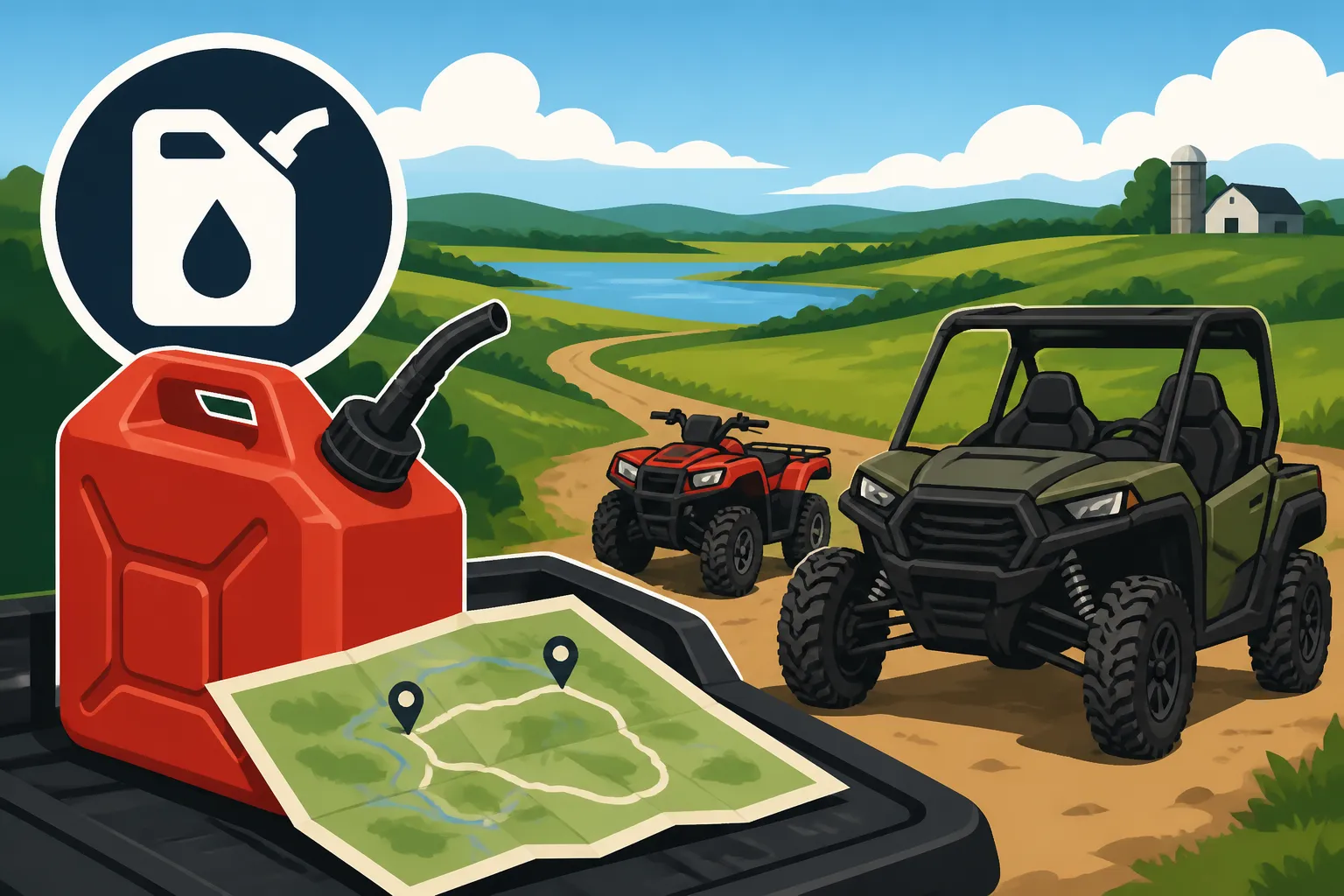
Mark fuel stops before the ride, not after the low-fuel light comes on. Look for fuel in towns along your planned travel corridor, then check whether the station is accessible to your tow vehicle and trailer. Confirm its location, operating status, and available fuel directly before relying on it. A point on a map is not automatically a dependable stop: it may be closed, inconvenient to enter with a trailer, or farther from the route than it first appears.
When mapping the ride, separate machine fuel from tow-vehicle fuel. A station that is easy to reach with a truck and trailer may not be a legal or practical place to ride an ATV or UTV to. Unless you have confirmed that a road is open to your machine and that you meet the rules for riding there, plan to trailer between riding areas rather than treating roads as convenient trail connectors. See Iowa Rules for Riding a Gravel Road before considering any public-road segment.
Digital mapping tools can help you examine the route and mark candidate stops. For instance, onX Offroad can help organize route information and saved locations, but a map should not replace checking local access, park notices, and actual fuel availability. The safest plan combines a map with direct confirmation of the places you intend to use.
Treat Gypsum City as a riding destination, not an assumed fuel stop
Gypsum City OHV Park near Fort Dodge is a recognizable northern Iowa riding destination. If you are planning a weekend around the park, use Riding Gypsum City for a Weekend and 65 Miles in Webster County as route-planning context, but do not assume that fuel is available at the trailhead or that a town stop is close enough for your machine’s range. Confirm amenities and access before you go.
A practical plan is to arrive with the machine ready for the intended ride and with the tow vehicle’s needs accounted for separately. If you expect to leave the riding area to refuel, first establish how you can do that lawfully and safely. In many cases, hauling to a confirmed station or carrying an appropriate fuel reserve is a more reliable plan than improvising a road ride.
For a larger northern Iowa outing, think in separate riding segments. You might ride one area, load up, refuel the tow vehicle and machines where appropriate, and then travel to another destination. Do not assume that parks or trails form a continuous route simply because they appear close together on a regional map. Check Fuel Between Iowa Trailheads and Trailering an ATV Across Iowa when you are organizing stops between separate riding areas.
Use maps as planning tools, then verify on the ground
A saved route makes it easier to compare options, but maps can show roads or tracks that are not legal riding routes, are closed, or do not provide the access you need. Use onX Offroad to organize candidate routes and fuel locations, then verify the riding rules and trail status with the relevant park or land manager. Save an offline map if you expect weak mobile service, and make sure every rider knows how to identify the staging area and the planned return point.
Also bring a paper or offline backup of the essentials: the route, the fuel-stop addresses, a contact number for the park or destination, and the location of your trailer. A phone battery can drain quickly when used for navigation, photos, and group messages. A backup plan is particularly useful when the group separates briefly or a rider takes a wrong turn at a junction.
Before the trip, review Iowa Trail Maps From the DNR and compare them with current park information. Maps help you prepare; current access information helps you avoid driving a loaded trailer to a closed gate or planning a ride around a trail that is unavailable.
Carry fuel and plan the group’s limits
Set the ride limit by the machine with the shortest range
A group’s route should be based on the machine with the least dependable range, not the one with the largest tank. Machines can vary in capacity and fuel use, and the rider who goes farthest on one tank may not be the rider with the smallest reserve. Before leaving the staging area, agree on a turn-back point and make sure every rider understands that the plan may change if fuel use is higher than expected.
If people in the group have not ridden together before, compare machine types and ask how each rider estimates their range. This need not turn into a complicated calculation. The important part is making sure nobody assumes that another rider’s machine can comfortably complete the same loop. If one machine has uncertain fuel use, plan a shorter first segment and reassess before committing to more distance.
Set a simple rule: the group turns back when the first machine reaches the planned reserve threshold, rather than waiting until its fuel is nearly gone. That keeps the group together and avoids putting pressure on the least-resourced rider to continue. If the route includes a long stretch with no confirmed refueling option, shorten the loop to fit the most conservative estimate.
Carry only suitable, secured fuel
If you decide to carry extra fuel, use a container intended for fuel and suitable for the way you will transport it. Secure it so it cannot tip, slide, rub against hot components, or interfere with steering and passenger movement. Do not improvise with an unapproved bottle or leave a container loose in a cargo area.
Keep fuel away from ignition sources, protect it from damage, and follow the container manufacturer’s handling instructions. Refuel outdoors in a suitable location, shut the engine off, and allow hot parts to cool before adding fuel. Avoid smoking or open flames. Take care not to spill fuel onto the machine, hot exhaust components, soil, or water, and clean up any spill safely before continuing.
Carrying extra fuel is not a substitute for estimating the ride. Too much unsecured cargo can create a hazard, while a small reserve can give a false sense of security if the route is longer or harder than expected. Check the machine’s manual for fuel and refueling guidance, and check the riding area’s rules before bringing fuel onto the property.
Keep the reserve separate from your normal ride allowance
Think of reserve fuel as a contingency, not as fuel that belongs in the planned route. If your estimate says the machine can complete the loop with a margin, avoid stretching the ride simply because you packed extra. A detour, group delay, worsening trail conditions, or a navigation mistake can use that safety margin faster than expected.
For a family ride, explain the plan before engines start. Tell younger or less experienced riders where the group will stop, what to do if someone has a machine problem, and why the group may turn around early. A calm conversation at the staging area is much easier than trying to coordinate a change of plan after the group has spread out on the trail.
If a machine begins using fuel faster than expected, shorten the ride immediately. Stay together, choose the most direct legal route back to the staging area, and avoid unnecessary idling. Do not assume another rider’s spare fuel will fit your machine or that transferring fuel is safe without the right equipment and conditions.
Build a practical northern Iowa fuel plan
Use a pre-ride checklist
A few checks before departure can prevent the most common fuel-planning problems. Use this list when you prepare:
- Confirm the ride area is open. Check current notices and conditions before loading. A closed or muddy trail can force a last-minute change, so identify a backup destination if the drive is substantial.
- Check the route and return point. Confirm the planned distance, junctions, and staging location. Do not rely on memory or assume every mapped line is an approved ATV or UTV route.
- Estimate fuel from your machine’s experience. Use a similar ride and load as your reference, then account for tougher conditions.
- Confirm refueling options. Verify the fuel stop’s location, access, and availability. Keep the tow vehicle’s fuel needs separate from the machines’ needs.
- Agree on a conservative turn-back point. Make the group plan around the machine with the shortest dependable range.
- Check your gear and machine. Look for leaks, loose caps, damaged containers, or other issues before riding. Carry water, basic tools, and a way to contact the group or emergency help.
- Save the plan offline. Store the route and important locations where you can access them without a strong mobile signal.
If weather or trail conditions change, update the plan rather than forcing the original route. Checking Whether Three Parks Are Shut is a useful reminder to check more than one destination when you are willing to travel to a backup area. If your first choice closes, you will want to know whether the alternative is open before moving the trailer and machines.
Decide whether to shorten, refuel, or trailer
When the fuel plan feels tight, there are three sensible options: shorten the loop, add a confirmed refueling stop, or trailer to a different riding segment. The right choice depends on legal access, station location, trail conditions, and how much fuel your machine is likely to use.
Shortening is often the simplest fix. Remove an optional spur or choose a loop with a clear return to the staging area. A shorter ride that ends comfortably is better than an ambitious route that leaves the group watching the fuel gauge. Adding a refueling stop can work, but only when access is confirmed and the stop does not depend on an unverified road connection. Trailering is useful when destinations are separate or when a public-road link is not authorized for your machine.
Avoid trying to solve a range problem by riding faster or pushing a machine harder. That can make fuel use less predictable and create unnecessary risk. If a rider is low on fuel, head back as a group, keep the route simple, and stop adding mileage.
Make a plan everyone can follow
A good fuel plan is easy to explain. Before the ride, tell the group the planned route, the expected stopping point, where the vehicles are parked, and the conditions that will trigger a shorter ride. Share the route with another responsible person if the outing is remote or the group is unfamiliar with the area.
For a multi-day trip, reassess each morning. Yesterday’s fuel use may not predict today’s if the weather, load, terrain, or route changes. Refill and inspect the machines before starting, and write down any unusually high consumption so you can adjust the next day’s plan. Keep the process straightforward: know what the machine uses, know where fuel is available, and do not count on access you have not verified.
With those steps in place, planning fuel for a northern Iowa loop becomes less of a guess. You can focus on the ride, keep the group within a sensible range, and avoid relying on a distant station or an uncertain route when the fuel gauge is already low.
Disclaimer
This article is for general informational purposes only and does not constitute professional advice. Laws, prices and regulations vary by location and change over time. Consult a qualified professional for guidance on your specific situation.