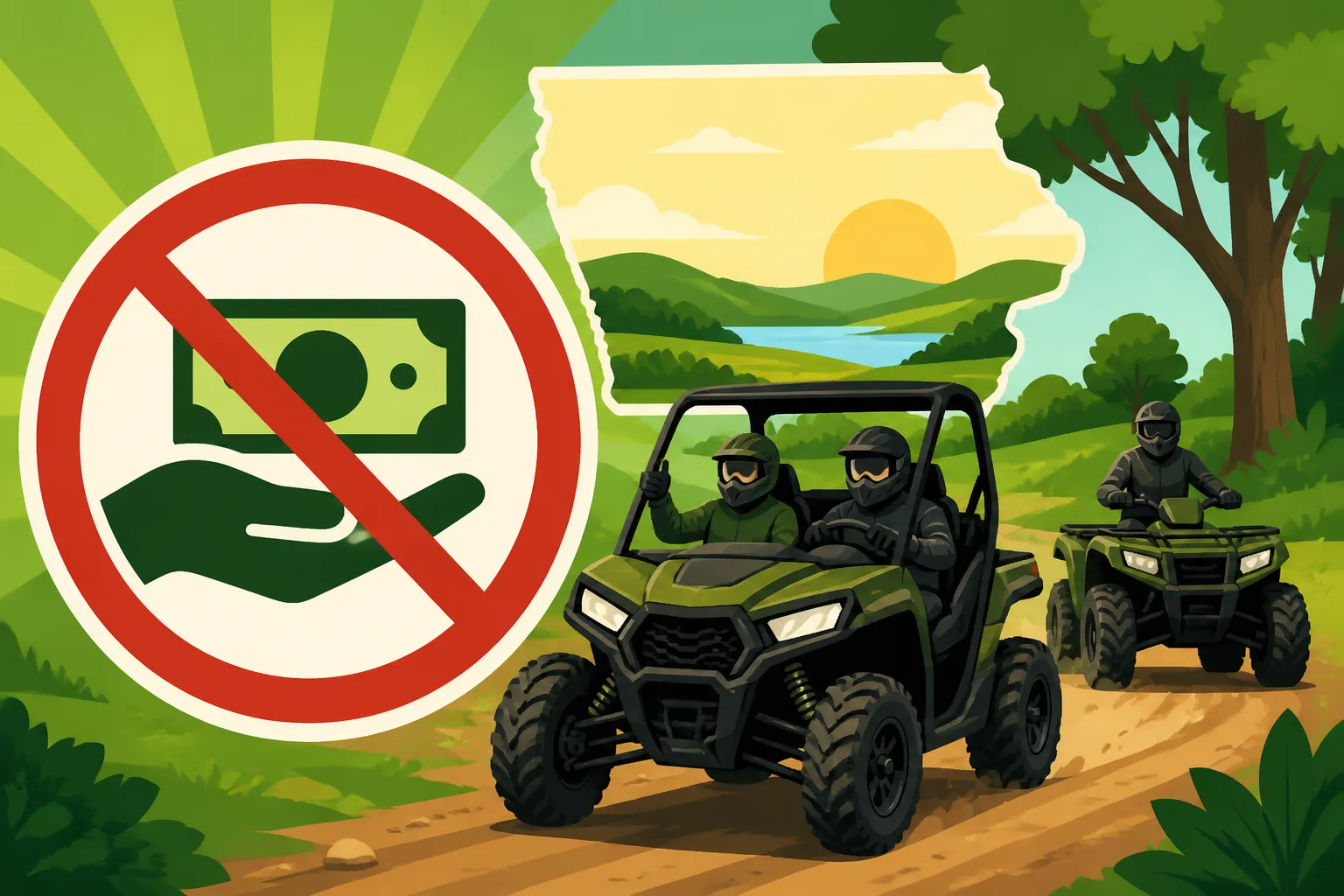
Why Iowa Parks Charge No Day-Use Fee
If you arrive at an Iowa OHV park expecting to pay at a gate, you may be surprised to find there is no day-use charge. That doesn’t mean riding is automatically free or that every machine is ready to ride. This guide explains how Iowa’s decal and permit system works, what a no-fee gate does—and does not—cover, and what visitors should check before unloading.
Why Many Iowa Parks Do Not Charge a Separate Day-Use Fee
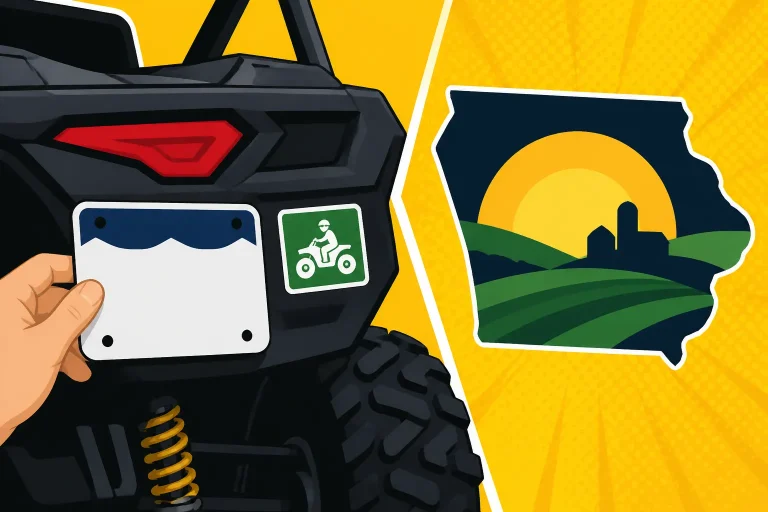
At many Iowa designated OHV riding areas, the registration decal or visitor permit is the key to riding. Instead of collecting a separate fee each time you enter, the system ties access to the machine’s Iowa registration or required nonresident permit. The decal functions as the park pass, rather than an additional gate charge.
That arrangement can make riding simpler. You generally do not have to stop at a booth, pay a different admission charge at each park, or buy a separate day ticket for every riding day. But “no day-use fee” is not the same as “no cost.” The machine still needs the correct documentation, and riders may have other trip expenses such as fuel, camping, lodging, repairs, and equipment.
The system also reflects how Iowa riding areas are supported. Public registration and permit revenue helps fund off-highway vehicle recreation, including trail-related work and grants. Some riding areas are operated by local governments or clubs, so the place you ride may rely on a combination of public support, local resources, and volunteer work. The funding model is not necessarily a direct payment from your machine to the specific park you visit.
That distinction helps explain why you may not see an attendant collecting admission. The cost is handled through the machine’s registration or permit process, and trail access depends on having the right decal and following the site’s rules. For more on the connection between a decal and access, see Why the Iowa Decal Is the Only Pass and Your Registration Decal Is the Park Admission.
No gate fee is not a promise of open access
A park can have no day-use charge and still be closed, restricted, or unsuitable for your machine on a particular day. Weather, trail conditions, maintenance, special events, and local operating rules can all affect access. A decal does not override a closure or give permission to ride outside designated areas.
Nor does the no-fee model apply automatically to every place where someone might ride an ATV or UTV. Iowa has designated OHV parks, but private land, other public areas, campgrounds, and organized events may have different access rules. Check the location you plan to visit instead of assuming that one decal opens every trail or recreation area in the state.
What Counts as Admission for Iowa Residents and Visitors
The right document depends on the machine and the rider’s situation. Iowa residents generally need the machine’s required Iowa registration and decal. Visitors may need an Iowa nonresident user permit unless an applicable exemption or reciprocity rule applies. Keep the documents for the machine you actually brought; a decal or permit attached to another machine does not grant access for yours.
| Rider and machine situation | What to check before riding | Practical point |
|---|---|---|
| Iowa resident with an ATV or UTV | Current Iowa registration and decal | Confirm the registration is valid and the decal is properly displayed. |
| Visitor with an out-of-state machine | Iowa nonresident permit requirements and any applicable reciprocity | Do not assume that a home-state registration alone is enough. |
| Rider relying on an exemption | Whether that specific machine and use qualify | An exemption may be limited; confirm it before heading to a riding area. |
| Machine rented in Iowa | Whether the rental has the required documentation and what the rental agreement requires | Ask the rental provider rather than guessing from the machine’s appearance. |
| Rider under the applicable safety-certificate age rules | Certificate and supervision requirements | Registration or a permit does not replace a rider’s separate safety obligations. |
For Iowa residents, start with Registering an ATV in Iowa or Registering a Side-by-Side in Iowa. For visitors, Iowa’s Permit for a Visiting Machine and Do Visitors Need an Iowa ATV Permit? explain the questions to resolve before travel. If you have heard that your home-state registration is honored, check the details at Does Iowa Honor Out-of-State Registration? and the specific reciprocity page for your state.
Reciprocity is a common source of confusion because it can sound broader than it is. A rule that recognizes one kind of out-of-state documentation may not erase every Iowa requirement, and it may depend on where the machine is registered or how it will be used. Check the current Iowa guidance for your home state and machine type. If you cannot confirm that your documents qualify, contact the appropriate Iowa office or the park before leaving home.
The permit follows the machine
Treat the decal or permit as machine-specific. Do not assume you can move it from a registered ATV to a side-by-side, or use one permit for two machines in your group. If you are bringing more than one machine, check each one separately. The rule is not about how many people are in the truck; it is about the documentation required for each machine that will be ridden.
That matters when friends share a trailer. One correctly documented machine does not make the rest of the group’s machines compliant. Before loading, match each machine to its registration or permit paperwork and check that any display requirements are met. For a visitor permit’s machine-by-machine limits, see Why an Iowa Nonresident Permit Covers One Machine and Why an Iowa Nonresident Permit Cannot Transfer.
What a No-Fee Gate Does Not Cover
A free entrance or lack of a day-use charge only answers one question: whether you pay a separate admission fee to ride that site. It does not answer every question about cost, permission, or what you can do once you arrive.
Camping and other amenities
Camping may be governed separately from trail access. A park may have campsites, hookups, reservation procedures, quiet hours, or other rules that do not come with the riding decal. Some sites may offer camping without a separate charge, while others may have costs or arrangements to confirm. Check the specific location before planning an overnight stay, especially if you are bringing a trailer or need an electric site. The site’s access policy and camping policy are not necessarily the same.
You should also distinguish trail access from special activities. An organized event, competition, commercial ride, or reserved facility may have its own procedures or costs. Ask the organizer or site operator whether an event requires advance permission, a separate registration, or proof of insurance. Do not rely on the ordinary riding-access rules to cover a special use.
Registration is not a pass for every kind of riding
A valid decal does not grant permission to ride on a closed trail, outside a marked route, or on land where you lack permission. It is also not a general road-use permit. Riding on public roads, private property, or other public land involves separate rules. For private ground, review Riding Private Ground in Iowa and Iowa Landowner Permission Rules. For designated areas, Iowa Rules on Designated Riding Areas is a useful place to start.
The same caution applies to equipment and rider requirements. A registration decal does not replace a safety certificate when one is required, make an undersized machine suitable for a young rider, or remove the need to follow site-specific helmet and passenger rules. If you are riding with children, review Iowa ATV Safety Certificate Requirements and Iowa Rules for Riders Under 12.
Equipment can add to the real cost of a ride
Even when there is no day-use payment, it is sensible to budget for the parts of the outing that prevent a small problem from becoming an expensive one: a properly maintained machine, suitable protective gear, a trailer with sound tie-downs, and a way to carry the required paperwork. A waterproof document pouch can help keep papers from getting wet or dirty. If you shop for one on Amazon or at a local outdoor store, choose a pouch that protects the papers without interfering with the machine’s required decal display.
A spare set of gloves or goggles may also be useful for a family ride, but buying gear is separate from park admission. Amazon is one option for comparing basic riding accessories; check fit, safety information, and return terms rather than treating an online listing as proof that an item meets a park rule. If you are trailering, Amazon may also carry general tie-down equipment, but make sure the straps are appropriate for your machine and trailer. Those purchases are optional trip preparation, not a charge imposed by the park.
The point is not to turn a no-fee visit into a shopping list. It is to budget honestly: no gate charge can still mean real costs before, during, and after the ride.
How Visitors Should Think About Reciprocity
Visitors often plan around the assumption that an out-of-state registration will be enough. That assumption can create a frustrating problem at the trailhead: the machine is unloaded, the group is ready, and only then does someone discover that an Iowa permit or other documentation was needed.
The safest approach is to verify the requirement before travel. Check whether Iowa requires a nonresident user permit for your machine, whether a reciprocity provision applies to your state, and whether the permit must be purchased for each machine. Make sure you are looking at information for the machine category you are bringing. ATV, UTV, dirt bike, youth machine, and electric machine rules may not be identical.
If you ride across state lines often, keep a simple trip file with the machine’s home-state registration, any Iowa permit confirmation, and the relevant safety or ownership documents. A phone photo can be a useful backup, but do not assume it replaces any document that must be carried or displayed. Check Iowa’s current instructions for what must be shown and where it must be kept.
For more visitor-specific guidance, see Iowa ATV Registration for a Nonresident, Iowa Reciprocity With Minnesota, Iowa Reciprocity With Missouri, Iowa Reciprocity With Nebraska, or Iowa Reciprocity With Wisconsin, as applicable. If the machine is registered in a different state, use the page for that state rather than relying on a general statement about visitors.
Confirm the details with the right source
For the permit or registration rule, check the official Iowa information before your trip. For whether a particular riding area is open, check that park’s current notices or contact the operator. These are separate checks: the state documentation can be in order while a park is closed, and an open park does not make an undocumented machine eligible to ride.
If a rule is unclear, ask a specific question. For example: “This machine is registered in my state, and I am visiting this riding area. Do I need an Iowa nonresident permit, and does this location have any separate camping or event charge?” That is more useful than asking only whether the park is free.
A Simple Checklist Before You Tow
A few minutes of checking can save a long drive and an awkward conversation at the entrance.
- Identify each machine. Note whether it is an ATV, UTV, dirt bike, youth machine, or another type of off-highway vehicle. Do not assume all machines in your group follow identical requirements.
- Check the documentation for each machine. Iowa residents should confirm registration and decal status. Visitors should confirm whether an Iowa nonresident permit is required or whether a specific reciprocity rule applies.
- Check display and carrying requirements. Make sure the decal is mounted as instructed and keep any required certificate or permit information accessible. See Iowa ATV Decal Placement and Carrying the Certificate on an Iowa Ride.
- Confirm the park is open. Look for closures, trail restrictions, maintenance notices, and weather-related updates. A valid decal does not authorize riding on closed trails.
- Ask about camping and special activities separately. Verify site arrangements, reservations, event rules, and any costs that are not part of ordinary day-use access.
- Review rider and machine rules. Check age and supervision requirements, safety-certificate obligations, helmet rules, passenger limits, and machine restrictions for that location.
- Plan the practical details. Bring suitable protective gear, water, basic tools, and a recovery plan. If trailering, check that the trailer and tie-downs are in good condition.
- Keep a backup plan. A weather closure or local restriction can change the day. Identify another suitable riding area and verify its rules before driving there.
This checklist also helps avoid mixing up three different things: the right to operate the machine under Iowa’s documentation rules, the right to enter a particular riding area, and the right to use additional services such as camping. The decal or permit may settle the first part of park access, but the other details still deserve a separate check.
The Practical Bottom Line
Iowa parks can charge no separate day-use fee because, at many designated OHV areas, the required registration decal or nonresident permit serves as the riding pass. The access model avoids collecting another admission charge at the gate, but it does not make every ride cost-free or every site automatically open to every machine.
Before you go, confirm the correct documentation for each machine, check whether reciprocity applies to your situation, and look up the park’s current operating and camping rules. A little preparation is usually easier than arriving with a machine that cannot legally ride or a group that has misunderstood what the no-fee gate covers.
Disclaimer
This article is for general informational purposes only and does not constitute professional advice. Laws, prices and regulations vary by location and change over time. Consult a qualified professional for guidance on your specific situation.