Iowa Trails Closed After Rain
A rainy forecast can turn an Iowa riding weekend into a frustrating guessing game: trails may be muddy, damaged, or closed even when the sky has cleared. There is no single statewide rule that every park shuts after the same amount of rain. This guide explains why closures happen, how to check conditions before loading up, and what to do when your usual trail is unavailable.
Why Iowa ATV trails close after rain
Iowa soil can stay soft after the storm passes
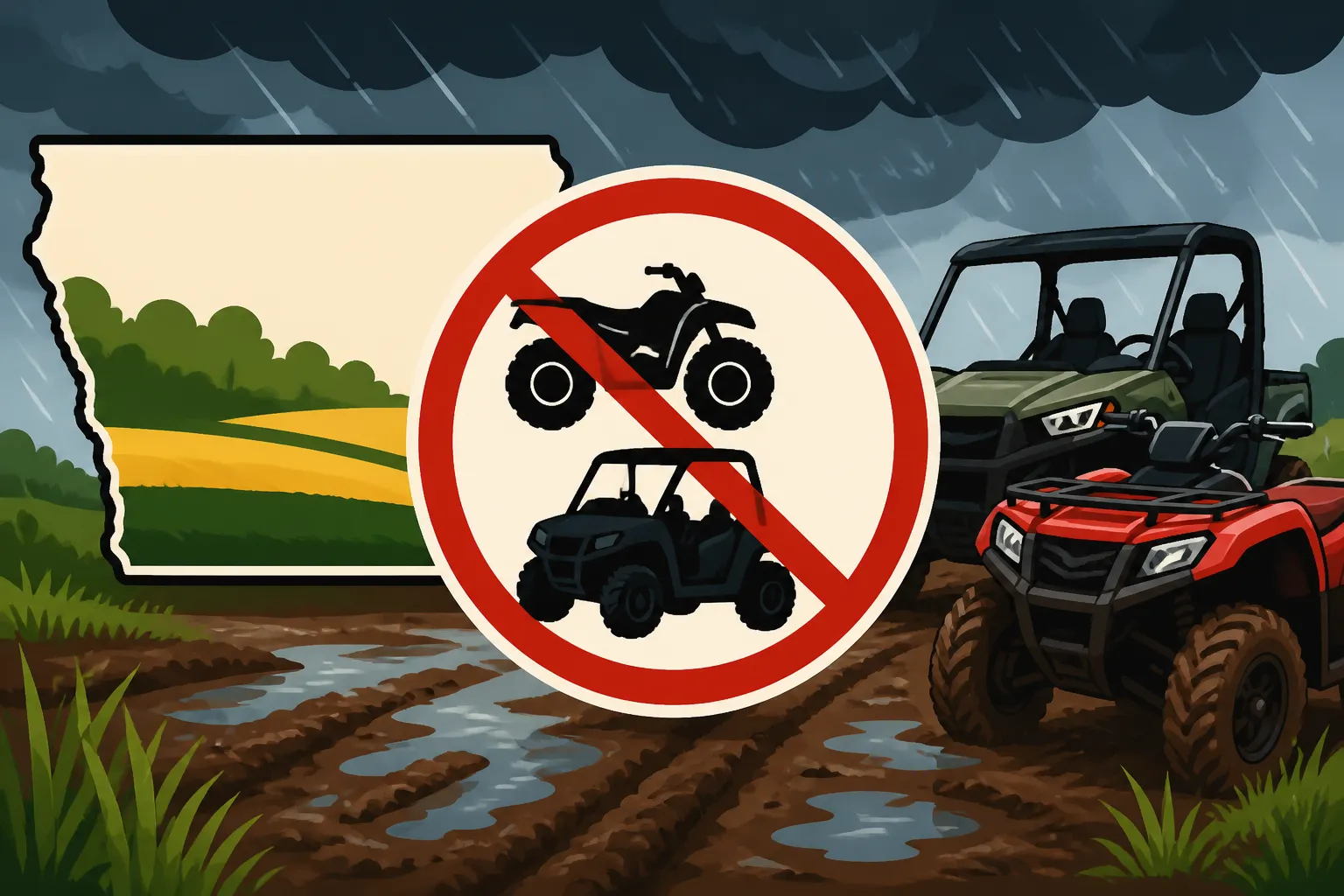
A trail can look rideable from the parking lot and still be too wet farther in. Iowa’s clay-rich soil can become slick and greasy when saturated, and low areas may hold water long after the rain stops. Shaded woods, creek crossings, and heavily used corners can dry at different speeds from exposed ground.
That matters because tire tracks do more than leave a cosmetic mark. A machine spinning for traction can deepen ruts, loosen soil, and send water down the trail instead of across it. On a slope, repeated passes may carve channels that are difficult to repair. A ride that seems manageable to one person can leave a lasting problem for everyone who follows.
Conditions also vary within a single park. A sunny stretch may firm up quickly while a wooded section remains soft. Recent rain, soil type, drainage, shade, traffic, and the route’s elevation all affect how a trail holds up. That is why a park may close particular loops or areas rather than reopen everything at once.
For a closer look at how weather affects local routes, see [Iowa's Weather-Driven Trail Closures] and [Iowa Trails Closed After Rain]. The practical takeaway is simple: a clear afternoon does not necessarily mean the trails are ready.
Closures protect trails, riders, and park operators
When a trail is wet, a closure gives the surface time to drain and firm up. It can also help prevent the kind of rutting that makes a route rougher or more hazardous after it dries. Deep ruts can catch a tire, make steering unpredictable, or force riders into unstable edges where erosion is more likely.
A closure is not always a sign that the entire park is flooded. Staff or volunteers may be trying to protect one vulnerable section, keep riders away from a damaged crossing, or avoid turning a short stretch into a repair project. Parks may also close when conditions make safe access or emergency response difficult.
If you arrive and find a posted closure, treat it as part of the riding rules, not a suggestion to find a way around. Riding past a barrier can damage the trail and may lead to enforcement. The same applies to taking an unofficial bypass through grass or woods: it can create a new trail where none is approved.
Learn more about what can happen when riders leave an authorized route in [Iowa Rules for Riding Off a Marked Trail]. If you want to understand how conditions and closures are communicated, [Reading a DNR Closure Alert] is also useful.
One wet weekend can affect parks differently
Rainfall totals alone do not tell the whole story. A quick shower over dry ground may have little effect, while steady rain after several wet days can leave trails saturated. A park’s drainage, terrain, soil, and recent rider traffic all shape how quickly routes recover.
That means one park can be open while another is closed, even if they are in the same general part of Iowa. Gypsum City near Fort Dodge, Bluff Creek near Eddyville, Rathbun near Plano, and other riding areas each have their own conditions and management decisions. Do not assume that a closure at one location means every park is closed—or that an open park has no wet sections.
| What you notice | What it may mean | A sensible next step |
|---|---|---|
| Rain stopped, but shaded ground is still soft | The trail may remain vulnerable | Check the park’s latest notice before leaving |
| Standing water or fresh deep ruts | A route may be unsafe or damaging to ride | Do not enter a closed or clearly compromised section |
| One loop is blocked while others are open | The operator may be protecting a specific area | Follow posted signs and use only open routes |
| No closure notice, but recent heavy rain | Conditions may have changed since the last update | Call or check the official park channel before loading |
| The parking area looks dry | Interior trails may still be saturated | Do not judge the whole park from the entrance |
How to check trail conditions before you drive
Start with the park or land manager’s own updates
Before setting out, look for a current notice from the park operator, county, club, or agency responsible for the riding area. A map app can help with general navigation, but it may not show temporary closures or same-day trail conditions. A listing that says a place is open is not a guarantee that every trail is open or rideable.
If a notice is unclear, contact the park or managing organization directly. Ask whether the trails are open today, whether any loops or sections are closed, and whether conditions have changed after recent rain. If the park provides a recorded message or social media updates, check the date and time so you are not relying on an old post.
The Iowa DNR alert feed can be one place to look for applicable public updates, but individual parks may also communicate through their own channels. See [Iowa Trail Conditions Before You Ride] and [Iowa Trail Closures to Check First] for a useful checklist of what to verify.
Use maps as a planning tool, not an open-status promise
An off-road map can help you understand the layout, compare possible destinations, and plan a backup route. onX Offroad may be useful for organizing a ride and reviewing mapped routes, but a map should not replace a current closure notice from the park operator. Temporary barriers, wet-trail restrictions, and local decisions can change faster than map information.
Before leaving home, use the map to identify a second destination or a shorter option nearby, then confirm that alternative with its operator. If your first choice is closed, that small bit of planning can save a long trailer haul followed by a disappointing turn-around.
At the trailhead, compare posted signs with what you saw online. If the signboard says a route is closed, follow the sign even if a map shows the route as open. You can use onX Offroad to orient yourself, but do not use it to navigate around a closure or to decide that an unmarked route is acceptable.
Make a practical go-or-no-go decision
A good decision combines official information with what you observe on arrival. A park may be technically open while sections remain wet, or the latest update may not reflect a new downpour. If you see water across a trail, soft ground, fresh deep ruts, or a barrier, pause and reassess rather than assuming the route will improve farther in.
When in doubt, ask the park operator or choose another activity. Protecting a machine from a muddy recovery is one benefit; avoiding trail damage and keeping other riders safe are just as important. If the park is open but you are unsure whether your chosen route is appropriate, stay on clearly marked, permitted trails and turn back before conditions deteriorate.
Do not confuse a road, farm track, or nearby public area with an authorized OHV route. Riding access depends on the land and its rules. For private property, get permission from the landowner, and review [Iowa Rules for Riding Private Land] before heading out.
What to do when a trail is closed or too wet
Respect the closure and avoid making a new route
A closed trail is not an invitation to ride around the gate. The detour may cross private land, sensitive ground, or an area that is closed for safety or repair. Riding around a barrier also spreads traffic onto ground that may not be designed or approved for motorized use.
If you reach a closure after entering the park, turn around using the open route you came from when it is safe to do so. Avoid spinning tires, cutting across vegetation, or widening the trail to get around a muddy patch. If you encounter a closure that is not clearly marked on the map, follow the signs and notify the park operator when you can.
For more on the consequences of using a closed route, read [Iowa Rules for Riding a Closed Trail]. A short, frustrating turn-around is usually better than leaving damage that takes time and volunteer effort to fix.
Keep your machine from making wet conditions worse
Even an open trail can be too soft for your machine, your tires, or your experience level. If the tires are sinking or spinning, stop before the ruts get deeper. Avoid repeated attempts to power through a muddy stretch; that can tear up the surface and leave you stuck in a worse position.
If you are already on a wet route, move carefully and follow the park’s direction. Do not ride through standing water when you cannot see what is beneath it, and do not assume a puddle is shallow. Water can hide ruts, branches, holes, or a soft shoulder. A passenger or group should also avoid crowding a vulnerable section while someone tries to get through.
For general preparation, [Iowa Riding After Heavy Rain] covers the kinds of conditions riders should consider. If the park is open but the trail feels beyond your comfort level, turning back is a sound decision—not a failure to finish the ride.
Have a backup plan before loading the trailer
A backup destination can make a weather-dependent weekend less stressful. Check another park’s status before you leave, confirm its rules and hours, and make sure your machines meet its requirements. Do not assume that a park farther away has better conditions just because it received a different forecast; confirm directly.
You can also plan a non-riding alternative, especially if you are traveling with family or friends. A closure may mean postponing the ride, exploring a nearby town, or choosing a different outdoor activity rather than driving from one closed trail to another.
Keep your expectations flexible. When rain interrupts a planned trip, the best outcome may be a shorter ride on a suitable open route—or no ride that day. The official closure notice, visible trail condition, and park rules should guide that choice. Use onX Offroad for route planning, then verify access and trail status with the people responsible for the park before you unload.
How to ride responsibly when trails reopen
Follow signs and stay on designated routes
Reopening does not mean every part of a park is equally firm or that all previous restrictions have disappeared. Read posted notices at the entrance, observe barriers, and stay on designated routes. If a section remains marked closed, do not cross the barrier because another rider appears to have done so.
This is especially important when a park uses temporary signs that are not reflected on a general map. onX Offroad can help you follow your planned route, but on-the-ground signs and instructions from park staff take precedence. If a route appears newly damaged or unsafe, avoid it and report the issue to the operator rather than trying to repair or bypass it yourself.
Leave the trail in a condition the next rider can use
Responsible riding is not only about obeying a closure. It also means avoiding unnecessary wheel spin, slowing down around soft sections, and not widening a trail to get around a puddle. Give other riders room, particularly when a narrow muddy stretch has limited safe passing space.
If you ride with a group, make sure everyone understands the plan before setting off. A group that spreads out or takes different routes can unintentionally create several tracks across a fragile area. Agree to turn around together if a route is too wet, and do not pressure a less experienced rider to continue through conditions that feel unsafe.
Check again before your next ride
Trail conditions can change quickly. Rain may arrive after you check, a park may reopen only certain routes, or a storm may damage a section that was previously passable. Make a fresh check before each trip rather than relying on what a friend saw last weekend.
If you want to explore other options when your regular destination is closed, [Where to Ride an ATV in Iowa] can help you start looking at alternatives. Use it alongside current park notices, not in place of them. A little extra checking can spare you the drive to a closed gate and help keep Iowa’s trails usable for the next dry weekend.
Disclaimer
This article is for general informational purposes only and does not constitute professional advice. Laws, prices and regulations vary by location and change over time. Consult a qualified professional for guidance on your specific situation.