Iowa OHV Parks Near Sioux City
Finding an Iowa OHV park close to Sioux City can be frustrating: the western corner of the state has fewer obvious designated riding destinations than central and eastern Iowa. This guide explains which Iowa park to investigate first, what the drive may involve, how to check trail access before loading up, and what to sort out for machine requirements and ride-day planning.
The closest Iowa OHV park to investigate from Sioux City
Why Gypsum City is usually the first stop to consider
Sioux City does not sit beside one of Iowa’s best-known designated OHV parks. For a dedicated Iowa park trip, Gypsum City OHV Park near Fort Dodge is generally the first destination to investigate. It is in Webster County, east of Sioux City, and is a more practical starting point than parks farther south or east.
The drive is still a real outing, not a quick hop to a nearby trailhead. Depending on your starting point, route, traffic, and stops, expect to spend a good part of the day getting there and back. Check a current navigation app before leaving, and compare the travel time with the park’s latest access information. The broader list in [Iowa's Eight Designated OHV Parks] can help if you are weighing Gypsum City against other Iowa destinations.
Gypsum City is known for an extensive trail network and more than one kind of riding area, so it may suit a family or group with varied experience better than a small, single-purpose riding site. Before planning around a particular loop or track, though, confirm what is open and appropriate for your machine. The overview of [Gypsum City OHV Park at Fort Dodge] is a useful starting point, and [65 Miles of Trail at Gypsum City] explains why the park can be a full-day destination rather than a brief stop.
How other Iowa parks compare from Sioux City
Other established Iowa OHV parks are generally farther away from Sioux City. A park that looks close on a statewide map can still mean a long drive once you account for where it sits, the road route, and the time needed to haul a trailer. If your group is open to a longer weekend, compare locations rather than choosing by name alone.
| Riding option | How it fits a Sioux City trip | What to check before committing |
|---|---|---|
| Gypsum City near Fort Dodge | Often the first Iowa park to investigate for a dedicated ride from Sioux City | Open status, machine suitability, trail conditions, and campground details |
| Parks farther south or east, such as Bluff Creek or Rathbun | Better considered for a planned longer outing than a quick local ride | Total drive time, operating information, weather, and overnight options |
| Private land or local riding arrangements | May be closer, but access depends on permission and specific rules | Written permission, boundaries, and whether the land is actually open for riding |
| Parks in a neighboring state | Could be an alternative if you are willing to cross state lines | That state’s registration, permit, equipment, and park rules |
Names such as Bluff Creek OHV Park and Rathbun OHV Area may come up when you search for places to ride in Iowa, but they are not substitutes for checking the trip from Sioux City. The farther the park, the more important it is to confirm current access before you buy fuel, load the trailer, or book a campsite.
A nearby map pin does not automatically mean a ride is allowed
A trail line on a phone map can be useful for orientation, but it does not establish that the route is open to ATVs or UTVs. It might be a hiking trail, a private road, a closed route, or a track that is not part of a designated OHV area. Public ownership alone also does not mean motorized riding is permitted.
Mapping tools such as onX Offroad can help you compare routes and get a broad picture of your trip, but treat them as planning aids—not as permission to ride. For the same reason, do not assume a dirt road, field edge, drainage, or wooded track outside an OHV park is an authorized riding route. The rules in [Iowa Rules for Riding a Designated Riding Area] are a better place to start when you are sorting out where an off-road machine may be used.
How to confirm a park is worth the drive
Check closures and trail conditions close to departure
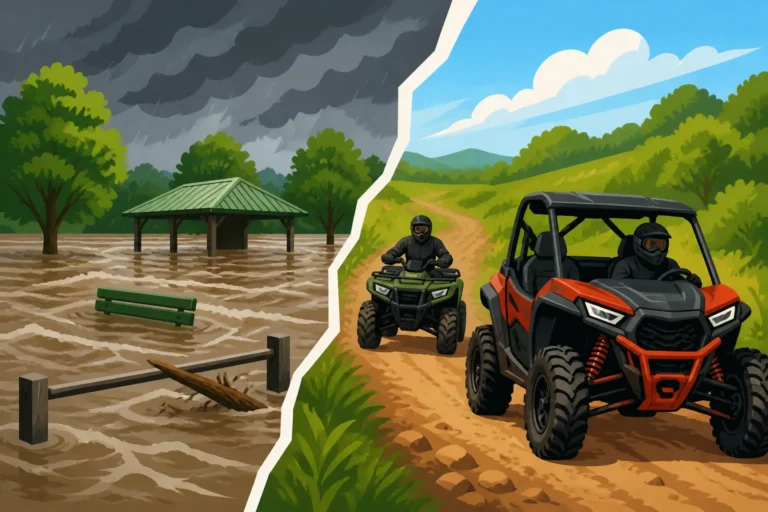
A park can be listed as open and still have individual areas affected by rain, maintenance, or changing trail conditions. Iowa’s clay soils can turn slick and hold water, and riding on saturated ground can damage trails and create difficult conditions for riders. A long drive makes this check especially important: a closed gate or limited trail access is a rough surprise after you have already hauled a machine across the state.
Look for the park’s own announcements and relevant Iowa DNR updates before leaving. The resources on [Iowa Trail Conditions Before You Ride] and [Iowa Trail Closures to Check First] can help build a pre-trip routine. Check again on the morning of the ride if weather has changed since you first made plans. A sunny forecast in Sioux City does not guarantee the same conditions around Fort Dodge.
If the main park is closed or not suitable for your machine, have a backup plan before you set out. That might mean rescheduling rather than driving farther to an unverified location. The advice in [Iowa's Weather-Driven Trail Closures] is particularly useful when rain is in the forecast or the ground has stayed wet for several days.
Make sure the park matches your machine and experience
Before loading, confirm that the park allows your type and size of machine. A rider on a dirt bike, a family using youth machines, and a group bringing wide side-by-sides may not all have the same trail options. Even within a single park, a track or loop may have different suitability from the rest of the network.
Be realistic about experience, too. A large trail system can include routes that feel very different in width, terrain, traffic, and difficulty. If newer riders are coming, ask whether there are appropriate beginner areas and whether the park provides a current map or difficulty guidance. [Iowa Trails for Beginners] offers useful context for choosing a ride that does not push the least experienced person into a stressful day.
Talk through the plan before the group arrives. Decide who is leading, where you will stop, and how you will handle a machine issue or a rider who wants to turn back. On a big riding day, a simple regrouping plan can prevent the familiar problem of one person thinking everyone is at the parking area while the rest of the group is still on a trail.
Use maps carefully, and keep official information in charge
A route-planning app can help you estimate a drive, identify fuel stops, and keep track of where your group expects to travel. onX Offroad can be one tool for reviewing the broader area, but compare its map information with the park’s own directions and rules. App data and official notices serve different purposes, and neither should be treated as a substitute for posted signs at the park.
Download or save the information you need before you reach the trailhead. Cell service can vary, and it is frustrating to arrive with a low battery and no working map. If your group uses onX Offroad, make sure everyone knows the planned meeting point and carries a way to communicate if riders get separated. Keep the park’s official map or directions accessible too.
At the gate, parking area, or trail junction, follow posted instructions even if they differ from the route you planned. Conditions and closures can change, and a map may not show a new restriction. If you are unsure whether a route is open to your machine, stop and ask park staff or use the park’s contact information rather than guessing.
Registration, permits, and rules to check before riding
Confirm what your machine needs in Iowa
Iowa riding requirements can depend on where you live, how your machine is registered, and where you plan to ride. Do not assume that the paperwork you use at home automatically covers a visit to an Iowa OHV park. Residents and visitors may face different requirements, and the details can vary by machine type.
If you are coming from outside Iowa, check [Iowa's Permit for a Visiting Machine] and [Iowa ATV Registration for a Nonresident] before your trip. Those topics can help you identify which permit or registration rules may apply. If you live in Iowa, review the relevant registration information for your machine rather than relying on a decal that may have expired or belongs to another vehicle.
Also confirm what documents you should carry and whether your machine’s required decal is displayed correctly. A stop at the park entrance is a poor time to discover that a form, permit, or sticker is missing. Keep required paperwork where you can access it without unpacking half the trailer.
Understand the difference between park riding and road riding
Getting to an OHV park does not mean you can ride on every road around it. Rules for designated riding areas are not the same as rules for public roads, and local authorization can matter. Do not ride your ATV or UTV from a campground, parking area, or fuel stop onto a public road unless you have confirmed that the route is legally open to that type of machine and that you meet applicable requirements.
This matters around smaller communities and rural roads, where a short stretch of pavement may look like the obvious connection between two places. A route shown on a general map is not proof that ATVs or UTVs may use it. Check the road-specific rules, signage, and local permissions, and trailer the machine when you are unsure.
The same caution applies to riding on nearby private land. Seeing tracks in a field or timber does not tell you who owns the property or whether riders have permission. Ask the landowner directly and get clear approval for the area and timing. For broader land-access guidance, see [Iowa Landowner Permission Rules].
Make the permit and safety check part of your packing routine
Put paperwork and equipment on the same checklist as helmets, fuel, tie-downs, and tools. Before departing Sioux City, confirm your machine’s registration or permit status, required safety equipment, and any park-specific rules. If younger riders are joining, check the requirements that apply to their ages and machine types, and make sure supervision expectations are clear.
A straightforward checklist can prevent last-minute scrambling:
- Confirm the park is open and review any trail restrictions.
- Verify that your machine is permitted and suited to the trails you plan to ride.
- Check Iowa registration or nonresident permit requirements.
- Pack required documents and safety equipment.
- Save the park map, directions, and contact details.
- Choose a meeting point and backup plan in case riders get separated.
- Recheck weather and trail conditions before you leave.
The Iowa DNR’s [Iowa Trail Maps From the DNR] can be helpful when comparing official riding locations and planning a route. Keep in mind that a map helps you navigate; current notices and posted rules determine what you can ride that day.
Planning a smoother Sioux City riding trip
Decide whether the trip is a day ride or an overnight
For many Sioux City riders, Gypsum City is far enough away that the day’s driving and hauling deserve as much attention as the riding itself. A day trip may work if your group is organized and you leave enough time for the return drive. If you want a relaxed pace, plan to stay overnight rather than trying to fit every ride, meal, and mile into one day.
Check camping details directly with the park or the relevant local operator before counting on a site. Availability, facilities, and seasonal access can change. The guide to [Camping Near an Iowa OHV Park] can help you think through the basics, but confirm the arrangements for your chosen destination before you travel.
If you are camping, pack for the fact that a trail day gets dusty, muddy, and tiring. Bring suitable clothing, water, food, basic tools, and a plan for washing or securing gear. Keep a dry change of clothes separate from riding equipment, especially if the forecast suggests rain.
Prepare the trailer, machines, and group before leaving town
A loose tie-down or a machine that will not start can turn the first hour into a roadside repair session. Check tires, lights, straps, trailer connections, fuel, and basic machine condition before departure. If you are bringing more than one machine, confirm that the trailer has enough space and that every vehicle can be secured independently.
Agree on who brings what. One rider can carry a basic tool kit while another handles first aid and water, for example. Make sure everyone knows where the truck and trailer will be parked and how to reach the group if someone needs to return early. These small conversations are particularly valuable when family members or riders with different experience levels are sharing a long day.
Finally, leave room in the plan for a slower ride than expected. Trail conditions, congestion, breaks, and mechanical issues all affect how much ground you cover. A good day is not measured by squeezing in every loop; it is one where everyone rides within their comfort level and gets home safely.
Set expectations about what “near Sioux City” means
When people search for Iowa OHV parks near Sioux City, they may be hoping for a trail area just outside town. In practice, the best-known Iowa destination to investigate is farther east, and a dedicated park ride may require a substantial drive. If that is not the outing you want, consider planning a neighboring-state destination or arranging a legal private-land ride—but verify the rules and access independently.
Do not let a map label or social media post substitute for current permission. A place someone rode last season may now be closed, restricted, or private. Check official park information, confirm the route is appropriate for your machine, and make a backup plan before you load.
A little preparation makes the longer trip feel much more manageable. Choose the park based on machine fit and conditions, not just its name; verify permits and closures; and give yourself enough time to enjoy the ride without rushing back to Sioux City in the dark.
Disclaimer
This article is for general informational purposes only and does not constitute professional advice. Laws, prices and regulations vary by location and change over time. Consult a qualified professional for guidance on your specific situation.