Iowa Horn Requirement for Road Use
Hitting Iowa's scenic gravel roads or even crossing a paved secondary route on your ATV or UTV can be an absolute blast, a real taste of freedom. But that exhilarating feeling can quickly turn to a knot in your stomach if you're stopped by a deputy and realize your beloved machine isn't quite up to snuff for legal road use. One of those often-overlooked requirements, and a real head-scratcher for many riders, is the humble horn. This comprehensive guide will untangle Iowa's horn requirement for ATVs and UTVs, ensuring you know exactly what you need to ride legally and confidently.
Navigating Iowa's Road-Use Rules for ATVs and UTVs: The Horn's Place
It’s easy to think of your ATV or UTV primarily as an off-road beast, built for trails, fields, and pushing through tough terrain. And for the most part, that’s exactly what they are designed for. However, the moment your tires leave private property and touch a public road – even a short stretch of gravel to get to another trail or farm field – the rules of the game change entirely. Iowa lawmakers, in their wisdom, decided that if these powerful machines are going to share space with cars, trucks, and even bicycles, they need to adhere to certain safety standards designed for road-going vehicles. This shift from purely recreational equipment to a recognized, albeit specialized, vehicle is where the horn, among other items, becomes absolutely essential.
Stepping Onto Public Roads: The Shift in Rules
The biggest frustration for many riders in Iowa is understanding that simply owning an ATV or UTV doesn't automatically grant you permission to ride it on public roads. There's a whole set of criteria your machine must meet, turning it into what's often referred to as "street legal" – though that term itself can be a bit of a misnomer, as very few ATVs or UTVs are truly street legal in the same way a car is on all roads. The core idea is that when you're on public land, especially roads, you're not just accountable for your own safety but also for the safety of others you might encounter. This is why even just crossing a short paved section, or riding down a level B road, suddenly brings a host of rules into play that don't apply when you're tearing through your back forty.
Think about it: when you're driving your car, you expect other vehicles to have working headlights, taillights, turn signals, and yes, a horn. This expectation extends to ATVs and UTVs operating in similar environments. The law isn't there to make your life difficult; it's there to provide a baseline of safety and communication between all road users. Ignoring these rules, even the seemingly minor ones like a horn, isn't just a risk for a ticket; it's a risk to yourself and others. This foundational understanding is key to grasping why Iowa's regulations exist and why every piece of required equipment, including that horn, has a vital role to play.
The Full Road-Legal Checklist: More Than Just a Honk
While this article zeroes in on the horn, it’s crucial to understand that it’s just one piece of a larger puzzle when it comes to making your ATV or UTV compliant for Iowa road use. A horn on its own won't get you a clean bill of health from a patrolling deputy. Iowa law has a pretty clear list of what your off-highway vehicle (OHV) needs to have to legally venture onto those unpaved secondary roads, or even cross certain paved ones with county authorization. It's a comprehensive approach to safety, ensuring that you can see, be seen, and communicate effectively with other vehicles and pedestrians.
Here's a quick rundown of some of the other key items you'll need, beyond just your trusty horn:
- Headlights: You need at least one, and it must be on at all times, even in broad daylight. This isn't just for seeing; it's for being seen.
- Taillights: At least one, visible from the rear. Essential for preventing rear-end collisions, especially during dusk or dawn.
- Brake Lights: These need to illuminate when you hit the brakes, signaling to anyone behind you that you’re slowing down or stopping.
- Mirrors: You'll need at least one rearview mirror, properly mounted, to give you a clear view of traffic approaching from behind. Many riders find that having two, one on each side, offers a much better field of vision. Check out [Iowa Mirror Requirement for Road Use] for more details on this.
- Slow-Moving Vehicle (SMV) Triangle: This bright orange and red triangle needs to be mounted on the rear of your machine, visible from a certain distance. It's a universal signal that your vehicle travels slower than typical road speeds. You can learn more about its specific placement and use in [Iowa Slow-Moving Vehicle Sign Rules].
- Tires: Your tires must be pneumatic (air-filled) and designed for road use, not just aggressive off-road lugs that could damage road surfaces or be unsafe at speed.
- Insurance: Perhaps one of the most critical requirements, you absolutely must carry liability insurance that meets Iowa’s minimum coverage limits. A lack of insurance can lead to significant fines and penalties. We cover this extensively in [Iowa ATV Insurance Requirement].
- Registration and Decal: Your machine must be properly registered with the Iowa DNR through your county recorder, and you must display the current decal on the rear of your machine. You also need to carry the registration certificate with you.
- Driver's License and Age: You must be at least 18 years old and hold a valid driver's license to operate an ATV or UTV on public roads in Iowa. This is a common point of confusion, and there are strict rules about it. See [Iowa Minimum Age to Ride a Road] for the full scoop.
All these components work together to ensure your machine meets the fundamental safety expectations for road users. Skipping any one of them can not only lead to a citation under [Iowa Fines for Illegal ATV Road Use] but also compromise your safety and the safety of others. Understanding this full checklist, detailed in articles like [What Iowa Requires of an ATV on a Public Road] and [Are ATVs Street Legal in Iowa?], helps put the horn requirement into its proper context.
Deciphering the Iowa Horn Requirement: What Makes a Legal Horn
Now, let's drill down into the nitty-gritty of the horn itself. When the law states you need "a horn," it's not just talking about any old noise-maker. There are some implicit, and sometimes explicit, expectations about what constitutes a legal and effective warning device. This isn't about having a novelty horn that plays a tune; it's about having a functional, reliable piece of safety equipment that can alert other drivers, cyclists, or pedestrians to your presence in a potentially dangerous situation. It's about preventing accidents, plain and simple.
The Legal Definition of an ATV or UTV Horn in Iowa
Iowa Code doesn't get overly prescriptive about the type of horn, but it's clear about its function: it must be "in good working order and capable of emitting sound audible under normal conditions from a distance of not less than two hundred feet." This is the crucial part. It means your horn can't be a tiny squeak that only you can hear. It needs to be loud enough to cut through ambient noise – things like engine sounds, wind noise, or other traffic – and truly grab attention from a reasonable distance.
This requirement often frustrates riders who have a small, stock horn on their ATV or UTV. You might think, "Well, it makes a sound, so it's a horn, right?" But a deputy at a roadside stop might test it and determine it's simply not loud enough to meet that 200-foot audibility standard. This isn't about personal preference; it's about a measurable safety threshold. Imagine you're approaching a blind curve on a gravel road, and a car is coming the other way. A quick, loud blast of your horn could be the difference between a near-miss and a collision. The law wants to ensure your horn is up to that task.
Another important point: the horn must be permanently attached to the vehicle and operated by a push-button or similar mechanism, easily accessible from the driver's position. This isn't something you can just hold in your hand or attach temporarily. It needs to be an integral part of your machine's safety features, ready to deploy at a moment's notice, whether you're riding [Iowa Rules for Riding a Gravel Road] or navigating a paved secondary road under [Iowa Rules for Riding a Paved Secondary Road].
Choosing the Right Horn for Your Iowa Machine
Given the requirement for audibility, many stock ATV horns, especially on older models, might not quite make the cut. This means many Iowa riders find themselves in the market for an aftermarket horn. Luckily, there are plenty of options available, ranging from simple electric upgrades to more robust air horns.
- Electric Horns: These are the most common type and often the easiest to install. They connect to your machine's electrical system. You can find louder, more robust electric horns that are specifically designed for powersports vehicles, providing a more authoritative sound than a standard factory horn. Brands like SuperATV offer various electric horn kits, some even designed as direct plug-and-play replacements, making the upgrade process relatively straightforward. When choosing an electric horn, pay attention to its decibel rating (dB) and reviews regarding its loudness.
- Air Horns: For those who really want to make their presence known, air horns are an excellent choice. They typically consist of a small compressor, an air tank, and one or more trumpets. Air horns are considerably louder than most electric horns and easily meet the 200-foot audibility requirement. The trade-off is often a more complex installation process, as they require more space for components and a power source for the compressor. However, the peace of mind they offer in terms of alerting others is often well worth the extra effort.
- Manual Horns: While technically a "horn," things like bicycle bells or handheld air horns are generally not acceptable for ATV/UTV road use in Iowa. The law implies a powered, permanently mounted, and easily accessible device. A deputy is unlikely to consider a handheld air horn as meeting the spirit of the law for a vehicle of this type.
When making your choice, consider not just the loudness but also the durability and weather resistance of the horn. Your ATV or UTV is likely to be exposed to mud, water, dust, and vibrations, so a robust, waterproof design is critical for longevity and reliability. Brands that specialize in off-road accessories, such as SuperATV, often design their horns with these harsh conditions in mind, ensuring they stand up to whatever Iowa's trails and roads can throw at them.
DIY vs. Dealer Installation: What to Consider
Once you've chosen your horn, the next step is installation. This can be a straightforward DIY project for those with some mechanical aptitude and basic tools, or it can be something best left to a professional.
For the DIY Enthusiast:
Installing an electric horn typically involves mounting the horn itself in a location where it's protected but can still project sound, running a power wire (often through a relay and fuse for protection) to the battery, and connecting a switch on your handlebars or dash. Many aftermarket kits, like those from SuperATV, come with comprehensive instructions and all the necessary wiring, connectors, and mounting hardware, which can greatly simplify the process. The key is to ensure all connections are secure and weather-sealed, and that the wiring is routed safely away from moving parts or heat sources. Test your horn thoroughly after installation, both for function and for audibility from a distance.
For Dealer Installation:
If you’re not comfortable with electrical work, or if your chosen horn (like an air horn system) has a more complex installation, having a qualified dealer or powersports mechanic install it is a smart choice. They have the expertise, specialized tools, and knowledge of your machine's electrical system to ensure the horn is installed correctly, safely, and in compliance with all regulations. While there’s an added cost, the peace of mind knowing it's done right can be invaluable. This is especially true if you’re doing a full road-legal conversion kit, where multiple electrical components need to be integrated seamlessly.
Regardless of who does the installation, remember to verify the horn works perfectly before you head out onto any public roads. A non-functional horn is just as problematic as no horn at all.
Beyond the Installation: Maintaining and Verifying Your Horn's Readiness
Getting a horn installed is a great first step, but it’s not a "set it and forget it" kind of deal. Just like your brakes or your tires, your horn needs to be maintained and regularly checked to ensure it’s always ready when you need it most. A horn that works perfectly in your driveway might suddenly fail after a particularly muddy ride or a heavy rainstorm if it wasn't installed correctly or if its components weren't adequately protected. For Iowa riders, where conditions can change rapidly from dusty fields to slick mud, regular vigilance is key to staying compliant and, more importantly, staying safe.
Performing Regular Checks for Reliability
Making horn checks a regular part of your pre-ride routine is a habit worth cultivating. Before you even pull out of the garage or off your private land, give that horn button a tap.
- Listen for Clarity and Volume: Does it sound strong and clear, or is it weak, garbled, or just a click? If it sounds off, don't dismiss it.
- Physical Inspection: While you're at it, take a quick visual inspection. Is the horn mounted securely? Are the wires still firmly connected and free from corrosion? Is the horn unit itself clean and free from mud, debris, or rust? Many horns, especially aftermarket ones from reputable brands like SuperATV, are designed to be quite robust, but even the best equipment can suffer wear and tear from constant exposure to the elements and vibrations inherent in ATV/UTV riding.
- Weather Effects: Pay extra attention after you’ve ridden through deep water, heavy rain, or a particularly dusty session. Moisture and grit are the arch-enemies of electrical components. If you suspect water ingress, you might need to dry out the horn or check connections for corrosion.
- Battery and Electrical System: A weak battery can also affect horn performance. If your horn sounds weak, and other electrical components are also sluggish, it might be a sign of a low battery charge or an issue with your machine’s charging system. A well-maintained electrical system ensures all your safety features, including the horn, operate at their peak.
These quick checks take mere seconds but can save you from a potential safety hazard or an inconvenient citation. The goal is to always have a fully functional, properly sounding horn at your disposal whenever you might need to communicate on an Iowa road.
What Happens If Your Horn Isn't Up to Snuff on Iowa Roads
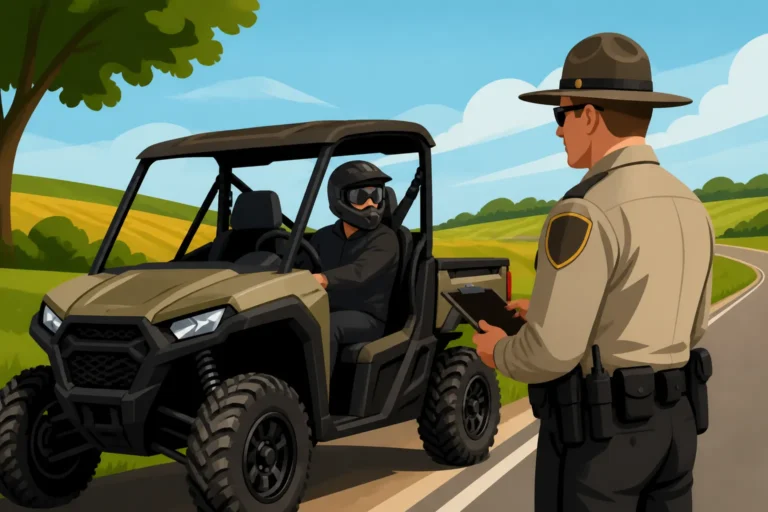
Riding without a functional horn on Iowa's public roads isn't just a minor oversight; it's a violation of state law. If a law enforcement officer, such as an Iowa DNR conservation officer or a county deputy, pulls you over and finds your horn either absent or not meeting the audibility requirement, you could face consequences.
- Citations and Fines: The most immediate consequence is typically a citation. Fines for equipment violations can vary, but they can certainly put a damper on your riding day and your wallet. These aren't usually astronomical, but they are certainly avoidable. The specific fine amount can depend on the county and the discretion of the officer, but it’s always more than zero. You can get more information on penalties for various violations in [Iowa Fines for Illegal ATV Road Use].
- Safety Risk: Far more significant than the financial penalty is the safety risk. A horn is a critical communication tool. Imagine a scenario where a child or a pet suddenly darts out from a driveway onto a gravel road you're traveling on. Your immediate reaction would be to brake, but a quick blast of the horn could also alert them, or others, to your presence, potentially preventing a tragic accident. Without that warning capability, you've lost a crucial layer of defense. This is especially true when navigating roads with blind spots or heavy vehicle traffic.
- Impoundment (Rare but Possible): In extreme cases, or if there are multiple serious violations, an officer could deem your machine unsafe for road travel and impound it, requiring you to address the issues before you can retrieve it. While this is less common for a simple horn issue, it highlights the importance of overall compliance.
- Loss of Riding Privileges: Repeated or severe violations could potentially impact your ability to register your machine or even lead to temporary loss of riding privileges on public lands.
The bottom line is that Iowa's horn requirement is not arbitrary. It’s a pragmatic measure to enhance safety for everyone on our roads. Taking the time to ensure your ATV or UTV has a loud, reliable, and functional horn isn't just about avoiding a ticket; it's about being a responsible, safe rider who respects the rules designed to protect our community. So, before you embark on your next adventure across Iowa's varied terrain, make sure that horn is ready to honk!
| Required Road-Use Equipment | Description | Importance |
|---|---|---|
| Horn | Audible at 200 feet, permanently mounted, accessible. | Alerts others to your presence, prevents collisions. |
| Headlights | At least one, on at all times. | Ensures you can see and be seen by others. |
| Taillights | At least one, visible from rear. | Signals your presence from behind, crucial for night/low visibility. |
| Brake Lights | Illuminates when braking. | Warns following traffic of deceleration or stop. |
| Rearview Mirror | At least one, properly mounted. | Provides critical visibility of traffic behind you. |
| SMV Triangle | Mounted on rear, visible. | Universal signal for slow-moving vehicle, enhancing safety. |
| Liability Insurance | Meets Iowa minimums (20/40/15). | Protects you financially in case of accident, legally required. |
| Registration/Decal | Current DNR registration, decal displayed. | Legal authorization to operate on public roads, funds trail maintenance. |
| Driver's License | Valid driver's license, 18+ years old. | Verifies operator competence for road use. |
Disclaimer
This article is for general informational purposes only and does not constitute professional advice. Laws, prices and regulations vary by location and change over time. Consult a qualified professional for guidance on your specific situation.