Iowa Minimum Age to Ride a Road
It's incredibly frustrating when you're eager to hit the trails or even just cross a short stretch of road on your ATV or UTV, only to realize the rules about who can ride where are a tangled mess. For families with younger riders, this can be especially confusing – when can your teen join you on a quick jaunt down a gravel road? This guide is here to untangle the specific age requirements for operating an ATV or UTV on public roads in Iowa, ensuring you understand the law and can ride safely and legally.
The Iowa Age Rule: Why Eighteen Is the Magic Number for Roads
Let's cut right to it: in Iowa, if you want to operate an ATV or UTV on a public road, you must be at least 18 years old. This isn't just a suggestion; it's a hard and fast rule set by the state. While ATVs and UTVs are fantastic for off-road adventures and farm work, when they touch public roads, they're treated with a different set of regulations, mirroring some aspects of regular motor vehicle laws. This age limit is firmly in place to prioritize safety, acknowledging the increased risks and responsibilities that come with sharing the road with other traffic.
Understanding the "Driver" Requirement
The reason Iowa sets the age at 18 for road use boils down to how the state classifies someone operating a vehicle on a public roadway. You're not just an "operator" in the off-road sense; you're considered a "driver," and with that comes the requirement of holding a valid driver's license. To obtain a standard driver's license in Iowa, you must be at least 18 years old, or meet specific requirements for a provisional license which still have significant restrictions. An ATV or UTV on a public road, even a quiet gravel lane, is treated much like any other motor vehicle regarding the operator's qualifications. This means that even if a younger rider has completed an ATV safety course and is proficient off-road, those qualifications don't extend to public road operation.
It's a common misconception that a youth ATV safety certificate, which is required for riders aged 12 to 17 on designated trails, somehow grants permission for road use. This is simply not the case. The safety certificate is specifically for off-highway vehicle park and private land riding, ensuring young riders have foundational knowledge for safe off-road operation. Public roads present a completely different environment, with varying speeds, blind spots, unexpected hazards, and other drivers who might not be looking out for off-highway vehicles. The state's stance is clear: if you're driving on a public road, you need to be an adult with a proper license.
No Gray Area for Minors on Public Roads
Unlike some other states or even other types of vehicles, Iowa doesn't offer a lot of wiggle room or special exceptions for minors when it comes to riding ATVs or UTVs on public roads. There's no "if supervised by an adult" clause, no "daylight hours only" provision that bypasses the age 18 rule for roads. The law is quite explicit, and it's designed to be unambiguous to prevent tragic accidents. This strictness can feel restrictive, especially for experienced younger riders, but it stems from a consistent application of traffic safety principles. You'll find similar strictness regarding [Iowa Minimum Age to Ride a Road].
Imagine a scenario: a 16-year-old, a very capable rider with years of off-road experience, needs to cross a short stretch of gravel road to get from one section of their family's farm to another. While this might seem like a minor deviation, legally, that 16-year-old would be in violation of the age restriction for public road use. The intent is to keep all minors off public roads with these machines, regardless of the distance or perceived safety of the road itself. This isn't about skill; it's about legal driving age and the responsibilities that come with it.
What About Supervision? Does It Change Anything?
A common question that arises is whether an adult can simply supervise a minor, perhaps riding alongside them, to allow them to operate an ATV or UTV on a public road. Unfortunately, the answer is a definitive no. The age requirement for public road use is tied to the operator themselves, not to the presence of a supervising adult. While adult supervision is absolutely critical for young riders on private land or in designated off-road parks, it does not act as a substitute for meeting the legal age and licensing requirements for public road operation.
This can be a tough pill to swallow for families who want to share their passion for powersports. A parent might feel confident in their 17-year-old's ability to handle a machine, perhaps even one equipped with safety features from a brand like SuperATV, but the law doesn't make exceptions for individual skill levels when it comes to public roads. The legal framework treats any individual under 18 operating an ATV or UTV on a public road as violating the law, regardless of who is present or how closely they are being watched. This underlines the distinct difference in how Iowa views off-road recreational riding versus shared public road use.
What It Means for Families and Young Riders
Understanding Iowa's strict age requirement for road use is paramount for families who enjoy ATV and UTV riding. It means carefully planning where and how younger family members will ride. It separates the thrill of the trail from the responsibilities of the road, demanding different approaches to each. This distinction isn't always intuitive, especially when a gravel road might seem like an extension of the private land you've been riding on.
Keeping Youth Machines Off Public Roads
Given the 18-year-old age requirement, it naturally follows that youth-model ATVs and UTVs have absolutely no place on Iowa's public roads, even those unpaved secondary roads. Youth machines are specifically designed for younger riders, often with speed limiters and smaller engines, making them unsuitable for the speeds and demands of public road travel. Even a quick hop across a low-traffic country road is off-limits. The design of these machines, combined with the age of their intended operators, reinforces why they are strictly confined to off-road environments.
Parents should ensure that their children understand this rule clearly. It's not just about avoiding a ticket; it's about their safety and the safety of others. Public roads introduce variables like cars, trucks, and even farm equipment that youth machines are simply not equipped to handle safely. Moreover, other drivers may not anticipate seeing a small ATV, especially one operated by a minor, on a public road. Brands like SuperATV offer many accessories for full-size machines, but those road-legal modifications are typically for adult-operated vehicles, not youth models. For more details, see [Iowa Rules for Riding a Gravel Road].
The Importance of Designated Riding Areas
So, if public roads are out for anyone under 18, where can younger riders legally and safely enjoy their ATVs and UTVs? The answer lies in Iowa's fantastic network of designated off-highway vehicle (OHV) parks and trails. These areas are specifically designed and managed for recreational ATV and UTV use, often with different sections catering to various skill levels, including youth tracks. Places like Gypsum City OHV Park or Bluff Creek OHV Park are perfect examples where riders as young as 12 (with a safety certificate) can operate their machines.
These parks provide a controlled environment where the focus is entirely on off-road riding. They have specific rules, typically requiring helmets for all riders, and often offer beginner-friendly trails. This is where the [Iowa ATV Safety Certificate Requirements] truly come into play, providing young riders with the foundational knowledge they need. By sticking to these designated areas, families can ensure their younger riders are not only complying with the law but are also riding in the safest possible environments, away from the complexities and dangers of public road traffic.
When the Rules Change: Private Land Versus Public Roads
It's crucial to understand the distinct legal difference between riding on private land and riding on public roads. On private property, with the landowner's permission, the state's age restrictions for road use do not apply. This means that even very young children can operate ATVs or UTVs under proper adult supervision on private land. This is where many families teach their kids to ride, starting them young in a safe, controlled environment. However, the moment a tire touches a public thoroughfare—even if it’s just crossing a ditch to get to another field—the state's public road laws immediately take effect.
This distinction is vital for rural families, who might frequently use ATVs or UTVs for chores and assume a quick trip down a county road is part of the "farm use" exemption. While there are specific agricultural exemptions for certain machines, they typically apply to implements of husbandry directly engaged in farming activities, and usually still require an 18+ operator for road travel. A recreational ATV, even one used for hauling feed on a farm, still falls under the 18+ rule if it ventures onto a public road for anything other than specific, approved agricultural tasks. Always confirm [Iowa Rules for Agricultural Road Use] if you believe an exemption might apply to your situation, but assume the 18+ rule applies for recreational machines on public roads.
Broader Requirements for Road Use in Iowa
While the 18-year-old age requirement is non-negotiable for operating ATVs and UTVs on Iowa roads, it's just one piece of a larger puzzle. To legally drive these machines on permissible public roads, you need to meet several other criteria, covering everything from your personal credentials to the machine itself. Ignoring these other requirements can lead to citations, fines, and even more serious consequences, regardless of your age.
Driver's License and Other Essential Credentials
As mentioned, being 18 is tied directly to possessing a valid Iowa driver's license. You can't just be 18; you must also be a licensed driver. This means passing the written and practical driving tests for a standard vehicle. There isn't a separate "ATV/UTV driver's license" in Iowa; your regular driver's license is what qualifies you. Along with a valid license, you must also carry proof of insurance. Iowa law mandates that any ATV or UTV operating on a public road must have liability insurance with minimum coverage amounts, similar to what's required for cars. This usually means $20,000 for bodily injury to one person, $40,000 for bodily injury to two or more people, and $15,000 for property damage. Without this insurance, you're not only subject to fines but could face significant financial hardship if involved in an accident.
It's a good idea to always carry your driver's license and proof of insurance on you or in a secure compartment on your machine whenever you're riding, especially if there's any chance you might encounter public roads. Law enforcement can and will ask for these documents during a roadside stop. Furthermore, your ATV or UTV also needs to be properly registered with the Iowa Department of Natural Resources (DNR), displaying a current registration decal. While the registration itself doesn't grant road access, it's a fundamental requirement for legal operation in Iowa and demonstrates that the machine is recognized by the state. You can find out more about this process in [Titling an ATV in Iowa].
Machine Requirements for Road Legal Status
Beyond the operator's age and licensing, the ATV or UTV itself must meet specific requirements to be considered road-legal on authorized routes. This isn't about transforming your off-road beast into a streetcar, but rather ensuring basic safety and visibility. Key requirements often include:
- Headlights and Taillights: Operational headlights and taillights are mandatory, and they must be on at all times, even during daylight hours.
- Brakes: The machine must have working brakes.
- Horn: A functional horn is required.
- Mirrors: At least one rearview mirror is needed, allowing the operator to see at least 200 feet to the rear. Often, an additional side mirror is recommended, especially for UTVs.
- Slow-Moving Vehicle (SMV) Triangle: When operating on roads, particularly those with higher speed limits or limited visibility, an SMV triangle is required on the rear of the machine. This alerts other drivers to your slower speed.
- Muffler and Spark Arrester: The machine must have an effective muffler and, if operating in areas where fire is a concern, a U.S. Forest Service approved spark arrester.
Not all ATVs or UTVs come from the factory equipped with all of these features, particularly the horn, mirrors, or SMV triangle. Many riders turn to aftermarket suppliers like SuperATV to get the necessary upgrades, such as mirrors or additional lighting kits, to comply with Iowa's road-legal requirements. Before venturing onto any public road, double-check that your machine is fully compliant with all these equipment mandates. Otherwise, even if you meet the age and licensing criteria, you could still be ticketed.
The Role of Local Ordinances
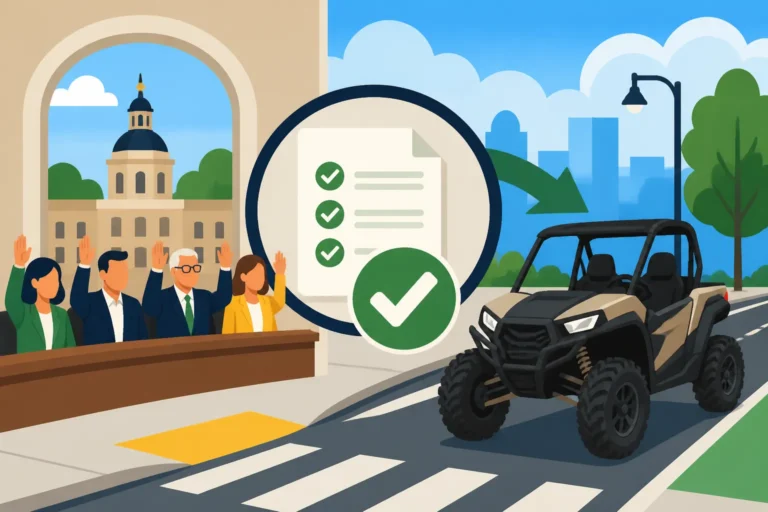
It's important to remember that while Iowa state law sets the 18+ age limit for all public roads, it also grants local authorities—counties and cities—the power to further regulate or even prohibit ATV and UTV use on specific roads within their jurisdictions. This means that even if a state road theoretically allows ATV use, a county board of supervisors or a city council can vote to restrict or close certain roads or streets. This often leads to a patchwork of rules across the state. For instance, some counties might open all their unpaved secondary roads, while others might keep some closed or add additional restrictions.
Before planning any road travel on your ATV or UTV, it's always advisable to check with the specific county recorder's office or city clerk's office for the areas you intend to ride. They can provide information on local ordinances that might affect your route. What's legal in Webster County might be prohibited in Mahaska County, even if both are just using state guidelines. This localized control means that even for an 18-year-old licensed driver with a fully equipped, insured, and registered machine, not all roads are automatically open. Always do your homework, because riding on a road that has been locally designated as closed can result in tickets and fines, similar to riding an unregistered machine. For insights into this variability, look into [Iowa Cities That Allow ATVs on Streets].
Penalties and Enforcement for Underage Road Use
Knowing the rules is one thing; understanding the consequences of breaking them is another. For underage ATV and UTV road use in Iowa, the penalties can range from significant fines to more serious legal and financial repercussions, often impacting both the rider and the adult responsible for them. Law enforcement in Iowa takes these rules seriously, especially when safety is concerned.
The Consequences of Violating Age Restrictions
If a minor is caught operating an ATV or UTV on a public road in Iowa, the immediate consequence will likely be a citation. These aren't just minor warnings; they often carry fines that can be substantial. Beyond the financial penalty, the incident will go on the minor's record, which could impact future driving privileges or even insurance rates when they eventually become licensed drivers. The ATV or UTV might also be impounded, adding towing and storage fees to the already growing cost.
Crucially, the adult who permitted or allowed the minor to operate the machine on a public road can also face legal repercussions. This could include fines, and in some cases, even more severe charges, especially if an accident occurred. The law places a heavy burden on adults to ensure minors comply with age restrictions. It's not enough to simply say "I didn't know" or "They only went a short distance." The responsibility falls squarely on the adult. For information on general penalties, consider [Iowa Fines for an Unregistered ATV], as unauthorized road use often carries similar weight.
How Law Enforcement Handles Underage Riders
When an Iowa county sheriff's deputy or a state conservation officer spots a minor on an ATV or UTV on a public road, their primary concern is safety and enforcing the law. They will typically pull over the rider, verify their age and any other relevant credentials, and then proceed with issuing a citation. In many cases, they will also contact the parents or guardians of the minor. The machine may be impounded, requiring an adult to retrieve it and pay associated fees. Officers often have limited discretion when it comes to clear violations like underage road use; the law is quite black and white.
It's important to remember that law enforcement officers are operating under the mandate to protect public safety. An ATV or UTV operated by an underage, unlicensed driver on a public road is seen as a significant risk. They aren't trying to spoil anyone's fun, but rather prevent accidents and ensure everyone adheres to the established safety regulations. Being polite and cooperative with an officer is always the best approach, even if you disagree with the situation.
Education as the Best Defense
The absolute best way to avoid any of these penalties and ensure a safe, enjoyable riding experience is through education. Understand the rules, communicate them clearly to all riders in your family, and adhere to them without exception. Teach younger riders the importance of riding only in approved areas and never venturing onto public roads until they meet the legal age and licensing requirements. Utilizing resources like the Iowa DNR's safety course and local club educational programs can reinforce these messages.
By proactively educating yourself and your family on Iowa's ATV and UTV laws, you're not just avoiding fines; you're cultivating a culture of responsible riding. This includes understanding [Iowa ATV Safety Certificate Requirements] for off-road parks, and the distinct and more stringent rules for public road use. Responsible riders are safer riders, and that's a win for everyone.
| Riding Scenario | Minimum Age Requirement | Key Considerations |
|---|---|---|
| Public Roads (ATV/UTV) | 18 years old | Must possess a valid Iowa driver's license, proof of insurance, and meet machine equipment standards. Local ordinances apply. |
| Designated OHV Parks (ATV) | 12-17 years old | Requires an Iowa DNR Safety Certificate. Adult supervision often recommended/required for younger riders. |
| Designated OHV Parks (UTV) | Any age | Operators generally exempt from safety certificate. Helmets usually mandatory. Adult supervision crucial for minors. |
| Private Land (ATV/UTV) | Any age | With landowner permission, no state age minimum. Adult supervision is highly recommended for all minors. |
| Agricultural Use (Roads) | Varies (16+ with permit) | Specific exemptions for "implements of husbandry" directly engaged in farming. Still requires proper licensing/permits. |
Disclaimer
This article is for general informational purposes only and does not constitute professional advice. Laws, prices and regulations vary by location and change over time. Consult a qualified professional for guidance on your specific situation.