Riding an ATV on Iowa Roads
Riding an ATV or UTV on Iowa's vast network of roads can feel like navigating a legal labyrinth. Many riders dream of the convenience of simply hopping on their machine to run an errand or get to a trail, only to be met with confusing rules and the fear of a ticket. This guide will cut through the noise, explaining exactly when and where you can legally ride your ATV or UTV on Iowa public roads, what equipment you need, and the critical rules you must follow to stay safe and compliant.
The Basics: Can You Even Ride an ATV on Iowa Roads?
It's a common misconception that ATVs and UTVs are strictly off-road vehicles in Iowa, forever confined to trails or private land. While that's the general starting point, the truth is a bit more nuanced. Iowa does allow ATVs and UTVs on certain public roads, but it comes with a stringent set of rules, conditions, and equipment requirements that many riders, even seasoned ones, aren't fully aware of. Ignoring these rules can lead to hefty fines and a ruined ride, so understanding the foundational principles is your first step toward street-legal fun.
The General Rule and Its Exceptions
The core principle in Iowa is that off-highway vehicles (OHVs), which include ATVs and UTVs, are generally prohibited from operating on public streets, roads, and highways. This is the default, the rule you should always assume unless a specific exception applies. Think of it like this: your ATV is born an off-roader, and it takes deliberate action and compliance to earn its temporary road-riding privileges. This isn't just about safety; it's about classification and the different roles these machines play in traffic. Iowa's legislators recognized the growing popularity of these machines and the practical need for some road access, especially in rural areas, but they balanced that with the need for public safety.
However, Iowa Code Chapter 321I carves out specific exceptions that allow you to venture onto public thoroughfares under certain conditions. These exceptions aren't blanket permissions; they are tightly controlled. For instance, you might be allowed on specific types of roads, for specific purposes, or only after certain local governmental bodies have given their explicit approval. We're talking about unpaved secondary roads, some paved secondary roads, and even certain city streets, but always with layers of rules. The key takeaway here is to never assume your machine is legal for road use without first verifying that you meet all the criteria for one of these exceptions. It's not enough to simply have lights; you need to understand the why and where of the exception.
Understanding Iowa's Off-Road Vehicle Definition
Before we dive deeper into where you can ride, it's crucial to understand what Iowa considers an "Off-Road Vehicle" (ORV) in the first place, as this definition dictates which laws apply to your machine. The Iowa Code broadly defines an ORV as any motor vehicle used on or operated over land, snow, ice, or other natural terrain for recreational purposes. This includes snowmobiles, but for our purposes, it primarily covers all-terrain vehicles (ATVs) and utility task vehicles (UTVs), also commonly known as side-by-sides. This definition is important because it's what separates your recreational machine from, say, a golf cart or a farm tractor, each of which has its own distinct set of rules for road use.
An "all-terrain vehicle" specifically refers to a motor vehicle with three or more wheels, weighing less than 1,000 pounds, being 50 inches or less in width, and having a seat or seats designed to be straddled by the operator and any passenger. Think of your traditional quad here. A "utility task vehicle" (UTV), on the other hand, is generally a side-by-side that isn't designed to be straddled, typically has a steering wheel, foot pedals, and a roll cage, and often seats two or more people side-by-side. While their physical characteristics differ, both ATVs and UTVs fall under the ORV umbrella in Iowa when it comes to road use regulations, meaning the same core set of rules will apply to both types of machines when you're considering taking them on the pavement or gravel. [Which Machines Iowa's Off-Road Vehicle Law Covers] breaks down these definitions further, helping you categorize your machine correctly.
The Specifics: Where You Can Ride
Knowing your machine falls under the ORV definition is just the start. The next crucial step is understanding the specific types of roads in Iowa where you're actually permitted to ride. Iowa's approach is highly granular, differentiating between various road classifications and empowering local authorities—county boards of supervisors and city councils—to make critical decisions about road access. This means that what's legal in one county or town might be strictly forbidden just a few miles down the road. It's a patchwork, and riders must be vigilant about understanding the local rules before hitting the throttle on any public thoroughfare.
Unpaved Secondary Roads
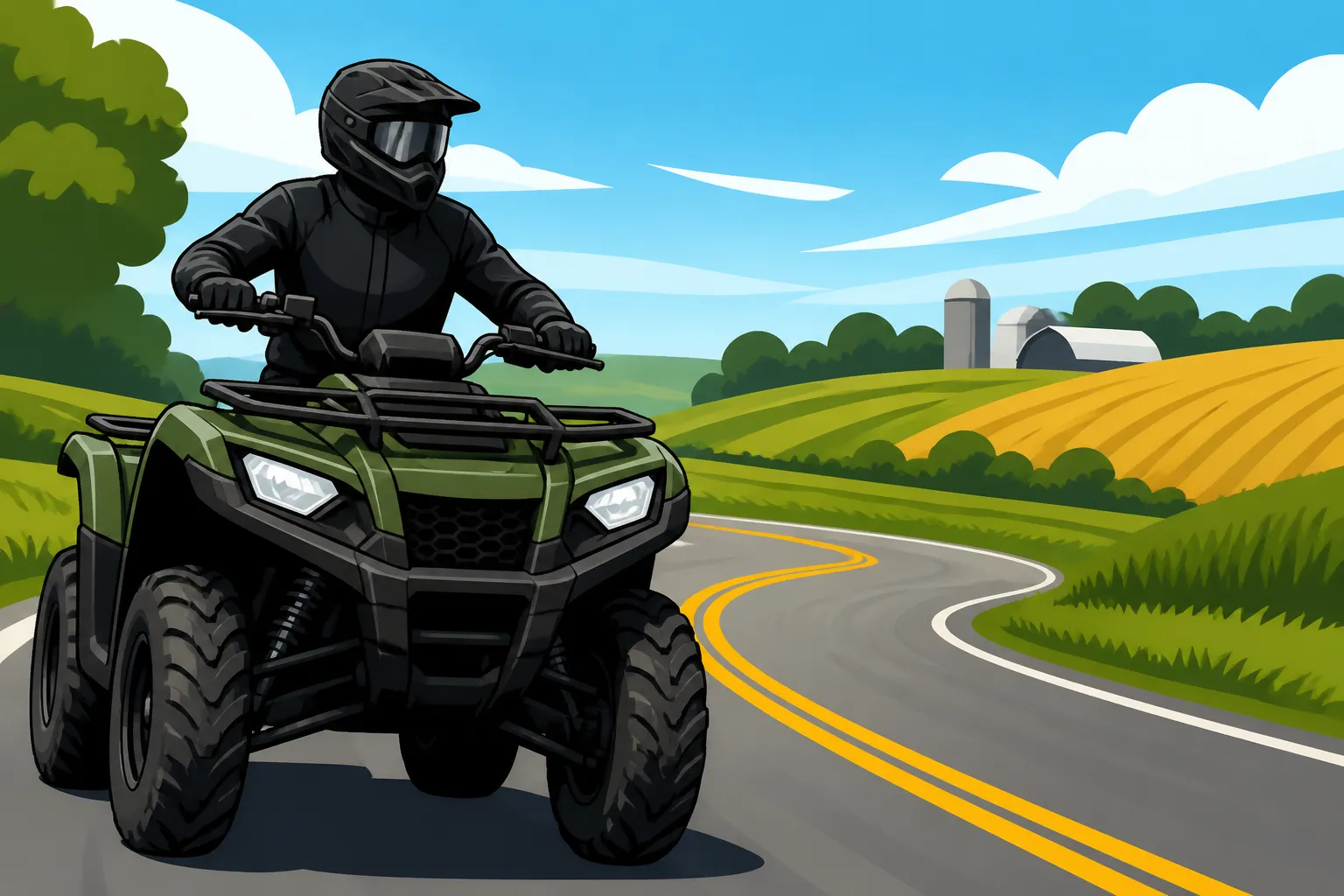
This is often the most accessible category for ATV and UTV riders looking to legally use public roads. Unpaved secondary roads, commonly known as gravel roads or dirt roads, are generally open for ATV and UTV use in Iowa without requiring specific action from the county. These are the backroads, the connectors between small towns, and the routes that crisscross Iowa's agricultural landscape. The thinking here is that these roads typically have lower traffic volumes, slower speeds, and a surface that's more akin to the off-road environments these machines are designed for, making them a more natural fit for shared use.
However, even on unpaved secondary roads, there are still rules you must follow. Your machine must meet all the equipment requirements we'll discuss later, and the operator must adhere to age and licensing laws. You also need to stick to the road itself; riding in the ditch beside a gravel road might seem harmless, but it can quickly lead to trespassing issues or fines if not explicitly permitted. The beauty of these roads is their ubiquity across Iowa, offering a vast network for getting from Point A to Point B, accessing trailheads, or simply enjoying the rural scenery on your machine. [Iowa Rules for Riding a Gravel Road] offers a deeper dive into these specific regulations, helping you navigate the unpaved paths confidently.
Paved Secondary Roads and County Authorization
Now, this is where things get a little more complicated. While unpaved secondary roads are generally open, paved secondary roads—those blacktop or concrete county roads—are not automatically open to ATVs and UTVs. For an ATV or UTV to be legally operated on a paved secondary road, the county board of supervisors must have passed a specific ordinance authorizing such use. This isn't a statewide blanket rule; each of Iowa's 99 counties gets to decide for itself whether to open its paved secondary roads to OHVs, and if so, under what conditions. This discretion allows counties to consider local traffic patterns, road conditions, and community sentiment.
If you plan to ride on any paved county road, your homework begins before you leave your driveway. You absolutely must verify that the specific county you're in has enacted an ordinance permitting ATV/UTV use on those paved roads. This information is typically available through the county auditor's office or the county engineer's department. Some counties might open all paved secondary roads, while others might designate only certain routes. Without this specific county authorization, riding your ATV or UTV on a paved secondary road is illegal, regardless of whether you have all your safety gear. [Iowa Rules for Riding a Paved Secondary Road] provides more detail on how these local authorizations work and what you need to look out for.
City Streets and Council Authorization
Just like paved secondary roads, city streets are another area where local control is paramount. You cannot simply ride your ATV or UTV on city streets in Iowa without explicit permission. For an ATV or UTV to be legally ridden within city limits, the city council must have passed a specific ordinance to allow it. This means that one town might be completely open to OHV use on its streets, while the neighboring town might strictly prohibit it. This local control allows communities to tailor rules to their unique layouts, traffic densities, and residential concerns. Cities like Waukon, for example, have adopted ordinances to open specific streets, often with particular hours of operation or routes.
If you're considering using your ATV or UTV to travel through a town, visit a local business, or access a trail from within city limits, you absolutely must check the municipal ordinances for that specific city. Do not assume anything. This usually involves contacting the city clerk's office or checking the city's official website for their municipal code. These ordinances will outline exactly which streets are open, any time restrictions (e.g., "no riding after midnight"), and any other conditions that might apply. Riding on unauthorized city streets can result in a quick citation from local law enforcement, so always be sure of the local rules. [Iowa Cities That Allow ATVs on Streets] can give you a starting point for cities that have embraced OHV use.
Primary Highways and Crossings
When it comes to Iowa's primary highways—the major state routes, U.S. highways, and especially interstates—the rules become much stricter. Generally, ATVs and UTVs are prohibited from operating on primary highways and interstates in Iowa. These are high-speed, high-volume roadways designed for conventional vehicle traffic, and the slower speeds and different handling characteristics of ATVs and UTVs pose significant safety risks in such environments. The intent of the law is to keep OHVs off these major arteries for the safety of all motorists.
However, there's a very limited exception for crossing primary highways. You may cross an undivided, two-lane primary highway at an intersection, but only if you are doing so on the "most direct route" to another authorized road or trail. This is not an invitation to ride along a primary highway; it's strictly about a perpendicular crossing at an intersection. You must proceed directly across the highway, yielding to all traffic. Similarly, crossing multi-lane primary highways or interstates is generally forbidden, even at intersections, due to the inherent dangers. The "most direct route" language is crucial here; it means you can't weave around or use the highway as part of a scenic tour. [Iowa Rules for Riding a State Highway] goes into more detail about these restrictive rules, emphasizing safety and compliance.
Who Can Ride: Age, Licensing, and Passengers
It's not just about where you can ride your ATV or UTV; it's also about who is operating it and who might be riding along. Iowa has specific requirements for operators and strict rules regarding passengers when these machines are on public roads. These regulations are in place to ensure a minimum level of maturity, skill, and legal accountability, recognizing that operating an OHV on a public road carries different responsibilities than off-road riding. Ignoring these rules can lead to serious legal consequences for both the rider and the machine's owner.
The 18-Year-Old Driver Requirement
Perhaps one of the most critical rules to understand is the minimum age for operating an ATV or UTV on any public road in Iowa: you must be at least 18 years old. This is a non-negotiable requirement. While Iowa has provisions for younger riders (12-17) to operate ATVs and UTVs off-road with a safety certificate and under supervision, those rules do not extend to public road use. The state recognizes the increased dangers and complexities of sharing public roadways with other vehicles, and thus mandates adult operation.
This 18-year-old minimum applies universally, whether you're on a gravel road, a county-approved paved road, or an authorized city street. There are no exceptions for younger riders, even if they possess a valid driver's license for a car. This means that a 17-year-old with a full driver's license cannot legally operate an ATV or UTV on an Iowa public road. This rule is a fundamental safety measure, aiming to ensure that anyone operating these machines in a public traffic environment has the judgment and experience typically associated with adulthood. [Iowa Minimum Age to Ride a Road] covers this topic in depth, explaining the rationale behind it.
Driver's License Requirements
In addition to being 18 years old, anyone operating an ATV or UTV on an Iowa public road must possess a valid Iowa driver's license. This isn't just about age; it's about demonstrating that you have passed the state's requirements for operating a motor vehicle and understand traffic laws. The type of driver's license typically required is a standard Class C non-commercial license, the same one you'd use to drive a car or light truck. You do not need a special "motorcycle endorsement" or a specific "OHV license" to operate an ATV or UTV on authorized roads, beyond the standard driver's license.
Carrying your physical driver's license with you while riding on public roads is essential. If you are stopped by law enforcement, you will be expected to produce it, just as you would in a car. Operating an ATV or UTV on an Iowa public road without a valid driver's license is a serious offense, subject to fines and other penalties, similar to operating any other vehicle unlicensed. This requirement underscores the state's intent to integrate ATVs and UTVs into the existing traffic framework, rather than treating them as entirely separate entities when they enter public rights-of-way. [Iowa Driver's License Rules for ATVs] explains these requirements in more detail.
Passenger Rules on Iowa Roads
Carrying passengers on your ATV or UTV while riding on public roads in Iowa also comes with specific rules, primarily dictated by the design of your machine. For ATVs (the straddle-seat machines), Iowa law generally states that an ATV designed for one operator may not carry a passenger. If your ATV is specifically designed by the manufacturer to carry a passenger, usually indicated by a designated passenger seat and handholds, then carrying one passenger is permissible, provided they also meet any age or safety requirements. Riding "double" on a single-rider ATV on public roads is illegal and dangerous.
For UTVs (side-by-sides), the rules are a bit more flexible because they are inherently designed to carry passengers in a seating arrangement similar to a car. Generally, you can carry as many passengers as there are designated seating positions with seatbelts in your UTV. All occupants must be properly seated and utilize the provided seatbelts or restraints. Regardless of the machine type, passengers must behave responsibly and not interfere with the operator's ability to control the machine. Just like in a car, an overloaded or improperly loaded machine, or passengers engaging in unsafe behavior, can lead to citations and serious accidents. Always prioritize the safety of all occupants when considering taking a passenger on an Iowa road.
Equipping Your Machine for Road Use
Simply being old enough and having a license isn't enough to make your ATV or UTV street legal in Iowa. Your machine itself must be properly equipped to safely share the road with other vehicles. Think of it like a motorcycle or even a slow-moving farm implement; certain safety features are mandatory for visibility and communication. These requirements are designed to bring your off-road machine up to a minimum standard for operating in traffic, making it safer for both you and others on the road. Many aftermarket companies like SuperATV offer a range of products that can help riders meet these requirements, from lighting kits to mirrors.
Essential Lighting and Reflectors
When operating an ATV or UTV on Iowa roads, especially during dawn, dusk, or nighttime hours, proper lighting is absolutely critical for visibility. Your machine must be equipped with at least one headlight that emits a white light visible from a distance of 500 feet to the front. This headlight needs to be on and operational at all times when riding on public roads, even during daylight hours. This is similar to motorcycle laws in many states, where "lights on" is a constant safety mandate.
At the rear, your machine must have at least one tail lamp that emits a red light visible from 500 feet to the rear. This tail lamp also needs to be active whenever the headlight is on. Additionally, a brake light (or lights) that illuminates upon application of the brake is required. Beyond active lighting, your machine must display reflective material. Crucially, a slow-moving vehicle (SMV) triangle emblem must be securely mounted on the rear of your ATV or UTV. This bright orange and red triangle signals to other drivers that your machine is designed for speeds under 25 mph, though the legal limit for ATVs on Iowa roads is 35 mph. It's a crucial warning for approaching traffic, especially on rural roads where speed differentials can be significant. [Iowa Lighting Requirements for ATVs] offers a detailed breakdown of these essential visibility components.
Horn, Mirrors, and Windshield Regulations
Beyond lighting, other equipment is necessary for safe operation and to meet Iowa's street-legal standards. Your ATV or UTV must have a horn that is audible for at least 200 feet, allowing you to signal warnings to other drivers or pedestrians. This isn't just a courtesy; it's a vital safety device. Imagine rounding a blind curve on a gravel road and needing to alert an approaching vehicle – a working horn is indispensable.
Mirrors are also mandatory. Your machine must be equipped with at least one rearview mirror, mounted on the left side of the machine, that provides a clear view of the road to the rear. Many riders opt for two mirrors for improved situational awareness, but one on the left is the minimum legal requirement. If your machine is equipped with a windshield, there are specific rules regarding its condition and tint. Any windshield must be made of safety glass or a similar shatterproof material, and it must be free of cracks or obstructions that impair visibility. Furthermore, any tint applied to the windshield must allow a certain percentage of light transmittance, usually defined in Iowa law as allowing at least 70% light transmission. This prevents dangerously dark tints that reduce visibility, especially at night or in adverse weather. You can often find durable, compliant windshields and mirrors from accessory manufacturers like SuperATV that are designed for rugged use. [Iowa Mirror Requirement for Road Use] details these crucial aspects of road-ready equipment.
Speed Limits and Operation
Even when all equipment is in order and you're on an authorized road, how you operate your ATV or UTV is paramount. Iowa law imposes a strict speed limit for ATVs and UTVs operating on public roads: you cannot exceed 35 miles per hour. This speed cap is in place because these machines are not designed for sustained high-speed road travel and have different handling characteristics than conventional vehicles. Maintaining this speed limit is crucial for safety, especially on roads shared with faster-moving cars and trucks.
Beyond the speed limit, general rules of the road apply. You must operate your machine in a safe and prudent manner, obey all traffic laws, signs, and signals, and yield to other vehicles as required. Riding single file, staying to the right side of the road, and using turn signals (if equipped, or hand signals if not) are all part of responsible road operation. Reckless driving, excessive speed, or operating the machine in a manner that endangers others will lead to citations and potential accidents. The goal is to integrate these machines into traffic as safely as possible, which means the operator bears a significant responsibility to drive predictably and respectfully. [Iowa ATV Speed Limit on Roads] provides further context on the operational limitations you'll encounter on Iowa roads.
The Insurance Imperative: Protecting Yourself and Others
One of the most overlooked, yet absolutely critical, requirements for riding an ATV or UTV on Iowa public roads is having adequate insurance coverage. Just like driving a car, operating an OHV on a public thoroughfare carries inherent risks, and accidents can happen. Iowa law doesn't just encourage insurance; it mandates it. Riding without the proper coverage isn't just a financial risk; it's a legal violation that can lead to significant penalties, making your brief road trip far more expensive than planned.
Iowa's Minimum Coverage Requirements
When you take your ATV or UTV onto an Iowa public road, it effectively becomes subject to the state's mandatory motor vehicle insurance laws. This means you must carry liability insurance that meets Iowa's minimum coverage requirements. These minimums are often referred to as "20/40/15" coverage:
- $20,000 for bodily injury liability per person: This covers medical expenses, lost wages, and pain and suffering for one person injured in an accident where you are at fault.
- $40,000 for total bodily injury liability per accident: This is the maximum amount your insurance will pay for all injuries sustained by multiple people in an accident where you are at fault.
- $15,000 for property damage liability per accident: This covers damages to another person's property (their vehicle, fence, etc.) in an accident where you are at fault.
These are just the minimums. Many riders choose to carry higher limits for greater protection, as a serious accident can easily exceed these figures. Your insurance policy must specifically cover your ATV or UTV for road use. Some off-road specific policies might only cover you on private land or designated trails, so always verify with your insurer that your coverage extends to legal public road operation in Iowa. You need to carry proof of this insurance, typically an insurance card, whenever you're operating your machine on public roads. [Iowa ATV Insurance Requirement] explains these financial protection rules in greater depth.
Penalties for Riding Without Insurance
Riding an ATV or UTV on an Iowa public road without the required liability insurance is a serious offense. It's not just a minor infraction; it can lead to significant legal and financial repercussions. If you're pulled over or involved in an accident and cannot provide proof of valid insurance, you could face substantial fines. The base fine for operating an uninsured motor vehicle in Iowa is often around $250, but this can escalate with additional court costs and fees.
Beyond the immediate financial penalty, you could also face administrative actions, such as the suspension of your driver's license or even your vehicle registration. If you're involved in an accident while uninsured, you would be personally responsible for all damages and injuries you cause to others, which could easily amount to tens or hundreds of thousands of dollars. This financial burden can be catastrophic. Law enforcement officers, whether a county deputy or a state patrol trooper, regularly check for insurance during roadside stops involving ATVs and UTVs on public roads. It's a fundamental part of responsible vehicle operation, and Iowa takes it seriously. [Iowa Fines for No Proof of Insurance] outlines the severe consequences for non-compliance.
Navigating Local Ordinances and Nonresident Rules
The granular nature of Iowa's ATV and UTV road laws means that local rules play a huge role. What's allowed in one corner of the state might be prohibited a few miles away. This can be confusing, not just for residents, but especially for visitors from other states who might assume their home state's rules or a universal "street legal" designation applies. Understanding how local governments make these decisions and what's required for nonresidents is key to avoiding an unwelcome interaction with local law enforcement.
How Cities and Counties Authorize Road Use
The authority for opening paved secondary roads and city streets to ATVs and UTVs rests squarely with local governing bodies: the county board of supervisors for county roads, and the city council for city streets. This isn't a casual decision; it involves a formal legal process. Typically, a county or city will conduct public hearings, gather input from residents, and then vote to pass an ordinance. This ordinance will specify exactly which roads or streets are open, under what conditions (e.g., specific hours, certain times of year), and any local exceptions or additions to the state law. For example, some counties might only open paved roads that connect to established trail systems, or cities might restrict OHV use to specific routes leading to businesses.
This means that if you're planning to ride on paved county roads or city streets, you cannot rely on what you think is allowed. You must actively investigate the specific ordinances for the county or city in question. This information is usually available on the county's official website (often under "Ordinances" or "Resolutions") or by contacting the county auditor's office or city clerk's office directly. Don't assume that because a few ATVs are seen on a road, it's legal. Those riders might be operating illegally, or their specific use (e.g., farm exemption) might be different from yours. Always do your due diligence. [How an Iowa County Authorizes a Paved Road] and [How an Iowa City Authorizes a Street] explain these processes in detail, helping you understand the legal framework.
Nonresident Permits and Reciprocity
If you're visiting Iowa from another state and wish to ride your ATV or UTV on authorized public roads, you need to be aware of specific nonresident requirements. Iowa does not generally have "reciprocity" with other states for ATV or UTV registrations when it comes to road use, meaning your home state's registration and street-legal status won't automatically make you compliant in Iowa for road riding. Your machine must still meet all of Iowa's equipment requirements (lights, horn, mirror, SMV triangle, insurance, etc.), and you must be 18 with a valid driver's license.
In addition to meeting Iowa's operational and equipment standards, nonresidents are typically required to purchase an Iowa Nonresident User Permit. This permit is a sticker that must be affixed to your machine. It's generally valid for a specific period and allows you to operate on Iowa's designated trails and, if you meet all other state and local requirements, on authorized public roads. While your home state's registration for your ATV might be recognized for off-road trail access in some cases, the moment you transition to public road use, Iowa's full suite of road-specific laws, including the permit, comes into play. Always check the Iowa DNR website or contact a county recorder's office for the most current nonresident permit information and purchase options. [Iowa's Nonresident User Permit] provides comprehensive information on these visitor requirements.
Common Mistakes and How to Avoid Them
Even with the best intentions, riders can easily fall into common traps when trying to navigate Iowa's ATV and UTV road laws. These aren't always malicious errors but often stem from misinterpretations of the law or assuming certain exemptions apply when they don't. Being aware of these frequent pitfalls can save you from a ticket, a damaged machine, or even a serious accident. Education and diligence are your best defenses.
Misinterpreting the "Most Direct Route"
One of the most frequently misunderstood clauses in Iowa's OHV road law concerns the "most direct route." This phrase pops up in various contexts, particularly when discussing crossing primary highways or using secondary roads to access trails. The intent behind "most direct route" is to allow ATVs and UTVs to efficiently get from one legal riding area to another (e.g., from private land to a gravel road, or from a gravel road to an OHV park entrance) without unnecessarily lingering on public roads or using them for recreational cruising.
The common mistake is interpreting "most direct route" as "any route I prefer to get where I'm going." It doesn't mean you can take the scenic way, stop for multiple errands, or detour significantly just because it's a public road. It implies the shortest, most efficient, and most logical path between two points. For instance, if you're using a gravel road to get to a specific trailhead, you should proceed directly there without taking unnecessary detours. Joyriding or using public roads as part of an extended recreational ride, even on authorized roads, can be viewed by law enforcement as a violation of this "most direct route" principle. Always plan your route with this rule in mind, minimizing your time on public roads and ensuring your travel is purposeful. [The Most Direct Route to an Iowa OHV Park] offers insights into what this means in practice for trail riders.
The Implement of Husbandry Exemption on Roads
Another common area of confusion revolves around the "implement of husbandry" exemption. Many riders, especially those in rural areas, believe that if they're using their ATV or UTV for farm-related tasks, it automatically makes them exempt from all road rules, including registration, equipment, and licensing. While Iowa law does provide some exemptions for implements of husbandry, it's a very narrow and specific definition that often does not apply to the casual use of an ATV or UTV for farm chores.
For a machine to qualify as an implement of husbandry, it must be used exclusively for agricultural purposes, such as planting, harvesting, or directly transporting agricultural products or implements. More importantly, the exemptions for road use are generally limited to specific activities like crossing a highway to access fields, or traveling within a very short distance (e.g., 2 miles) from the farm for direct agricultural work. It does not mean you can ride your unregistered, uninsured, or uneqiupped ATV to town for parts, even if those parts are for a tractor. As soon as an ATV or UTV is used for recreational purposes, or for purposes not directly and exclusively agricultural, it typically loses its implement of husbandry status and must comply with all standard OHV registration, titling, and road-use laws. Never assume this exemption applies without carefully reviewing the specific legal definition and consulting with local authorities if you're unsure. [The Implement of Husbandry Exemption in Iowa] delves deeper into the specifics of this commonly misunderstood rule.
Safety and Responsible Road Riding
Ultimately, the legality of riding an ATV or UTV on Iowa roads is only one part of the equation. Safe and responsible operation is paramount, not only to avoid accidents and injuries but also to ensure these privileges aren't revoked in the future. As an OHV rider, you share the road with everything from bicycles to semi-trucks, and their operators might not expect to see an ATV. Your actions directly impact how the general public and lawmakers view our sport.
The Importance of Visibility
Given the smaller size and different profile of an ATV or UTV compared to a car or truck, maximizing your visibility to other drivers is critically important. Your machine should be equipped with bright, functioning headlights and taillights, which, as we discussed, must be on whenever you're on a public road, regardless of daylight. Consider adding extra reflective tape to your machine, especially if it's a darker color, to make it stand out further. Brightly colored clothing or a reflective vest for yourself and any passengers can also significantly increase your conspicuity.
Remember, the slow-moving vehicle (SMV) triangle is not just a legal requirement; it's a vital safety device. Ensure it's clean, unobstructed, and properly mounted on the rear of your machine so it's easily visible to approaching traffic from behind. On dusty gravel roads, your SMV triangle can quickly become obscured, so take moments to wipe it clean. When sharing the road, always assume other drivers haven't seen you, and actively work to make yourself noticeable. This proactive approach to visibility is a cornerstone of safe ATV and UTV road riding.
Sharing the Road with Other Vehicles
Riding an ATV or UTV on a public road means becoming part of the broader traffic ecosystem. This requires a heightened level of awareness, courtesy, and defensive driving. Unlike off-road trails where you might only encounter other OHVs, on public roads, you'll share space with cars, trucks, motorcycles, bicycles, and even large agricultural equipment. Many drivers might not be accustomed to seeing ATVs and UTVs on the road, or they might underestimate your speed and maneuverability.
Always maintain a safe following distance from other vehicles. Be predictable in your movements: use hand signals or turn signals well in advance, and avoid sudden swerving or braking. When meeting oncoming traffic or being overtaken, stay as far to the right side of the road as safely possible, especially on narrower gravel roads. Be mindful of dust you might kick up, which can obscure visibility for vehicles behind you. Yield the right-of-way when required, and exercise patience. If a driver seems aggressive or confused by your presence, respond defensively rather than engaging in confrontation. By riding courteously and responsibly, you contribute to a positive perception of ATV and UTV riders and help ensure these road access privileges remain available.
| Road Type | Legal Status for ATVs/UTVs | Authorization Needed | Key Requirements |
|---|---|---|---|
| Unpaved Secondary Rd. | Generally Permitted | None (Unless specifically prohibited by county ordinance) | 18+ w/ Driver's License, Insurance, All Equipment, 35 mph cap |
| Paved Secondary Rd. | Not Automatically Permitted | Specific County Board of Supervisors Ordinance REQUIRED | 18+ w/ Driver's License, Insurance, All Equipment, 35 mph cap, Designated Route/Hours (if specified by ordinance) |
| City Streets | Not Automatically Permitted | Specific City Council Ordinance REQUIRED | 18+ w/ Driver's License, Insurance, All Equipment, 35 mph cap, Designated Route/Hours (if specified by ordinance) |
| Undivided 2-Lane Primary Highway | Crossing ONLY | None (Must be "most direct route" at intersection) | 18+ w/ Driver's License, Insurance, All Equipment, 35 mph cap, Yield to all traffic |
| Multi-Lane Primary/Interstates | Prohibited | None (Crossing generally forbidden, no travel permitted) | – |
Disclaimer
This article is for general informational purposes only and does not constitute professional advice. Laws, prices and regulations vary by location and change over time. Consult a qualified professional for guidance on your specific situation.