Iowa ATV Registration for a Dealer Demo
Navigating the specific registration requirements for an ATV or UTV that your dealership intends to use as a "demo" can feel like walking through a dense fog. It's not quite a new machine for sale, and it's not strictly a personal vehicle, leaving many dealers wondering if it even needs to be registered. This guide aims to clear up that confusion, providing Iowa dealers with a comprehensive understanding of how to properly register demo ATVs and UTVs to ensure compliance and avoid unexpected hurdles.
Understanding Why Dealer Demos Need Registration in Iowa
It's a common misconception among dealers that a machine designated as a "demo" is still considered part of their inventory and, therefore, exempt from registration until it's sold to a customer. Unfortunately, in Iowa, the moment a machine transitions from merely being "for sale" on the showroom floor to being "in use" – whether for customer test rides, staff training, or promotional events – it often triggers the need for official registration. This isn't just bureaucratic red tape; it's about ensuring all operational off-highway vehicles contribute to the funding of Iowa's trails, administration, and overall safety oversight, regardless of who owns them or how long they'll be "in service" at the dealership.
Iowa's comprehensive off-highway vehicle (OHV) laws are designed to cover a broad spectrum of machines and their uses. As soon as a machine is being operated, even temporarily, outside of a strictly private, closed-loop dealer property, it often falls under the same registration requirements as a privately owned ATV or UTV.
The "Operational" Aspect of a Demo Machine
Think about it this way: what makes a "demo" machine different from one simply displayed in the showroom? It's the fact that it's operational. It's being started, ridden, and put through its paces. A customer might take it for a spin around the lot, a sales associate might use it for a quick errand, or it could be trailered to a community event for public demonstrations. In all these scenarios, the machine is performing its intended function, much like a privately owned ATV would.
Even if a demo machine primarily stays on the dealership's private property, if that property is open to the public for test rides or if the machine ever crosses or uses a public road (where permitted by local ordinance) to move between lots, it steps into a realm where state registration becomes critical. The intent behind registration is to track machines that are actively used and to ensure they meet basic legal criteria for operation. The state doesn't differentiate between a private owner joyriding on a designated trail and a dealership letting a prospective buyer test drive a unit; if it's being operated, especially in areas accessible to the public or on public land, it generally needs to be registered.
Exceptions and Misconceptions for Dealers
One of the biggest misconceptions dealers face is assuming a "for sale" status grants an automatic exemption. While some states have specific temporary permits or dealer plates for demonstration models, Iowa's framework generally requires full registration once an OHV is actively used for demonstration purposes. This means that a dealer can't simply slap a "demo" sticker on a machine and assume it's good to go for test rides outside the immediate, contained private property.
There isn't a widely recognized "temporary dealer demo permit" in Iowa that negates the need for full registration for operational units. Instead, the pragmatic approach is to register the demo unit in the dealership's name. This ensures full compliance and avoids potential fines or complications down the road. It essentially treats the dealership as the "owner" of the operational unit, even if its ultimate fate is to be sold. While other vehicle types might have different rules, for ATVs and UTVs, the operational use is often the trigger.
The Step-by-Step Registration Process for Dealers
Registering a dealer demo ATV or UTV in Iowa largely mirrors the process for a private owner, but with the dealership acting as the registrant. The crucial first step, just like with any [Registering an ATV in Iowa], is to gather all the necessary paperwork. You’ll be heading to your local County Recorder's office, not the Iowa Department of Transportation (DOT) or DMV. They are the official hubs for all ATV and UTV titling and registration in the state.
A designated employee, typically someone from the office staff or a title clerk, will handle this. It’s important to remember that for a demo machine, the dealership is effectively registering the machine to itself as the owner for the period of its operational use. This is a critical distinction, as it will impact things like sales tax initially.
Essential Paperwork for a Dealer Demo
When you head to the County Recorder, you'll need to be prepared with specific documentation. For a brand-new machine intended for demo use, the Manufacturer's Statement of Origin (MSO) is paramount. This document proves the machine's origin and that it hasn't been titled before. You’ll also need an invoice or proof of purchase from the manufacturer to the dealership, showing the transaction.
If the demo machine is a used unit—perhaps a high-quality trade-in that the dealership intends to use for demonstrations before its final sale—then you'll need the previously assigned title. This is where you, as the dealer, would take the role of the new owner, having that title signed over to your dealership. In some cases, if a used machine never had a title in Iowa (perhaps an older model or one from out of state), you might need additional documentation to prove its lineage. For context, if you were buying a used machine privately, you’d typically need [An Iowa Bill of Sale for an ATV] along with the signed-over title.
The [What Iowa's Registration Form Asks For] is straightforward, requesting details about the machine, the dealership's information, and confirming declarations of ownership. Filling this out accurately at the counter will expedite the process.
The Financial Side of Dealer Demo Registration
Understanding [What Iowa Charges to Register an ATV] is essential for budgeting these demo units. When a dealership registers a demo machine, they are subject to the same fee structure as any private owner. This typically includes:
- The base annual registration fee: This is the core cost for the decal that allows operation. Currently, [The $15 Base Fee Inside an Iowa Registration] forms the largest part of this.
- A "writing" fee: A small administrative charge, often around [The $2 Writing Fee on Every Registration].
- The DNR administration fee: This goes towards the overhead of managing the state's OHV program and is also a modest charge, often referred to as [The Iowa NRC Administration Fee].
All these fees combined contribute to the overall [Iowa ATV Registration Cost] and are collected by the County Recorder at the time of registration.
Now, let's talk about sales tax, which can be a point of confusion for dealers. When a dealership registers an ATV or UTV to itself for demo use, they are essentially taking ownership of that machine for their own operational purposes. Therefore, the dealership will typically be required to pay Iowa's sales or use tax on the purchase price of that machine at the time of registration. This is because the machine is no longer strictly "inventory for resale" but is being "used" by the dealership. [Iowa ATV Sales Tax Rate] is generally 6% statewide, plus any local option sales tax, often bringing it to 7% in most counties. This is a crucial difference from when the machine is eventually sold to a retail customer, at which point the customer pays sales tax on their purchase. For the dealer demo, the dealer pays the use tax when registering it for their own operational use.
Maintaining Compliance and Eventual Sale
Once your dealership's demo ATV or UTV is properly registered and titled, the responsibility shifts to maintaining its compliance and understanding the process for its eventual sale. This means ensuring the registration decal is correctly displayed and that the necessary documentation is always with the machine during operation.
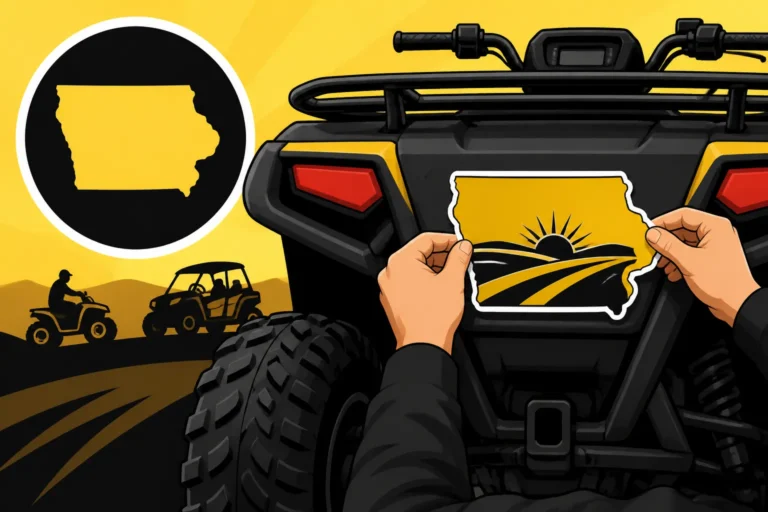
The registration decal, which is the official proof of current registration, must be properly mounted. Iowa law specifies [Where the Iowa Decal Mounts], typically on the rear of the machine, clearly visible. Along with the decal, the physical registration certificate must be carried with the machine whenever it's being operated. This ensures that if a conservation officer or law enforcement official performs a check, you can quickly provide proof of registration. For details, refer to [Carrying the Certificate on an Iowa Ride].
Like all ATV and UTV registrations in Iowa, demo units will have an expiration date of December 31st each year. This means your dealership will need to remember to [Renewing an Iowa ATV Registration] annually, usually starting in September. Missing this renewal can lead to penalties and could put your dealership in a tough spot if a demo machine is operated on an expired registration.
Proper Use and Display of a Dealer Demo
Operating a registered demo unit on public roads (where local ordinances permit such use) means adhering to all the same rules and regulations that a private owner would. This includes specific requirements like minimum age for the operator (18 in Iowa for road use), carrying appropriate insurance, observing speed limits, and having proper lighting. You can find more comprehensive details in [What Iowa Requires of an ATV on a Public Road]. Furthermore, having the correct [Iowa ATV Insurance Requirement] is not just a legal obligation but also a smart business practice, protecting the dealership in case of an incident during a test drive.
For dealership-hosted events, organized rides, or promotions, having the demo machines legally registered provides peace of mind and professionalism. It confirms that your dealership operates within legal boundaries and prioritizes safety. When managing multiple demo units or preparing legal documents for customer test rides and waivers, a service like LawDepot can be invaluable for creating standardized forms and agreements. While LawDepot doesn't handle the state registration process itself, it can assist with the internal legal framework surrounding the use of demo units, ensuring your dealership has robust documentation for any customer interactions or liability waivers.
Selling a Titled Demo Machine
When the time comes to [Selling an ATV in Iowa] that has served its purpose as a demo, the process is quite straightforward because the machine is already titled in the dealership's name. You will effectively be selling a used, titled machine.
The dealership, as the current titled owner, will sign over the existing title to the new buyer. This process is very similar to how a private party would sell their used ATV or UTV. The original MSO is no longer relevant at this point; the machine has been titled, and the title is the document of ownership that transfers.
The new buyer will then take that signed-over title to their County Recorder’s office. There, they will pay the sales tax on the final purchase price of the used machine, transfer the title into their name, and register the machine for their own use. This ensures a clean transfer of ownership and proper registration for the new owner.
Dealer Responsibilities and Best Practices
Beyond the initial registration, dealerships have ongoing responsibilities to ensure their demo ATV and UTV fleet remains compliant. This not only protects the business from legal issues but also upholds its reputation as a responsible and trustworthy establishment.
Maintaining meticulous records for all demo machines is absolutely critical. This includes copies of the original MSO (or prior title for used demos), the registration application, the actual registration certificate, and documentation of all fees paid, including sales/use tax. These records should be easily accessible for audits or inquiries.
Furthermore, it's vital to train all staff who may operate or demonstrate these machines on the legal requirements. Every employee should understand the importance of current registration, proper decal placement, and carrying the registration certificate. Regular checks of all demo unit registrations should be part of a routine operational checklist, perhaps monthly or quarterly, to ensure no registrations have inadvertently expired.
Managing Multiple Demo Machines
For dealerships with a fleet of several demo ATVs and UTVs, implementing a centralized tracking system is a non-negotiable best practice. A simple spreadsheet can work wonders, detailing each machine's VIN, model, date of initial registration, annual renewal date, and eventual sale date. This proactive approach helps avoid missed renewals and ensures continuous compliance. Dealership management software often includes modules for tracking inventory that can be adapted for this purpose. Utilizing a system for internal documentation can be bolstered by resources from LawDepot, which can help create consistent forms for tracking maintenance, usage logs, or even specific test-ride agreements that ensure all necessary information is captured for each demo unit.
Avoiding Pitfalls and Penalties
Operating an unregistered ATV or UTV, even for demo purposes, can lead to significant headaches. Iowa imposes [Iowa Fines for an Unregistered ATV] on operators caught without proper registration. These penalties can add up quickly and become a costly oversight for a dealership. Beyond the monetary fines, operating unregistered demos can severely damage a dealership's reputation. Word travels fast, and customers expect a reputable dealer to adhere to all legal requirements. A dealership found to be operating outside the law can lose trust and future business.
To stay informed and avoid these pitfalls, it's important to regularly consult resources from [The Iowa DNR and Off-Highway Vehicles] and your local County Recorder's office. Laws and regulations can sometimes change, and staying proactive in understanding and implementing current guidelines is the best way to ensure your dealership remains compliant and your demo operations run smoothly.
Disclaimer
This article is for general informational purposes only and does not constitute professional advice. Laws, prices and regulations vary by location and change over time. Consult a qualified professional for guidance on your specific situation.