Iowa ORV Permits Explained
A ride across the Iowa border can turn into an unwelcome paperwork problem if you assume your home-state registration automatically covers you. Iowa’s rules depend on who owns and operates the machine, where it is registered, and where you plan to ride. This guide explains nonresident permits, reciprocity, safety certificates, and the difference between riding on trails, private land, and roads.
Start With the Right Iowa ORV Requirement
Registration, a permit, and a safety certificate are different things
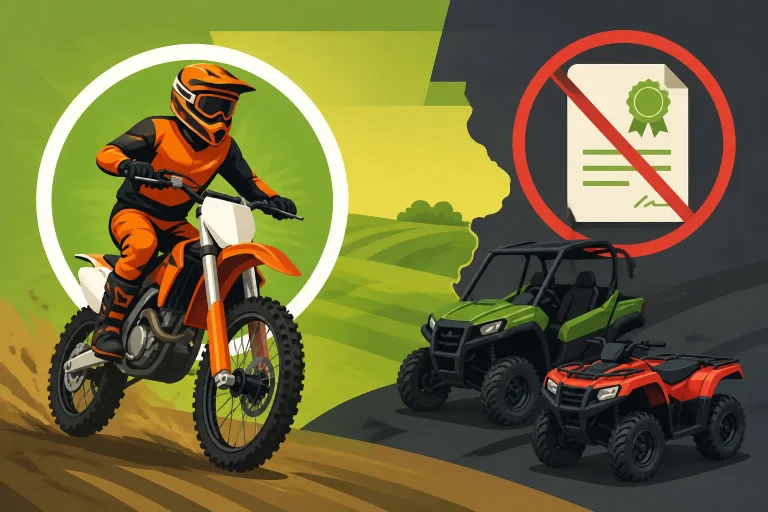
Iowa’s off-road vehicle requirements are easier to sort out when you separate three things that are often casually called “permits.” A machine’s registration or decal relates to the vehicle. A nonresident user permit may apply when a visitor brings an out-of-state machine into Iowa. A safety certificate relates to the operator’s age and the type of machine being operated.
These requirements do not replace one another. A visitor might have valid registration from home but still need to determine whether Iowa recognizes it for the intended use. A young operator may have to meet Iowa’s safety-certificate rules even if the machine has the correct registration or permit. And having the right paperwork does not, by itself, authorize riding on every road or parcel of land.
Start with four questions: Are you an Iowa resident? Where is the machine registered? What type of machine is it? And where will you ride? Those details point you toward the right rules more reliably than searching for a single “Iowa ATV permit” requirement.
Which requirement applies to which rider
For an Iowa resident using an off-road vehicle covered by Iowa’s registration rules, the usual starting point is Iowa registration and its associated decal. For a visitor, the next question is whether the machine’s home-state registration is recognized for the proposed Iowa use or whether the visitor needs an Iowa nonresident user permit. The answer can depend on the machine and the registration status, so do not assume that an out-of-state plate or sticker settles the matter.
The operator’s age can create a separate obligation. Iowa has safety-certificate requirements for some young riders and exemptions for certain machine types and age groups. A parent who has handled the machine’s paperwork should still check whether each child operating it needs a certificate, supervision, or both.
| Situation | What to check first | What it does not automatically authorize |
|---|---|---|
| Iowa resident riding an off-road vehicle | Iowa registration and decal requirements | Riding on closed land or roads without authorization |
| Visitor bringing a machine registered in another state | Iowa reciprocity rules and nonresident permit requirements | Riding beyond the locations or uses allowed |
| Young rider | Safety-certificate and supervision rules | Operating a machine that is unsuitable or otherwise not allowed |
| Rider using private property | Landowner permission and applicable machine requirements | Riding on neighboring or public land |
| Rider using an OHV park or club trail | The location’s access rules and current conditions | Road use or access to a different riding area |
Before a trip, check the Iowa DNR’s current information for the vehicle category and the place you intend to ride. Then check any local or site-specific restrictions. If your situation involves a borrowed, rented, inherited, or recently purchased machine, resolve the ownership and registration questions before leaving home.
Iowa’s Nonresident User Permit
When an out-of-state visitor should investigate a permit
If you live outside Iowa and plan to ride an ATV, UTV, or another covered off-road vehicle in the state, do not assume your home-state paperwork automatically satisfies Iowa’s requirements. Check whether your machine’s registration qualifies under Iowa’s reciprocity rules and whether the particular machine needs an Iowa nonresident user permit. The answer may depend on more than the state named on your paperwork.
A weekend visitor heading to a designated riding area and a seasonal visitor keeping a quad at a cabin should both check before riding. So should someone borrowing a friend’s machine. The important details include the machine’s classification, who owns it, where it is registered, and whether that registration is current and applicable to off-road use.
The nonresident permit is not a general pass that makes every kind of riding legal. It addresses an out-of-state machine’s permit or registration status under Iowa’s rules. It does not grant permission to use private property, override a park closure, or give a rider permission to operate on roads where ATVs or UTVs are restricted. For a closer look at the visitor requirement, see Iowa’s Permit for a Visiting Machine.
Where to buy it and what to have ready
Use an official Iowa DNR purchasing or licensing channel, or ask an authorized counter whether it can issue the permit for your machine. The available purchasing route and associated charges can change, so confirm the current process and total before you complete the transaction. If you are buying in person, check the location’s services and operating arrangements before making a long drive.
Have the machine information available, including its make, type, and serial or vehicle identification number if requested. Keep your home-state registration information nearby, too. If a machine is borrowed or rented, make sure you can identify its owner and know what documents came with it. A matching, legible identifier helps prevent a frustrating mismatch between the permit record and the machine you actually brought.
Once you have completed the purchase, read the instructions about displaying or carrying the permit and keep the supporting record accessible. Do not rely on a confirmation screen alone if the rules call for a physical decal or document. If you are uncertain how a permit must be shown, ask before riding rather than trying to interpret the requirement at a trailhead. For the purchasing steps, see Where to Buy an Iowa Nonresident Permit.
Why one permit is not a group pass
A nonresident permit is associated with the individual machine, not simply with the person who paid for it or the group heading out for the day. If two visitors bring two machines, do not assume one permit covers both. Likewise, a permit attached to one quad should not be treated as permission for a second machine in the trailer.
This distinction matters when friends share equipment. Imagine one visitor buys a permit for a machine, then swaps to a different ATV after arriving. The second machine may have a different registration status and may require its own paperwork. The fact that the rider already paid for a permit does not necessarily make that change acceptable.
Keep each machine’s paperwork matched to its own identifiers, and do not move a decal or assume a permit transfers when ownership changes. When replacing a machine, changing its registration, or borrowing another vehicle for the same trip, check the requirements for that specific machine. The one-machine rule is explained in Why an Iowa Nonresident Permit Covers One Machine and Why an Iowa Nonresident Permit Cannot Transfer.
Reciprocity and Out-of-State Registration
What reciprocity means in practice
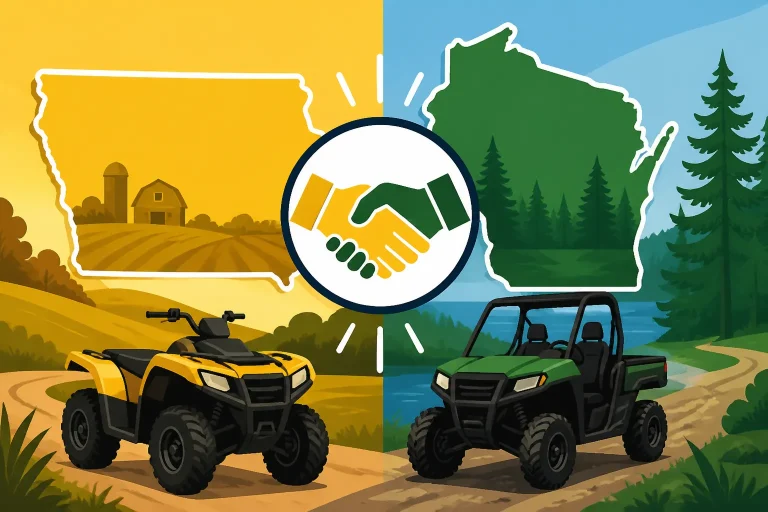
Reciprocity is an arrangement under which Iowa may recognize certain out-of-state registration for a visitor’s machine. It is not a blanket promise that every state’s sticker, plate, or registration document works for every vehicle in Iowa. The state where the machine is registered, the vehicle type, and the registration’s validity and purpose can all matter.
That is why the question “Does Iowa honor my registration?” needs a little more detail. An ATV’s paperwork may not be the same as a UTV’s, and a state’s on-road vehicle registration may not necessarily be the same as its off-road registration. A machine with an expired sticker or incomplete paperwork is also a different case from one with current registration that clearly applies to that vehicle.
Check Iowa’s guidance for the state and type of registration you have, and confirm whether a separate Iowa permit is required for your planned use. The overview Does Iowa Honor Out-of-State Registration? is a useful starting point, but do not treat a general reciprocity statement as a substitute for checking your machine’s exact situation.
Check your home state, not just the sticker
A visitor from Minnesota, Missouri, Nebraska, or Wisconsin should look for guidance specific to that state rather than guessing based on a neighboring state’s rules. Iowa maintains state-specific reciprocity information, and the relevant details may vary. Follow the instructions that apply to the machine’s home registration, not simply the state where the owner currently lives or where the machine was purchased.
Carry the original or accepted proof of registration and make sure it identifies the machine you brought. If a decal is damaged, unreadable, or missing, resolve that issue with the home state before traveling when possible. A photo on a phone may be useful as a backup, but it should not be assumed to replace a required physical registration or decal.
Useful state-specific pages include Iowa Reciprocity With Minnesota, Iowa Reciprocity With Missouri, Iowa Reciprocity With Nebraska, and Iowa Reciprocity With Wisconsin. If your state is not among those examples, look for Iowa’s applicable guidance for your state instead of inferring that the rules are identical.
Common reciprocity mistakes
One common mistake is confusing a license plate for a car or truck with an off-road vehicle registration. The paperwork must apply to the actual ATV, UTV, or other covered machine. A trailer registration or a tow vehicle’s registration does not establish that the off-road machine is properly registered for Iowa use.
Another mistake is treating reciprocity as an exemption from every Iowa rule. Even when Iowa recognizes the machine’s registration, the visitor still needs to follow rules about where riding is allowed, site access, safety certificates when applicable, and any restrictions imposed by the park or landowner. Registration answers a paperwork question; it does not erase location-specific rules.
Finally, visitors sometimes rely on what worked on a previous trip. A machine may have changed hands, its registration may have expired, or the planned riding area may have different requirements. Recheck before each trip, especially after changing machines or renewing registration. If the documents are unclear, contact the relevant agency or site before unloading.
Safety Certificates, Age, and Supervision
When young riders need to check certificate rules
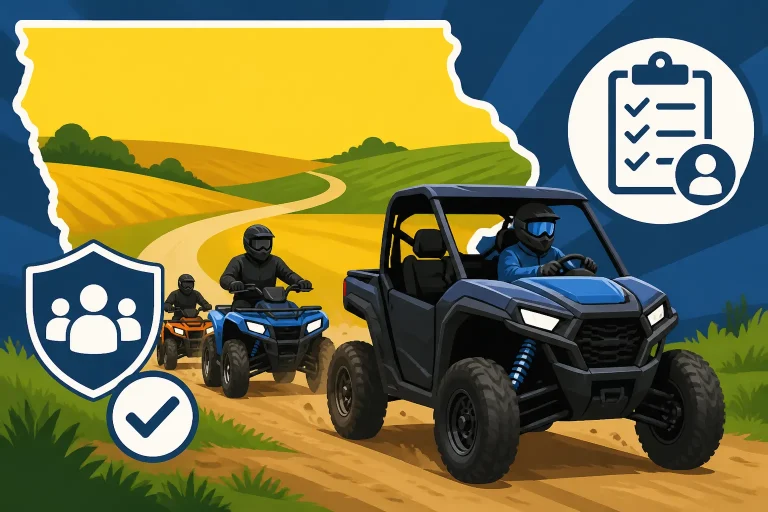
Iowa has safety-certificate requirements for some young operators of certain off-road vehicles. Age matters, but so does machine type: the rules do not necessarily apply in exactly the same way to an ATV, UTV, or off-road motorcycle. A parent should check the rule for the specific vehicle rather than relying on a general statement about “kids on ATVs.”
A safety certificate is an operator requirement, not a vehicle permit. That means the machine’s registration does not answer whether a young rider is qualified under Iowa’s rules. Likewise, a child’s certificate does not register the machine or give the family permission to ride on land where they lack access.
The age range, exceptions, and course or card requirements should be checked against current Iowa guidance before the ride. See Iowa’s Safety Certificate for Ages 12 to 17 for the age-related overview, and verify the machine-specific requirements for a side-by-side or motorcycle rather than applying ATV guidance automatically.
Supervision and planning for a family ride
When a child is within an age group subject to supervision rules, the adult needs to understand what supervision means for the planned ride. It is not enough to be somewhere in the same park if the rule requires a qualified adult to accompany or supervise the young operator. Confirm the applicable conditions, including any age, experience, or licensing requirements for the supervising adult.
Families often discover this detail at the last minute: the trailer is loaded, the child is excited, and the certificate is in a kitchen drawer. Make paperwork part of the pre-ride routine. Check each operator’s age, certificate status, and supervision plan before loading, then carry the required documentation in a place where it can be found without unpacking the vehicle.
A certificate also does not make an unsuitable machine safe. Match the machine to the child’s size, ability, and experience, and consider whether the riding area has a beginner-appropriate route. Keep children within sight and choose a pace and terrain that leave room for mistakes. A technically compliant setup can still be a poor choice if the rider cannot comfortably control the vehicle.
Certificates do not expand where you may ride
A safety card does not authorize riding on a closed trail, a public road, or land where the owner has not given permission. Those are separate access and location questions. A family can have the right paperwork for the machine and operator and still need to turn around because the trail is closed or the land is off-limits.
Before bringing young riders to a park, check the site’s current age, helmet, supervision, and machine rules. Some locations may impose rules beyond the general state requirements. Confirm that the route is suitable, that the machine is allowed there, and that the park is open to the type of riding you have planned.
For a private-property ride, make sure the owner’s permission covers the riders, machines, and area being used. Permission from one neighbor does not extend to the next parcel. Iowa’s general guidance on access is covered in [Iowa Rules for Riding Private Property], but landowner permission and any applicable vehicle requirements should be checked for the specific ride.
Where You Plan to Ride Changes the Answer
Designated parks, public riding areas, and club trails
A permit or registration does not guarantee access to a particular Iowa OHV park. The site may have its own admission process, operating hours, machine restrictions, safety rules, or temporary closures. Some areas may use the registration decal as part of their access system, while other site requirements still apply. Check the rules for the exact park before setting off.
Club trails and organized riding areas can have additional conditions. A trail might be open only to members or invited guests, require advance permission, or close when wet ground is vulnerable to damage. Never assume a trail is public just because it is marked, appears on a map, or has been used by riders in the past.
Check the applicable access information for Iowa Rules on Designated Riding Areas and [Iowa Rules for Riding a Club Trail]. Before a long drive, confirm the site is open and that your machine is allowed. Iowa’s clay can become slick and easily damaged after rain; riding a closed or saturated route can leave ruts that take much longer to repair than the ride took to make.
Private property and agricultural land
Private land is not an automatic permit-free zone. The landowner’s permission is central, and the permission needs to cover the place where you actually ride. A friend may have permission to use one field or timber parcel but not the neighboring tract, a drainage area, or a road crossing beyond the property.
If you are visiting a farm, clarify boundaries and allowed routes before starting the engine. Ask whether the owner permits passengers, children, trail building, or riding after dark, and whether any gates or livestock areas must be avoided. Clear expectations help prevent the familiar dispute in which a rider believes “the farm” means the whole property, while the owner intended one specific path.
Also separate access permission from registration and equipment requirements. Landowner permission does not necessarily remove applicable state obligations for the machine or operator. If the ride includes leaving the property, crossing a public area, or using a road, check those rules separately. A private-land plan should never quietly turn into a public-road shortcut.
Roads are a separate set of rules
An Iowa nonresident permit is not a street-legal conversion. Road use is governed by separate requirements and restrictions, and the rules differ by road type and local authorization. A machine that can legally ride on a designated off-road trail may still be prohibited from a nearby road, even if the road seems like the easiest way to reach another trail.
Before planning a road segment, identify the road and determine whether that type of road is open to the machine under Iowa law and any county or city authorization. Then check the applicable rider age, driver’s license, insurance, equipment, and speed requirements. Do not infer that a road is open because you see another ATV using it.
This distinction is especially important for visitors who see a gravel road connecting two trail areas and assume it is part of the route. A valid off-road permit or home-state registration does not settle road access. If your ride depends on using a public road, review the road-specific rules and local authorization first, or choose a route that stays within a properly open riding area.
A Practical Checklist Before You Ride
Check the paperwork for every machine
Start by listing every ATV, UTV, dirt bike, or other off-road vehicle in the group. For each one, record who owns it, where it is registered, whether the registration is current, and whether the machine’s type is covered by the paperwork. If the rider is a visitor, check Iowa’s reciprocity rules and determine whether a nonresident permit is needed.
Next, confirm that each permit or registration corresponds to the machine it is meant to cover. Do not transfer a decal between machines or count on a single permit to cover a trailer full of vehicles. If the serial number on the paperwork is difficult to read or does not match the vehicle, resolve the discrepancy before the trip.
Finally, gather operator documents. Check each young rider’s certificate status and the supervision plan, and make sure the adults know what they are responsible for. Store documents where they can be accessed during the ride, not buried under helmets, tools, and camping gear.
Confirm access and site conditions
Choose the actual destination before deciding that your permit is enough. Confirm the area’s access rules, allowed vehicle types, hours, and any temporary closure notices. If you are riding a club trail, contact the club or land manager if access is not plainly stated. If you are riding private property, get clear permission from the owner for the specific land and route.
Look at weather and ground conditions, too. A park that is normally open may close trails after heavy rain to prevent damage. A trailhead sign or current alert may carry information that an older map or a previous visit does not. When there is uncertainty, call the park or check the relevant official notice before hauling the machines across Iowa.
Think through the full route, not just the destination. If you must use a road to reach the riding area, check road legality separately. If the route crosses private land, obtain permission. If the machine will be stored at a river cabin or seasonal property, verify that the paperwork remains current for the times you plan to ride.
Avoid last-minute permit surprises
A smooth pre-ride check takes only a few minutes compared with arriving at a park and discovering that one machine has the wrong paperwork. Make a simple folder or digital checklist with each machine’s identifying information, registration details, permit instructions, and operator documents. Keep copies as backups, while still following any requirement to carry or display an original or physical decal.
If something has changed since the last trip—new ownership, a different machine, a renewed home-state registration, a child moving into a new age bracket, or a new riding area—recheck the rules. Small changes can alter which requirement applies. A buddy’s advice may be well intentioned, but it cannot account for every difference in vehicle type or registration.
For a straightforward trip, the sequence is simple: identify the machine, confirm its registration or permit status, check operator requirements, verify that the riding area is open and accessible, and review any road segment separately. If one answer is uncertain, pause and resolve it before riding. That is far easier than trying to fix missing paperwork or unauthorized access after the trailer is already parked.
Disclaimer
This article is for general informational purposes only and does not constitute professional advice. Laws, prices and regulations vary by location and change over time. Consult a qualified professional for guidance on your specific situation.