Driving to Bluff Creek OHV Park at Eddyville
A trip to Bluff Creek OHV Park can become frustrating before the riding even starts: a map pin may lead to Eddyville’s town center, a trailer route may take you onto an awkward road, or you may arrive after weather has affected the trails. This guide covers how to plan the drive, prepare your rig and trailer, and check the details that make arrival easier.
Plan the route to Bluff Creek OHV Park
Route to the park entrance, not just Eddyville
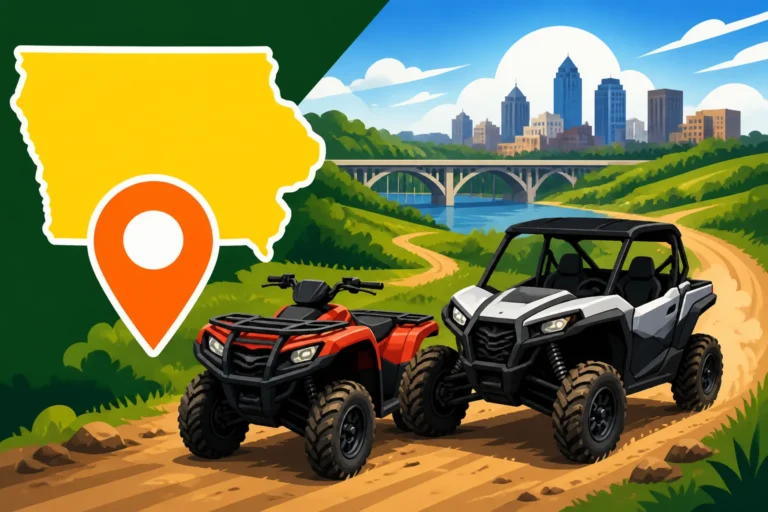
Bluff Creek OHV Park is near Eddyville, but searching for Eddyville alone is not enough to plan the final stretch. Set your destination to the park entrance or the specific staging area you intend to use. If your navigation app only offers a general park pin, compare it with current park directions before setting out. A small difference between a town-center pin and the actual entrance can matter when you are pulling a long trailer.
From Des Moines, your route will generally take you southeast toward the Eddyville area. From Cedar Rapids or Iowa City, you will be approaching from farther east; from Ottumwa, the drive is comparatively short, but the last part still deserves a look before you leave. These are broad starting-point descriptions, not turn-by-turn directions. Road work, closures, and the exact location of your staging destination can change which approach makes sense.
Use a route planner to map the full trip, then inspect the last few miles rather than accepting the first suggested route automatically. Apps such as onX Offroad can help you check riding-area information and plan around your destination, while a standard road-navigation app is usually better suited to turn-by-turn driving. Save the destination and directions before leaving if you expect to travel through areas with unreliable cell service.
Pick a route that works for your tow vehicle
The fastest route is not always the most comfortable one with a loaded trailer. Consider the length and width of your setup, how confidently you can reverse it, and whether you are comfortable using narrow rural roads. A route that looks like a minor shortcut on a screen may involve tight turns, rough pavement, limited places to pull over, or a tricky approach to a junction.
Before you depart, look over the route for obvious constraints. Check that your tow vehicle has enough fuel for the drive and that your trailer tires, lights, coupler, safety chains, and tie-downs are in good shape. If your trailer is carrying more than one machine, confirm that the load is balanced and that your ramps and straps are secured where you can reach them.
If you are crossing a large part of the state, allow a buffer for a fuel stop, food, a slow farm vehicle, or a road delay. A stop is easier to plan before the trailer is loaded than to improvise when you are tired and searching for a place with room to turn around. For more preparation, see [Trailering an ATV Across Iowa] and [Fuel Between Iowa Trailheads].
Prepare for the last miles and arrival
Check the approach before you leave home
Rural navigation is where a little preparation pays off. Zoom in on the map around the park, review the approach from the nearest main road, and make sure you understand which turn leads to the entrance. If the route includes a gravel stretch, plan to slow down and leave more room between your vehicle and the one ahead. Dust can reduce visibility quickly, especially when another truck or trailer is traveling in front of you.
Do not assume that every road shown on a mapping app is a suitable shortcut for a vehicle and trailer. Some smaller roads can be rough, narrow, or difficult to turn around on. If a suggested route looks questionable, choose a more established approach and confirm it with current park information. The few extra minutes are usually preferable to backing a loaded trailer down an unfamiliar lane.
It can also help to save an offline map or a screenshot of the final approach. That gives you a backup if your connection drops. onX Offroad may be useful for checking the riding-area context and mapping nearby off-road information, but use a road-navigation tool for the drive itself and confirm the park entrance with reliable local directions.
Know what to expect when you pull in
When you arrive, take a moment to orient yourself before unloading. Follow posted signs, watch for other vehicles entering or leaving, and avoid blocking the access lane while you decide where to park. If the lot is busy, take your time: a trailer can swing wider than expected, and a rushed turn may put you close to another vehicle or a person walking between machines.
Unload only in an appropriate staging area. Keep your tow vehicle and trailer clear of marked routes, gates, and places where emergency or maintenance vehicles may need access. If you are traveling with children or a group, agree on a meeting point before everyone separates to gear up. That simple step avoids the familiar scramble of trying to find one another in a busy parking area.
Parking arrangements can vary with attendance and conditions, so do not count on a particular space or layout. If you need room for a wide trailer, arrive with enough time to choose a safe position rather than squeezing into the first opening. [Parking a Trailer at an Iowa Park Lot] offers more to consider when you are planning where to stage.
Check trail conditions and park information
Look for weather and closure updates
A clear forecast at home does not guarantee that the trails will be in good shape when you arrive. Rain can make Iowa clay slick and leave ruts that are difficult to see from the parking area. A wet stretch may also lead to temporary trail restrictions or closures, even when the drive to the park is completely manageable.
Check park information shortly before departure and again on the day of your trip. Look for notices about trail conditions, access, events, and any temporary changes to normal operations. If the park provides a phone number or an official update channel, use it when the information online is unclear. A quick confirmation can save you a long drive with a trailer if conditions have changed.
Use [Iowa Trail Conditions Before You Ride] and [Iowa Trail Closures to Check First] as part of your planning routine. A mapping tool such as onX Offroad can help you think through the riding area and nearby options, but a map does not replace a current closure notice. Keep a backup destination in mind if the weather or trail status makes Bluff Creek a poor choice that day.
| Before you leave | What to check | Why it matters |
|---|---|---|
| Route | Park entrance, final turns, and road conditions | Avoids routing to the town center or an unsuitable shortcut |
| Tow setup | Tires, lights, hitch, chains, straps, and load balance | Reduces the chance of a roadside problem |
| Fuel | Tow vehicle range and planned stops | Makes it easier to avoid last-minute searching with a trailer |
| Park status | Current access, trail conditions, and notices | Helps prevent arriving during a closure or restriction |
| Arrival plan | Staging area, unloading, and group meeting point | Keeps the entrance and parking area orderly |
Confirm riding and access requirements
Before unloading, confirm that your machine is ready for the type of riding you plan to do and that you have any required registration or permit documents. Requirements can depend on the machine, rider, and place where you ride, so do not rely only on what a friend remembers from a previous visit. Check the rules that apply to your situation and carry the paperwork you may need.
If you are visiting from outside Iowa, make sure you understand what Iowa requires for your machine. [Iowa's Permit for a Visiting Machine] explains the nonresident permit issue, while [Does Iowa Honor Out-of-State Registration?] covers the question many visitors have before they load up. If a young rider is coming along, review [Iowa ATV Safety Certificate Requirements] before the trip rather than sorting it out at the gate.
Also check the specific rules posted for the riding area. A machine that is appropriate for one trail or park may not be suitable everywhere, and riders should stay on marked routes and follow any posted limits. If it is your first visit, look over a map before riding so you have a basic sense of the layout and can agree on a simple plan with your group.
Make the drive easier for your group
Pack for the trip, not only the ride
A successful day starts with more than a full tank and a loaded ATV. Pack drinking water, snacks, weather-appropriate layers, gloves, eye protection, and any basic tools your group may need. Keep documents and keys somewhere dry and easy to reach. A small first-aid kit and a phone charging option are also sensible additions, especially if you are traveling with children or riding with a group.
Think through the order of your gear. Items needed at the staging area—such as helmets, boots, gloves, and tie-down tools—should not be buried under cargo. Keep anything that could leak or shift during the drive secured. Before leaving home, do a quick walk-around to check that ramps are locked down and that nothing is hanging loose near a tire or exhaust.
If you are unfamiliar with the area, tell someone who is not on the ride where you are going and when you expect to return. Make sure the group has a way to contact one another and a plan if someone gets separated. Do not assume every rider will have a reliable phone signal once away from the parking area.
Build a practical backup plan
Travel plans are smoother when the group has already agreed on what to do if something changes. Decide whether you will wait out a short delay, switch to another riding area, or head home if the park is closed or conditions are unsuitable. This is especially helpful when several vehicles are traveling together or people have driven from different parts of Iowa.
Save the park’s contact information and a second destination before you start driving. Avoid choosing a backup only after you arrive at a closure notice; by then, everyone may be tired, hungry, or reluctant to reload. If you are considering a nearby alternative, check its access rules and status too. A second park is not a useful backup if it is also closed or does not suit your machine.
For Bluff Creek-specific planning, [Bluff Creek OHV Park at Eddyville] provides related park information. You can also read [Why Bluff Creek Costs Nothing to Ride] and [Camping Free at Bluff Creek] if you are planning a longer visit. Confirm current access and camping arrangements before departure rather than assuming that a past visit reflects today’s conditions.
Disclaimer
This article is for general informational purposes only and does not constitute professional advice. Laws, prices and regulations vary by location and change over time. Consult a qualified professional for guidance on your specific situation.