Iowa Riding After Heavy Rain
Heavy rain can turn an Iowa trail from firm and familiar to slick, rutted, and risky in just a few hours. The hard part is knowing whether a park is still rideable, officially closed, or simply too soft to handle without causing damage. This guide explains how to check conditions, make a responsible go-or-no-go decision, and adjust your plans when Iowa trails are saturated.
Why heavy rain changes Iowa trail conditions
Iowa soil can stay slippery after the rain stops
A blue sky does not necessarily mean a trail is ready. Iowa’s clay-heavy soils can hold water and become slick under tires, especially in low spots, shaded sections, and places where runoff collects. When clay is wet, it may cling to tires and reduce traction, then feel greasy again when pressure from repeated passes disturbs the surface. A trail can also look firm from the staging area while remaining soft farther into the woods.
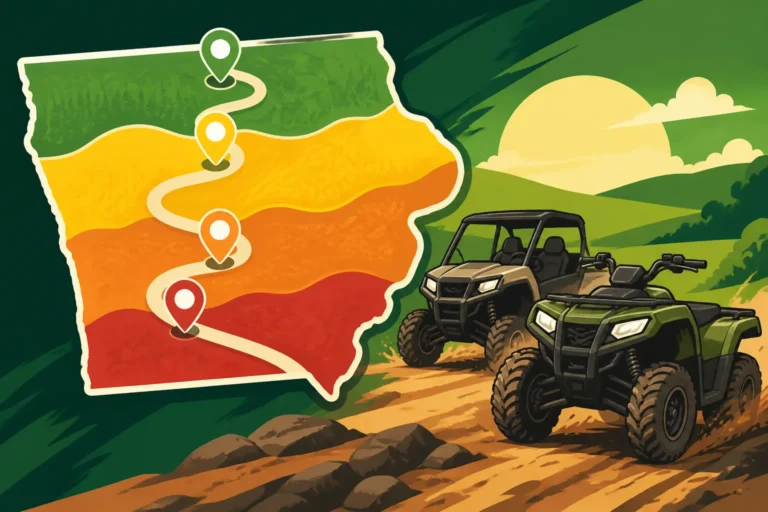
Conditions vary from one park to another and even between routes within a single park. A ridge may drain relatively quickly while a hollow or creek-side stretch stays muddy. At parks such as Gypsum City OHV Park near Fort Dodge, Bluff Creek OHV Park near Eddyville, or Rathbun OHV Area near Plano, the terrain and drainage differ, so a report from one location cannot reliably tell you what another park is like.
The number of hours since the rain ended is only one clue. Recent rainfall, overnight temperatures, shade, soil type, trail grading, and the number of riders using the route all affect how it recovers. That is why a simple rule like “wait until tomorrow” can lead to a disappointing drive or, worse, a damaged trail. Check the specific destination before loading rather than assuming that conditions are uniform across Iowa.
Mud is not a reliable measure of whether a trail is open
Some muddy patches are part of normal riding conditions, but deep or widespread mud can signal that a route is too soft for safe, low-impact use. Tires may lose grip, machines can slide sideways, and riders may be tempted to steer around a puddle. That detour can widen the trail, flatten vegetation, or create new ruts that channel water during the next storm.
Repeated passes make the problem worse. A route that one rider crosses carefully may become heavily churned after a busy day, particularly if machines spin their tires or try to power through boggy sections. Wet soil is more vulnerable to being displaced, and the damage may remain after the surface dries. A trail can become rougher, erode more quickly, or require maintenance before it is ready for regular use again.
If you are unsure what a closure means for a planned trip, start with [Iowa Trails Closed After Rain] and [Trail Damage From Riding Too Wet]. Those topics help put the choice in perspective: skipping a ride may feel frustrating, especially after arranging a trailer and a day off, but turning back can protect the trails people want to use next weekend.
How to check conditions before you load
Look for current information from the park or land manager
Start with the official information channel for the specific riding area. Check its website, social media page, recorded phone message, or other channel used for closures and condition notices. A park’s status can change after a storm, so an old post, a saved screenshot, or a message from a friend may no longer reflect what is happening at the entrance.
For Iowa OHV areas, the Iowa DNR alert information can help riders find updates, but do not assume every local detail will appear in one place. Parks may be managed by different organizations, and a club or local operator may share updates through a separate channel. If the report is unclear, contact the park or managing organization directly. Asking “Are the trails open today?” is useful; asking whether the trails are open after recent rain and whether particular loops are restricted is even better.
Use [Iowa Trail Conditions Before You Ride], [Iowa Trail Closures to Check First], and [Reading the Iowa DNR Alert Feed] as a planning checklist. If you are already comparing possible routes, onX Offroad can help you review mapped riding areas and plan navigation, but treat a map as a planning aid—not confirmation that a trail is open or dry. Official notices and local guidance should determine whether you ride.
Ask questions that help you make a real go-or-no-go decision
A vague “How are the trails?” may get a vague answer. Be specific about when the rain fell, which park you plan to visit, and whether you are bringing an ATV or a wider UTV. Ask whether the park is open, whether any sections are closed, whether staff or volunteers are asking riders to stay off soft areas, and whether conditions have changed since the latest posted update.
It can also help to ask what “open” means in practice. A park may be open while particular loops remain muddy, or the entrance may be accessible while some routes are not suitable for riding. The person answering may not be able to describe every section, so use their guidance together with posted signs and your own judgment at the trailhead. If the information is uncertain, do not treat uncertainty as permission.
A short call before you leave can save a long, frustrating haul. [Calling a Park Before You Load] covers why that check matters, and it is especially useful when your drive crosses a large part of the state. For added trip planning, onX Offroad may help you keep your route organized and identify nearby mapped riding areas, but confirm access, closures, and operating details with the park itself before you set out.
| What you find | Sensible next step |
|---|---|
| Official closure or instruction to stay off the trails | Do not ride there; choose another activity or reschedule |
| Park is open, but specific routes are closed | Stay out of restricted areas and follow posted directions |
| Park is open, but conditions are described as very soft | Consider postponing, especially if the route is already showing damage |
| No recent update and recent heavy rain | Contact the park or choose a confirmed alternative |
| Dry staging area but muddy conditions farther in | Turn around if the route is soft, unsafe, or being damaged |
How to decide whether to ride
Treat closure notices and posted signs as the deciding information
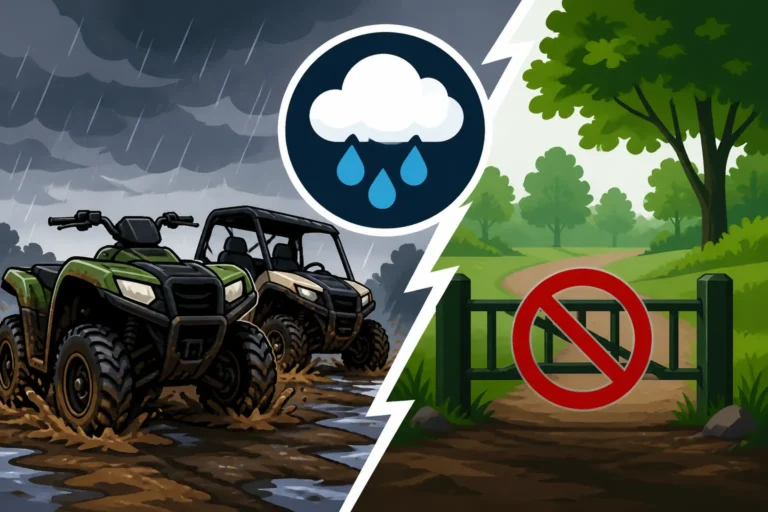
If the park or land manager closes a trail, respect the closure even if the entrance looks dry or another rider says the route is passable. A closure may protect a vulnerable section, allow maintenance, prevent unsafe access, or apply to an area that cannot be judged from the parking lot. Riding past a gate or sign can also create problems for the people responsible for keeping the area available.
Pay attention to signs at the entrance and at junctions. Conditions can differ by loop, and a marked closure may apply only to one section. Do not move a barrier, go around a blocked route, or assume an unmarked shortcut is acceptable. If there is no clear instruction and you cannot get confirmation, the conservative choice is to hold off rather than test the trail with your machine.
This is where patience can be harder than it sounds. You may have driven in from another county, brought your family, or finally found a free weekend. Still, riding a closed or clearly saturated trail can make future access harder for everyone. Read [When a Club Asks Riders to Stay Off] before treating a local request as optional; a club’s notice may reflect on-the-ground conditions that are not obvious from a distance.
Judge the surface honestly when the park is open
An open park is not a promise that every section is suitable for every machine or rider. Before entering a muddy stretch, look for signs of standing water, deep tire tracks, crumbling edges, or a surface that gives way under light foot pressure. Watch what happens to your tires on the first short section. If they begin spinning, sliding, or carrying thick mud that changes the surface, stop and reassess rather than trying to muscle through.
Avoid riding around a puddle if doing so would take you off the marked route. The ground beside a trail may be softer than the track itself, and widening the route can create a new path for water and more damage. If a section appears unsafe or badly churned, turn around where it is safe to do so. Do not follow another rider simply because they made it through; their machine, tires, skill, and line may be different from yours.
Newer riders and families may want a lower threshold for postponing. A slick hill or uneven rut can be difficult to manage when a rider is still learning throttle control or when a youth machine has limited traction. Use [Iowa Trails for Beginners] and [Iowa Riding With Children at an Iowa Park] as helpful planning topics, but base the final decision on the current surface and the park’s guidance.
What to do if you ride after rain
Ride gently and stay on the marked route
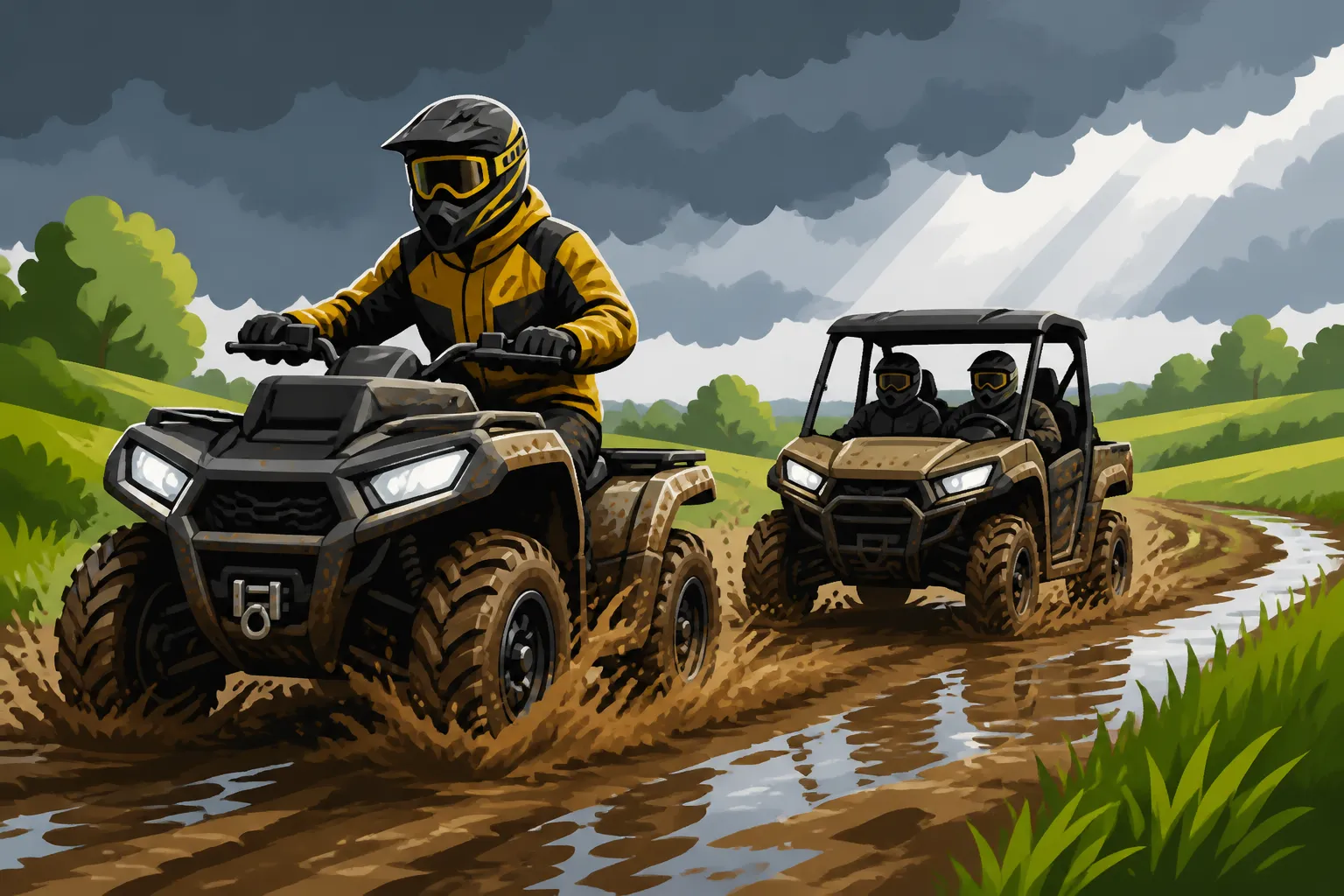
If the park confirms that riding is allowed and conditions appear suitable, adjust your approach. Use smooth throttle and braking rather than sudden inputs that can break traction. Give other riders more room, especially on hills, blind corners, and narrow sections where a machine could slide. Keep your speed appropriate for visibility and grip, and do not assume a familiar route will handle the same way when its surface is wet.
Stay on marked trails even when the main line is messy. Cutting a new line through grass, around a puddle, or across a hillside can expand the damaged area. If you encounter a section that seems too soft, do not keep making passes to find a better track. Turn around if you can do so safely, and let the park know what you observed through its preferred reporting channel.
Wet conditions also make it easier to miss hazards. Water can conceal a rut, loose rock, washout, or debris, while mud may cover a branch or change the shape of a familiar turn. Ride at a pace that leaves room to react, and keep the group together without pressuring anyone to continue. One rider’s cautious decision to stop should not become a group argument about who has enough experience to push through.
Protect your machine and avoid spreading mud
Mud can pack into tires, footwells, fenders, suspension components, and cooling areas. After a ride, inspect the machine before putting it away. Clear packed material carefully, check for damage, and follow the owner’s manual for cleaning. Avoid directing high-pressure water at seals, bearings, electrical connectors, or other sensitive components unless the manufacturer’s instructions permit it.
Mud carried from one trail system to another can also be a concern. Clean your tires, underbody, and trailer before traveling to a different riding area, especially if you have picked up soil or plant material. It is easy to overlook the trailer ramps or tie-down points, but debris can collect there too. Clean equipment makes the next outing easier and helps avoid transferring unwanted material between locations.
If the trail is soft enough that your machine is collecting heavy mud after only a short distance, that is a practical sign to stop. You do not need to wait for a dramatic recovery or a stuck vehicle to decide conditions are poor. For a broader look at how rain affects route choice and local soil, see [Iowa Clay That Turns to Grease] and [Iowa Riding in Spring]. onX Offroad can be useful for keeping trip notes or planning where to go next, but an app cannot replace a careful look at the actual trail surface.
How to make a rain-safe riding plan
Build a backup plan before leaving home
A backup plan takes the pressure off when the first destination is closed or too wet. Identify another activity or riding location that you can verify is open, and decide ahead of time how far you are willing to travel. Do not assume a nearby park received less rain just because it is in a different county; check its status separately. Conditions can vary widely, and a second location may have received the same storm or have its own closure.
If no other riding area is confirmed, consider rescheduling rather than driving from park to park hoping to find dry trails. That can be disappointing, but it is better than arriving at a locked gate or riding somewhere that is asking visitors to stay away. [Picking a Backup Park an Hour Down the Road] offers a useful way to think about alternatives, while [Iowa Trail Closures to Check First] helps you make closure checks part of the plan rather than an afterthought.
When planning with onX Offroad, use it to organize your route and note possible destinations, then verify access and conditions with the responsible park or land manager. Keep the official contact information handy in case weather changes while you are on the road. A simple plan with one confirmed destination and one verified backup is usually more useful than a long list of unconfirmed map pins.
Set clear expectations for everyone in the group
Before the trip, tell your group that the plan may change if the trails are closed or too soft. Agree that a closure, posted sign, or visibly damaging surface means turning around—not splitting up to look for a way through. That conversation is especially helpful when people have different machines, different experience levels, or strong opinions about whether a route is “rideable.”
Make sure everyone knows the meeting point, the backup plan, and what to do if the group turns around. If conditions are uncertain, keep the day flexible enough that you can pivot without feeling forced to ride simply because you already made the drive. Families can also plan a non-riding activity nearby, so a closure does not have to mean the entire outing is lost.
After the trip, share useful condition information through the park’s preferred channel. Be specific and respectful: describe the area, what you observed, and when you visited, without encouraging others to ride a closed or damaged route. A thoughtful report can help other riders make better decisions and can support the people who maintain Iowa’s riding areas. Most of all, remember that a rain delay is temporary; avoiding trail damage helps keep the next ride possible.
Disclaimer
This article is for general informational purposes only and does not constitute professional advice. Laws, prices and regulations vary by location and change over time. Consult a qualified professional for guidance on your specific situation.