Why Iowa Closes Parks for Wet Trails
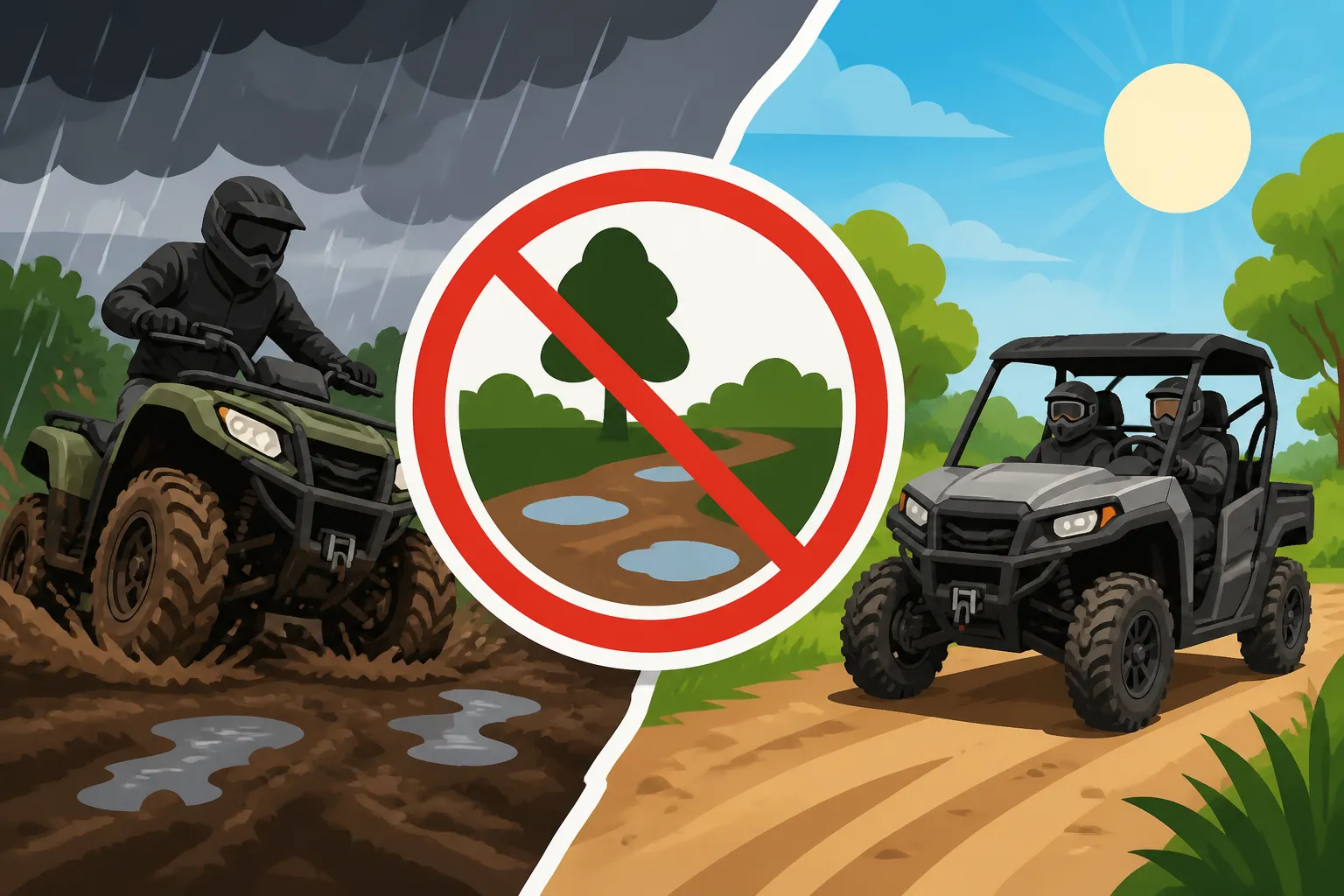
After a night of rain, the trails can look rideable from the parking lot but turn slick, rutted, and damaging just a short way in. Iowa parks close trails when wet ground cannot handle traffic without lasting harm or unsafe conditions. This guide explains what those closures protect, how to check conditions, and what to do when your ride is interrupted.
Why wet trails are a problem in Iowa
Iowa soil can change quickly after rain
Many Iowa riding areas have soil that becomes soft and slippery when saturated. Clay is especially troublesome: it can feel firm in one spot, then turn greasy under a tire on a shaded slope or low-lying section. A trail that was manageable before a storm may be hard to control afterward, even if the rain has stopped and the sun is out.
The trouble is not limited to deep mud. When a tire spins on wet ground, it can loosen soil and carve a rut. Repeated passes deepen that rut, push water along the trail instead of letting it drain, and leave a rougher surface that may be harder to ride and maintain. On a hill, a machine may slide sideways or lose traction. In a low area, standing water can hide soft spots and make a trail difficult to navigate.
Conditions also vary within a single park. An exposed ridge may dry sooner than a shaded hollow. A broad gravel staging area can look fine while a wooded trail remains wet. That is why a park’s closure decision may seem surprising to riders who have only checked the entrance or driven past one section.
For a closer look at why Iowa clay behaves this way, see [Iowa Clay That Turns to Grease]. It helps explain why a trail’s appearance at the gate is not always a reliable guide to its condition deeper inside the park.
Tire damage can compound with every pass
A single rider might leave only a shallow mark, but a busy weekend can bring many machines over the same soft trail. Tires press into the soil, and spinning wheels throw loose material aside. Riders following one another may widen the damaged area to avoid ruts, gradually turning a narrow trail into a broader scar.
Ruts can also redirect runoff. Instead of water spreading across the landscape, it may flow down the track and wash out soil. The next storm can make that erosion worse. The result may be a trail that requires repair, rerouting, or a longer closure before it is safe and sustainable to use again.
This is one reason a closure can protect more than the trail surface. It can help prevent damage to slopes, drainage features, trail edges, and nearby vegetation. [Trail Damage From Riding Too Wet] covers the ways a short ride in poor conditions can create problems that last well beyond the day’s weather.
What a wet-trail closure protects
It helps preserve trails for the whole season
Trail systems need to withstand repeated use, and their condition depends partly on how well water drains away. If machines travel over saturated ground, they can compact some areas while loosening others. That uneven surface may hold water, funnel runoff, or become deeply rutted. Once a trail is damaged, crews or volunteers may need to reshape it and wait for suitable conditions before reopening it.
Closures can feel frustrating when you have already loaded the machine, driven across the state, and finally reached the park. Still, a temporary pause can prevent a small weather problem from becoming a bigger maintenance project. It may also help keep a trail available for more riding days later in the season.
Different parks have different terrain, trail layouts, and people responsible for operations. Some are managed through a mix of public agencies, local organizations, clubs, or counties. As a result, the way a closure is announced or reviewed can vary. The broader context is explained in [Why Iowa Parks Are Run by Clubs and Counties].
It reduces the chance of losing control
Wet surfaces can make it harder to steer, brake, and climb. A rider may approach a familiar corner at a familiar speed, only to find that the tires slide across slick soil. A slope that was easy to climb when dry can become difficult to descend safely, particularly if the trail is narrow or has limited room to recover.
Mud also affects machines. Packed material can add weight, cover components, and make it harder to see hazards under the tires. Water-filled ruts may conceal rocks, roots, or sharp changes in depth. Riders in a group can face additional risks if one machine gets stuck or slides into the path of another.
A closure is not a guarantee that every possible hazard has been eliminated, nor does a reopening mean every rider will find ideal conditions. It is a management decision based on the park’s conditions and the need to protect riders and trails. Taking it seriously is safer than assuming a familiar route will behave the same way after rain.
It protects access beyond one park visit
A trail that needs repair can affect everyone who planned to ride there, not just the person who made the first rut. Damage may require staff or volunteers to spend time correcting the surface instead of maintaining other routes. If the problem is severe, a section—or, in some cases, a wider area—may need to stay closed until it can be addressed.
That can disrupt family outings, club rides, camping plans, and travel to nearby towns. It can also affect the people who contribute time to maintaining routes. Respecting a closure is one practical way riders help keep public riding opportunities viable.
Wet-trail rules are therefore not just about avoiding a muddy machine or a difficult climb. They are a shared-use measure: ride when conditions can support traffic, and give the ground time to recover when they cannot.
How parks decide when trails should close
Conditions matter more than the number of rainy hours
There is no single amount of rainfall that automatically makes every Iowa trail unsafe or vulnerable. The effect of rain depends on the soil, slope, drainage, shade, recent weather, and the trail’s existing condition. A brief shower after a dry spell may have a different effect from several days of rain on already saturated ground.
Park staff or local managers may assess conditions on the ground rather than relying only on a forecast. They might consider whether tires are leaving deep marks, whether water is moving along the trail, or whether a route has become difficult to travel without spinning tires. Conditions can change from one section to another, so a closure may apply to a particular route, area, or entire park.
Riders should not treat a closure as a challenge to find a loophole. If a park posts that trails are closed, stay off them even if the parking area is dry or another rider says a particular loop seems fine. [Iowa's Weather-Driven Trail Closures] offers more context on how weather can affect riding access across Iowa.
Reopening may take longer than the rain lasts
A common frustration is watching the rain stop and expecting trails to reopen immediately. But the ground may remain saturated after the sky clears. Shaded woods, low spots, and clay-heavy sections can hold moisture longer than open ground. A warm, sunny afternoon does not necessarily dry every trail evenly.
Managers may also need time to inspect routes after wet weather. A trail could look passable but still have unstable edges, soft sections, or drainage damage. If repairs are needed, reopening before the work is finished could expose riders to hazards and lead to more damage.
That is why a weather app alone cannot confirm that a park is open. Check the park’s own updates and follow any posted instructions. Before driving, consult [Iowa Trail Conditions Before You Ride] and [Reading the Iowa DNR Alert Feed] for guidance on finding relevant condition notices. When the status is unclear, contact the park or managing organization rather than relying on an old social media post or a previous visit.
What to do when your planned ride is closed
Check the status before loading the trailer
A quick status check before leaving can save a long drive with a loaded trailer. Look for a current update from the park or the organization responsible for it. Pay attention to the date and wording: an old announcement may no longer describe today’s conditions, and a closure for one trail does not necessarily mean every nearby riding area is closed.
If the information is incomplete, call the park or manager before setting out. Ask whether the closure applies to the whole park or only particular routes, whether the parking area or campground remains accessible, and where the latest update will appear. The useful questions are practical, not just “Is it muddy?” A trail can be wet but open, or closed to protect it even when it does not look dramatically muddy.
Use a map to think through alternatives, but do not treat a map as proof that a trail is open. For instance, onX Offroad can help you plan a route and identify possible riding areas, while the park’s official notice should guide your decision about access. Check [Calling a Park Before You Load] when you need a simple pre-trip routine.
| Before leaving | What to check | Why it matters |
|---|---|---|
| Park status | Current closure or reopening notice | Prevents a wasted trip and helps you follow access rules |
| Closure area | Whole park, specific trail, or facility | Avoids assuming every route has the same status |
| Weather history | Recent rain as well as the forecast | Soil can remain saturated after rain ends |
| Alternative plan | Another confirmed-open area or a non-riding activity | Keeps the day flexible without risking a closed trail |
| Travel details | Parking, camping, and access information | Some facilities may have different conditions from trails |
Make a backup plan without riding around the closure
A backup plan is useful, but it should not involve entering a closed trail from another access point, following an unofficial shortcut, or riding onto land without permission. Closure signs apply even if you can see an unmarked route nearby. Trying to bypass a closure can create safety, trespass, and trail-damage problems.
Instead, identify another confirmed-open riding area before you leave, or keep the day’s plans flexible. If you are travelling with children or a group, deciding on a backup in advance can prevent a tense conversation in a parking lot after everyone has already geared up. You might choose a different park, postpone the ride, or turn the trip into a camping or sightseeing day if those facilities are open.
onX Offroad can be useful as a planning aid when comparing possible destinations, but confirm access and operating conditions with the relevant park. A mapped route does not tell you whether a trail has been closed after rain. Keep that distinction clear: maps help you plan; park updates tell you whether you may ride.
Be ready for a closure after you arrive
Even careful planning cannot prevent every surprise. Rain may move through overnight, or managers may discover a problem during an inspection. If you arrive and find a closure notice, read it fully before unloading. Do not assume a route is open because other riders are preparing their machines or because the gate is not physically blocked.
If only certain trails are closed, stay within the routes that are clearly open and follow posted directions. If the notice says the park is closed, do not ride there. If there is no clear information, ask park staff or the responsible organization before proceeding. When nobody is available to clarify, the safe choice is to avoid entering trails until access is confirmed.
For trail-specific planning, [Iowa Trails Closed After Rain] and [Checking Two Iowa Parks Before You Drive] can help you think through changing conditions and alternatives. A little patience at the trailhead is far less costly than damaging a route or getting stranded on a slick section.
How riders can help trails recover
Respect signs and avoid soft ground
The most helpful action is also the simplest: do not ride closed trails. Do not move a barrier, go around a sign, or use a side path to reach a route that has been shut. A closure protects the ground precisely when it is most vulnerable, and one machine can leave marks that others may follow.
When trails are open but conditions are still damp, ride deliberately. Avoid spinning tires, making unnecessary turns on soft edges, or repeatedly attempting a climb that is breaking apart under traction. If a machine starts to slip, stop and reassess rather than adding throttle until the tires dig deeper. Stay on marked routes, where managers can maintain drainage and monitor use.
A responsible rider also avoids widening a trail to bypass a puddle or rut. Going around the obstacle can damage vegetation and create a second track that spreads the impact. If a route appears unsafe or badly damaged, turn back if you can do so safely and report the concern to the park.
Share accurate updates with other riders
It is tempting to post a quick message that says a park is “fine” or “a mess,” but vague reports can mislead people. Conditions can differ across the same property, and they can change after a new storm or a day of drying. If you share an update, include when you were there, which section you rode, and whether the park’s official status has changed.
Do not present a personal impression as permission to ride. A trail that seemed passable to one experienced rider may be a poor choice for a beginner, a youth rider, or a wider machine. And if the park has announced a closure, a personal report that the surface “looks okay” does not override it.
onX Offroad or another mapping tool may help a group discuss route options, but share the official closure notice alongside any map information. That keeps the practical distinction clear for everyone: a route may appear on a map and still be unavailable for riding.
Support the people who maintain riding areas
Many trail systems depend on people who inspect routes, clear obstacles, maintain drainage, communicate closures, and help organize access. A closure can mean extra work for those people, especially after storms. Respectful questions and clear reports are more useful than pressure to reopen a route before it is ready.
If you belong to a club or regularly ride a particular area, learn how that park shares updates and how riders can report damage. Follow local guidance about volunteer days, trail etiquette, and permitted access. Do not try to “fix” a drainage problem yourself unless the park has asked you to help; an improvised repair can redirect water or make the situation worse.
If you need a broader look at how weather affects local access, [Iowa Riding After Heavy Rain] explains why waiting for suitable conditions matters. Patience may cost you one planned ride, but it can help preserve trails for the next family, club outing, or weekend trip.
Disclaimer
This article is for general informational purposes only and does not constitute professional advice. Laws, prices and regulations vary by location and change over time. Consult a qualified professional for guidance on your specific situation.