Gravel Roads You May Ride Without Asking Anyone
There's nothing quite like the call of a wide-open gravel road, inviting you to kick up a little dust on your ATV or UTV. But if you're like many Iowa riders, you've probably felt that nagging uncertainty: "Can I really ride here, or am I going to get myself into trouble?" It's a valid concern, because while Iowa offers a lot of freedom, there are specific rules. This guide is here to untangle the confusion and clearly lay out which gravel roads are legally open for your machine, no special permission needed.
Understanding Iowa's Unpaved Secondary Road Rules
The desire to ride on public roads is often met with a lot of misinformation or vague answers, especially when it comes to ATVs and UTVs. Iowa law does permit the use of these machines on certain public roads, but it’s crucial to understand the specifics. You're not alone if you've seen others riding gravel and wondered if you're missing a secret handshake or a special permit. The truth is, the rules are standardized across all 99 counties, and once you know them, it becomes much clearer where you can and cannot go. [Why Iowa Standardised All 99 Counties]
What Qualifies as an Open Gravel Road?
In Iowa, the type of road that's generally open to ATVs and UTVs without needing specific authorization from a city council or county board is an "unpaved secondary road." What does that mean, exactly? These are typically the gravel roads maintained by your local county, not state highways (even two-lane ones) and definitely not interstates. The pavement is the key differentiator here. If it's paved, even if it feels like a quiet backroad, it's likely not an "unpaved secondary road" and has different rules, which often require specific county authorization to ride. This distinction is vital because riding a paved road that isn't specifically opened by the county or a city ordinance can lead to fines and citations. The freedom you're looking for lies mostly in the dirt and rock paths crisscrossing our rural landscape. [Unpaved County Secondary Roads in Iowa]
It’s easy to get confused because some counties have indeed authorized ATVs and UTVs on paved secondary roads, but that's a specific local decision, not a blanket state rule. The default, statewide permission exists solely for the unpaved ones. So, when you're looking at your county map or driving around, ask yourself: is this truly an unpaved road, or is it merely a less-traveled paved one? That simple question can save you a lot of grief. [Iowa Rules for Riding a Gravel Road]
The Crucial "Most Direct Route" Principle
Now, just because a gravel road is "open" doesn't mean it's a free-for-all for joyriding. Iowa law includes a critical caveat: you must be using the gravel road as the "most direct route" for a specific purpose. This isn't about aimlessly cruising for hours, though it might feel like that sometimes. It means you're using the road to connect from point A to point B.
What kind of points? Think about these scenarios:
- Connecting to an OHV Park: You might use a gravel road to get from your home or a staging area to a designated off-highway vehicle park like Gypsum City or Bluff Creek. You're taking the shortest, most practical route to get your machine to the trails. [Riding to Gypsum City the Short Way]
- Accessing Private Property: Perhaps you have a hunting lease, a friend's farm, or your own timber property that's only accessible via a stretch of gravel. Using the road to reach that private land is a perfectly legal application of the "most direct route."
- Moving Between Farm Fields: For those using their UTVs or ATVs for agricultural purposes, traversing gravel roads to move between different fields or parts of a farm operation is often necessary and falls under this principle.
The "most direct" part is key. You shouldn't be taking a scenic, roundabout way if a shorter, more logical path exists. It's about practical transportation, not recreational cruising on the roads themselves. This rule is designed to allow riders practical access to areas where they can legally operate their machines, while still prioritizing road safety for all users. Understand this, and you'll greatly reduce your chances of running afoul of local law enforcement. [Iowa's Most Direct Route Rule]
Getting Your ATV or UTV Ready for Iowa's Gravel Roads
Riding your ATV or UTV on Iowa's gravel roads comes with responsibilities, and that includes making sure your machine and your paperwork are in order. It's not just about hopping on and going; there are specific requirements that turn your off-road toy into a road-legal vehicle for those unpaved stretches. Ignoring these steps can lead to frustrating roadside stops and unnecessary fines.
Mandatory Registration, Title, and Insurance
This is probably the most critical part of becoming road-legal. Your ATV or UTV needs to be properly registered with the state of Iowa, and that process typically starts at your county recorder's office. This isn't just a suggestion; it's a legal requirement for any off-highway vehicle (OHV) operating on public land, including those open gravel roads. When you register, you'll receive a decal that must be displayed on the rear of your machine, clearly visible. Don't forget your title either; just like a car, your ATV or UTV needs a proper title. [Iowa ATV Registration Cost], [Titling an ATV in Iowa]
Beyond registration, Iowa law mandates that any ATV or UTV operating on public roads must have liability insurance. This is a common point of frustration for many riders who feel like their machine is primarily for off-road use, but the moment your tires hit that gravel, you're expected to carry coverage. This insurance protects you and others in case of an accident, and the minimum coverage limits are the same as for a car: $20,000 for bodily injury to one person, $40,000 for bodily injury to two or more people, and $15,000 for property damage. Always carry proof of your insurance, along with your registration certificate, whenever you're riding on public roads. A deputy will absolutely ask for it if you're stopped. [Insurance Iowa Requires on a Road], [Carrying the Certificate on an Iowa Ride]
Essential Equipment for Road Use
Your off-road machine needs a few upgrades to be considered street-legal on Iowa's gravel roads. These aren't just suggestions; they are requirements designed to ensure your visibility and ability to interact safely with other traffic. It's understandable to feel like you're turning your rugged machine into something more complicated, but these pieces of equipment are for everyone's safety.
Here's the rundown of what you'll need:
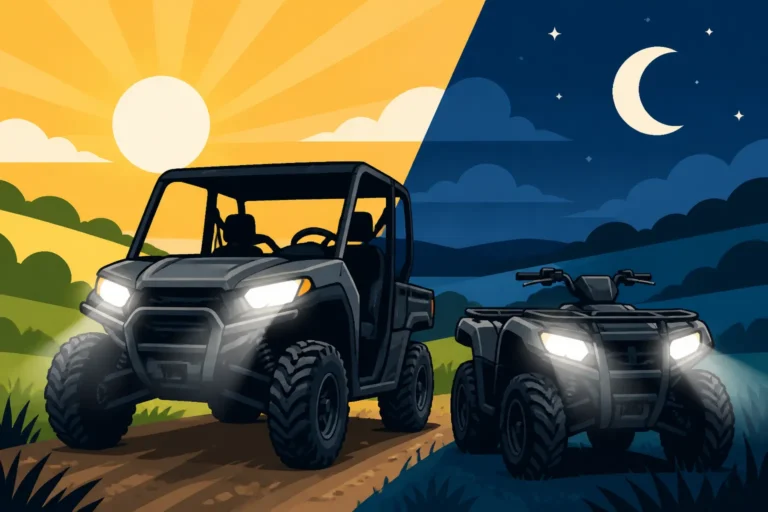
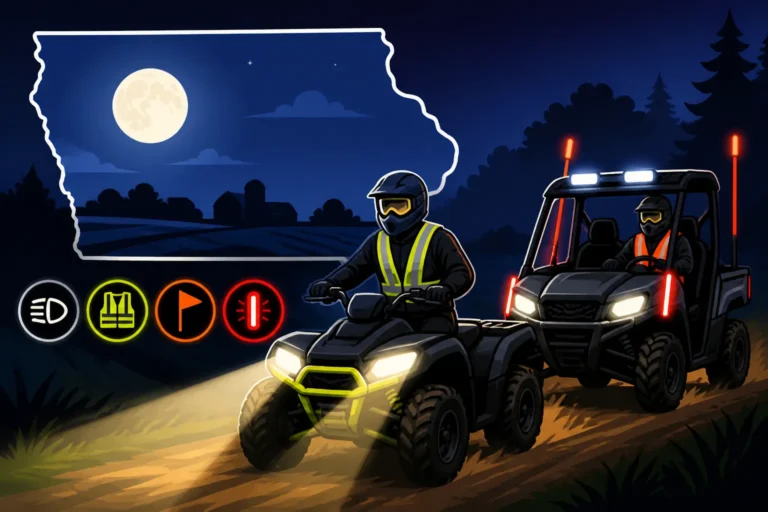
- Headlamps and Taillamps: Your headlamps must be on at all times while operating on public roads, even in broad daylight. You also need functional taillamps. [Headlights Burning at Noon]
- Brakes: A working brake system is, of course, essential for stopping safely.
- Muffler: Your machine needs an adequate muffler to prevent excessive or unusual noise.
- Rearview Mirror: At least one rearview mirror is required. This is crucial for being aware of traffic approaching from behind, whether it's another ATV, a car, or a massive combine. Many riders turn to aftermarket suppliers like SuperATV for robust and easily installed mirrors that can withstand the rigors of off-road and gravel use. [Iowa Mirror Requirement for Road Use]
- Audible Horn: You need a horn that can produce sound for at least two seconds. This is for signaling other drivers and pedestrians. [Iowa Horn Requirement for Road Use]
- Slow-Moving Vehicle (SMV) Triangle: This bright orange triangle with a red border must be displayed on the rear of your ATV or UTV. It alerts other drivers that your machine is traveling at 35 mph or less, giving them time to react and pass safely. [Iowa's Slow-Moving Vehicle Triangle]
- Signal Lamps: If your ATV or UTV came equipped with signal lamps (turn signals), they must be functional. If not, hand signals are generally acceptable.
Ensuring your machine has all these components isn't just about avoiding a ticket; it's about making yourself visible and predictable to other drivers on those dusty roads.
Who Can Ride and What They Need
Beyond the machine itself, the person behind the handlebars or steering wheel has specific requirements for riding on Iowa's public gravel roads. This is an area where many younger riders and their families often face disappointment, as the rules are quite clear.
To legally operate an ATV or UTV on any public road in Iowa, including unpaved secondary roads, you must meet two main criteria:
- Age Requirement: You must be 18 years of age or older. This rule is firm, and there are no exceptions for minors, even with adult supervision, when it comes to public road use. This often surprises people who know minors can ride in designated OHV parks with a safety certificate and supervision. But roads are different, and the law considers the increased risks of mixed traffic. [Why Iowa Requires a Driver 18 or Older]
- Valid Driver's License: You must possess a valid driver's license. This doesn't necessarily mean a special motorcycle endorsement; a standard Class C non-commercial driver's license is sufficient. The key is that you are a licensed driver, demonstrating you have passed the state's basic requirements for operating a motor vehicle. [Eighteen Years Old Behind the Bars]
These rules are in place because operating an ATV or UTV on a public road, even a gravel one, places you in a shared environment with other vehicles. The state aims to ensure that operators have the maturity and demonstrated driving competence to handle these situations safely. A young person, even with a strong safety course background, doesn't meet the public road operating requirements until they turn 18 and obtain their driver's license.
Navigating and Staying Safe on Open Gravel Roads
Once you've got your machine registered, equipped, and you meet the operator requirements, you're ready to hit those Iowa gravel roads. But safe riding isn't just about compliance; it's about awareness, courtesy, and defensive driving. These roads, while often less traveled, are still public thoroughfares shared by various types of traffic.
Respecting the Speed Limit and Other Drivers
The most crucial rule to remember when riding your ATV or UTV on Iowa's open gravel roads is the speed limit: 35 miles per hour, max. It doesn't matter if the road looks clear or if you think your machine can handle more; exceeding this limit is a violation and unsafe. Gravel roads can be unpredictable – loose surfaces, washboards, unexpected dips, and blind corners are common. Maintaining a lower speed gives you more time to react to hazards, whether it's a deer jumping out or a sudden patch of deep gravel. [Iowa's 35 mph Cap]
Beyond the speed limit, remember that you're sharing the road. Iowa's rural landscape means you'll encounter a variety of other vehicles. This includes cars, trucks, and, significantly, large farm equipment. Combines, tractors, and grain trucks can take up the entire width of the road and move slowly. Always be prepared to yield, slow down, and move to the side. Kicking up a huge dust cloud can blind oncoming drivers, so reduce your speed when you see someone approaching. A courteous wave goes a long way in fostering good relationships between riders and local residents. [Meeting a Combine on a Gravel Road]
Crossing Paved Roads and Primary Highways
This is another area ripe for confusion, and it's essential to get it right. While you generally can't ride your ATV or UTV on paved secondary roads (unless specifically authorized by county ordinance) or primary highways, Iowa law does allow you to cross them.
Here’s how it works:
- Crossing at Intersections: You may cross a paved road or highway, but only at an intersection. You cannot simply pull out onto a paved road mid-block and ride a short distance.
- Perpendicular Crossing: The crossing must be made as close to a 90-degree angle as possible. This minimizes your time in the lane of travel.
- Most Direct Route Principle Still Applies: Even when crossing, the "most direct route" rule is in play. You're crossing to get to another section of legal gravel road or private land, not to transition to riding on the pavement itself. [Crossing a Multi-Lane Highway at an Intersection]
For primary highways (state routes marked with numbers like Iowa 1, 14, 21, etc.), the rules are even stricter. You can only cross an undivided two-lane primary highway if it's the most direct route to your destination on an unpaved road. You absolutely cannot ride an ATV or UTV on four-lane primary highways or interstates. The key takeaway is: gravel is generally open for limited use, pavement is generally closed unless explicitly opened by local authority, and primary highways are mostly off-limits except for direct crossings. Understanding [Where a Gravel Road Meets Pavement] is critical for making safe transitions.
What to Expect from Law Enforcement
Let's be realistic: you might encounter law enforcement while riding on Iowa's gravel roads. A county sheriff's deputy or an Iowa Department of Natural Resources (DNR) conservation officer might pull you over. It's usually not personal; they're simply doing their job to ensure everyone is compliant with the law and operating safely. This is where all those requirements we've discussed really come into play.
If you are stopped, be polite, cooperative, and have your documents ready. A deputy will typically check for:
- Registration Decal: Is it current and properly displayed on your machine? [Getting Cited for Riding Without a Recorder Decal]
- Proof of Insurance: Do you have a valid insurance card for the ATV or UTV?
- Operator's Driver's License: Are you 18 or older and do you have a valid driver's license?
- Required Equipment: Do you have headlamps on, a rearview mirror, a horn, and the SMV triangle visible?
If you meet all these criteria, a brief chat and a friendly reminder to ride safely are often all you'll experience. However, if you're found to be in violation – perhaps riding without insurance, without a valid license, or operating on an unauthorized paved road – you can expect a citation and potentially a fine. It's far better to be prepared and compliant than to deal with the hassle and cost of a ticket. [A Deputy at an Iowa Roadside Stop]
Key Iowa ATV/UTV Road Use Requirements
To help summarize everything we've covered, here's a handy table outlining the key requirements for operating your ATV or UTV on Iowa's open unpaved secondary roads.
| Category | Requirement | Notes |
|---|---|---|
| Road Type | Unpaved secondary roads | County-maintained gravel roads. Paved roads typically require specific county/city authorization. |
| Purpose | Must be the "most direct route" | For purposes like reaching OHV parks, private land, or connecting farm operations. Not for recreational cruising. |
| Operator Age | 18 years or older | No exceptions for minors on public roads. |
| Driver's License | Valid driver's license required | Standard Class C non-commercial license is sufficient. |
| Registration | Current Iowa OHV registration decal | Must be displayed on the rear of the machine. Obtained at county recorder's office. |
| Title | Properly titled in Iowa | Ensures legal ownership. |
| Insurance | Proof of liability insurance (20/40/15 minimums) | Mandatory for public road use. Carry proof at all times. |
| Headlights | On at all times | Must be functional and illuminated while operating on the road. |
| Taillights | Functional taillamps | Required for visibility from the rear. |
| Mirror | At least one rearview mirror | Essential for awareness of traffic approaching from behind. |
| Horn | Audible horn | Must be capable of producing sound for at least two seconds. |
| SMV Triangle | Slow-Moving Vehicle (SMV) triangle | Displayed on the rear of the machine, indicating speeds of 35 mph or less. |
| Speed Limit | 35 mph maximum | Strictly enforced. Adjust for dust, visibility, and road conditions. |
| Paved Crossings | Only at intersections, perpendicularly | Use the most direct route across. No riding on multi-lane primary highways or interstates. |
Riding your ATV or UTV on Iowa's gravel roads can be an incredibly rewarding experience, offering a unique way to explore the beauty of our state's rural landscapes. The key to enjoying this freedom without worry is to understand and respect the rules. By ensuring your machine is properly registered, insured, and equipped, and that you, as the operator, meet the age and licensing requirements, you can confidently hit those dusty trails. Always ride responsibly, share the road courteously, and prioritize safety above all else. The open gravel roads are waiting for you, so go make some memories!
Disclaimer
This article is for general informational purposes only and does not constitute professional advice. Laws, prices and regulations vary by location and change over time. Consult a qualified professional for guidance on your specific situation.