Iowa Rules for Riding Home From a Trail
There’s nothing quite like the feeling of wrapping up an incredible day on the trails at an Iowa OHV park – maybe you’ve been conquering the hill climbs at Gypsum City, or carving through the timber at Bluff Creek. Your machine is dirty, you’re tired but happy, and the thought of firing up the truck and trailer for the haul home looms. But sometimes, that short hop from the park entrance to your trailer or even your own driveway involves navigating public roads, and it can be a real head-scratcher trying to remember all the specific Iowa rules. This guide is here to untangle the complexities of riding your ATV or UTV home legally and safely after a trail ride in the Hawkeye State, making sure your adventure ends on a high note, not with a citation.
The Core Principle: Most Direct Route & Unpaved Roads
Iowa isn't a free-for-all when it comes to off-highway vehicles (OHVs) on public roads, and that can be a source of frustration for riders just trying to get from point A to point B. The state has specific regulations designed to balance rider access with public safety and infrastructure protection. Understanding these fundamental principles is your first step to a hassle-free journey home.
Understanding the "Most Direct Route" Rule
Picture this: you've just pulled off the main trail at Rathbun OHV Area, and your trailer is just a mile down the county road. Iowa law understands that you need a way to connect these points, but it's not an invitation for a joyride. The "most direct route" rule is exactly what it sounds like: you are permitted to operate your ATV or UTV on certain public roads only for the most direct route between points where the vehicle is legally operated.
What does this mean in real-world terms? It means you can travel directly from the OHV park exit to your home, a local gas station for fuel, a repair shop, or your staging area where your trailer is parked. You can't, for example, take the scenic route through three different small towns just because you feel like it. The intent is strictly utilitarian – to facilitate necessary travel, not recreational cruising. This rule is often tested during roadside stops, so sticking to the spirit of the law, which is laid out in [Iowa's Most Direct Route Rule], is key. If a deputy asks where you're headed, your answer should reflect this directness.
The Unpaved Secondary Road Rule
Here's where a lot of riders breathe a sigh of relief. Generally speaking, Iowa allows ATVs and UTVs on unpaved county secondary roads. These are your gravel and dirt roads that crisscross much of rural Iowa. For many of us, this is our bread and butter for getting home from the local timber or a nearby trail system.
It's a big deal because it means you often have a network of roads that are legally accessible without needing special county authorization. However, "unpaved" is the operative word. As soon as that gravel turns to blacktop, the rules often change, which we’ll discuss next. Even on unpaved roads, common sense and courtesy are paramount. You'll be sharing these roads with local residents, farm equipment, and sometimes even other recreational users. Kicking up excessive dust, driving recklessly, or failing to yield to larger vehicles can quickly lead to complaints and increased law enforcement presence. Remember, your actions reflect on all riders, so let's keep it respectful out there. Many of the details on these roads can be found under [Unpaved County Secondary Roads in Iowa].
Navigating Paved Roads and City Streets
While unpaved roads offer a degree of freedom, things get a bit more restrictive when pavement enters the picture. This is where local discretion plays a huge role, leading to inconsistencies that can be frustrating for riders traversing county lines or city limits.
Paved Secondary Roads: County Discretion
Unlike their unpaved counterparts, paved county secondary roads are not universally open to ATVs and UTVs in Iowa. For you to legally ride on a paved county road, the county Board of Supervisors must have passed a specific ordinance authorizing such use. This creates a patchwork quilt of regulations across the state. One county might open all its paved secondary roads, while the neighboring county might keep them completely closed, or only open a select few.
This inconsistency means that relying on what you know about one county might get you into trouble in another. It's crucial to do your homework before you embark on your ride home, especially if it involves any paved sections. A quick call to the county sheriff's office or checking the county's official website can save you a lot of headache. Understanding [How an Iowa County Authorizes a Paved Road] is crucial for planning your journey. This is where getting caught off guard can happen, especially if you’re riding through unfamiliar territory after a day at, say, Nicholson-Ford OHV Park and heading back to your staging area.
City Streets and Town Ordinances
Moving from county roads to city streets adds another layer of complexity. Generally, ATVs and UTVs are not permitted on city streets in Iowa unless the specific city council has passed an ordinance to allow it. This is why you might see ATVs legally cruising through a small town like Waukon but face immediate fines if you try the same thing in a larger city without specific authorization.
These city ordinances often come with their own set of rules, such as specific hours of operation, designated streets, or restrictions on horsepower or speed. They're usually in place to serve local residents who use their machines for specific purposes, or to allow access to trailheads. If your route home takes you through any incorporated city or town, you absolutely need to verify their specific rules. A call to the city clerk's office is always a good idea. Don't assume anything. For more information, you can look up [Iowa Cities That Allow ATVs on Streets]. It’s a common pitfall to assume a town's rules are the same as its rural surroundings.
Primary Highways and Restricted Roads
When it comes to the bigger, faster roads in Iowa, the rules become even stricter. Interstates, four-lane highways, and most primary highways (those designated with a US or Iowa route number) are generally off-limits for ATVs and UTVs. These roads are designed for high-speed traffic, and OHVs simply aren't built for that environment safely.
There's usually a very limited exception for crossing these multi-lane highways at an intersection, but even then, it must be done with extreme caution and as part of your "most direct route." You cannot ride along these roads for any significant distance. The dangers are obvious: speed differentials, lack of adequate visibility for larger vehicles, and the sheer volume of traffic make these roads incredibly hazardous for OHVs. Stick to the gravel and authorized paved secondary roads to ensure your safety and avoid hefty fines. It's a non-negotiable rule that aims to keep everyone on the road safe.
Essential Requirements for Road-Legal Riding in Iowa
Even if you’re on an authorized road, your machine and your driving behavior must meet specific state requirements. Ignoring these can lead to significant penalties, undermining all your efforts to ride legally.
Driver Age, License, and Insurance
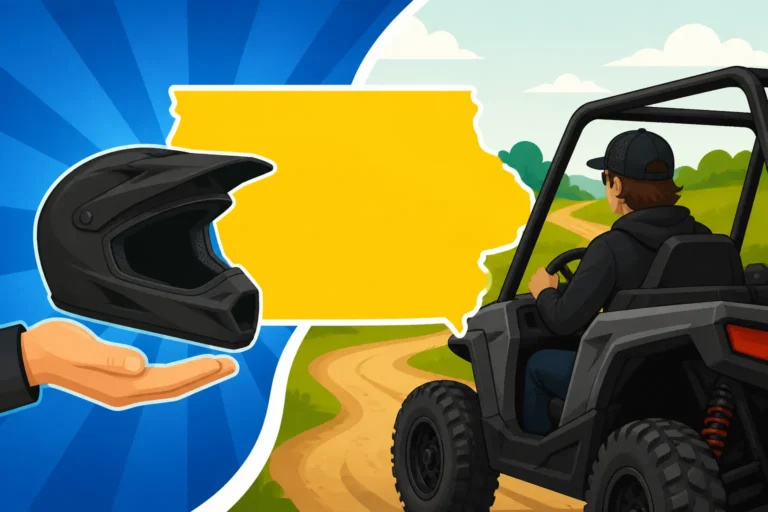
This is a big one, and often a surprise to younger riders. To operate an ATV or UTV on any public road in Iowa – paved or unpaved, authorized or not – the operator must be at least 18 years old and hold a valid driver's license. This means your 16-year-old who’s a whiz on the trails at Bluff Creek cannot legally drive the machine down the gravel road to the truck. This rule is firm and has no exceptions for supervised minors on public roads. You can find more details on this under [Iowa Minimum Age to Ride a Road].
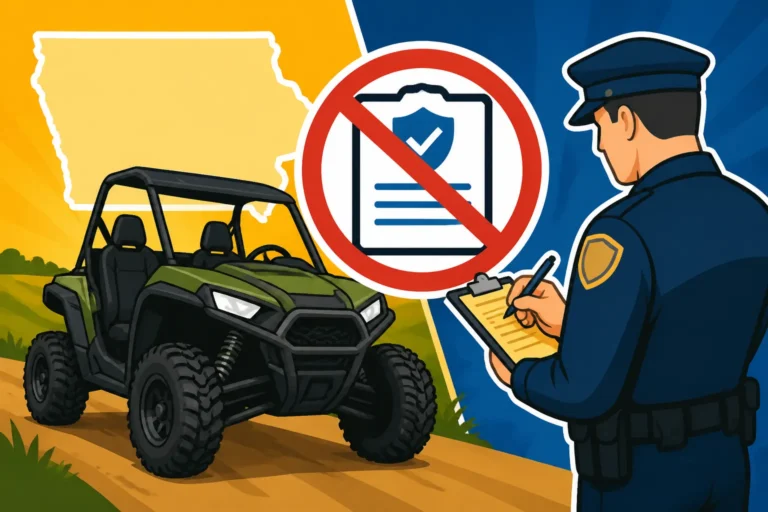
Beyond age and licensing, insurance is non-negotiable. Iowa mandates that any ATV or UTV operated on a public road must carry liability insurance. This isn't just a suggestion; it's a legal requirement. The minimum coverage amounts are specific:
- $20,000 for bodily injury to one person in an accident.
- $40,000 for bodily injury to two or more persons in an accident.
- $15,000 for property damage in an accident.
These are often referred to as 20/40/15 limits. Think about it: if you accidentally swerve and hit a farmer's mailbox or cause an accident with another vehicle, these limits cover the basic costs. Without this insurance, you're not just looking at fines; you could be personally liable for tens of thousands of dollars in damages. Always carry proof of insurance, as an Iowa deputy will ask for it during any roadside stop. For more specifics, check out [Iowa ATV Insurance Requirement] and understand the severe implications of [Iowa Fines for No Proof of Insurance].
Machine Equipment: Lights, Horn, Mirror, and SMV Sign
Your machine itself needs to be properly equipped to be considered road-legal in Iowa. It's not enough to just have a working engine; you need specific safety features that make you visible and able to interact with other traffic. These are often the first things law enforcement will check when they pull you over.
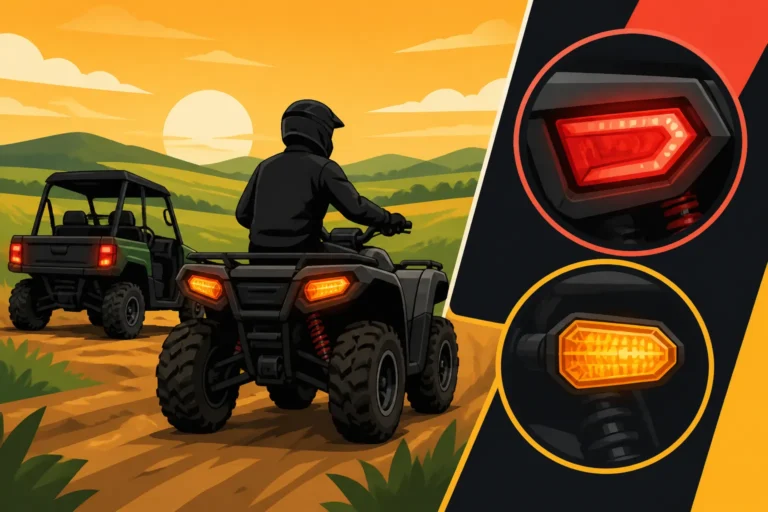
- Lights: This includes a functional headlight that must be on at all times, day or night, when operating on a public road. You also need a taillight and a brake light. This is paramount for visibility, especially if your ride home stretches into the evening, as discussed in [Riding Home After an Iowa Sunset]. Many riders find that adding aftermarket lighting, perhaps from a brand like SuperATV, can significantly improve visibility on dusty gravel roads or when the light starts to fade.
- Horn: A working horn is a must. It’s not just for signaling; it's a critical safety device to alert other drivers or pedestrians to your presence.
- Mirror: You must have at least one rearview mirror on your ATV or UTV that allows you to see traffic approaching from behind. Most machines come with this, but it’s worth double-checking its condition and placement. SuperATV, for instance, offers a range of durable mirrors designed for off-road machines that stand up to the rigors of the trail while providing excellent road visibility.
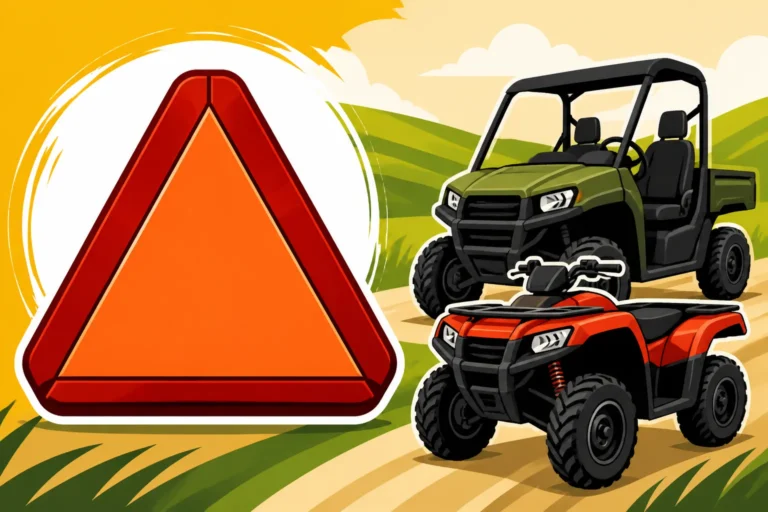
- Slow-Moving Vehicle (SMV) Triangle: This is a bright orange fluorescent triangle with a red reflective border that must be displayed on the rear of your machine. It visually alerts other drivers that your vehicle is traveling at a speed significantly lower than the flow of traffic, a critical safety measure on any road.
These requirements are specifically designed to make OHVs safer and more visible when sharing the road with cars and trucks. For a complete list of what's required, review [What Iowa Requires of an ATV on a Public Road].
Speed Limits and Passenger Rules
Iowa has a strict speed limit for ATVs and UTVs on public roads: you cannot exceed 35 mph. This applies even if the posted speed limit for cars is higher. Remember, your machine isn't designed for sustained high-speed road travel, and this cap is a safety measure to prevent accidents. Adhering to [Iowa's 35 mph Cap] is non-negotiable and helps maintain control, especially on changing surfaces from trail to gravel.
Regarding passengers, the rule of thumb is simple: your ATV or UTV must be designed by the manufacturer to carry a passenger, and that passenger must be seated in a designated passenger seat. You can’t have someone riding on your lap, on the fender, or in a cargo bed unless it's specifically designed for passenger transport with appropriate restraints. Overloading your machine or carrying passengers improperly can significantly compromise handling and braking, putting everyone at risk. Always prioritize safety over convenience.
Practical Tips for a Smooth Ride Home
After a thrilling day on the trails, the last thing you want is a legal snag on your way back. A little preparation and awareness can make all the difference for your journey home.
Pre-Ride Check and Route Planning
Before you even think about leaving the trail exit and hitting the road, take a few minutes for a quick pre-ride inspection of your machine. Make sure all your lights (headlight, taillight, brake light) are working. Give your horn a toot, and check your rearview mirror for obstructions or damage. Ensure your tires are properly inflated for road use – often a bit more pressure than trail riding – and that your Slow-Moving Vehicle (SMV) triangle is securely mounted and clean.
Next, have a clear plan for your route home. Don't just wing it. If you're relying on paved county roads or city streets, confirm they are authorized for OHV use. Use a GPS, but also have a general understanding of the area’s layout, particularly the unpaved secondary roads that are usually accessible. There are many reliable GPS systems and mounts available, and some riders install permanent solutions from companies like SuperATV for seamless navigation. Knowing your path helps you stick to the "most direct route" and avoid accidental detours onto unauthorized roads.
Carrying Documentation and Staying Visible
This cannot be stressed enough: always carry your essential documentation. This includes your valid driver's license, proof of ATV/UTV liability insurance, and your machine's current Iowa registration certificate. Keep them in a waterproof pouch or a secure compartment on your machine. If you're pulled over, having these documents readily available will make the stop much smoother. Also, ensure your Iowa registration decal is properly mounted on the rear of your machine and is clearly visible. If your decal is fading or damaged, you might want to order a replacement, as discussed in [A Decal on the Rear of an Iowa Machine].
Beyond paperwork, make yourself as visible as possible to other motorists. Wear bright, contrasting clothing, even during the day. Consider adding reflective tape to your helmet or machine. Remember, many drivers aren't expecting to see an ATV or UTV on the road, so anything you can do to stand out increases your safety. Some riders even add aftermarket flags or enhanced lighting from brands like SuperATV to ensure they are seen from a distance, especially if they anticipate riding during dawn, dusk, or in challenging weather conditions.
Encountering Law Enforcement
No one wants to be pulled over, but it can happen. If you see flashing lights behind you, remain calm. Signal safely and pull over to the right shoulder of the road, just as you would in a car. Turn off your engine, keep your hands visible, and wait for the officer to approach.
Be polite and cooperative. Provide your driver's license, registration, and proof of insurance when asked. Clearly explain your destination and that you are taking the most direct legal route home from the trails. If you've done your homework and followed the rules, you have nothing to fear. However, if you are riding illegally – perhaps on a closed paved road, without insurance, or under 18 – be prepared for the consequences, which could include fines for violations like [Getting Cited for Riding Without a Recorder Decal] or much worse. Your best defense is knowing and following the rules before you ever leave the trailhead.
| Iowa Road Use Rule | Description | Applies To | Key Requirement |
|---|---|---|---|
| Most Direct Route | Travel only for necessary connection between legal points. | All Public Roads | No Joyriding |
| Unpaved Secondary | Generally allowed on gravel/dirt county roads. | County Roads | Watch for Pavement |
| Paved Secondary | Only if county Board of Supervisors authorizes by ordinance. | County Roads | Check County Ordinances |
| City Streets | Only if city council authorizes by ordinance. | City Limits | Check City Ordinances |
| Primary Highways | Generally prohibited; crossing at intersections is a limited exception. | State & US Routes | Avoid Riding Along |
| Driver Age | Must be 18 years or older. | All Public Roads | Valid Driver's License |
| Insurance | Liability coverage (20/40/15 minimums) required. | All Public Roads | Carry Proof of Insurance |
| Speed Limit | Maximum 35 mph. | All Public Roads | Obey Speed Cap |
| Lights | Headlight on at all times, taillight, brake light. | All Public Roads | Functional Lighting |
| Horn | Functional horn required. | All Public Roads | Audible Warning |
| Mirror | At least one rearview mirror. | All Public Roads | Visibility to Rear |
| SMV Triangle | Slow-Moving Vehicle triangle displayed on rear. | All Public Roads | Clear & Visible |
Disclaimer
This article is for general informational purposes only and does not constitute professional advice. Laws, prices and regulations vary by location and change over time. Consult a qualified professional for guidance on your specific situation.