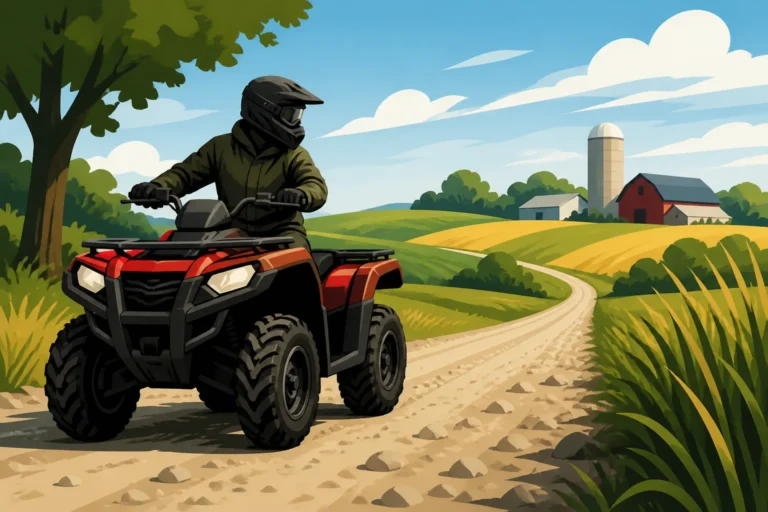
A Triangle on the Back of an Iowa Machine
It's incredibly frustrating when you just want to get your ATV or UTV from point A to point B in Iowa, maybe to a local trail or even just across town for gas, and you're constantly worried about whether you're breaking the law. The rules for riding off-highway vehicles (OHVs) on public roads can feel like a confusing maze, especially when it comes to specific equipment. This guide is here to clear up the confusion surrounding one of the most important, yet often overlooked, requirements for legal road use in Iowa: the slow-moving vehicle (SMV) triangle.
Understanding Iowa's Road Use Rules for ATVs & UTVs
Before we dive into the specifics of that bright orange triangle, it’s crucial to grasp the overarching philosophy Iowa has adopted regarding OHVs on public roads. It's not a free-for-all, and it's certainly not the same as driving a car. The state has carefully crafted regulations to balance the desire of riders to access trails and services with the safety of all road users. Ignoring these foundational principles can quickly land you in trouble, even if your machine seems perfectly equipped.
The Basic Premise: Why Road Use is Restricted
Iowa's primary stance is that ATVs and UTVs are designed for off-road use. Their handling characteristics, speed capabilities, and lack of certain safety features common to automobiles mean they aren't generally considered street-legal in the same way your car or truck is. The law makes allowances, but these are almost always conditional, focusing on specific types of roads and particular purposes. This is why you can't just cruise down a state highway on your quad like you would in a pickup. The goal is to get you from one off-road area to another, or to access necessary services, in the safest way possible, not to make every ATV a daily commuter.
Think of it like this: your ATV is a specialized tool. While it can perform some tasks on the road, it's not its primary function. The state wants to ensure that when it does share the road, it does so safely and predictably for everyone involved. These restrictions are in place to protect you, other drivers, and the integrity of the road infrastructure itself. It's about minimizing risk in an environment where OHVs are the exception, not the norm.
The "Most Direct Route" Principle
One of the most significant concepts governing ATV and UTV road use in Iowa is the "most direct route" rule. This isn't just a suggestion; it's a legal requirement. When you are allowed to operate your machine on a public road, it must be for the purpose of getting to a designated riding area, a service facility, your residence, or a place where the machine is legally permitted to operate. Furthermore, you must take the shortest, most practical path to reach that destination. You can't just take the scenic route or detour unnecessarily. [The Most Direct Route to an Iowa OHV Park] is often the only route allowed by law.
This means if you're trying to get to Gypsum City OHV Park, you can't decide to take a 20-mile loop through three different towns just because it's a "nicer ride" if there's a 5-mile direct path available. The intent of the law is to facilitate necessary travel, not joyriding on public roads. A county deputy at a roadside stop will likely ask you where you're coming from and where you're going. If your answer suggests you're not on the most direct route, you could face a citation for illegal road use. This rule underscores that road use for ATVs and UTVs in Iowa is about utility and access, not recreation.
The Essential Slow-Moving Vehicle Triangle
Among all the equipment requirements for operating an ATV or UTV on Iowa roads, the slow-moving vehicle (SMV) triangle is perhaps the most universally recognized and yet, sometimes misunderstood. This bright orange, reflective triangle isn't just a suggestion; it's a critical safety device that communicates vital information to other drivers, particularly those approaching from behind.
What the SMV Triangle Signifies
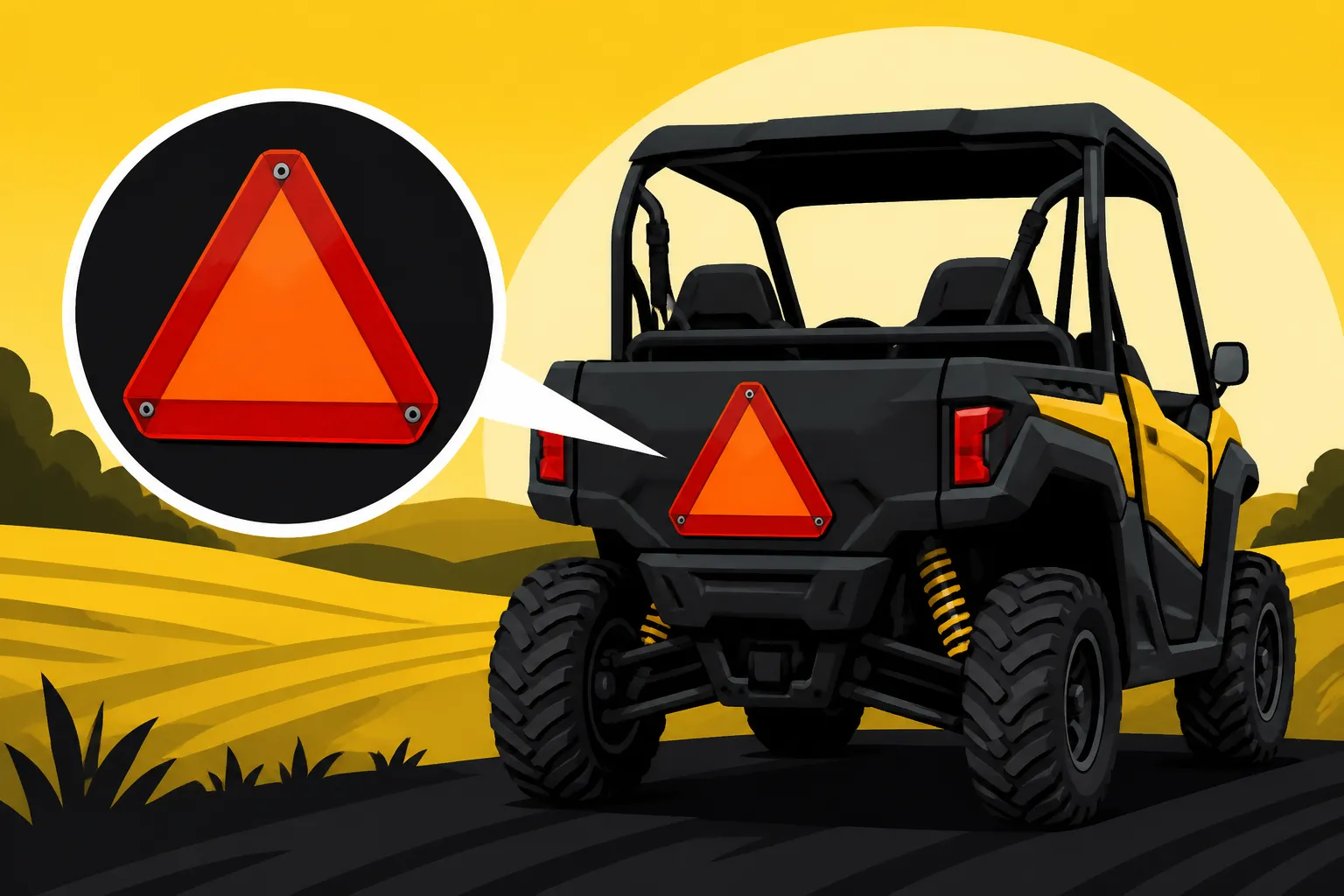
The SMV triangle is a distinct, equilateral triangle with a fluorescent orange center and a retroreflective red border. Its purpose is singular: to warn other motorists that the vehicle displaying it is traveling at a speed significantly slower than the normal flow of traffic. For ATVs and UTVs on Iowa roads, this is particularly relevant because, even with the 35 mph speed limit, these machines often operate well below that, especially on gravel or in certain conditions. [Iowa's 35 mph Cap] is a strict limit, and you should always be prepared for others to approach faster than you.
When a driver sees that bright orange triangle, their brain immediately registers "slow down, potential hazard ahead." This early warning gives them precious extra seconds to react, slow their own vehicle, and prepare to safely pass your machine. Without it, your ATV or UTV, especially if it's a darker color or during dusk/dawn, could blend in more easily with the background, leading to dangerous situations. It's a universal symbol of caution that transcends language barriers, making it indispensable for road safety.
Proper Placement and Visibility
Simply having an SMV triangle isn't enough; it must be correctly mounted and clearly visible to be effective. Iowa law specifies that the triangle must be mounted on the rear of the machine, as close to the center as practicable, and positioned between two and ten feet above the ground. It should be mounted with the point upward, ensuring its distinct triangular shape is immediately recognizable. Obstructions like cargo racks, flagpoles, or even tall passengers can easily block its view, rendering it useless.
Think about the sightline of a driver in a pickup truck or a semi-truck approaching your machine from behind. If your triangle is too low, it might be obscured by their hood. If it’s too high, it might be missed entirely. The goal is maximum visibility. Many riders opt for a sturdy bracket to attach their SMV triangle, often to the rear rack or a specific mounting point designed for such accessories. Companies like SuperATV offer various mounting solutions that can help ensure your SMV triangle is both secure and visible, preventing it from flapping around or getting knocked off during a bumpy ride. Remember, if a deputy can't see it clearly, it's as good as not having one at all.
Other Mandatory Equipment for Iowa Road Use
While the SMV triangle is a crucial piece of the puzzle, it's far from the only requirement for legally operating your ATV or UTV on Iowa roads. The state has a comprehensive list of equipment designed to enhance safety and make your machine more visible and predictable to other motorists. These requirements transform your off-road warrior into a somewhat more road-friendly vehicle, but still not quite a car.
Lighting Requirements for Visibility
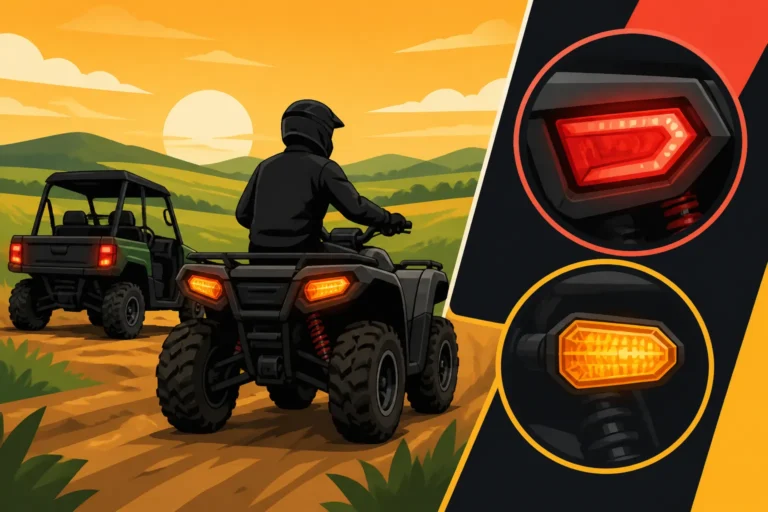
Visibility is paramount when sharing roads with other vehicles, especially when conditions are less than ideal. Iowa law mandates specific lighting for ATVs and UTVs used on public roads. This includes at least one headlight that emits white light, visible from a distance of 500 feet to the front. This headlight must be illuminated at all times while operating on a public road, not just after dark. Think of it like motorcycles that always run with their headlights on. Similarly, your machine must have at least one tail lamp that emits red light, visible from a distance of 500 feet to the rear. This isn't just for nighttime; it's a year-round, always-on requirement for road use. [Iowa Lighting Requirements for ATVs] are strict for a reason.
Beyond these basic lights, turn signals are also required if your machine was originally manufactured with them, or if you've added them. While many factory ATVs don't come with turn signals, most UTVs do. If your machine is equipped with them, they must be in good working order and used appropriately to signal your intentions to other drivers. Having functional brake lights is also essential. When you slow down or stop, the red lights illuminating at the rear of your machine provide a critical warning to those behind you. Ensuring all your lights are clean, operational, and properly aimed is a pre-ride ritual you shouldn't skip when planning road travel.
Horn, Mirrors, and Other Safety Gear
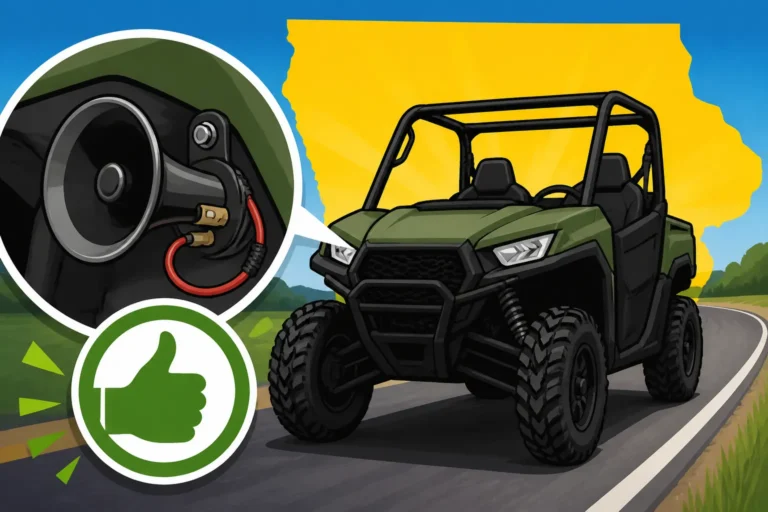
Beyond lights, other equipment plays a vital role in ensuring safe road operation. A functioning horn is a must. This isn't for honking at friends; it's a safety device used to warn pedestrians, animals, or other vehicles of your presence if they don't see you. It needs to be audible from a reasonable distance, typically around 200 feet, to be effective. Think about that moment a car starts to drift into your lane – a quick tap of the horn could prevent a collision. [Iowa Horn Requirement for Road Use] is non-negotiable.
You also need at least one rearview mirror mounted to provide a clear view of the road behind you. This is crucial for monitoring traffic, especially before making turns or changing lanes. Many riders prefer two mirrors for better peripheral vision, but one is the legal minimum. Companies like SuperATV offer a range of robust and adjustable mirrors designed to withstand the vibrations and elements that off-road vehicles experience, ensuring you always have a clear line of sight.
Finally, while Iowa doesn't mandate helmets for adult ATV/UTV operators on roads, it's always a good idea to wear one for your own safety, especially considering the open nature of these vehicles. Eye protection is also highly recommended to shield against dust, debris, and insects. While not explicitly listed as road-use equipment, a safety flag can also enhance visibility, particularly in dusty conditions or over hills, though it's typically more common on dunes or specific trail systems.
The Role of Insurance and Driver Requirements
Even if your ATV or UTV is equipped with all the right lights, mirrors, and that all-important SMV triangle, you're not legal to ride on Iowa roads without proper insurance. Iowa mandates minimum liability insurance coverage for any OHV operated on public roads. This protects you financially in the event you cause an accident that results in injury or property damage to others. The required minimums are often referred to as 20/40/15: $20,000 for bodily injury to one person, $40,000 for bodily injury to two or more people, and $15,000 for property damage. Not having this insurance can lead to significant fines and penalties if you're caught. [Iowa ATV Insurance Requirement] is a serious matter.
Beyond insurance, the operator of the ATV or UTV must be at least 18 years old and possess a valid driver's license. This means a provisional license, an instruction permit, or simply being under 18 won't cut it for road use. The state wants to ensure that anyone operating these machines on public thoroughfares has demonstrated a basic level of driving competence and responsibility. You must carry proof of your insurance and your driver's license with you when riding on public roads. These requirements are in place to ensure a baseline level of responsibility and preparedness for anyone choosing to take their off-road machine onto shared public spaces.
Where You Can Legally Ride on Iowa Roads
Understanding the equipment requirements is only half the battle; knowing where you can actually operate your ATV or UTV on Iowa roads is equally crucial. The state's laws are specific about which types of roads are open to OHVs and under what conditions. It's not a blanket authorization across all public asphalt and gravel.
Navigating Unpaved County Secondary Roads
For many Iowa riders, unpaved county secondary roads are the most accessible and common places to legally operate their ATVs and UTVs. These are your typical gravel roads that crisscross the rural landscape. Iowa law generally permits OHVs on these unpaved roads, provided all other requirements (equipment, insurance, driver's license, direct route, etc.) are met. This is often the path connecting a rider's home to a nearby trail system or to a gas station in a small town. [Iowa Rules for Riding a Gravel Road] are what most riders become familiar with first.
It's important to remember that "unpaved" is the key term here. As soon as a section of the road becomes paved, even for a short stretch, the rules can change, which we'll discuss next. Even on gravel, always be mindful of other traffic, including cars, trucks, and farm equipment. Dust can be a significant visibility issue, both for you and for others, so adjust your speed accordingly. While you have a right to be there, you also have a responsibility to ride defensively and courteously, ensuring safety for all users of the road.
Paved Roads and County Authorization
Here's where things get a bit trickier. Generally, ATVs and UTVs are not permitted on paved county roads or state highways in Iowa. However, counties do have the authority to open specific paved secondary roads to OHV use through a formal resolution by their board of supervisors. This means that just because a road is paved, it isn't automatically off-limits, but it isn't automatically open either. You cannot assume anything.
It is entirely up to each individual county to make these decisions, and there is no statewide mandate to open paved roads. If a county has passed such a resolution, they are often required to post signs indicating where OHVs are permitted. Always check with the specific county's recorder's office or website for their local ordinances before riding on any paved secondary road. Don't rely on word-of-mouth or assume a road is open just because you see someone else riding on it. Ignorance of the law is not an excuse. For state highways, even if two lanes and undivided, they are generally closed to OHVs except for direct crossings at intersections. [Paved Secondary Roads and County Authorization] clarifies this often-confusing distinction.
City Streets and Local Ordinances
Riding your ATV or UTV on city streets introduces yet another layer of complexity. Similar to paved county roads, city streets are generally off-limits unless the city council has passed a specific ordinance authorizing OHV use within its corporate limits. Just because a small town seems relaxed doesn't mean their streets are open. Each city or town has the autonomy to decide whether to permit OHVs on its streets and, if so, under what conditions (e.g., specific hours, designated routes, or certain areas only).
Some cities, such as Waukon, have indeed opened certain streets or alleys to OHV traffic, often with specific restrictions like hours of operation or routes that connect to trail systems. However, there is no centralized state list of these ordinances, so you absolutely must contact the city clerk's office of the specific municipality you plan to ride in. A phone call or a quick check of their municipal code online before you load up your trailer can save you a significant headache and a potential fine. [Iowa Cities That Allow ATVs on Streets] are the exception, not the rule, and always come with their own unique set of rules.
Common Misconceptions and Penalties
The intricacies of Iowa's ATV and UTV road laws often lead to misconceptions among riders. These misunderstandings can easily result in tickets, fines, and even more serious consequences. It's essential to bust these myths and understand the real-world implications of non-compliance.
The Myth of "Any Gravel Road"
One of the most widespread myths is that all gravel roads in Iowa are automatically open to ATVs and UTVs. While it's true that unpaved county secondary roads are generally permitted, the nuance often gets lost. Riders might assume that any dirt or gravel path, including Level B roads, private lanes, or even ditches next to paved roads, falls under this umbrella. This is simply not the case. Level B roads, for example, are often unimproved, unmaintained roads that are not necessarily intended for regular vehicle traffic, and they can have different rules or even be completely impassable.
Furthermore, while you might technically be on a gravel road, if you're not following the "most direct route" principle or if you're engaging in recreational riding instead of point-to-point travel, you could still be in violation. The law's allowance for gravel road use is tied to the purpose of travel, not just the surface type. It's not a free pass to explore every backroad without consideration for the law. Always remember that public roads are for public transit, and your OHV's use of them is conditional, not absolute.
Consequences of Non-Compliance
Operating an ATV or UTV on Iowa roads without adhering to the legal requirements can lead to a range of penalties, from simple fines to more severe consequences. If you're caught riding an unregistered machine, without the proper safety equipment (like that SMV triangle, lights, or mirrors), without insurance, or by an underage or unlicensed driver, you will likely face a citation. Fines can vary depending on the specific violation, but they can quickly add up. For instance, [Iowa Fines for Illegal ATV Road Use] can be substantial, making a casual ride an expensive mistake.
Beyond monetary fines, repeated offenses or serious violations (like reckless driving or operating while intoxicated) could lead to your machine being impounded, your driver's license being suspended, or even criminal charges. If you're involved in an accident while illegally operating your machine, your insurance might not cover the damages, leaving you personally liable for significant costs. It's not just about avoiding a ticket; it's about ensuring your safety, the safety of others, and protecting your financial well-being. Always prioritize legality and safety over convenience or a spur-of-the-moment decision to ride where you shouldn't.
Preparing Your Machine for Iowa Road Riding
Getting your ATV or UTV ready for legal road use in Iowa isn't just about bolting on an SMV triangle and calling it a day. It involves careful consideration of the equipment you choose, ensuring everything is properly installed, and conducting thorough pre-ride checks. This preparation is what truly bridges the gap between an off-road machine and one that can safely and legally share the asphalt and gravel with other vehicles.
Choosing the Right SMV Triangle and Accessories
When it comes to the SMV triangle, don't just grab the cheapest one you can find. Quality matters significantly for something designed to protect you. Look for a durable triangle made from weather-resistant materials, with highly reflective red borders and a vibrant, fade-resistant fluorescent orange center. This ensures it remains effective even after exposure to sun, rain, and mud. Companies like SuperATV offer robust SMV triangles and mounting kits specifically designed for the rigors of ATV and UTV use, which are often far more durable than general farm implement triangles. You might also consider one with a sturdy, flexible mount that can absorb some of the bumps and vibrations without breaking.
Beyond the triangle itself, think about other accessories that enhance road safety. Upgrading to brighter, LED headlights and tail lights can significantly improve your visibility, especially when riding at dusk or dawn. Investing in high-quality, shatter-resistant mirrors that offer a wide field of view is also a smart move. If your machine doesn't have factory turn signals, consider adding an aftermarket kit. While not strictly mandated for all machines, they are an invaluable tool for communicating your intentions on the road. Remember, every piece of equipment you add should contribute to making your presence on the road clearer and safer for everyone.
Pre-Ride Checks for Road Legality
Before you even pull out of your driveway onto a public road, a comprehensive pre-ride check is absolutely essential. This isn't just about making sure your engine starts; it's about verifying that every single piece of required equipment is present, functional, and properly secured.
Here’s a quick checklist to run through:
| Item | Check | Notes |
|---|---|---|
| SMV Triangle | Is it clean, intact, point up, and securely mounted on the rear? | Ensure it's clearly visible and not obstructed by cargo or passengers. |
| Headlights | Are they working and properly aimed? | Must be on at all times on public roads. Consider LED upgrades for better visibility. |
| Tail Lights/Brake Lights | Are they working and illuminating brightly? | Essential for rear visibility, especially when slowing down. |
| Turn Signals | If equipped, are all four working correctly? | Use them consistently to signal turns and lane changes. |
| Horn | Does it emit a clear, audible sound? | Test its functionality before each ride. |
| Mirrors | Is at least one mirror present, clean, and adjusted for a clear rear view? | Ensure it's securely mounted and free of cracks or damage. [Iowa Mirror Requirement for Road Use] is specific. |
| Tires | Are they properly inflated and in good condition for road travel? | Check for excessive wear, punctures, or dry rot. Road use can wear off-road tires quickly. |
| Brakes | Are both front and rear brakes functioning effectively? | Test them at low speed before entering traffic. |
| Driver's License | Do you have a valid, unexpired driver's license on you? | Must be 18 years or older. |
| Proof of Insurance | Do you have your current insurance card or documentation? | This is mandatory for road use. |
| Registration Decal | Is your current Iowa registration decal affixed and visible? | While not direct road equipment, it's a fundamental legality for public land use. [A Decal on the Rear of an Iowa Machine] is key. |
| Most Direct Route | Have you planned your route to be the most direct? | Avoid unnecessary detours or recreational riding on public roads. [The Most Direct Route Home in Iowa] is your legal obligation. |
Making these checks a habit will not only keep you compliant with Iowa law but, more importantly, will significantly enhance your safety and the safety of everyone else sharing the road. Road riding an ATV or UTV in Iowa is a privilege, not a right, and being prepared is key to enjoying that privilege responsibly.
Disclaimer
This article is for general informational purposes only and does not constitute professional advice. Laws, prices and regulations vary by location and change over time. Consult a qualified professional for guidance on your specific situation.