A Decal on the Rear of an Iowa Machine
It's incredibly frustrating when you're geared up for a ride on Iowa's beautiful trails or gravel roads, only to second-guess if your ATV or UTV is properly marked and legal. The rules around registration decals can feel like a maze, especially with specific placement requirements and the worry of being caught off-guard by an enforcement officer. This guide is here to clear up all that confusion, detailing exactly where your Iowa off-highway vehicle (OHV) decal needs to be displayed and why it's so important to get it right.
Understanding Iowa's OHV Decal System
Iowa has a clear system for identifying registered off-highway vehicles, and the humble decal is at the heart of it. This isn't just a sticker; it's your machine's visible proof that you've fulfilled your legal obligations to the state, contributing to the trails and enforcement efforts that keep riding enjoyable for everyone. Missing or improperly displaying it can turn a fun day into a costly one, which is the last thing any rider wants.
The Purpose of the Registration Decal
Think of your ATV or UTV registration decal as its license plate for off-road use. It's a small, adhesive sticker that contains vital information, including the current registration year and your unique registration number. This decal is designed for easy visual inspection by law enforcement, conservation officers, and even park staff, allowing them to quickly verify that your machine is legally registered to operate on public lands, designated trails, and any road where OHV use is permitted. Without it, there's no immediate way to tell if your machine is legitimate, leading to questions and potential fines.
It's about more than just avoiding trouble; the fees collected through registration directly support Iowa's OHV program. These funds go towards maintaining and developing trails, safety education programs, and covering the administrative costs associated with managing the state's OHV resources. So, while it might sometimes feel like just another hoop to jump through, your decal is a direct contribution to the riding opportunities you enjoy across the state.
Decal vs. Certificate: Knowing the Difference
It's common to confuse the physical decal with the registration certificate, but they serve distinct purposes. The decal is the visual proof that adheres to your machine, making it immediately apparent to anyone checking. It's what the officer sees when you're pulled over or when they're observing riders at an OHV park. This sticker signifies that the machine itself is registered for operation.
The registration certificate, on the other hand, is the paper document that contains all the detailed information about your machine's registration, including your name, address, machine details, and the registration number that matches the decal. It's your official record of registration. You're required to carry this certificate with you whenever you're operating the OHV. Many riders will keep it in a waterproof bag under the seat, in a glove box, or even in a wallet, ensuring it's protected and accessible. [Carrying the Certificate on an Iowa Ride] is a separate but equally important requirement, as an officer may ask to see both the physical decal and the accompanying paperwork.
Why the Decal Matters on Public Land
The moment your wheels touch public land—be it a designated OHV park, a state forest trail, or an approved gravel road—your decal becomes your official pass. Iowa law is quite clear that any ATV, UTV, or off-road motorcycle operating on public land must display a valid, current registration decal. This applies whether you're ripping through the mud at Bluff Creek OHV Park, navigating the trails at Gypsum City, or simply using an authorized secondary road to get from one section of your property to another.
The decal provides an immediate verification for the authorities, preventing the need for them to stop every rider to check their paperwork. It's a system designed for efficiency and compliance. Think of it as the green light for your ride; without it, you're essentially operating in the red, risking a stop, an inquiry, and potentially a citation for non-compliance. Even if you only ride occasionally, the moment you leave private property that isn't your own, that decal needs to be prominently displayed.
The Yearly Expiration and Renewal Cycle
Like many official documents, your Iowa OHV registration decal doesn't last forever. All Iowa ATV and UTV registrations expire annually on December 31st, regardless of when you initially registered the machine during the year. This uniform expiration date simplifies the process for both riders and the state, creating a predictable renewal cycle. It's easy to forget, especially if you bought your machine in the spring and think you have a full year.
The good news is that Iowa offers a generous renewal window. Riders can typically start renewing their registrations as early as September 1st, giving you four full months to get your paperwork in order before the December 31st deadline. This early window helps prevent a last-minute rush and ensures that you have your new decal in hand, ready for those crisp New Year's Day rides, or whenever the snow allows. It’s always a good idea to mark your calendar in September so you don't miss the renewal period. Failing to renew on time can lead to [Iowa's Late Registration Penalty], which is an additional fee on top of your standard registration costs.
Official Decal Placement on Your Iowa ATV or UTV
Iowa has specific rules about where your registration decal must be placed on your off-highway vehicle. These aren't arbitrary guidelines; they're designed to ensure maximum visibility and consistency, making it easy for enforcement officers to spot a valid registration without having to guess or search for it. Getting this right is as important as having the decal itself.
The "Rear of the Machine" Rule
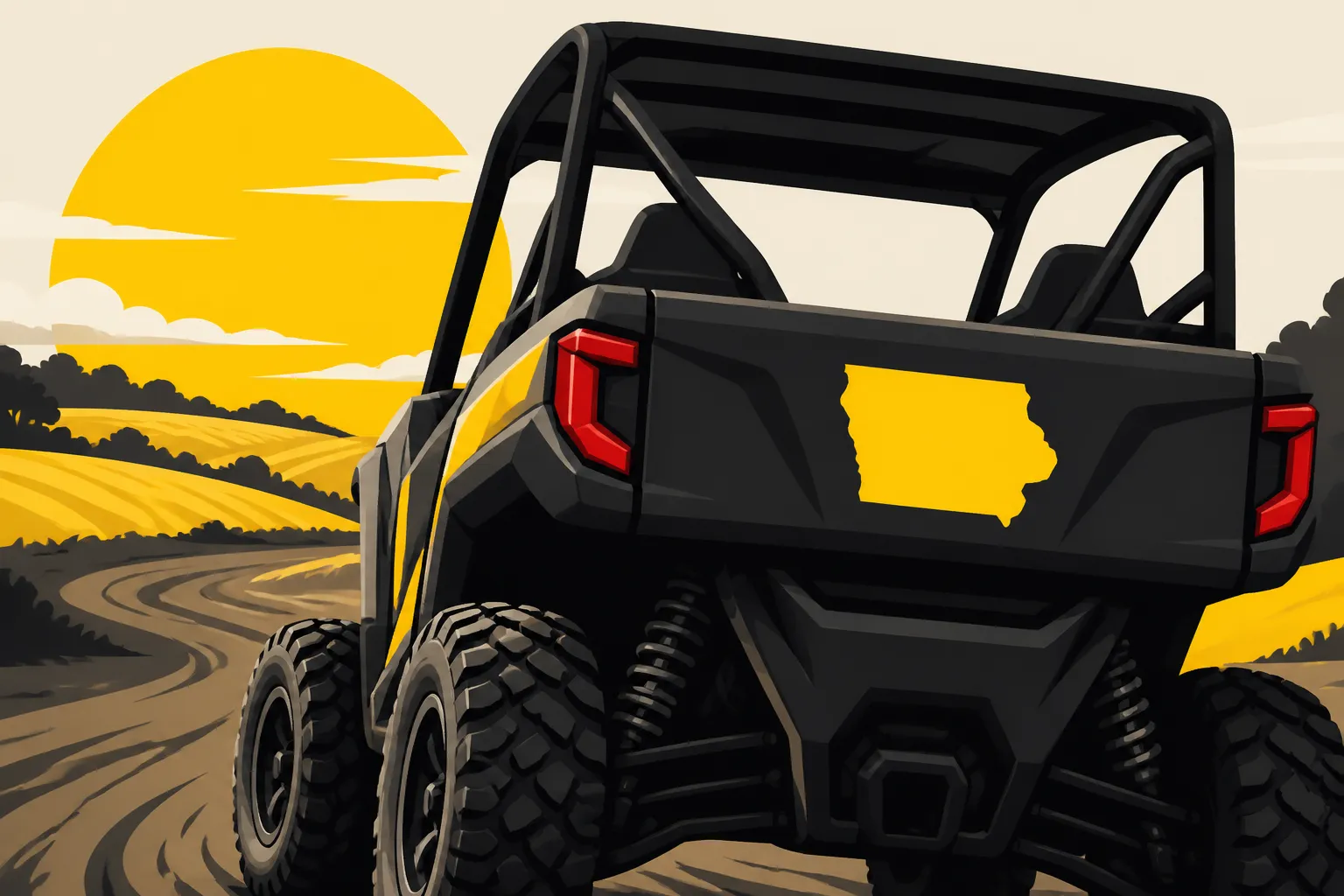
The primary rule in Iowa is that the registration decal must be affixed to the rear of the machine. This means the decal should be clearly visible from directly behind your ATV or UTV. For most ATVs, this typically translates to the rear fender or a dedicated decal plate on the back rack. For UTVs, it often goes on the rear bed, tailgate, or a flat surface that faces backward. The key is unobstructed visibility.
The reason for this placement is straightforward: when an officer is observing trails or checking vehicles, they are often doing so from behind, whether you're riding away from them or parked. A decal placed on the side, front, or in an obscure location defeats the purpose of quick identification. Iowa Administrative Code 571-46.7 further details these requirements, leaving little room for interpretation. Understanding [Iowa Admin Code 571-46.7 and Decal Placement] is crucial for all riders to ensure full compliance.
Why Proper Placement is Crucial for Enforcement
Imagine an Iowa DNR conservation officer patrolling an OHV park or a county sheriff's deputy monitoring a gravel road. They're looking for machines with current, visible decals. If your decal is caked in mud, hidden under a bag, or simply placed on the front fender, it complicates their job. This can lead to them stopping you for further inspection, even if you are legitimately registered. While it might feel like an inconvenience, it's about maintaining order and safety on public riding areas.
Proper placement means the decal is easily seen and read without the need for an officer to approach your machine or ask you to point it out. It’s a courtesy to enforcement officers and a clear sign that you, as a rider, understand and respect the regulations. Compliance helps keep everyone on the trails safer and more accountable.
Specifics for Different Machine Types (ATV, UTV, Dirt Bike)
While the general rule is "rear of the machine," the exact spot can vary slightly depending on the type of OHV you're riding.
- ATVs (Quads): For four-wheel ATVs, the most common and compliant spot is on the rear fender, typically on the left-hand side or in the center, ensuring it's not obscured by a rear cargo box or any other accessory. The surface should be clean and relatively flat for good adhesion.
- UTVs (Side-by-Sides): UTVs offer a bit more surface area, but the principle remains the same. The decal should be on the rear of the vehicle, often on the tailgate, the back of the bed, or a flat panel that faces directly backward. Avoid placing it where it might be easily scraped off by brush or cargo.
- Off-Road Motorcycles (Dirt Bikes): For dirt bikes, the decal is usually placed on the rear fender, often on the very back or to one side, as long as it's visible. Some riders also opt for the rear number plate if it offers a suitable flat surface that is clearly visible from the rear.
In all cases, ensure the decal is on a rigid part of the machine, not on a removable cargo bag or a flexible mud flap. It needs to be securely attached and remain visible in all riding conditions.
Common Mistakes and How to Avoid Them
Riders often make a few common errors when it comes to decal placement, usually inadvertently. Being aware of these can save you a headache later on:
- Placing it on the front: While some states allow front placement, Iowa does not. A decal on your front fender or hood is incorrect and may lead to a stop.
- Obscuring the decal: Don't put the decal where a spare tire, a cooler, a flag pole, or even excessive mud will consistently cover it. It needs to be visible at all times.
- Placing it on non-permanent parts: Attaching the decal to a removable piece of equipment, like a cargo box that isn't always on the machine, means the machine itself isn't properly marked when that piece is removed.
- Applying to a dirty or curved surface: The decal needs a clean, flat surface to adhere properly and remain legible. Applying it to a dirty or highly curved area means it might peel off or become unreadable quickly.
To avoid these issues, always choose a flat, clean, and permanent surface on the rear of your machine. Before applying, clean the area thoroughly with rubbing alcohol and ensure it's dry. Take your time to apply it smoothly, pressing out any air bubbles, so it has the best chance of staying put for the entire season. The location [Where the Iowa Decal Mounts] is specific and requires your attention.
Getting Your Iowa ATV or UTV Decal
The decal is a physical manifestation of your machine's successful registration. Understanding the process of how you obtain it, what to expect, and how to replace it if it becomes damaged or lost is vital for any Iowa OHV owner. It's not just about filling out a form; it's about initiating a process that ends with that important sticker on your machine.
The Registration Process and Decal Issuance
The journey to getting your decal begins with registering your ATV or UTV in Iowa. This is typically done through your local [Registering at an Iowa County Recorder] office. When you purchase a new or used machine, or if you've recently moved to Iowa, you'll need to visit the County Recorder's office in the county where you reside. You'll need to bring a few key documents, including your certificate of origin (for new machines) or the signed-over title (for used machines), and proof of sales tax payment.
Once you've completed the registration paperwork and paid the necessary fees, the County Recorder's office will process your application. They will issue you a temporary registration (often a paper printout) and a receipt. This temporary document allows you to legally operate your machine while you wait for your official decal and registration card to arrive in the mail. The physical decal is usually not handed to you on the spot because it's part of a centralized mailing process to ensure consistency and prevent fraud. This is also where you would pay the [Iowa ATV Registration Cost], which includes several components such as the base fee, writing fee, and DNR administration fee.
What to Expect After Registering
After you've paid your fees and submitted your paperwork at the County Recorder's office, there's a waiting period. The County Recorder sends the information to the Iowa Department of Natural Resources (DNR), which then mails out the official decal and your permanent registration certificate. This isn't an instant process, so don't expect to ride away with your new decal on the same day you register.
During this waiting period, keep your temporary registration documentation with you. It serves as your legal proof of registration until the official items arrive. It's a good habit to keep all your OHV-related documents in a designated folder at home, making them easy to find when you need them for renewal or transfer.
Two Weeks of Post Before a Decal Lands
Many riders wonder how long they'll have to wait for their decal to arrive. Typically, you should expect your new Iowa OHV registration decal to arrive in the mail within two weeks of completing your registration at the County Recorder's office. This timeframe allows for processing, printing, and mailing. While mail delivery times can vary slightly, two weeks is a good general estimate.
This waiting period highlights the importance of planning. If you know you have a big riding trip coming up, don't wait until the last minute to register your machine, especially if it's a new purchase or if you're renewing right before the December 31st deadline. Giving yourself ample time ensures that your decal arrives before you need to hit the trails or roads. If it's been longer than two weeks, or if you're approaching an important riding date, it's wise to contact your County Recorder's office to check on the status.
Ordering a Replacement Decal
Sometimes, despite your best efforts, decals get damaged, fade, or even come off entirely. Iowa understands this and has a process for obtaining a replacement. If your decal becomes unreadable, peels off, or is otherwise compromised, you should contact your County Recorder's office to [Ordering a Replacement Decal From the Recorder]. They will guide you through the process, which usually involves completing a form and paying a small fee for the replacement.
It's crucial not to ride with a damaged or missing decal. An unreadable decal is just as problematic as no decal at all from an enforcement perspective. Taking the proactive step to order a replacement ensures you remain compliant and avoid any unnecessary issues during your rides. When you receive your replacement, apply it promptly and correctly on the rear of your machine.
Consequences of Improper or Missing Decal Display
Thinking you can just "get by" without a properly displayed decal in Iowa is a risky gamble. The state takes its OHV regulations seriously, and enforcement officers are trained to spot non-compliance. The consequences can range from inconvenient stops to significant fines, making a properly affixed decal a small price to pay for peace of mind and legal riding.
Potential Fines and Citations
Riding an ATV or UTV in Iowa without a valid and properly displayed registration decal can lead to a citation and monetary fines. This isn't just a slap on the wrist; the fines can add up, making that missed registration or misplaced decal a much more expensive oversight than simply paying the registration fee. The exact amount of the fine can vary depending on the specific violation, whether it's a first offense, and the discretion of the issuing officer.
Beyond the initial fine, repeated offenses could potentially lead to more severe penalties. It's also worth noting that being cited for an unregistered or improperly decaled machine can interrupt your riding plans, as an officer may deem the machine unfit for continued public operation until the issue is resolved. This means a fun day out could be cut short, forcing you to load up and head home rather than enjoy the trails.
Roadside Checks and What Officers Look For
Iowa's law enforcement, including county sheriffs, city police, and especially Iowa DNR conservation officers, are regularly on the lookout for compliance when it comes to OHVs. When they conduct roadside or trailside checks, one of the first things they'll look for is that current, visible registration decal on the rear of your machine. They're trained to quickly identify the color, year, and serial number on the decal to ensure it matches current registration periods.
Officers are also checking for the overall condition of the decal: Is it legible? Is it securely attached? Is it placed in the correct location as prescribed by A Decal on the Rear of an Iowa Machine? If an officer can't easily see and read your decal, it raises a red flag and will almost certainly lead to a stop for further inquiry. They'll then ask for your physical registration certificate and potentially your title or bill of sale to verify ownership. Tools like those found on LawDepot can help you generate a [An Iowa Bill of Sale for an ATV] if you're buying or selling, which can be useful to have on hand, especially for new purchases.
Riding on a Decal That Expired at New Year
It's a common mistake, especially for those who don't ride much in the winter. Your Iowa OHV registration decals expire on December 31st every year. If you hit the trails on January 1st, or any day after, with a decal from the previous year, you are operating an unregistered machine. [Riding on a Decal That Expired at New Year] can definitely lead to a citation.
Even though the renewal window opens in September, many riders forget to renew until spring. But the law doesn't make exceptions for the off-season. An expired decal is just as much a violation as no decal at all. To avoid this, make it a habit to renew your registration in the fall, giving yourself plenty of time to receive the new decal before the year-end deadline. The [Iowa's September to December Renewal Window] is designed to give you ample time to get this done.
The Importance of Timely Renewal
Timely renewal isn't just about avoiding penalties; it's about ensuring uninterrupted legal riding. Imagine planning a trip to one of Iowa's popular OHV parks like Gypsum City or Bluff Creek, only to realize your decal expired. You won't be able to legally ride, potentially ruining your plans. Renewing on time ensures you always have a valid decal when you want to ride.
You can often renew your Iowa OHV registration [Renewing an Iowa Registration Online] through the DNR's license system or, of course, by visiting your local County Recorder's office. Making renewal a priority in the fall saves you from any last-minute stress or fines.
Navigating Decal Challenges and Special Scenarios
While the basic rules for Iowa OHV decals are straightforward, sometimes real-world situations throw a wrench into things. From faded decals to temporary permits, knowing how to handle these special scenarios ensures you stay compliant and enjoy your ride without unexpected issues.
Faded or Damaged Decals: When to Replace
Decals, by their nature, are exposed to the elements: sun, rain, mud, and even abrasive cleaning. Over time, they can fade, crack, peel, or become otherwise damaged to the point where they are no longer clearly legible. A faded or damaged decal, even if technically still attached, can be just as problematic as a missing one from an enforcement standpoint. If an officer cannot easily read the year and registration number, they may still stop you for inspection.
The rule of thumb is: if the decal is no longer clearly readable, it's time for a replacement. Don't wait until you're pulled over. Proactively visit or contact your County Recorder's office to inquire about obtaining a replacement decal. They can guide you through the process, which usually involves a small fee. It's a minor investment compared to the potential hassle of a citation or being unable to ride.
Temporary Plates or Permits for New Purchases
When you buy a brand-new ATV or UTV from a dealership, or a used machine from a private seller, you won't immediately have a physical Iowa registration decal. Dealers typically handle the initial registration paperwork for you, but the decal itself will still be mailed out. In the interim, you'll usually receive a temporary registration permit, often a paper document or a temporary plate that can be displayed until your official decal arrives.
This temporary permit serves as your proof of registration for a limited time, usually around 30 days. It allows you to legally operate your newly acquired machine while you await the official decal in the mail. Always ensure this temporary document is displayed according to any instructions provided (e.g., in a clear bag on the rear) and carried with your machine. Just like waiting for your permanent decal, expect [Two Weeks of Post Before a Decal Lands] after the dealer submits the paperwork.
Iowa's Nonresident User Permit and Decal Equivalent
If you're visiting Iowa from another state and plan to ride your ATV or UTV on Iowa's public trails or authorized roads, you need to be aware of Iowa's nonresident user permit. Even if your machine is registered in your home state, Iowa requires nonresidents to purchase an Iowa Nonresident User Permit. This permit serves as the nonresident equivalent of the resident registration decal.
The nonresident permit is a physical sticker that must be displayed on the rear of your machine, just like a resident decal. It provides a visual indication to Iowa authorities that you have paid the necessary fees to ride in the state. [Iowa's Nonresident User Permit] can be purchased online through the Iowa DNR's licensing system or in person at authorized vendors, like some county recorders. Make sure you purchase and display it before you start riding, as out-of-state registration alone is not sufficient.
Registering a Homebuilt Machine in Iowa and Decal Considerations
Building your own ATV or UTV, or significantly modifying an existing one to the point of being considered "homebuilt," is a fun and rewarding project for many enthusiasts. However, when it comes to registration and decals, these machines have a unique pathway. Iowa still requires homebuilt OHVs to be registered if they are to be operated on public land.
The process for [Registering a Homebuilt Machine in Iowa] typically involves an inspection by a law enforcement officer to verify the vehicle's unique serial number (or one assigned by the state if none exists) and its general safety. Once inspected and approved, you'll go through the standard registration process at the County Recorder's office. After registration, your homebuilt machine will also receive and must display the standard Iowa OHV registration decal on its rear, just like any factory-produced ATV or UTV. The key is to ensure the machine has a verifiable identity before it can be registered and decaled.
| Scenario | Decal Requirement | Placement | Notes |
|---|---|---|---|
| Iowa Resident ATV/UTV | Iowa Registration Decal | Rear of Machine | Mandatory for public land, trails, and authorized roads. |
| Iowa Nonresident ATV/UTV | Iowa Nonresident User Permit | Rear of Machine | Required even if registered in home state. |
| New Purchase (Temporary) | Temporary Paper Permit | Rear or Visible | Carry physical paper until official decal arrives (approx. 2 weeks). |
| Damaged/Faded Decal | Replacement Decal | Rear of Machine | Must be legible; obtain from County Recorder. |
| Homebuilt OHV | Iowa Registration Decal | Rear of Machine | Requires inspection and state-assigned serial number if no VIN. |
| Private Land (Your Own) | No Decal Required | N/A | Only applies to land you own; permission needed for others'. |
Beyond the Decal: Other Important Documents for Iowa Riders
While the registration decal is a critical visual component of legal OHV operation in Iowa, it's just one piece of the puzzle. There are other documents and requirements that riders need to be aware of and carry or have readily accessible, ensuring full compliance and a safe, worry-free riding experience.
Carrying the Certificate on an Iowa Ride
As mentioned earlier, the registration decal is the visible proof, but the physical registration certificate is the detailed document that backs it up. In Iowa, it is legally required that you [Carrying the Certificate on an Iowa Ride] whenever you are operating your ATV, UTV, or off-road motorcycle. This certificate contains all the pertinent details about your machine and its registration, including your name, address, machine make, model, VIN, and registration number.
This document serves as your official proof that you are the legal owner/operator of the registered machine. An officer conducting a stop or inspection will ask to see both your decal and this certificate to verify that they match and that your registration is valid. Many riders choose to keep their certificate in a waterproof bag or container, stored in a secure compartment on their machine, like a glove box or under the seat, to protect it from the elements and ensure it's always on hand.
Proof of Ownership: Title and Bill of Sale
While not always required to be carried on the machine during every ride, having easy access to your machine's title and/or bill of sale is incredibly important for proving ownership, especially during the registration process or if there are any questions regarding your machine's history. The title is the official document issued by the state that proves who legally owns the ATV or UTV. When you buy a machine, particularly a used one, ensuring you receive a properly signed-over title is paramount.
A bill of sale, especially for a private transaction, provides a clear record of the purchase, including the buyer, seller, date, price, and machine details. While the title is the ultimate proof of ownership, a comprehensive bill of sale, perhaps drafted using templates from services like LawDepot, can be invaluable. It can help resolve disputes, prove sales tax payment, and establish a clear chain of ownership, especially when dealing with [Buying a Used ATV in Iowa] where previous owners may not have perfectly maintained records. You should keep these documents in a safe place at home, accessible for when you need to transfer ownership or prove purchase details.
Safety Certificates for Young Riders
Iowa is committed to OHV safety, particularly for its younger riders. For individuals aged 12 to 17 who wish to operate an ATV or UTV on public lands, a valid Iowa DNR Off-Highway Vehicle Safety Certificate is mandatory. This certificate demonstrates that the rider has successfully completed an approved OHV safety course, learning critical skills and knowledge about safe operation, regulations, and responsible riding practices.
Riders under 12 years of age have even stricter regulations, typically requiring direct supervision by an adult over the age of 18 who holds a valid driver's license and has riding experience. If you have a young rider in your family, understanding and complying with these safety certificate rules is not just about legality; it's about protecting them and others on the trail. Carrying the safety certificate on the machine or on their person is also a requirement for those in the 12-17 age bracket.
Insurance Requirements for Road Use
While Iowa does not generally require insurance for OHV operation solely on designated trails or private land, there's a significant exception that many riders overlook: insurance is mandatory if you plan to operate your ATV or UTV on any public road where it is legally permitted. This includes approved gravel roads, paved secondary roads (where authorized by the county), and city streets (where authorized by local ordinance).
If you intend to use your machine on public roads, even for short distances to connect trails or access fuel, you must carry proof of liability insurance that meets Iowa's minimum coverage requirements. These typically include coverage for bodily injury per person, bodily injury per accident, and property damage. An officer conducting a roadside stop on a public road will not only check for your registration decal and certificate but also for proof of insurance. Failing to have it can result in significant fines. Always check with your insurance provider to ensure you have the appropriate coverage for any planned road use.
Disclaimer
This article is for general informational purposes only and does not constitute professional advice. Laws, prices and regulations vary by location and change over time. Consult a qualified professional for guidance on your specific situation.