Why No Gate Charges You Twice
Iowa OHV parks do not charge a separate gate admission, but that does not mean you can show up without the right paperwork. The required state registration or nonresident user permit serves as your access credential. Here’s how that works, what to carry, and how to avoid paying for the wrong thing—or arriving without a valid sticker.
Why Iowa parks do not charge a separate gate fee
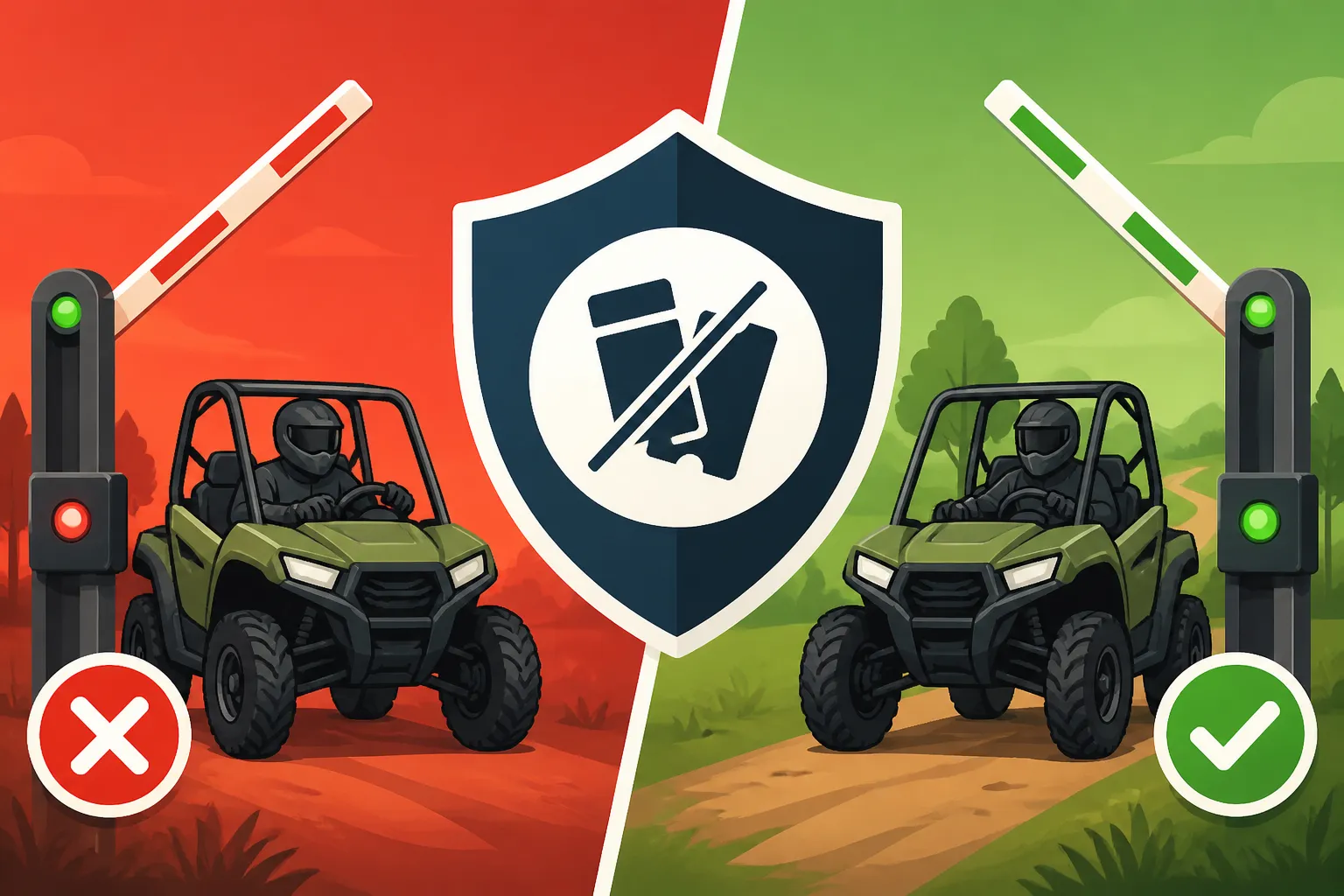
According to the Iowa Department of Natural Resources, Iowa OHV parks do not charge separate gate admission; access is covered by the required state vehicle registration or nonresident user permit. In practical terms, you generally do not pay one state fee for the vehicle and then another admission charge at the park entrance.
That does not make riding free. The required registration or permit has a cost, and you may still have expenses such as fuel, transportation, or equipment. The difference is that Iowa’s park access is not charged as a separate day-use ticket at the gate. Your state credential is what matters when you ride at a designated area.
This is why riders sometimes call the registration decal the admission pass. It is a useful shorthand, but it can be misleading if you take it to mean that any sticker—or a piece of paperwork alone—will do. Resident riders need a current Iowa DNR registration decal displayed on the machine. Nonresident riders need a valid Iowa DNR nonresident user permit sticker. The credential must match the rider’s situation and the machine being used.
For resident vehicles, the Iowa Department of Natural Resources requires registration for off-highway vehicles operated on public land, public ice, or at a designated riding area. The DNR also says a registered ATV can be operated at these locations when it displays a current registration sticker. That requirement applies at a designated riding area even if the operator has no intention of using public roads.
The gate itself is not the place where you buy a separate park ticket. Instead, plan ahead to have the correct credential before you ride. The distinction is especially important when visiting from another state, borrowing a machine, or taking a newly acquired vehicle to a park. Your Registration Decal Is the Park Admission explains the access credential in more detail, while Iowa’s Permit for a Visiting Machine covers the permit visitors may need.
| Rider or vehicle situation | Credential to plan for | What to check before riding |
|---|---|---|
| Iowa resident using a machine at a designated riding area | Current Iowa DNR registration decal | The decal is current and displayed on the machine |
| Nonresident using a machine at a designated riding area | Valid Iowa DNR nonresident user permit sticker | The Iowa permit is displayed on the machine |
| Nonresident whose home state requires registration | Iowa nonresident permit and the required home-state registration | Both required credentials are displayed |
| Operator age 12 through 17 on a covered public riding area | Required registration or permit, plus a DNR-approved education certificate | The certificate is in the operator’s possession |
| Rider using a privately owned property | Registration is not required solely for operating there | The property is private and the ride stays within it |
The table is a planning aid, not a substitute for checking which rules apply to a particular machine and location. Public land, public ice, and a designated riding area are not interchangeable with private property. If the ride will include more than one kind of location, check the requirements for each part of the trip.
What the registration or permit does—and does not do
A registration decal or permit is an access requirement, not a universal pass that replaces every other rule. It does not remove the need to carry registration paperwork, meet applicable education requirements, follow park rules, or comply with road-use laws if your route includes a public road.
For Iowa residents, the registration certificate must be either in the vehicle or on the operator while the vehicle is in use, according to the Iowa Department of Natural Resources. Keep the certificate available, not buried under gear in a trailer or left at home. The decal is displayed on the machine, while the certificate is the supporting document the operator must have available. They serve related but different purposes. See Carrying the Certificate on an Iowa Ride for a closer look at keeping the paperwork accessible.
Visitors have an additional detail to check. The Iowa Department of Natural Resources requires a valid Iowa nonresident user permit displayed on a nonresident machine at public land or a designated riding area. If the rider’s home state requires the machine to be registered, that home-state registration must also be displayed on the machine. An Iowa permit does not erase a home-state registration requirement.
Nonresident permits are available through the Iowa DNR Online License System, a statewide network of agents, and County Recorder’s Offices, according to the Iowa Department of Natural Resources. The listed amount can differ by purchase channel, so confirm the current amount and terms with the DNR or the seller before completing the purchase. Where to Buy an Iowa Nonresident Permit and Do Visitors Need an Iowa ATV Permit? can help you sort out which option applies.
The permit and registration are tied to riding authorization; they do not automatically make every use lawful. A machine on a park trail still has to follow the park’s operating rules. Road use is a separate matter: public-road rules require attention to matters such as driver eligibility, insurance, equipment, and where riding is allowed. A decal that gets you into a designated riding area is not, by itself, permission to ride every road on the way there. For that separate issue, see Are ATVs Street Legal in Iowa?.
There is also a distinction between a park and privately owned land. According to the Fiscal Services Division, an ATV does not need to be registered when operated on privately owned land. That exemption does not extend automatically to a public riding area, public ice, or a route that crosses public land. If your planned ride moves between private and public ground, do not assume the private-property rule covers the whole trip.
Get the right credential before you load up
A common source of trouble is waiting until the day of the ride to figure out whether the machine is registered, whether a visitor permit is needed, or where the certificate is. Sort out the credential first, then check that the decal and paperwork are with the correct machine and rider.
For a newly owned machine, or one not yet entered into the recreational vehicle and vessel registration system, the Iowa Department of Natural Resources says registration must be handled through the County Recorder’s Office. To register a new vehicle, the listed documents are a Bill of Sale and a Manufacturer’s Statement of Origin. For a used vehicle, the DNR calls for a Vehicle Title, if applicable, and/or registration, along with a Bill of Sale. Requirements can depend on the machine’s history, so it is sensible to contact the county recorder before making the trip.
A machine that is already registered still needs to stay current. According to the Iowa Department of Natural Resources, registrations must be renewed annually, and the renewal period without penalty runs from September 1 through December 31. The DNR allows ATV, ORV, and ORM registration renewals through the Iowa DNR Online License System. Check the renewal details and make sure the renewed decal is in hand before heading to a park. Renewing an Iowa Registration Online covers that process.
Mail delivery is another reason not to leave renewal until the last minute. The Iowa Department of Natural Resources says registration and decals sent through USPS can take up to 14 business days or more to arrive. If your planned ride is close, check the available renewal and delivery options rather than assuming the decal will arrive immediately.
Use this short preparation routine:
- Identify the riding location. Confirm whether you will be on public land, public ice, a designated riding area, or only private property.
- Confirm the machine’s registration status. If it is new to you or not entered in the system, contact the county recorder about registration and required documents.
- Check whether you need an Iowa nonresident permit. If you are visiting, verify the Iowa permit requirement and whether your home-state registration must also be displayed.
- Inspect the decal and paperwork. Make sure the appropriate current sticker is displayed and that the registration certificate is in the vehicle or on the operator when required.
- Check operator requirements and park conditions. Confirm any education-certificate requirement and review current park rules before you travel.
For paperwork protection, keep the certificate in a secure, weather-resistant sleeve or document pouch. A pouch sold through Amazon may be one convenient option, but any suitable holder works; it does not replace the requirement to have the certificate in the vehicle or on the operator. Keep the sticker visible and attached as required rather than treating a loose decal as equivalent to a displayed one.
If you ride with a group, do not assume one person’s credential covers every machine. Check each vehicle separately. This is particularly useful when friends bring machines from out of state or when the group includes both resident and nonresident riders. A quick check before loading can prevent the awkward—and avoidable—moment of reaching the park only to find that a machine lacks the required Iowa sticker.
Common misunderstandings at the gate
“No gate fee” means there is no cost to ride
Not quite. The DNR’s no-separate-admission policy means the park does not charge an additional gate admission for access. Riders still need the required state registration or nonresident permit, and those credentials involve a cost. Other trip expenses remain separate.
A resident registration is automatically enough for a visitor
It may not be. Nonresident machines must display a valid Iowa DNR nonresident user permit at public land or a designated riding area. If the rider’s home state requires registration, the Iowa Department of Natural Resources says that registration must also be displayed. Check the specific requirements for your vehicle rather than relying on a resident friend’s decal.
The sticker means the certificate can stay at home
For resident machines, the Iowa Department of Natural Resources requires the registration certificate to be in the vehicle or on the operator while it is in use. A visible decal does not cancel that separate requirement.
Private-land rules apply at a park
They do not. The Fiscal Services Division says an ATV does not need registration when operated on privately owned land. But the DNR requires registration for off-highway vehicles used on public land, public ice, or at designated riding areas. A designated park is not private land just because there is no ticket booth.
Every operator has the same education requirement
The rules depend on age and vehicle type. The Iowa Department of Natural Resources requires ATV operators ages 12 through 17 to have taken and passed an ATV education course. The education certificate must be in the operator’s possession when riding on public land, public ice, and designated riding areas. Check the applicable rule for the machine you plan to ride; do not assume a parent’s certificate or another rider’s paperwork covers the operator.
The permit settles all the rules for the day
It only addresses part of the picture. The credential is necessary for the covered riding locations, but it does not replace safety requirements or the rules for a specific park. It also does not authorize roadway use by itself. If your route includes a public road, check road requirements separately before riding there.
The simplest way to think about Iowa’s system is that the state credential replaces a separate park admission charge; it does not replace preparation. Confirm the location, put the correct sticker on each machine, keep required paperwork with the rider or vehicle, and check any age or operating rules that apply. That is what keeps the gate from becoming a paperwork problem.
Sources
- Department of Natural Resources — OHV Registration & Fees | Department of Natural Resources (checked November 3, 2026)
- Department of Natural Resources — OHV Safety & Education | Department of Natural Resources (checked November 3, 2026)
- Fiscal Services Division — 1543036.pdf (checked November 3, 2026)
- Department of Natural Resources — OHV Dealers | Department of Natural Resources (checked November 3, 2026)
- Department of Natural Resources — Snowmobile Education & Safety | Department of Natural Resources (checked November 3, 2026)
- Iowa Department of Natural Resources — download?inline (checked November 3, 2026)
Disclaimer
This article is for general informational purposes only and does not constitute professional advice. Laws, prices and regulations vary by location and change over time. Consult a qualified professional for guidance on your specific situation.