Iowa Rules for Riding a Wildlife Area
Riding an ATV or UTV on public land can seem straightforward, but Iowa wildlife management areas are not the same as designated OHV parks or trails. The key question is whether riding is allowed at all—not just whether your machine is registered. Here’s how to understand the general restriction, avoid mistaking nearby access for permission, and plan a ride where OHV use is permitted.
The general rule for Iowa wildlife areas
Iowa DNR says ATVs and other off-highway vehicles are generally not permitted within Iowa wildlife management areas. That restriction matters even if the area is public, your machine is registered, and you have the right safety documents. A registration decal is not permission to ride on every piece of public ground.
The safest practical approach is to treat a wildlife area as closed to ATV and UTV riding unless the area’s official rules clearly confirm otherwise. Do not assume that a trail, parking entrance, access road, or open-looking stretch of ground is an authorized OHV route. If you cannot verify that riding is allowed, choose a designated riding area instead.
This is different from the broad registration rule for riding where OHVs are allowed. According to the Iowa DNR, off-highway vehicles operated on public land, public ice, or a designated riding area must be registered. That requirement does not mean every public parcel is open to riding. The distinction between registration and access is central: registration makes a vehicle compliant for places where it may be operated; it does not establish that a particular place permits vehicles.
| Situation | What to keep in mind |
|---|---|
| Riding inside an Iowa wildlife management area | Iowa DNR says OHVs are generally not permitted there. |
| Riding on public land where OHV use is allowed | The machine must meet the applicable registration and decal requirements. |
| Riding at a designated riding area | A current registration sticker is required for registered ATVs, and riders must follow that area’s rules. |
| Riding on privately owned land | Iowa’s Fiscal Services Division says an ATV does not need to be registered when operated on privately owned land; you still need permission to ride there. |
| Using a public road near a wildlife area | Road-use rules are separate from permission to enter or ride within the wildlife area. |
If your question is about riding more broadly on public ground, Iowa Rules for Riding Public Land can help you separate public-land requirements from the rules for a specific property. For wildlife management areas, though, start with the area’s own access rules rather than assuming the general public-land registration rule makes riding acceptable.
Why the label “public land” is not enough
“Public land” describes who owns or manages a place; it does not, by itself, tell you which activities are allowed there. A wildlife area may be public while still generally prohibiting OHV operation. An authorized riding area, in contrast, is specifically set up for motorized riding subject to its rules.
That difference can be easy to miss when a route runs near a wildlife area or when a map shows connected public parcels. A route that reaches a boundary does not automatically continue through the property. Nor does a nearby road or trail prove that the land beyond it is open to ATVs or UTVs.
Before you unload, confirm the boundary and the rules for the exact place you intend to ride. If the official information is unclear, contact the managing office and ask whether ATV or UTV riding is allowed in the specific area, and whether any route or conditions apply. A general answer about a county, park, or nearby trail may not settle access to a particular wildlife area.
How to avoid confusing nearby access with permission
A common planning mistake is to see a rideable public road or an approved OHV park close to a wildlife area and assume the spaces connect for riding. Keep the rules for each location separate. Roadway use, a designated trail, privately owned ground, and wildlife-area interior are different settings with different access questions.
Iowa’s roadway rules do not create permission to ride off the road into a wildlife area. According to the Iowa Department of Transportation, public-road operation has its own requirements, including a minimum operator age of 18, a valid driver’s license, proof of insurance, illuminated headlights, and a maximum speed of 35 miles per hour. The Iowa DNR also says roadway operation is allowed on roads except interstates and four-lane roads. Those roadway rules do not answer whether the adjoining land is open to OHVs.
Similarly, a route that appears on a map may be a road, a trail, or a boundary line—not necessarily a route where OHV use is authorized. Check what the mapped line represents and confirm the applicable property rules. Do not ride through a wildlife area simply to connect two otherwise legal destinations unless access through that specific area is confirmed.
If you are looking for a place built for off-highway riding, use the rules for designated areas instead. Iowa Rules for Riding a Designated Riding Area explains the separate requirements that apply there. The Iowa DNR lists designated OHV parks such as Bluff Creek OHV Park in Eddyville, Gypsum City OHV Park in Fort Dodge, and Paul Huting Recreation Area in Waterloo. These are examples of designated riding areas, not evidence that nearby wildlife areas are open.
Before driving to a park, check for current access information and closures. Weather or trail conditions can affect whether a riding area is open, so a previously available route may not be available when you arrive. Iowa Trail Closures to Check First is useful when the main question is whether a designated riding destination is open for your trip.
If you are visiting Iowa
Nonresidents should not assume that a home-state registration automatically covers every Iowa riding situation. According to the Iowa DNR, nonresident machines must display a valid Iowa DNR nonresident user permit when operated on public land or at a designated riding area. Nonresidents whose home state requires registration must also display that home-state registration on the machine.
Those permit requirements address eligibility on places where riding is permitted. They do not override a wildlife area’s restriction. A valid Iowa permit is not a pass to enter a wildlife management area by ATV or UTV.
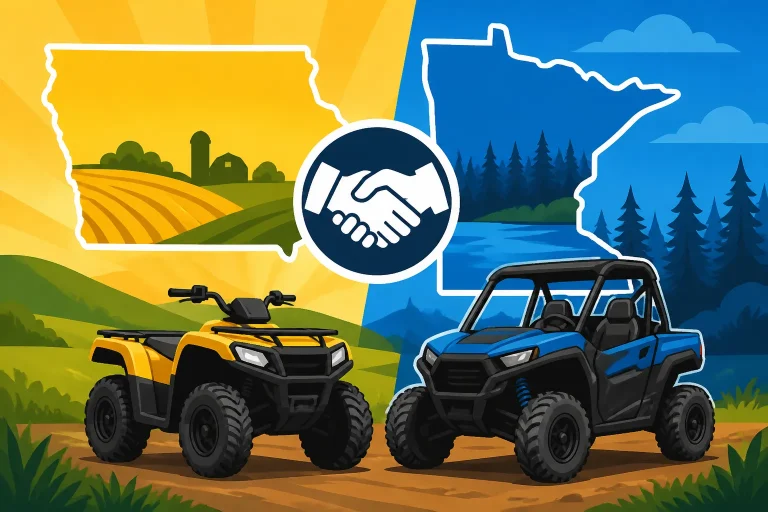
For more on the visitor requirements, see Do Visitors Need an Iowa ATV Permit? and Iowa Reciprocity With Minnesota. Even if you have the right permit and paperwork, verify that your intended destination allows motorized riding.
What to check before riding somewhere else
Once you choose a place where riding is allowed, confirm the vehicle, operator, and paperwork requirements before leaving home. These steps help prevent a common mix-up: preparing the machine for legal operation while overlooking whether the destination itself permits riding.
Confirm registration and the decal
According to the Iowa DNR, resident OHV machines need a valid, current Iowa DNR registration decal to operate on public land or in a designated riding area. Registered ATVs may be operated on public land, public ice, and designated riding trails when displaying a current registration sticker, according to the Fiscal Services Division.
The registration certificate is also important. The Iowa DNR requires the operator to have it either in the vehicle or on their person while the vehicle is in use. Keep it accessible rather than packed somewhere you cannot reach during a ride.
For a newly owned machine, or one not yet entered into the recreational vehicle and vessel registration system, the Iowa DNR directs owners to register through the County Recorder’s Office. According to the Iowa DNR, a new vehicle registration requires a Bill of Sale and a Manufacturer’s Statement of Origin. For a used vehicle, the required documents include a Bill of Sale and the Vehicle Title, if applicable, and/or registration.
Registrations must be renewed annually, according to the Iowa DNR. The renewal period without penalty runs from September 1 through December 31. Renewals for ATVs, ORVs, and ORMs may be completed through the Iowa DNR Online License System. If you need to replace a lost certificate or are sorting out a recently purchased machine, Iowa ATV Paperwork can help you identify the registration details to address.
Check age and education requirements
According to the Iowa DNR, ATV operators ages 12 through 17 must have taken and passed an ATV education course. The education certificate must be in the operator’s possession when riding on public land, public ice, and designated riding areas.
The Iowa DNR says a person under 12 cannot operate an ATV on public land or public ice unless directly supervised by an experienced, licensed parent or guardian who is at least 18 years old. These age and supervision rules concern operation in the listed settings; they do not make riding inside a wildlife area permissible.
If a rider needs a certificate, the Iowa DNR collaborated with Fresh Air Educators to provide an online ATV education option. The Iowa DNR says students must pass the final exam with 80% accuracy to earn the certificate, and the course has no riding component. For the course and certificate details, see Iowa ATV Safety Certificate Requirements.
Keep the destination decision separate
A reliable pre-ride check has two parts: first, confirm the place allows the planned riding; then confirm that the machine and operator meet the rules for that place. Reversing that order can lead to a wasted trip—or to riding where it is not allowed.
Use this checklist before loading:
- Identify the exact property, not just the nearest park, road, or public-land label.
- Check the current rules for that property and confirm whether ATVs or UTVs may be operated there.
- If the property is an Iowa wildlife management area, treat OHV use as generally prohibited unless official information confirms a permitted exception.
- If you are using a designated riding area, check its access status and site-specific rules before departing.
- Confirm that the vehicle has the required current Iowa registration decal, or the applicable nonresident permit and home-state registration.
- Carry the registration certificate, and make sure any rider who needs an ATV education certificate has it in their possession.
- If the route includes a public road, check the separate roadway requirements rather than treating road access as permission to ride on adjoining land.
For privately owned land, the registration rule is different: the Fiscal Services Division says an ATV does not need to be registered when operated on privately owned land. That does not mean a rider may enter without permission. Get the landowner’s consent and agree on where riding is allowed before using the property. Iowa Landowner Permission Requirements and Riding Private Ground in Iowa cover that separate access question.
When in doubt, do not use the machine to test the boundary. Ask the managing authority before riding, and choose a clearly authorized riding area if you cannot confirm access. That simple check helps protect wildlife-area rules and keeps a legal registration from being mistaken for a universal riding pass.
Sources
- Department of Natural Resources — OHV Safety & Education | Department of Natural Resources (checked November 3, 2026)
- Fiscal Services Division — 1543036.pdf (checked November 3, 2026)
- Department of Transportation — Driving Your ATV or UTV/ORV on Iowa Public Roads | Department of Transportation (checked November 3, 2026)
- IOWA DEPARTMENT OF NATURAL RESOURCES — download?inline (checked November 3, 2026)
- Department of Natural Resources — OHV Dealers | Department of Natural Resources (checked November 3, 2026)
- Department of Natural Resources — Snowmobile Education & Safety | Department of Natural Resources (checked November 3, 2026)
- Iowa Department of Natural Resources — download?inline (checked November 3, 2026)
Disclaimer
This article is for general informational purposes only and does not constitute professional advice. Laws, prices and regulations vary by location and change over time. Consult a qualified professional for guidance on your specific situation.