Iowa Trails Open in July
July can be a tempting time to load the ATV or UTV: the days are long, family schedules open up, and Iowa’s trails may be dry enough for a full ride. But heat, thunderstorms, mud, park rules, and seasonal operating dates can change the plan. This guide explains where to start, what to check before driving, and how to ride responsibly.
Where to Ride an ATV in Iowa in July
Iowa has designated off-highway vehicle parks as well as some riding opportunities on private land with the landowner’s permission. A park that is open during summer is often the simplest choice: trails are marked, riding is organized, and rules are posted for visitors. Still, “July” does not guarantee that every park or every trail is open on your chosen day.
The state’s designated parks include areas such as Gypsum City OHV Park near Fort Dodge, Bluff Creek OHV Park near Eddyville, Rathbun OHV Area near Plano, and Paul Huting Recreation Area near Waterloo. Conditions and operations differ from site to site. Before you set out, confirm the park’s access, trail status, hours, and any machine restrictions through the park or relevant official channels.
Start with a designated park
For a summer outing, choose a park that suits your group’s machines and experience. Gypsum City is a large riding area outside Fort Dodge, while Bluff Creek offers a different setting near Eddyville. Rathbun and Paul Huting also give riders options in other parts of the state. The best choice is not necessarily the closest one; it is the place whose current conditions and trails fit your ride.
If you are bringing a wide side-by-side, a young rider, or someone new to off-road trails, check whether the park accommodates that machine and rider. Trail width, terrain, rules for youth, and the availability of beginner areas can all affect whether a site feels comfortable. A route that looks easy on a map may be more challenging after a storm or on a hot afternoon.
Iowa’s designated parks are not interchangeable, and some are operated with local or club involvement. Check the park’s own information before loading the trailer, especially if you are traveling a long distance. [Iowa's Eight Designated OHV Parks] offers a broader look at the state’s riding areas, while [Best Places to Ride an ATV in Iowa] can help you compare possible destinations.
Treat seasonal dates as a starting point, not a guarantee
Some Iowa riding areas have seasonal operating periods. Gypsum City, for example, is associated with a seasonal window that runs from spring into fall. July falls within that general period, but that alone does not confirm that its trails are open on a particular day. Weather, maintenance, special events, and park-specific notices can affect access.
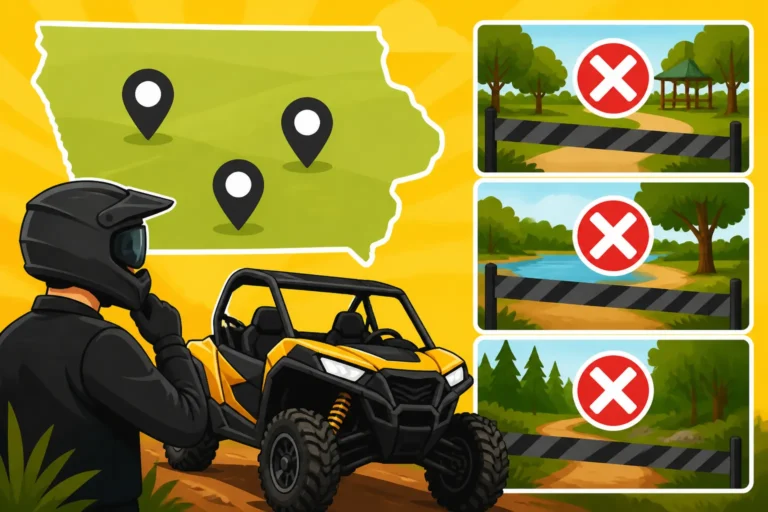
This is where a little pre-trip checking can spare you a frustrating drive. Look for recent closure notices and park updates, and confirm the expected gate hours and entry requirements. The same care applies to smaller or locally operated areas, where a posted schedule may not reflect a temporary closure after heavy rain.
If you are comparing parks for a family weekend, look beyond the word “open.” Ask whether the trails you want to ride are open, whether the campground or staging area is available, and whether any restrictions apply to your machine. [Iowa Trail Closures to Check First] and [Reading a DNR Closure Alert] can help you build a more reliable check-before-you-go routine.
How July Weather Changes Iowa Trail Conditions
July riding can mean long daylight hours, but summer weather can shift quickly. A dry stretch may leave trails dusty and firm; a thunderstorm can turn clay into slick mud or leave standing water in low areas. High temperatures also affect riders and machines, particularly during a long ride with limited shade or frequent stops.
Do not assume that yesterday’s trail report tells the whole story. A park can be rideable in the morning and muddy after an afternoon storm, or it can remain closed while wet sections dry out. Closures are often there to prevent damage, not to spoil anyone’s weekend. Driving through saturated ground can deepen ruts and make repair work harder for the people who maintain the trails.
Check trail status close to departure
Check conditions again on the day before your trip and, when possible, the morning you leave. Review the park’s official updates or contact the park directly if the information is unclear. A weather app can help you see likely rain, but it cannot tell you whether a specific trail loop has been closed or reopened.
A mapping tool such as onX Offroad can be useful for organizing a route and keeping track of your trip plan. Use it as a supplement, not as confirmation that a trail is open or that riding is permitted. A line on a map does not replace posted rules, a closure notice, or landowner permission.
Have a backup plan before you load. If your first choice is closed, another park may be a reasonable alternative, but only after you verify its conditions too. [Iowa Trail Conditions Before You Ride] and [Calling a Park Before You Load] are useful reminders that a short check can prevent a long, unnecessary drive.
Plan for heat, dust, and sudden rain
On a hot July ride, build in breaks and bring more drinking water than you think you will need. Wear suitable protective gear even when temperatures make it tempting to dress lightly. A helmet, gloves, eye protection, and durable clothing help protect against branches, dust, debris, and falls; park rules may also require specific equipment.
Dust can reduce visibility, especially when several machines are traveling close together. Leave room between riders, slow down when the trail is hazy, and avoid following so closely that you ride through another machine’s dust cloud. If rain begins, reassess the route rather than pressing on simply because the day was planned as a full-day ride.
Heat and dust can also be hard on the machine. Before leaving, check tires, brakes, fluids, and the air filter, and carry basic items appropriate for your vehicle and outing. After the ride, clean mud and dust from the machine and inspect it for damage. [Iowa Riding After Heavy Rain] and [Iowa Riding in Summer] cover seasonal conditions that can change how a trail behaves.
July Trail Planning for Families and Groups
A July ride often brings together people with very different comfort levels: an experienced rider, a beginner, a child, and someone who would rather enjoy a shorter loop than spend all day on a machine. The easiest way to keep everyone happy is to match the park and route to the least experienced rider, then build in flexibility.
Agree on a pace before starting. Keep the group together at intersections, choose meeting points, and make sure everyone knows what to do if they become separated. On a busy weekend, expect other riders on the trails and give them room. If the park has designated areas for youth or beginners, check the rules and suitability before the group arrives.
Choose terrain that matches the riders
A beginner-friendly ride is not simply a short ride. A short stretch with steep hills, deep ruts, or loose ground can be more demanding than a longer, smoother loop. Look at park information and trail markers, and be willing to turn around if the conditions feel beyond the group’s skill level.
For children and teens, check Iowa’s applicable age and safety-certificate requirements before the trip. Rules can depend on the rider’s age and the type of machine. Supervision is also important: keep younger riders within sight and choose terrain where an adult can respond quickly if someone has trouble.
Do not let a more experienced rider set the pace for everyone else. A useful group plan includes stops, a turnaround point, and a clear way to communicate. [Iowa Trails Good for Kids] and [Iowa Trail Difficulty Ratings] can help families think through what to look for before choosing a destination.
Sort out entry requirements before arriving
Before you leave home, confirm what registration, permit, or other documentation applies to your machine and situation. Iowa registration and nonresident requirements can differ, so visitors should not assume that a home-state registration automatically answers every question. Check the requirements for your machine and the place where you plan to ride.
Carry required documents and follow posted park rules. If you are riding a borrowed or rented machine, make sure you understand who is responsible for registration and any other required paperwork. A last-minute question at the gate is much easier to resolve before the machines are tied down and the group is ready to ride.
For visitors, [Do Visitors Need an Iowa ATV Permit?] explains a key question to settle before traveling. If you are riding with a younger family member, review [Iowa ATV Safety Certificate Requirements] as part of your planning rather than waiting until you reach the park.
A Practical Checklist for Riding Iowa Trails in July
A little preparation can make a summer ride feel much less stressful. It helps to separate the plan into three stages: before loading, at the park, and during the ride. This way, you are less likely to discover a closure, missing document, or unsuitable trail after you have already made the drive.
| When | What to check | Why it matters |
|---|---|---|
| Before loading | Park status, trail closures, hours, and access | Prevents a wasted trip and helps you choose a backup |
| Before loading | Registration, permits, and rider requirements | Avoids confusion at the park or on the trail |
| Before loading | Weather forecast and likely storm timing | Helps you plan around heat, rain, and changing trail conditions |
| At the park | Posted rules, trail markers, and restricted areas | Keeps your group on authorized routes |
| At the park | Machine suitability and group readiness | Helps prevent an uncomfortable or unsafe ride |
| During the ride | Water, breaks, spacing, and group check-ins | Reduces heat stress and keeps riders together |
| After the ride | Machine inspection and trail etiquette | Helps catch damage and supports responsible riding |
Before you load the trailer
Confirm the park’s current status and ask specifically about the trails you want to use. Check whether the staging area, restrooms, or campground are available if those details affect your plans. If you are taking more than one machine, verify the requirements for each one rather than assuming a single permit or decal covers the whole group.
Use a route-planning app such as onX Offroad to help prepare and keep your bearings, but confirm access through official park information. Bring a charged phone, but do not rely on cell service throughout the ride. Share your destination and expected return time with someone who is not traveling with you.
Pack water, snacks, basic first-aid supplies, and tools that make sense for your machine. Secure the load carefully and make sure everyone has protective gear that fits. If the forecast suggests severe weather, consider rescheduling; a planned ride is not worth being caught on exposed trails during a storm.
At the park and on the trail
Read the posted rules before unloading, even if you have visited before. Rules can vary between parks, and signs may identify temporary restrictions or closed sections. Stay on marked routes, respect gates and barriers, and do not ride onto nearby land simply because it appears connected to the trail.
Keep a safe following distance and make sure the last rider in the group knows the route. Stop in a safe place if someone needs help; avoid blocking a narrow trail or a blind corner. If the ground is getting soft or a storm is approaching, turn back rather than trying to finish the loop at any cost.
After the ride, check the machine for loose parts, leaks, tire damage, or packed debris. Clean it before the next outing, particularly if it has been through mud or dusty conditions. And if a park closes trails because of weather, respect the closure. Good July riding depends on trails being cared for as much as it depends on finding an open gate.
A successful Iowa trail day is less about squeezing in every mile than choosing a suitable park, confirming conditions, and being ready to adjust. Keep the plan flexible, follow local rules, and leave the trail in good shape for the next group.
Disclaimer
This article is for general informational purposes only and does not constitute professional advice. Laws, prices and regulations vary by location and change over time. Consult a qualified professional for guidance on your specific situation.