Iowa’s Weather-Driven Trail Closures
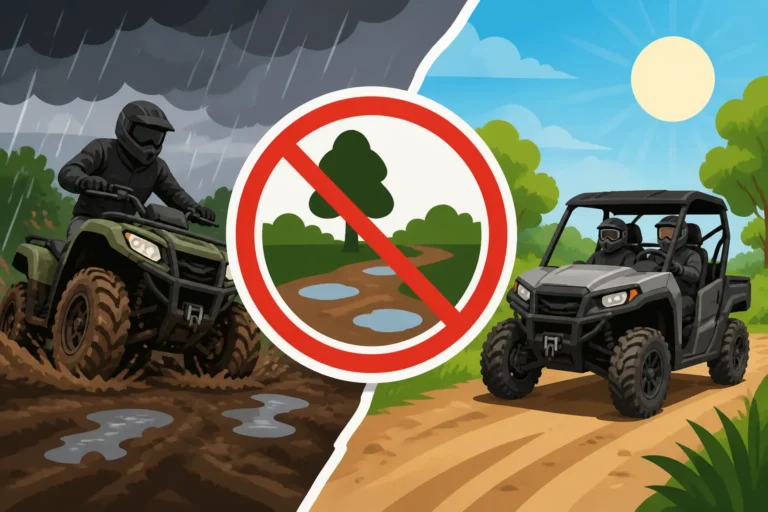
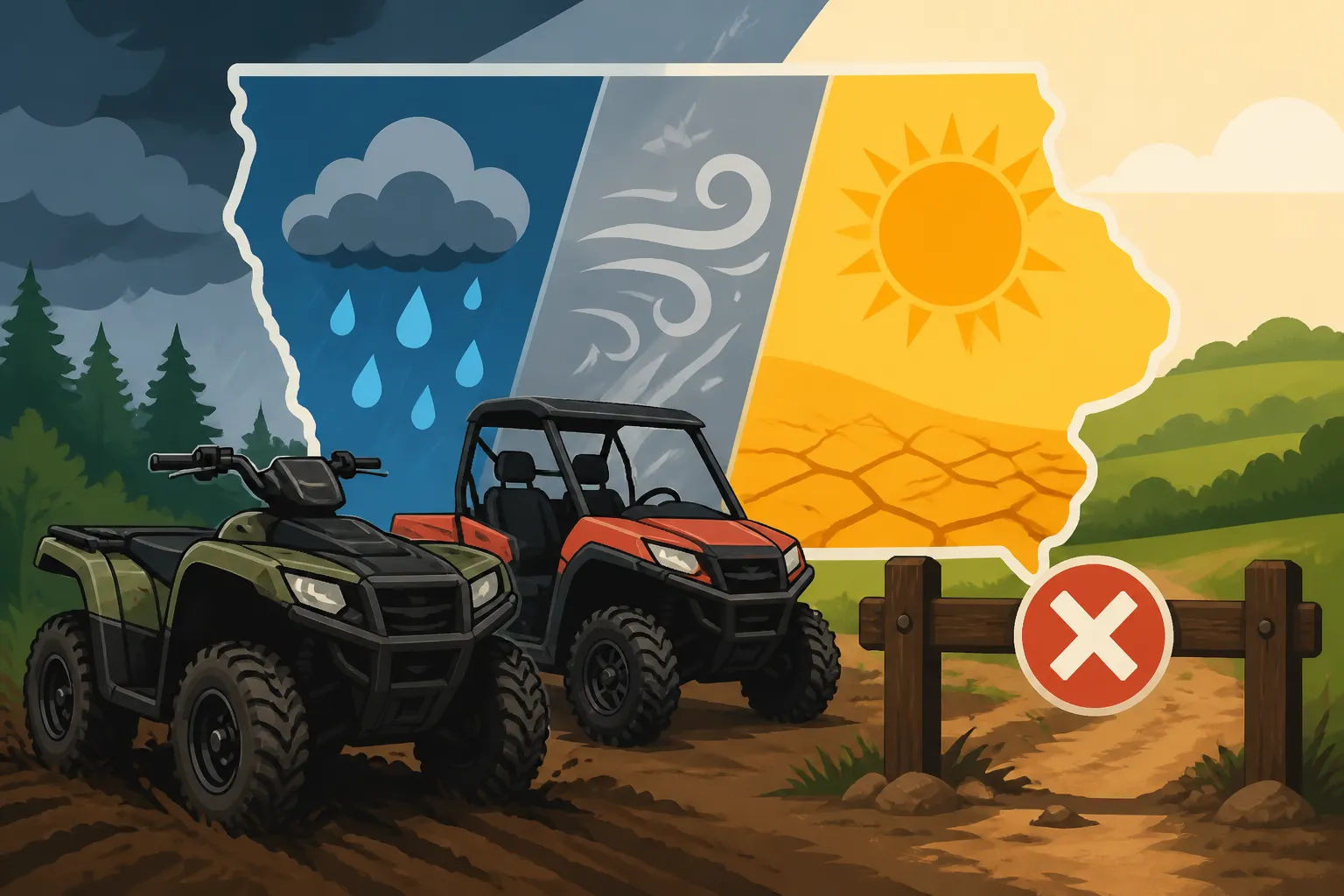
Rain can turn an Iowa trail from firm and enjoyable to slick, deeply rutted ground in a surprisingly short time. That makes a park’s open-or-closed status more than a minor planning detail: it affects your drive, your safety, and the trails other riders will use afterward. This guide explains why weather closures happen, how to check conditions, and what to do when a ride is uncertain.
Why Iowa OHV trails close after bad weather
Iowa soil can change quickly when it gets wet
A trail that feels solid beneath your tires on a dry afternoon may behave very differently after steady rain. Many Iowa riding areas have clay-rich soils. When those soils become saturated, the surface can turn slick and sticky, and tires may spin instead of finding traction. That can make even a familiar loop feel challenging, especially on a slope or in a tight turn.
The problem is not limited to deep mud. A thin, slippery layer can be enough to send a machine sliding toward a trail edge or make it difficult to stop where you expect. A route that was manageable for an experienced rider can also become frustrating for a newer rider, a child, or someone operating a heavier side-by-side.
There is a longer-term concern, too. A machine driven across saturated ground can cut channels into the trail. Once ruts form, later rain can flow through them and wash away more soil. That is one reason operators may close a park even when some sections appear rideable. The decision can protect the trail system as a whole, not just the wettest spot.
A closure protects trails as well as riders
When park staff or volunteers close a trail area after rain, it can be tempting to think the restriction is overly cautious. From the staging area, the ground may look firm enough, and a rider may feel confident about handling mud. But a closure is usually based on the condition of the park’s routes overall, including shaded sections and low areas that may not be visible from the entrance.
A closure also helps prevent repeated damage. If each rider makes only a few new ruts, the combined effect across a busy weekend can be substantial. The trail may then need more repair before it can reopen, which can extend the interruption for everyone. Respecting a closure is a practical way to avoid turning a short weather delay into a longer maintenance problem.
The same principle applies when a club or park operator asks riders to stay off a trail even if it is not formally marked closed. A request may reflect active repair work, standing water, or a soft area that is difficult to assess from a distance. Read [Why Iowa Closes Parks for Wet Trails] for more on why a closure can be part of responsible trail management rather than a judgment about whether one particular machine can make it through.
How weather affects different parts of a park
Rain, lingering moisture, and drainage all matter
The amount of rain is only one piece of the picture. Where it fell, how quickly it fell, and whether the ground was already saturated can all affect trail conditions. A short, heavy storm may leave water pooled in low spots, while a longer spell of lighter rain can soak the soil across a wider area. A breezy afternoon may dry exposed ground while shaded trails remain damp.
Drainage also varies from one route to another. A ridge or well-drained section may recover sooner than a low crossing or a shaded hollow. That means one loop can be muddy while another seems firm, but riders should not assume they can reach the better section without crossing vulnerable ground. Operators may close the whole riding area when conditions are uneven or difficult to monitor.
Even after rain stops, the ground may need time to firm up. A clear morning does not necessarily mean the trails are ready by the afternoon, especially after multiple wet days. Before loading up, check for a current update and ask whether the operator has assessed the trails since the most recent rainfall. [Iowa Riding After Heavy Rain] explores why waiting for the ground to recover can matter even when the sky has cleared.
Freeze and thaw can create a different kind of damage
Cold weather does not automatically make a trail firm. A frozen surface may hold a machine for part of the day, then soften as temperatures rise. When tires break through a crust into wet soil below, they can leave deep impressions that are harder to see than ordinary mud damage. A route that seemed manageable early in the morning might become much softer later.
Spring can be especially unpredictable because snowmelt, rain, and changing temperatures may overlap. Water can collect in low areas while higher ground dries. A park entrance or gravel staging lot may look perfectly usable even though interior trails remain soft. This contrast can lead riders to misread conditions if they judge the whole park from the parking area.
A winter ride also calls for careful attention to the specific route and the park’s current guidance. Do not assume that frozen ground means an area is open, or that a trail that was usable on a cold morning will remain firm all day. For a broader look at conditions and planning across the seasons, see [Iowa Trail Conditions Before You Ride].
How to check whether an Iowa trail is open
Start with the park or operator’s latest notice
Before you leave home, look for an update from the park or the group responsible for its operation. Iowa riding areas can be managed by different combinations of clubs, counties, and other local partners, so there is not one single condition report that covers every trail. A statewide resource can help you find information, but a local operator is often best placed to confirm what is happening at a specific park.
Pay attention to the date and wording of an update. A post from before yesterday’s storm may not tell you whether the park is open today. Likewise, a notice that says a park is open may not describe every trail segment or explain whether particular routes are restricted. If the information is vague, call or message the operator before you load the machines.
Check for more than the word “closed.” An operator might announce that trails are closed but the campground or staging area remains accessible, or that only part of a park is affected. Do not treat access to a parking area as permission to ride. [Reading the Iowa DNR Alert Feed] can help riders understand how to use a public alert as one part of their pre-trip check.
Use maps as a planning aid, not proof of access
A trail map helps you understand where a route runs and how you might reach a riding area, but a map alone cannot establish that the trail is open today. Conditions, operating decisions, and temporary closures can change after a map is published. Confirm current status through the park or operator even if a route appears on a digital map.
Tools such as onX Offroad can be useful for organizing a trip, reviewing mapped routes, and getting a sense of the surrounding area. Treat that information as a planning layer, not as a substitute for a current notice from the people managing the property. If the app shows a route but the operator says the park is closed, follow the operator’s direction.
It is also worth checking whether a mapped line crosses land you are allowed to ride. A visible trail or access road is not automatically public riding access. Keep your plans within the designated riding area and follow posted boundaries. To make your pre-departure routine easier, use [Iowa Trail Closures to Check First] as a reminder to confirm status before committing to a long drive.
| Before you leave | What to verify | Why it matters |
|---|---|---|
| Park status | Is the riding area open today? | An older update may not reflect recent weather. |
| Scope of closure | Are all trails closed, or only certain sections? | A staging lot or campground may be accessible while trails are not. |
| Last update | When did the operator post or confirm the information? | Rain and thaw can change conditions quickly. |
| Route access | Does your planned route stay within approved riding areas? | A mapped line does not prove that riding access is allowed. |
| Backup plan | Is another park open, and is it practical to reach? | A confirmed alternative can prevent a wasted trip. |
What to do when trail status is unclear
Call before making a long drive
If the latest notice is missing, old, or hard to interpret, contact the operator before loading your ATV or UTV. This is especially helpful when you are traveling from a distance or coordinating a group. A quick question can save you from arriving at a closed gate with a trailer full of machines and a group of disappointed riders.
Ask direct questions: Is the riding area open today? Did the park receive rain recently? Are all loops open, or are some sections restricted? Is the status likely to change during the day? Operators may not be able to predict every change, but they can often tell you what has been observed and whether riders should expect limited access.
If you cannot reach anyone, do not treat silence as confirmation that the park is open. Check the operator’s most recent public updates and be prepared to change plans. [Calling a Park Before You Load] is a useful step whenever a trip depends on conditions that may have changed since the last notice.
Have a realistic backup plan
A backup park only helps if it is also open and suitable for your group. Before you leave, check its status rather than assuming it will be available. Compare the drive, trail style, machine suitability, and facilities, especially if you are traveling with children, newer riders, or a mix of ATV and side-by-side operators.
You can also plan a non-riding alternative for the day. That might mean postponing the trip, choosing another outdoor activity nearby, or turning the day into a maintenance and gear-preparation session. It may not be the ride you wanted, but it is usually less frustrating than arriving at a closed park with no other option.
Keep your expectations flexible when weather is unsettled. If a park opens after a period of rain, the operator may still limit access to certain areas or ask riders to avoid soft sections. A plan that allows for a shorter ride, a different loop, or a return visit can make the day feel less like an all-or-nothing decision.
Reading conditions at well-known Iowa riding areas
Conditions can differ from park to park
Iowa’s riding areas are spread across different landscapes and have different trail layouts, drainage patterns, and operating arrangements. Gypsum City OHV Park near Fort Dodge, Bluff Creek OHV Park near Eddyville, and Rathbun OHV Area near Plano are not interchangeable just because they are all riding destinations. Weather that affects one region may not affect another in the same way.
The same is true for parks such as Lakeview OHV Park near Solon, Nicholson-Ford OHV Park near Marshalltown, and Paul Huting Recreation Area near Waterloo. A report for one park does not establish conditions at another. Check each operator’s notice separately if you are considering changing destinations, and confirm that the park is open to the type of machine and riding your group has planned.
Use named destinations as starting points for research, not as a reason to assume conditions. A park may be open on one weekend and closed the next, or have different access across sections of its trail system. For more context on why local operating arrangements matter, see [Why Iowa Parks Are Run by Clubs and Counties].
A local report is more useful than a regional guess
A weather app can tell you what the forecast or recent conditions look like around a town, but it cannot tell you exactly how a particular trail drains. Rainfall near Eddyville, for example, may not represent what fell near Fort Dodge or Solon. Even within one area, a low trail can remain wet after an exposed section has dried.
When you read a local update, look for clues about the area covered. Does it refer to the entire park, a specific loop, the access road, or only the campground? A short message can be easy to misread if it does not specify the scope. When in doubt, ask the operator to clarify before assuming that riding is permitted.
Digital maps can still help you prepare for a destination. For example, onX Offroad may help you review your planned route and nearby alternatives, while an official park update tells you whether you should ride at all. Keeping those roles separate makes it easier to avoid relying on a map pin or old route information as if it were a live closure notice.
How to ride responsibly when a park is open
Follow posted boundaries and requests from staff
An open park is not a signal to ride anywhere you can reach. Stay on designated trails and obey signs, gates, and instructions from park staff or volunteers. A route can be temporarily closed even when other parts of the area remain open, and crossing a barrier can worsen a soft section that the operator is trying to protect.
If you encounter a closed segment during your ride, turn around rather than going around the sign or cutting a new path through the woods. That detour can damage vegetation, disturb the ground, or lead you onto land where riding is not permitted. Let your group know about the restriction, especially if riders are spread out and someone behind you might otherwise miss the sign.
A closure is most effective when everyone respects it. Riders who ignore a temporary restriction can undo repair work and make future access harder to manage. If you want more background on how weather-related restrictions are communicated, read [Iowa Trails Closed After Rain].
Adjust your ride to the conditions you actually encounter
Even when the park is open, conditions may vary across the route. Slow down where visibility is limited, avoid charging into standing water, and leave more room to stop on slick ground. Give other riders space on hills and around blind corners. If a section feels beyond your group’s ability, turn back or choose an easier route rather than trying to prove that the machine can make it through.
For family rides, think about the least experienced person in the group. A steep, muddy section can become intimidating quickly, and a child may not be comfortable with a route that an adult has ridden many times. Set a turnaround point in advance and agree that anyone can ask to stop without being pressured to continue.
If your tires begin digging deep ruts, that is a strong reason to reassess the route rather than keep pushing through. A machine’s power and tires do not make saturated ground durable. [Trail Damage From Riding Too Wet] explains why backing out of a vulnerable section can be better for both the trail and the rest of your ride.
Preparing for closures without losing the whole weekend
Build a simple pre-trip routine
A reliable routine reduces the last-minute scramble. Start by checking the operator’s latest update the day before you go, then check again on the morning of the trip. If there has been rain, snowmelt, or a major temperature change, contact the park directly when the status is not clear.
Next, confirm the practical details for your group. Make sure the park’s riding rules fit your machines, check that everyone knows the expected route, and decide who will monitor updates. If you are traveling with several households, share the operator’s notice rather than passing along an informal “I heard it’s open” message.
Finally, choose a decision point. For example, agree that if the park has not confirmed an open status by a certain time, the group will switch plans or postpone. That avoids having one person make a stressful call while everyone else waits at a fuel stop with trailers in tow.
Keep your group informed and your plans flexible
A group ride can become complicated when people are coming from different towns. Share the same park update with everyone, including the date it was posted and any limitations it mentions. Ask riders to avoid making a separate assumption based on a map, an old social post, or a report from another park.
If the outing is postponed, use the time to prepare for the next suitable day. Check tie-downs, inspect tires, clean filters, review the trail map, and make sure helmets and other equipment are ready. Those tasks will not replace the ride, but they can make the next trip smoother and reduce the chance that a small equipment problem wastes a good-weather day.
For a group using onX Offroad to coordinate routes, agree that the mapped plan remains tentative until the park confirms access. Keep an alternate destination or date in mind, and do not route around a closure to preserve the original itinerary. A flexible plan is not a failed trip; it is part of riding responsibly in a state where weather and trail conditions can change quickly.
Disclaimer
This article is for general informational purposes only and does not constitute professional advice. Laws, prices and regulations vary by location and change over time. Consult a qualified professional for guidance on your specific situation.