Iowa Rules for Riding to an OHV Park
Let's be real, the dream of hooking up the trailer and heading out for a day of ripping trails at one of Iowa's awesome OHV parks, like Gypsum City or Bluff Creek, is what keeps many of us going. But what if you live just a few miles down the road and don't want to bother with the trailer? Can you just fire up your ATV or UTV and ride directly to the park entrance? This is a question that trips up a lot of riders, and Iowa's laws aren't always crystal clear or easy to navigate. This guide aims to clear up the confusion, walking you through the precise regulations for riding your off-highway vehicle on Iowa roads when your destination is an authorized OHV park.
Navigating Iowa's General Road Rules for ATVs and UTVs
It’s easy to look at your rugged ATV or spacious UTV and think it’s built for anything, including a short jaunt down the road. However, Iowa's approach to "street legal" is quite nuanced, far from a free-for-all. You can't just slap a license plate on your machine and expect to cruise anywhere you please. The state has specific conditions and limitations, particularly when it comes to which roads you can even consider. Understanding these foundational rules is the first step to legally reaching your favorite trail system without a ticket.
The Core Principle: Designated Roads Only
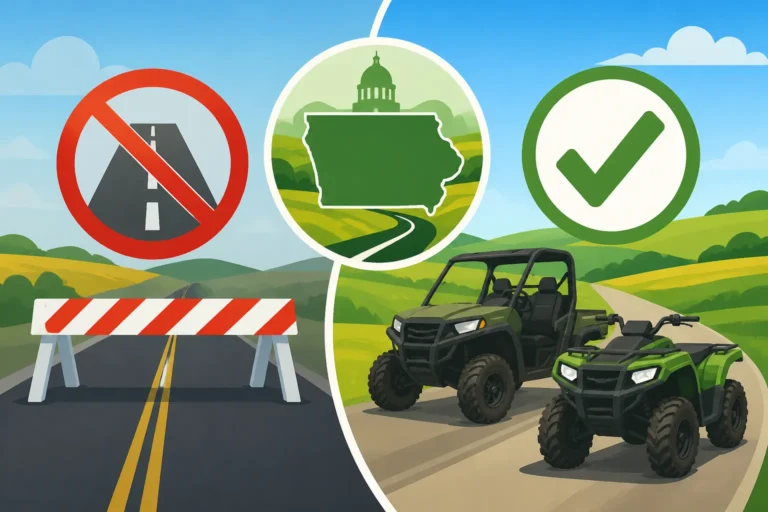
Forget the idea of an ATV or UTV being "street legal" in the same way a car or motorcycle is in Iowa. That's a common misconception that can lead to a lot of trouble. Instead, Iowa operates on a principle of designated roads. This means that only certain types of public roads are open to off-highway vehicles, and even then, often under specific circumstances. The vast majority of paved roads, particularly state and federal highways, are strictly off-limits to ATVs and UTVs. This can be incredibly frustrating, especially if the most logical path to the park involves a short stretch of blacktop that isn't designated.
Generally, you're looking at unpaved secondary roads, often referred to as gravel or dirt roads, as your primary routes. These are typically managed by counties. Additionally, some cities and counties have local ordinances that allow ATVs and UTVs on specific paved secondary roads or city streets. This patchwork approach means what's legal in one county or town might get you a hefty fine just a few miles down the road. It means you can't assume. Always check with the local county sheriff's office or city clerk if you're unsure about specific stretches of road. It’s a bit of a hassle, but far better than getting pulled over en route to your fun. If you're wondering [Iowa Rules for Riding a Gravel Road], this is your starting point.
Who Can Ride and How Fast
Beyond where you can ride, Iowa also sets strict rules for who can operate an ATV or UTV on public roads and how fast they can go. These aren't just suggestions; they're legal requirements designed for safety and to keep these powerful machines from mixing inappropriately with standard vehicle traffic. It’s important to remember that the context of "road use" implies a higher level of responsibility and interaction with other vehicles, which is why the state imposes these rules.
First off, any operator of an ATV or UTV on a public road in Iowa must be at least 18 years old and hold a valid driver's license. This means if you've got a teenager who's a fantastic rider on the trails, they still can't legally drive the machine on a gravel road, even with an adult present. This particular rule can be a real sticking point for families, as it limits the independence of younger riders who might otherwise be perfectly capable. If you're a parent, this means you'll be doing all the road driving when heading to the park. For more details, check out [Iowa Minimum Age to Ride a Road] and [Iowa Driver's License Rules for ATVs]. Furthermore, even on authorized roads, your speed is capped. You absolutely cannot exceed 35 miles per hour on an ATV or UTV on public roads in Iowa, regardless of the posted speed limit for other vehicles. This might feel slow, especially on a long stretch of gravel, but it's a critical safety measure and a non-negotiable legal limit. Staying below this speed is paramount not only for compliance but also for your safety and the safety of others. Understand all the nuances by reviewing [Iowa ATV Speed Limit on Roads].
The "Most Direct Route" to Your Iowa OHV Park
So, you've checked the local ordinances, confirmed the roads are open to ATVs/UTVs, and you meet the age and licensing requirements. Great! But there's another crucial piece of the puzzle: the "most direct route" rule. This isn't just about picking the shortest path; it's about the purpose of your road travel. Iowa isn't allowing you to joyride on public roads; it's granting limited access for specific, practical reasons, and getting to an OHV park is one of them.
Understanding the Most Direct Route Rule
The "most direct route" rule is exactly what it sounds like, but it's often misunderstood. It means you are authorized to use public roads only for the absolute shortest, most practical path from your origin (like your home or a staging area) to your authorized destination (the OHV park entrance). This isn't an invitation to take the scenic route, stop at a gas station far off the path, or visit a friend who lives a few blocks out of the way. The intent is strictly utilitarian.
Imagine you live five miles from Gypsum City OHV Park. If there’s a direct gravel road that takes you straight there in five miles, but also a slightly longer, winding gravel road that's more fun to ride, Iowa law states you must take the five-mile direct route. This rule is designed to minimize ATV/UTV exposure on public roadways, acknowledging that these machines are primarily for off-road use. It can feel restrictive, especially when you just want to enjoy the ride, but it's a non-negotiable part of Iowa's off-highway vehicle legislation. Law enforcement can, and does, enforce this. If you deviate without a clear, direct purpose, you could be cited. To truly grasp this concept, you'll want to read more about [The Most Direct Route to an Iowa OHV Park] and how it applies to you.
Practical Scenarios for Direct Routing
Navigating the "most direct route" rule can get tricky when you encounter different types of roads or intersections. It's not always a straight line on a map; sometimes, practicality dictates a slightly different approach. However, the core principle remains: minimize your time on public roads for non-essential travel.
One common scenario involves crossing a multi-lane highway. Iowa law allows ATVs and UTVs to cross a multi-lane highway at an intersection, provided it’s the most direct route. You cannot ride down the multi-lane highway, but you can go straight across it from one authorized road to another. This is a critical distinction and one that many riders overlook, leading to dangerous situations or citations. For instance, if the gravel road to Bluff Creek OHV Park requires you to cross a state highway, you must do so carefully and directly at an intersection. You can't turn onto the highway for any distance, no matter how short.
Another practical consideration is when a designated gravel road meets a stretch of authorized paved county road. If taking that paved section keeps you on the most direct path to the park, and the county has explicitly authorized it for ATV/UTV use, then it's permissible. However, you cannot use paved roads simply because they're smoother or faster if an equally direct, authorized unpaved alternative exists. It’s all about adhering to the letter and spirit of "most direct." This attention to detail is crucial, as any deviation could be seen as violating the rule, putting your ride and your wallet at risk. For deeper insights into navigating these crossroads, refer to [Crossing a Multi-Lane Highway at an Intersection]. And for those rides back home, remember the same rules apply to [Riding Home the Short Way].
Essential Equipment and Safety for Road Travel
Even if you're only riding a short distance to an OHV park, your ATV or UTV needs to be equipped for road use, not just trail use. Iowa has specific requirements to ensure your machine is visible and controllable in a public road environment, where you'll be sharing space with cars, trucks, and other vehicles. Skimping on these requirements isn't just illegal; it's dangerous. You want to make sure your machine is set up correctly before you even think about hitting that gravel road.
Required Lighting, Mirrors, and Horn
Visibility is paramount when riding on public roads. Your ATV or UTV must be equipped with working headlights, taillights, and brake lights. Just like any other vehicle, these lights need to be functional and turned on, especially if visibility is reduced (like during dawn, dusk, or bad weather). For some machines, adding these might require aftermarket solutions. Brands like SuperATV offer a variety of universal and machine-specific lighting kits, ensuring you can meet these requirements easily and effectively.
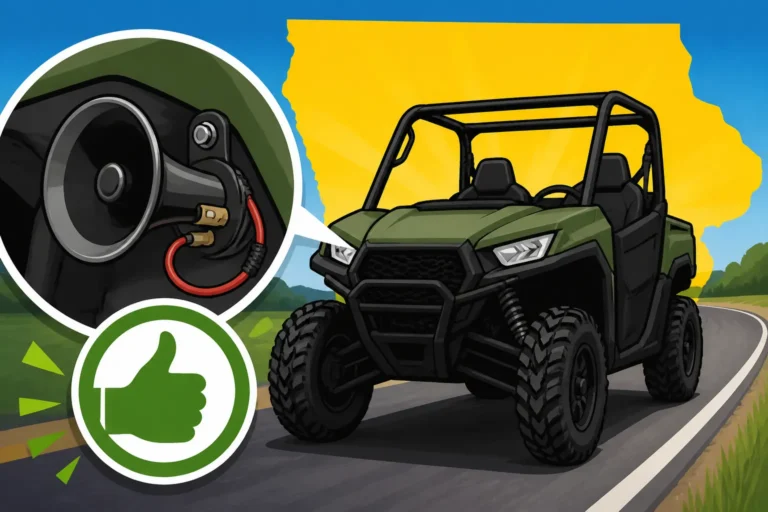
In addition to lighting, you must have at least one rearview mirror mounted on your machine. This is crucial for safely monitoring traffic behind you, a necessity on any public road. Many trail-focused machines might not come standard with mirrors, making this a common aftermarket addition. Again, SuperATV is a great resource for robust, trail-tested mirrors that will also keep you legal on the road. Finally, a functional horn is also a must-have. This isn't just a courtesy; it's a safety device allowing you to alert other drivers or pedestrians to your presence. Without these basic safety features, you’re not only risking a citation but also your own well-being. Always ensure these items are in good working order before you leave your driveway. You can find comprehensive details about these needs in [Iowa Lighting Requirements for ATVs], [Iowa Mirror Requirement for Road Use], and [Iowa Horn Requirement for Road Use].
Slow-Moving Vehicle Sign and Insurance
Beyond the immediate visibility items, Iowa mandates a couple of other crucial elements for any ATV or UTV operating on public roads: a slow-moving vehicle (SMV) sign and adequate liability insurance. These requirements underscore the state's recognition that ATVs and UTVs are not typical road vehicles and need additional safeguards.
The slow-moving vehicle triangle is easily recognizable: a fluorescent orange triangle with a dark red reflective border. This sign must be securely affixed to the rear of your machine, clearly visible to any traffic approaching from behind. It serves as an immediate visual warning to other drivers that your vehicle will be traveling at a lower speed, giving them more time to react and reducing the risk of rear-end collisions. Even if you're feeling a bit self-conscious about it, this sign is a legal necessity and a critical safety feature for road use. Many aftermarket cargo racks or bumper systems, including those from companies like SuperATV, are designed with easy mounting points for an SMV triangle.
Equally important, and often overlooked, is liability insurance. Iowa requires ATVs and UTVs operated on public roads to carry minimum liability insurance coverage, just like any other motor vehicle. The minimums are usually set at $20,000 for bodily injury to one person, $40,000 for bodily injury to two or more people, and $15,000 for property damage (often referred to as 20/40/15). Riding without proof of this insurance is not only illegal but also incredibly risky, as you could face substantial financial penalties if you're involved in an accident. Always carry your proof of insurance with you, alongside your registration certificate. This isn't just a piece of paper; it’s your financial safety net. Don't leave home without it. Dive into [Iowa Slow-Moving Vehicle Sign Rules] and [Iowa ATV Insurance Requirement] for the full details.
Windshields and Other Considerations
While Iowa doesn't have the same extensive list of road requirements for ATVs and UTVs as it does for cars, there are still a few other details to keep in mind, particularly regarding windshields and the paperwork you need to carry. These might seem minor, but they can make a difference during a roadside stop.
If your UTV or ATV has a windshield, it must comply with general vehicle safety standards, especially concerning tint. Excessively dark tints can impair visibility, especially at night, and are illegal. The general rule of thumb is that the tint should not significantly obstruct your view of the road or allow law enforcement to see into the vehicle. It's an issue that often comes up with aftermarket windshields designed more for sun protection or aesthetics than strict road compliance. If you've invested in a quality full or half windshield, ensure it adheres to these basic visibility standards. SuperATV, for instance, offers clear and light-tinted windshields designed to provide protection while maintaining legal visibility. You can get more specifics on this from [Iowa Windshield Rules for Road Use].
Finally, and this is crucial, you must carry your ATV/UTV registration certificate on your person or on the machine itself while operating it on public roads. This is your proof of legal ownership and that you've paid the necessary fees to the county recorder. Law enforcement officers will ask for this, along with your driver's license and proof of insurance, during any roadside stop. Failing to produce it can lead to delays and potential fines. While Iowa doesn't require helmets for adult ATV/UTV riders on public roads, it's always a wise safety choice, especially when sharing the road with faster, heavier vehicles. Prioritizing your safety beyond the minimum legal requirements is always a good practice. For a refresher on what paperwork to keep handy, see [Carrying the Certificate on an Iowa Ride].
| Requirement | Details | Legal Minimums |
|---|---|---|
| Operator Age | Must be 18 years or older | 18+ |
| Driver's License | Must possess a valid driver's license | Valid Iowa Driver's License |
| Speed Limit | Cannot exceed 35 mph on authorized roads | 35 mph |
| Road Type | Primarily unpaved secondary roads, some authorized paved county roads/city streets | Designated roads only |
| Route | Must follow the "Most Direct Route" to destination (e.g., OHV park) | Shortest, most practical path |
| Headlights | Required and must be on | Functional headlights |
| Taillights | Required and must be on | Functional taillights |
| Brake Lights | Required and must be functional | Functional brake lights |
| Rearview Mirror | At least one mirror required | One functional rearview mirror |
| Horn | Required and must be functional | Functional horn |
| SMV Sign | Slow-Moving Vehicle triangle affixed to the rear | Visible SMV triangle |
| Insurance | Minimum liability coverage required | 20/40/15 ($20k/$40k/$15k) |
| Registration | Certificate of registration must be carried on person or machine | Current Iowa ATV/UTV registration |
| Windshield | If present, must meet tint/visibility standards | Meets visibility standards (no excessive tint) |
| Helmet | Not required for adults 18+, but highly recommended | N/A (recommended) |
What to Expect When You Arrive at the Park
After carefully navigating Iowa's road rules and making it safely to your chosen OHV park, you might be wondering what happens next. The good news is that for most state-sanctioned parks, the process for entry is straightforward, as long as your machine is properly registered. However, it's still crucial to be aware of park-specific rules and conditions, as they can change based on weather or management.
The Decal as Your Admission Ticket
Here’s where all that initial registration work pays off: your Iowa ATV or UTV registration decal is essentially your admission ticket to most state-designated OHV parks. Unlike some other states or private parks that might charge a separate day-use fee, Iowa's system integrates the cost of trail access into your annual registration fee. This means that if your machine has a current and properly displayed Iowa registration decal, you typically don't need to pay an additional fee to enter and ride. It's one of the benefits of ensuring your machine is legally registered each year.
When you pull up to a park like Gypsum City, Bluff Creek, Rathbun, or Nicholson-Ford, park staff or volunteers will often be looking for that decal. It’s their visual confirmation that you’re a legal rider contributing to the fund that supports these parks. This streamlined system makes it easy for riders, eliminating the need to stop and purchase passes at a gate. So, while the initial registration might feel like a chore, remember that it grants you year-round access to Iowa's fantastic public riding opportunities. Make sure your decal is always up-to-date by checking [Renewing an Iowa Registration Online] and clearly displayed according to regulations. This decal is more than just a sticker; it's [Your Registration Decal Is the Park Admission]. To find out more about where you can ride with this decal, check out [Iowa's Eight Designated OHV Parks].
Park-Specific Rules and Trail Conditions
While your registration decal gets you in, remember that each OHV park has its own set of rules and operating conditions that go beyond general state laws. These are in place for rider safety, environmental protection, and to ensure a positive experience for everyone. Ignoring these can lead to fines, expulsion, or even park closures.
One of the most critical things to check before you even load up is trail conditions and closures. Iowa's OHV parks, particularly those with natural terrain, are highly susceptible to weather. Heavy rains can quickly make trails impassable, unsafe, and riding on wet trails can cause significant environmental damage, leading to closures. The Iowa DNR website and park-specific social media pages are excellent resources for checking real-time conditions. Nothing is more frustrating than arriving at a park only to find it closed, so always check [Iowa's Weather-Driven Trail Closures] beforehand.
Additionally, be aware of specific park rules. For instance, helmets are mandatory for all riders at some parks, such as the Paul Huting Recreation Area (formerly Riverview). Even though Iowa law doesn't always mandate helmets for adults on public roads, individual parks can and do enforce stricter safety rules. Other common park rules include sound limits for machines, which require properly muffled exhausts, and the requirement for spark arresters to prevent wildfires. Always look for posted signage at the park entrance or check the park’s official website for these specific regulations. Adhering to these rules ensures the continued operation of the parks and a safe riding environment for everyone. If you’re heading to Paul Huting, remember [Helmets Required at the Paul Huting Gate], and for general machine requirements, look into [Iowa Sound Limits at an OHV Park].
Disclaimer
This article is for general informational purposes only and does not constitute professional advice. Laws, prices and regulations vary by location and change over time. Consult a qualified professional for guidance on your specific situation.